
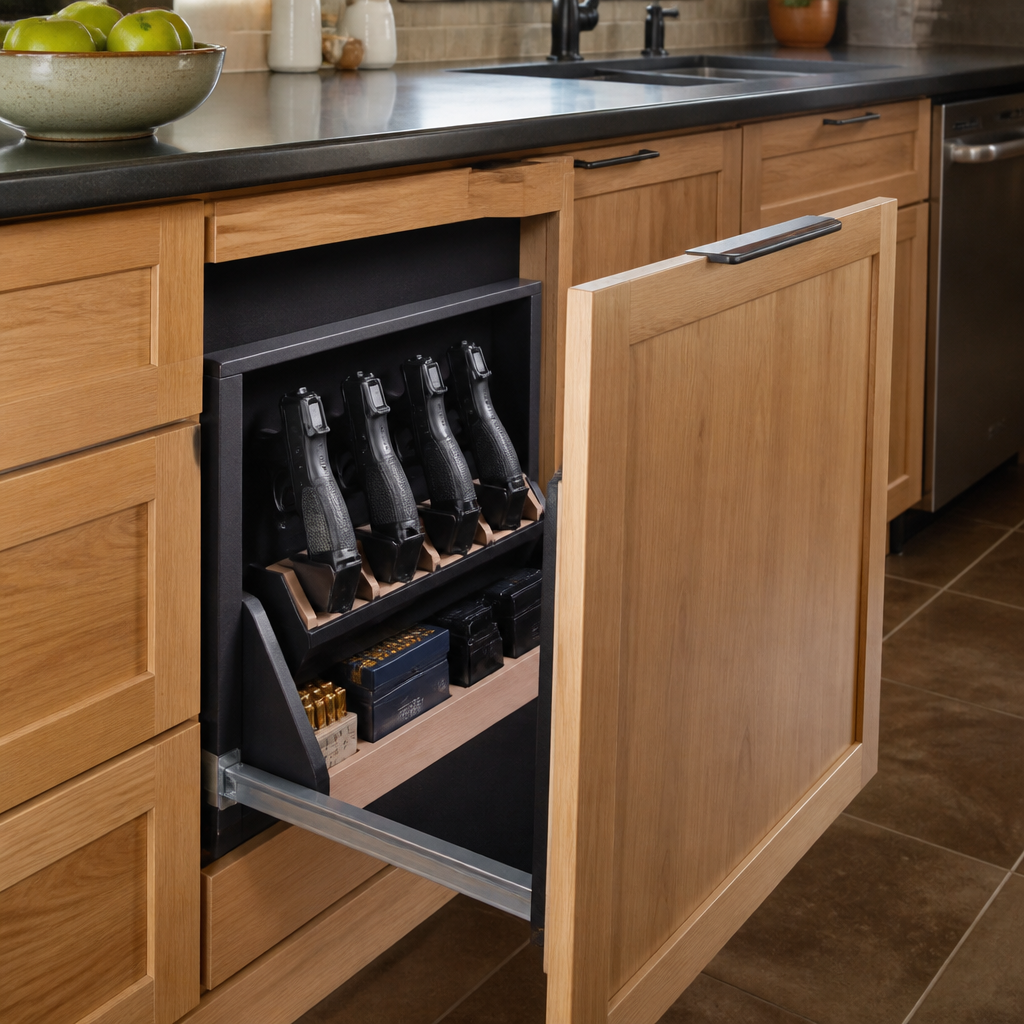
Hidden gun storage for kitchens solves a specific problem: keeping a defensive firearm accessible to authorized adults while preventing discovery, theft, or misuse in one of the busiest rooms in the home. In practical terms, hidden storage means a compartment or lockable enclosure designed to blend into cabinetry, drawers, toe-kicks, false panels, islands, or pantries instead of looking like a traditional gun safe. Secure firearms in cabinets means more than tucking a pistol behind dishes. It requires a locking mechanism, a stable mounting surface, protection from moisture and grease, and placement that accounts for children, guests, housekeepers, and service workers.
I have seen kitchen storage planned well and planned badly. The difference is usually not the hardware alone. It is the combination of threat assessment, cabinet construction, user habits, and compliance with local law. A hollow decorative panel with a magnetic latch may hide a gun from casual view, but it does not secure it. A purpose-built lockbox bolted inside a base cabinet can. That distinction matters because kitchen environments create unusual risks. Heat from ovens, humidity from sinks and dishwashers, grease aerosols from cooking, and high foot traffic all work against careless storage.
This topic matters because many homeowners spend more waking hours in or near the kitchen than any other room. The kitchen often sits on the path between bedrooms, exterior doors, and family gathering areas, making it a realistic defensive location. At the same time, it is also a magnet for children, visiting relatives, party guests, pet sitters, and contractors. A firearm that is hidden but not physically secured can be discovered during ordinary life: unloading groceries, searching for batteries, fixing a disposal, or cleaning under the sink. Good hidden kitchen gun storage reduces that risk without sacrificing rapid access.
As the hub page for hidden and discreet gun storage solutions, this article explains how to choose cabinet locations, what locking systems work, how to harden cabinets, and where kitchen storage fits within a broader home firearm safety plan. The best approach is layered: concealment, locking security, controlled access, environmental protection, and routine verification.
What hidden kitchen gun storage should accomplish
The goal of hidden kitchen gun storage is simple to state and difficult to execute: deny unauthorized access, preserve fast access for authorized users, and avoid obvious visual cues. In professional security terms, concealment delays discovery, but locks and anchoring prevent access and theft. Both are required. A pistol vault mounted inside a sink base cabinet, for example, may be hidden by the cabinet door, but unless it is bolted to structural members or reinforced panels, a burglar can remove the entire container in seconds.
For most households, a kitchen firearm should be stored unloaded only if the user’s training, local law, and defensive plan support that choice. Many owners instead store a defensive handgun loaded in a dedicated quick-access safe with trigger protection and full enclosure. Either way, the gun should never be loose in a drawer beside utensils, wrapped in a towel, or placed on a refrigerator shelf. Those are hiding spots, not secure storage solutions.
A strong cabinet-based setup typically includes a steel handgun safe of 12- to 16-gauge construction, internal foam or molded retention, pry-resistant door geometry, and either a UL-listed electronic lock, a dependable simplex-style mechanical pushbutton lock, or a biometric lock with a proven backup entry method. I generally prefer mechanical pushbutton locks for kitchens because they are unaffected by wet fingers, flour dust, or battery failure. Biometric models can work well, but only if the scanner is from a reputable maker and regularly tested under realistic conditions.
Best cabinet locations in a kitchen
Location determines both accessibility and risk. Base cabinets away from the sink and range are usually the best candidates because they offer deeper cavities, easier anchoring, and less exposure to steam and heat. A concealed lockbox in a kitchen island often performs even better, especially when mounted behind a false panel or inside a rarely used side cabinet facing away from the main traffic path. Islands provide central access, and their framing can often accept through-bolting with backing plates.
Upper cabinets are generally weaker choices. They are harder to access quickly under stress, more visible to anyone helping in the kitchen, and structurally lighter. Toe-kick compartments can be discreet, but they are vulnerable to dust, spills, and impact from feet or vacuums. They also force an awkward access posture. Under-sink cabinets are common hiding places but are usually poor storage zones because plumbing leaks, condensation, and cleaning chemicals threaten both firearms and locking electronics.
Pantries can work if they contain a hardened interior compartment rather than a gun simply hidden behind food containers. A walk-in pantry offers the advantage of privacy during access, but it also invites regular entry by many people. In households with children, the best hidden kitchen gun storage is usually in a locked base cabinet near, but not directly beside, the most common adult standing position, such as the prep side of an island or the cabinet bank near a breakfast nook.
| Location | Main advantages | Main drawbacks | Best use case |
|---|---|---|---|
| Base cabinet | Good depth, easier anchoring, fast access | Can be discovered during cleaning or repairs | Primary quick-access handgun vault |
| Kitchen island | Central location, hidden side access, solid framing | Requires custom installation | High-quality concealed compartment |
| Pantry cabinet | Privacy during access, larger compartments | Frequent traffic, variable humidity | Secondary locked storage |
| Toe-kick compartment | Excellent concealment | Awkward access, dust, spill exposure | Niche custom builds only |
| Under-sink cabinet | Commonly overlooked by visitors | Leaks, cleaners, condensation | Avoid in most homes |
Cabinet construction, anchoring, and reinforcement
Most kitchen cabinets are not designed as security furniture. Factory cabinets often use particleboard, MDF, staples, and thin backs. If you mount a safe to weak material, the cabinet fails before the safe does. The fix is reinforcement. In retrofits, I usually recommend adding a 3/4-inch plywood backer panel tied into wall studs or cabinet rails, plus large fender washers or steel backing plates on through-bolts. In an island, the safe should be anchored into framing members, not only decorative panels.
Door security matters too. If the gun safe sits behind a normal cabinet door, that outer door should not advertise that something valuable is inside. Soft-close hinges are fine, but hidden magnetic releases, RFID cabinet locks, and touch-latch false fronts should be viewed as concealment layers, not primary security. A determined intruder can defeat them quickly. The firearm itself still belongs inside a lockbox or dedicated in-cabinet safe.
For custom cabinetry, a false bottom drawer front, appliance garage, or disguised charging station can provide excellent concealment when paired with a steel enclosure. Good custom work also manages cable routing for powered locks, battery replacement access, and lighting. However, custom millwork introduces complexity. Installers who are excellent at cabinets may know little about firearm retention, lock reliability, or legal storage obligations. The design should be reviewed from both a cabinetry and firearm safety perspective before cutting panels.
Choosing the right lock and access method
Lock selection determines whether hidden kitchen gun storage is dependable in daily life. Electronic keypad safes are common, affordable, and fast. The better models have tamper alarms, illuminated buttons, and spring-assisted doors. Their weakness is battery dependency and occasional keypad wear that reveals frequently used digits. Mechanical pushbutton locks avoid both issues and offer consistent performance in greasy or wet environments, though they can be slower for users who do not practice.
Biometric safes appeal to many kitchen users because they allow one-handed access while carrying a child or phone. The problem is that biometric performance varies enormously. Moisture, cuts, flour dust, and skin changes can reduce read rates. If you choose biometric access, use a model tested by independent reviewers, enroll multiple fingers from both hands, maintain a keypad or key override, and drill realistic repetitions under low light. A biometric lock without a reliable secondary method is not appropriate for serious defensive storage.
Some owners ask about magnetic or RFID-triggered hidden compartments. These can be useful as outer concealment triggers, especially in a pantry or island where a false panel opens only when a coded magnet or RFID tag is presented. But they should never be the only barrier between a person and a firearm. Treat them as a disguised cabinet latch that reveals the actual locked safe. That layered design preserves discretion without sacrificing security.
Environmental risks unique to kitchens
Kitchens are harder on firearms than bedrooms or offices. Steam accelerates corrosion. Grease settles on surfaces and works its way into seams. Temperature swings affect optics batteries and lubricant viscosity. Cleaning chemicals can off-gas or spill. Because of that, hidden gun storage for kitchens should include desiccant packs or a compact dehumidifying solution where feasible, routine wipe-downs with a corrosion-inhibiting protectant, and separation from bleach, ammonia, and sink plumbing.
Stainless-looking appliances do not mean low humidity. Dishwashers vent warm moisture, and sink bases can stay damp for months after a minor leak. I have inspected cabinet interiors that looked fine externally but had rusting screw heads and swollen particleboard near the back panel. That environment is unacceptable for firearm storage. If a kitchen location cannot stay dry and structurally sound, move the safe elsewhere.
Ammunition also deserves consideration. Store spare magazines or cartridges inside the same locked container only if the safe is designed to fit them without interfering with draw access. Otherwise, keep reserve ammunition in a separate locked container in a better environmental zone. The first priority is a clean, accessible, secure handgun setup; stuffing a small kitchen vault with loose gear creates friction when seconds matter.
Safety, legality, and household protocols
Secure storage is not only a hardware decision. It is a household policy. Every authorized adult should know exactly which cabinet contains the firearm, how it opens, what condition the firearm is stored in, and what the response plan is during a break-in or other emergency. Everyone else should have zero access. That means codes are not shared casually, override keys are locked separately, and access logs or periodic checks are performed for smart safes that support them.
State and local laws differ widely. Some jurisdictions impose specific requirements when minors are present, after a prohibited person enters the home, or when a firearm is left unattended. Others impose criminal liability if a child or unauthorized person gains access due to negligent storage. Product standards also vary. California’s Department of Justice roster for firearm safety devices and independent safe testing can be useful reference points, even outside that state, when comparing products.
For families, kitchen storage should be one node in a larger plan under the gun safes and safety umbrella. A whole-home approach might include a primary long-gun safe in a low-visibility room, bedside quick-access storage, vehicle storage practices, and hidden but secure options in selected living spaces. Internal links from this hub should lead readers to deeper guides on RFID compartments, furniture safes, wall concealment, under-bed storage, and childproof access control. The key principle stays constant: discreet does not mean improvised.
The best hidden gun storage for kitchens combines concealment with a real locking safe, thoughtful placement, reinforced cabinetry, and a practiced access method. Choose a dry base cabinet or island location, anchor the safe to structural material, avoid sink and heat zones, and test your lock under realistic conditions. Then back the hardware with clear household rules, routine maintenance, and awareness of local law. If your current setup is simply hidden, upgrade it until it is genuinely secure. Start by auditing one kitchen cabinet today and deciding whether it protects your firearm or merely hides it.
Frequently Asked Questions
What is hidden gun storage for kitchens, and how is it different from simply hiding a firearm in a cabinet?
Hidden gun storage for kitchens refers to a purpose-built compartment, lockable insert, or concealed enclosure that blends into kitchen features such as base cabinets, drawers, toe-kicks, islands, pantry walls, or false panels while still providing controlled access for authorized adults. The key difference is security. Simply placing a handgun behind plates, in a cereal box, or on a high shelf may keep it out of casual sight, but it does not meaningfully protect against discovery by children, guests, workers, or intruders. It also does little to prevent theft if someone searches the room.
Proper hidden storage combines concealment with access control and physical retention. That usually means a locking mechanism, reinforced mounting, and a design that resists prying or easy removal. In a kitchen, this matters even more because the space is heavily trafficked and full of daily activity. Family members, babysitters, contractors, cleaners, and visitors may all pass through the room, open cabinets, or use drawers. A concealed storage solution is meant to look ordinary while still functioning like a secure firearm container, not just a clever hiding spot.
Well-designed kitchen gun storage also considers speed, discretion, and environmental factors. The firearm should be accessible under stress, but protected from grease, humidity, spills, and debris. In other words, the goal is not only to keep the gun out of sight, but to store it in a way that supports safe handling, legal compliance, and reliable readiness.
Where is the safest and most practical place to secure a firearm in kitchen cabinets?
The safest and most practical location depends on your household layout, who has access to the kitchen, and how quickly you may need to reach the firearm. In many homes, lower base cabinets, a concealed drawer insert, a false panel in an island, or a toe-kick compartment can work well because these areas are easier to access discreetly and can be reinforced more effectively than flimsy upper cabinets. A pantry can also be a viable option if it includes a locked inner compartment rather than simply placing the firearm on a shelf.
That said, the best location is one that balances three priorities: limited visibility, secure construction, and reliable adult access. You want a spot that is not routinely opened by children or guests, is not obvious during a casual search, and can be fitted with a sturdy locking device and anchored housing. Avoid locations near sinks, dishwashers, stovetops, ovens, or other areas exposed to excess heat, steam, leaks, grease, or food debris. Kitchen conditions can affect both the storage hardware and the firearm itself over time.
You should also think through movement patterns in the room. If the storage area is directly beside a commonly used trash pullout, snack drawer, or cookware cabinet, it may be opened frequently by other household members. A better choice is often a less-trafficked section of cabinetry that still allows a responsible adult to reach it quickly without crossing the entire room. The strongest setups are typically custom-fitted or professionally installed so the cabinet compartment is structurally sound, the lock is dependable, and the concealment feature does not interfere with safe deployment.
What security features should hidden kitchen gun storage include to keep firearms safe from children, theft, and unauthorized access?
At a minimum, hidden kitchen gun storage should include a real locking mechanism, solid mounting, and a compartment that cannot be opened just by pulling on a panel or rummaging through a cabinet. A disguised compartment without a lock is concealment only, not secure storage. For most households, useful options include mechanical locks, electronic keypad locks, RFID systems, or biometric locks, provided the chosen method is reliable and familiar to the authorized user. The right choice depends on your preference for speed, simplicity, battery independence, and redundancy.
Beyond the lock itself, the compartment should be anchored to cabinet framing or another stable structural surface so it cannot be lifted out or easily detached. Reinforced materials matter as well. Thin decorative wood alone may not resist prying, impact, or fast removal. The interior should hold the firearm in a stable orientation so it does not shift, snag, or become obstructed by stored items. A dedicated compartment is much safer than sharing space with utensils, cleaning products, food containers, or other kitchen contents.
For households with children, security should assume curiosity and persistence, not just obedience. The storage should remain locked when not in immediate use, and adults should never rely on secrecy alone. For theft resistance, hidden placement helps, but concealment should be paired with a lock and fixed installation so a burglar cannot simply grab the entire unit. It is also wise to choose a system with quiet, repeatable access, backup entry options, and a maintenance routine for batteries, hinges, latches, and lock function. The most effective kitchen firearm storage is not only hidden, but intentionally engineered to prevent accidental discovery, unauthorized handling, and easy removal.
Are hidden gun cabinets in kitchens legal and safe for families with children or frequent visitors?
They can be legal and safe, but only if the storage method complies with the laws in your area and is used responsibly. Firearm storage laws vary by state and locality, and some jurisdictions impose specific requirements when minors may be present in the home. In many places, legal problems arise not from the location itself, but from negligent storage that allows unauthorized access. That means homeowners should verify whether local law requires a locked container, child-resistant measures, unloaded storage in certain circumstances, or separate ammunition practices. Legal compliance should always be confirmed before installation or use.
From a safety standpoint, a kitchen is a challenging environment because it is one of the most used spaces in a home. Children pass through it constantly, visitors gather there, and service workers often access cabinets or pantries without much thought. For that reason, hidden storage in a kitchen should meet a higher practical standard than an out-of-the-way closet. The firearm should be kept in a locked, dedicated compartment that is inaccessible to children and not likely to be opened during routine kitchen use. Adults in the home should be trained on how the system works, who is authorized to access it, and what the emergency plan is.
Families should also remember that safety is a layered practice, not just a product choice. Secure storage, responsible supervision, regular function checks, and age-appropriate firearm education all matter. If your household includes small children, teenagers with friends visiting often, memory-impaired adults, or frequent guests, the storage solution must reflect that reality. A hidden kitchen cabinet can be part of a safe home-defense setup, but only when concealment is paired with robust locking, consistent habits, and full awareness of legal obligations.
How do you maintain quick access to a defensive firearm in a kitchen while still keeping it secure and discreet?
The best way to maintain quick access is to choose a storage system designed specifically for defensive use rather than retrofitting a random cabinet to serve as a hiding place. Quick access comes from consistency and deliberate setup. The firearm should be stored in the same orientation every time, inside a compartment that opens the same way every time, using a lock that the authorized adult can operate smoothly under stress. A hidden storage solution loses much of its value if the user has to fumble through objects, move cookware, or remember a complicated sequence in an emergency.
Discretion is preserved by integrating the compartment into ordinary kitchen design elements. False drawer fronts, toe-kick safes, concealed end panels on islands, or hidden cabinet inserts can all look natural while still providing controlled access. The important point is that concealment should not reduce reliability. The release method should be simple, repeatable, and tested regularly. If the system uses batteries, they should be checked on a schedule. If it uses a biometric reader, users should verify that it recognizes them consistently and that a backup opening method is available.
Practical readiness also means keeping the surrounding area clear and predictable. Do not place hidden gun storage where chairs, trash bins, pet bowls, or movable kitchen items can block access. Practice accessing the compartment safely and legally, and make sure every authorized adult understands safe handling procedures. At the same time, the firearm should remain protected from accidental contact, unauthorized discovery, and environmental damage. The right hidden kitchen storage setup makes access fast for the right person, difficult for everyone else, and discreet enough that it does not advertise the presence of a firearm in the home.