
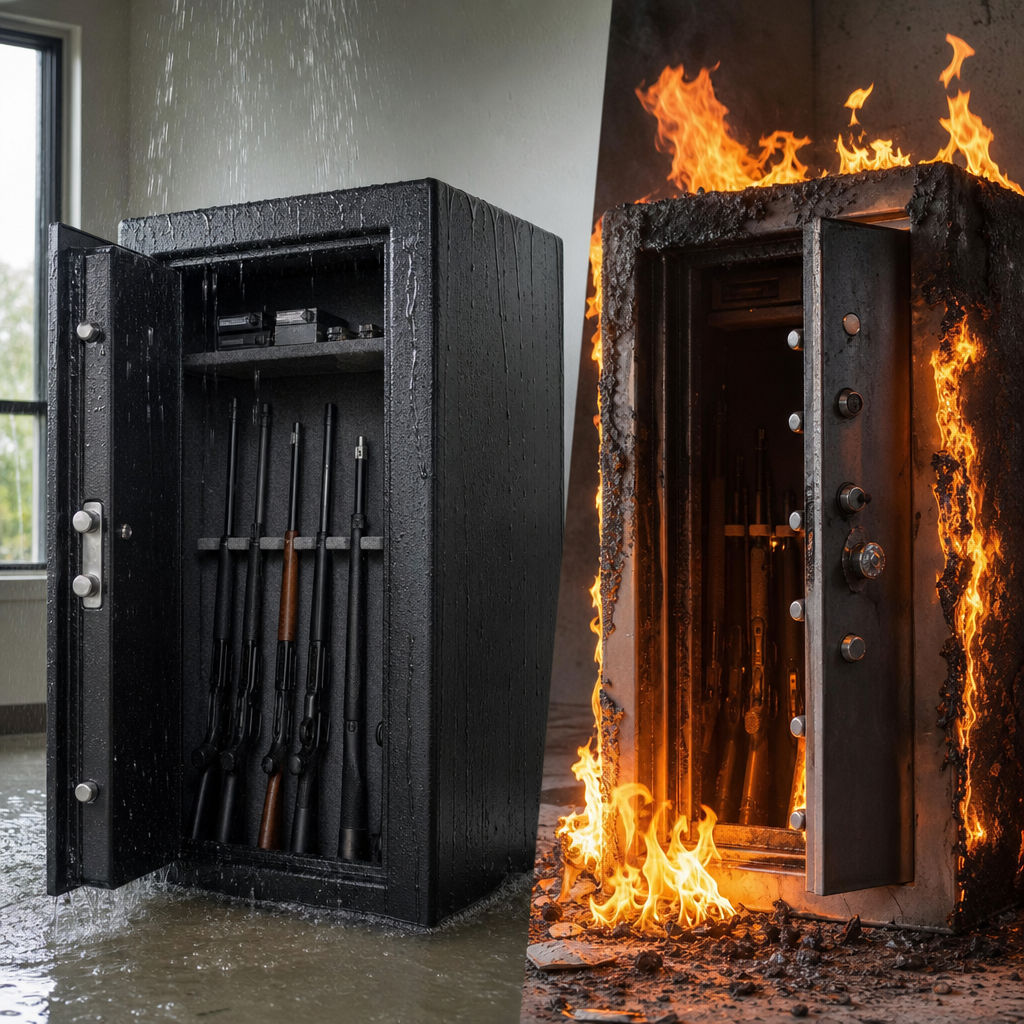
Choosing a gun safe by size or price alone is a mistake, because the biggest difference between brands often shows up when a house fire starts, a sprinkler line bursts, or firefighters flood a room to stop flames. Fire resistance in gun safes refers to how long the interior can stay below a stated temperature during a furnace test, while water resistance refers to how well the safe keeps out water from sprinklers, hose spray, light flooding, or temporary submersion. Those claims sound straightforward, but after years of comparing safes in showrooms, reviewing test sheets, and helping owners replace units after losses, I can say brand standards vary widely.
That variation matters because firearms, optics, paper records, and ammunition components fail at different thresholds. Paper chars around 350 degrees Fahrenheit, many polymers deform well before that, and optics adhesives, lubricants, and electronics can be ruined by heat or moisture long before a steel shell visibly fails. A gun safe marketed as “fireproof” may simply use gypsum board and an expanding door seal, while another may combine multiple insulation layers, a continuous weld body, and an independently verified fire rating. Likewise, “water resistant” can mean anything from a basic door sweep to a tested seal designed to block several inches of standing water for a set period.
For shoppers researching gun safe comparisons and brand spotlights, the key is understanding how manufacturers build, test, and communicate protection. Some brands publish outside laboratory certifications; others rely on internal testing. Some focus on fire endurance at 1200 degrees, while others prioritize tighter seals against smoke and water. This hub article explains how different gun safe brands handle fire and water resistance, what construction details actually matter, and which questions should guide your next comparison. If you are evaluating Liberty, Fort Knox, Browning, Rhino Metals, Winchester, Cannon, Sports Afield, Vaultek, or modular brands such as SecureIt, this guide gives you the framework to judge claims with confidence.
How fire resistance is built into a gun safe
Most gun safe brands achieve fire resistance through a combination of steel shell design, insulation, door seals, and interior layout. The most common insulating material in residential gun safes is gypsum-based fireboard, similar in principle to drywall. Gypsum contains chemically bound water that turns to steam under heat, slowing temperature rise inside the cabinet. In practical terms, more layers usually improve endurance, but thickness alone does not tell the whole story. The way those layers are attached, whether there are gaps at corners, and whether the body is continuously welded or stitch welded all affect performance.
Door construction is equally important. A safe body can be heavily insulated, but if the door edge leaks hot gases, internal temperatures rise quickly. Premium brands often use expandable intumescent seals that swell under heat to block smoke and flame paths around the door perimeter. Better designs pair that seal with a recessed door jamb or step system so the expanding material has pressure against multiple contact surfaces. On safes I have inspected after minor structure fires, that detail often separated smoky but salvageable contents from total loss.
Fire ratings also depend on the test method. A 60-minute rating at 1200 degrees is not equivalent to a 60-minute rating at 1400 or 1680 degrees. Some independent tests include a cool-down phase because contents continue heating even after external flames subside. Others add an impact drop to simulate a floor collapse. Without knowing the protocol, shoppers can accidentally compare unlike products as if the labels mean the same thing.
How brands approach water resistance and flood protection
Water resistance receives less marketing attention than fire protection, yet it causes frequent claims because firefighting water is common and finished basements flood regularly. Gun safe brands typically handle water resistance through gasketed doors, raised thresholds, tight body seams, and external or internal channeling that diverts runoff. The simplest systems use a compressible gasket around the door opening. More advanced systems combine a heat-activated seal for fire with a separate waterproof gasket designed to maintain compression when the door is latched.
The limit is pressure. A safe that blocks hose spray may not survive partial submersion, and a safe that survives 72 hours in twelve inches of water may still leak if a deep flood creates stronger pressure on the door. Because of that, reputable brands state a time-and-depth standard instead of making an absolute waterproof claim. Placement matters too. If a safe sits directly on concrete, water can pool around the base and exploit any weakness at the lowest seam. Elevating the safe on a plinth or composite riser materially improves real-world performance.
Interior moisture management matters after the event as well. Even when liquid water stays out, a hot safe cools and condenses humidity. That is why many experienced owners pair a dehumidifier rod, rechargeable desiccant, or wireless hygrometer with any safe rated for fire and water exposure. The safe can pass the event and still develop corrosion later if moisture is trapped inside.
What major gun safe brands usually do differently
Brand differences become clearer when you compare how claims are documented and where each manufacturer positions its products. Liberty has long emphasized broad dealer availability, multiple fire tiers, and door seals that expand under heat; higher lines generally add longer rated durations, more robust bodies, and better fit around the frame. Fort Knox focuses on custom builds, heavier steel options, and layered fire insulation packages, making it popular with buyers who prioritize structure as much as the rating itself. Browning typically highlights organized interiors and competitive fire ratings across broad price bands, while Rhino Metals, including Ironworks and Kodiak lines, often differentiates through styling, seal systems, and practical feature sets.
Winchester and Cannon frequently compete in big-box retail channels, where published fire times can look attractive for the money, but the buyer needs to inspect body steel thickness, door edge design, and whether testing details are clearly stated. Sports Afield has pushed waterproof positioning more aggressively than many legacy brands, often specifying water depth and time, which is more useful than a generic promise. Vaultek, known for handgun safes and smart features, approaches the issue differently: compact electronic safes may offer anti-pry and environmental seals, but they are not direct substitutes for a full-size long-gun safe during a structure fire. SecureIt and other modular systems prioritize fast assembly, lighter weight, and organized storage; they serve a different use case and generally should not be judged by the same fire expectations as a multi-layer traditional safe.
| Brand type | Typical fire strategy | Typical water strategy | Best for |
|---|---|---|---|
| Premium traditional brands | Multiple insulation layers, heavier steel, upgraded seals, optional certifications | Gasketed doors, tighter seams, better fit and finish | Owners prioritizing long-term protection and customization |
| Mid-market retail brands | Competitive published fire times at moderate temperatures | Basic gaskets, limited flood claims | Value-focused buyers needing balanced protection |
| Water-focused value brands | Standard fireboard systems with practical ratings | Specific depth-and-duration claims for flooding | Basements, garages, and humid regions |
| Modular or lightweight systems | Limited passive fire protection compared with welded safes | Minimal flood resistance unless specifically stated | Apartments, fast installation, low floor loading |
The lesson is not that one brand is universally superior. It is that each brand family makes tradeoffs among steel thickness, insulation mass, interior capacity, weight, price, and logistics. A safe with a longer published fire rating may use thinner steel than a competitor with a shorter rating, and that affects burglary resistance, fit, and long-term door alignment. You need the whole construction picture, not one headline number.
How to compare fire ratings without being misled
The most reliable way to compare gun safe fire resistance is to ask five direct questions. First, who performed the test: an independent laboratory such as Intertek/ETL, UL-related protocol, or the manufacturer itself? Second, what exterior temperature was used, and for how long? Third, what maximum internal temperature was allowed, and was that threshold chosen for paper, media, or a general interior standard? Fourth, did the test include a cool-down period, because thermal soak continues after heating stops? Fifth, was the safe tested as sold, including interior, wiring ports, and anchor holes?
In store aisles and online listings, brands often compress all of that into a single badge. That badge is useful only when the underlying method is transparent. For example, a safe advertised at 75 minutes at 1200 degrees may underperform against another rated 45 minutes at 1400 degrees if the second model uses a stricter threshold and better door construction. Likewise, a large safe with thin insulation can post a rating that looks impressive on paper yet develop hotter top corners where rising heat concentrates.
I also recommend checking for practical service details. Replacement door seals, documented warranty terms after fire, and local dealer support matter because severe heat can damage locks and trim even when firearms survive. Several major brands have strong lifetime fire replacement programs, but the terms differ on freight, labor, and proof of loss. That should be part of the comparison, especially for heavy safes that are expensive to move.
How to compare waterproof claims in plain terms
A credible waterproof claim includes a measurable depth and duration. If a brand says a safe is waterproof for two hours in two feet of water, you have a basis for comparison. If it only says “water resistant,” you do not. Ask whether the rating applies to the entire safe or only the door opening, whether power outlets or dehumidifier pass-throughs affect the seal, and whether the warranty covers water intrusion or only the safe shell. Some brands exclude contents entirely, which means the practical value of the promise is lower than the marketing implies.
Also separate flood protection from humidity control. A waterproof gasket does nothing for long-term corrosion if the safe is placed in a damp garage and rarely opened. In coastal markets and southern climates, I have seen quality safes develop surface rust on firearms because owners trusted the seal and skipped active moisture control. The fix is simple: elevate the safe, use a powered dehumidifier where possible, add desiccant backup, and monitor humidity. For most gun collections, keeping the interior around 45 to 50 percent relative humidity is a sensible target.
Installation choices can improve or undermine any brand’s design. Bolting the safe down is important for theft resistance, but floor penetrations should be sealed correctly according to the manufacturer’s guidance. In flood-prone spaces, a steel stand or poured curb can preserve water resistance far better than placing the cabinet flat on the slab.
Which buyers should prioritize which brands and features
If you store heirloom firearms, paper records, suppressor paperwork, and valuable optics, prioritize brands with transparent fire testing, substantial insulation, and strong dealer support. If your main risk is a basement utility-room leak or regional flooding, prioritize models with explicit water depth ratings and elevate them during installation. If you rent, move often, or cannot place a thousand-pound safe on an upper floor, a modular system may be the right compromise, but you should treat it as a security cabinet first and a fire barrier second.
For many households, the best choice sits in the middle: a reputable traditional gun safe from a brand with clear published ratings, an expanding fire seal, a credible waterproof gasket, and a warranty you can verify before purchase. Compare steel gauge, total weight, lock type, bolt design, and interior dimensions alongside fire and water claims. Then cross-reference those details with the rest of your research on gun safe comparisons and brand spotlights so you are not buying a label; you are buying a tested construction method matched to your risks.
Different gun safe brands handle fire and water resistance in noticeably different ways, and those differences are not cosmetic. Fire protection depends on insulation layers, door geometry, seal quality, and the honesty of the test standard behind the rating. Water protection depends on gasket design, seam quality, installation height, and whether the brand states a real flood threshold instead of a vague promise. When you compare safes through that lens, marketing language becomes easier to decode.
The smartest buyers start with their actual exposure. A rural home with delayed fire response may need more thermal endurance than an urban condo. A finished basement near a sump pump may need documented flood resistance more than an extra five minutes of furnace time. Premium brands, retail brands, waterproof-focused models, and modular systems all have a place when their strengths align with the job.
Use this hub as your starting point for deeper gun safe comparisons and brand spotlights. Build a shortlist, read the detailed brand pages, verify the testing method, and ask for written specifications before you buy. A safe should not only hold firearms securely; it should keep them viable after the emergency you did not plan for.
Frequently Asked Questions
1. How do different gun safe brands test and advertise fire resistance?
Gun safe brands do not all measure fire resistance the same way, and that is one of the biggest reasons their claims can be difficult to compare at a glance. In most cases, a fire rating refers to how long the inside of the safe stays below a specified internal temperature while the exterior is exposed to high heat. Many brands use a target interior temperature low enough to help protect paper documents, but that does not automatically mean every item stored inside will be equally protected. Firearms, optics, electronics, and wood stocks can all react differently to prolonged heat, humidity, and expanding insulation materials.
Some brands rely on independent laboratory testing, while others use internal factory testing or reference standards that are not fully explained in marketing materials. That distinction matters. A safe advertised as “60 minutes at 1,200 degrees” may have gone through a very different test procedure than one advertised as “75 minutes at 1,400 degrees.” The furnace ramp-up rate, how long peak temperature is maintained, whether the safe is preheated, and whether the unit is opened after testing can all affect the real meaning of the rating. More reputable brands usually provide clearer details about the test method, maximum exterior temperature, acceptable interior temperature, and whether the test was conducted by a recognized third party.
Construction methods also vary by brand. Some use multiple layers of drywall-style fireboard, while others use poured or proprietary insulation blends. Door seals, body seams, bolt openings, and hinge-side gaps can all influence how heat and smoke move into the safe. In short, the brand’s fire rating should be treated as a starting point, not the whole story. The best approach is to compare not just the advertised number of minutes, but also who tested it, what standard was used, and how transparently the manufacturer explains the result.
2. Does a higher fire rating always mean one gun safe brand is better than another?
Not necessarily. A higher published fire rating can indicate stronger thermal protection, but it does not automatically make one safe better overall. The key issue is whether the ratings are based on the same testing conditions. If one brand gives a 90-minute rating from an independent lab and another gives a 120-minute rating from an in-house test with limited detail, the lower number may actually be more trustworthy. Fire ratings only become truly useful when they are comparable, and in the gun safe market, that is not always the case.
It is also important to think about what the rating means in the real world. House fires are not uniform. Some burn hotter in one room than another, some are knocked down quickly, and others involve collapse, prolonged smoldering, and heavy water exposure afterward. A safe with a longer fire rating may still disappoint if it has weak door seals, thin steel, poor fit and finish, or insulation that performs inconsistently when exposed to rapid temperature changes. Meanwhile, a well-built safe with a more modest but credible rating may offer more dependable protection in a realistic emergency.
Brand quality should be judged across the full design of the safe. Look at steel thickness, door construction, active and expanding seals, locking mechanism quality, fit of the body-to-door gap, and how the safe handles both heat and the water used to extinguish the fire. The best brands tend to be more transparent, more consistent in manufacturing, and more specific about their test procedures. So while a higher fire rating can be a positive sign, it should never be the only factor used to compare brands.
3. How do gun safe brands differ in water resistance, and what should buyers pay attention to?
Water resistance varies widely among gun safe brands because there is no single universal claim that means the same thing across the market. One brand may design a safe to resist water from overhead sprinklers and firefighting hose spray, while another may advertise protection against several inches of standing water for a limited time. Those are very different scenarios. Light spray, leaking ceilings, burst pipes, and temporary flooding all challenge a safe in different ways, so the type of water event a brand is designing for matters just as much as the claim itself.
Most water-resistant safes rely on door gaskets, tight body seams, threshold-style door designs, and construction intended to slow or block water intrusion. Some brands add expandable heat seals that help during a fire, while others use compression seals meant specifically for moisture and splash resistance. A few premium models are tested for short-term submersion or water depth exposure, but many gun safes are not intended to be waterproof in the way a marine container or purpose-built document chest might be. That is why buyers should read the wording carefully. “Water resistant,” “water protected,” and “waterproof” are not interchangeable terms.
When comparing brands, pay close attention to whether the manufacturer lists a depth, a duration, and a test condition. For example, a safe tested for 2 inches of water for 7 days is making a much more specific claim than one that simply says it protects against floods. Also consider practical details such as whether the safe sits directly on the floor, whether the door lip is raised above the base, and whether anchoring hardware could create potential entry points if not properly sealed. If your biggest risk is a basement flood or heavy water runoff after a fire, brand differences in sealing design and tested performance may matter just as much as fire protection.
4. Can a gun safe protect firearms during both a house fire and the water used to put it out?
Yes, but the level of protection depends heavily on the brand, the model, and how realistic the manufacturer’s ratings are. During a house fire, a safe is not dealing with heat alone. It may also face smoke, steam, collapsing debris, and then large amounts of water from sprinklers or firefighters. Some gun safe brands design their products with both expanding fire seals and water-resistant door systems, which can help create a more complete barrier during and after a fire. Others focus more heavily on thermal insulation and provide only limited water protection.
For firearms specifically, post-fire moisture can be a major problem even if the interior never reaches a catastrophic temperature. Steam and humidity can encourage rust, damage optics, affect ammunition, and harm wood or laminate stocks. That means a safe that survives the heat portion of the event but allows significant water intrusion may still leave contents at risk. Better brands recognize this and build around a layered protection approach: insulation for temperature control, seals for smoke and heat expansion, and door designs that help shed or resist water during suppression efforts.
Even so, no gun safe should be treated as absolute protection against every fire and flood scenario. A severe structural fire, extended burn time, or deep standing water can exceed what many residential safes are built to handle. Buyers who want stronger protection should compare fire test details, water-resistance specifications, and warranty language, especially coverage related to fire or flood damage. For maximum protection, many owners also use supplemental measures such as desiccants, dehumidifiers, elevated installation platforms, and document or media containers inside the safe for especially vulnerable items.
5. What is the smartest way to compare gun safe brands for fire and water resistance before buying?
The smartest approach is to compare brands using specific, verifiable details instead of broad marketing language. Start by looking at the fire rating and asking three questions: how long, at what exterior temperature, and under what test standard? Then find out whether the test was done by an independent lab or by the manufacturer. Brands that clearly publish these details tend to inspire more confidence than those that rely on vague phrases like “advanced fire protection” or “industry-leading heat defense” without showing what those claims mean.
Next, review water-resistance information with the same level of skepticism. Ask whether the safe is designed for spray, standing water, or submersion, and for how long. Check for details on door seals, threshold design, and any published water-depth rating. It is also wise to look at the safe’s construction in person if possible. Examine the door gap, the finish around seams, the solidity of the body, and whether the safe appears engineered to manage both heat expansion and water exposure. Premium brand differences often become obvious once you look beyond the brochure and focus on the actual build quality.
Finally, match the brand to your real risk profile. If you live in a wildfire-prone area, fire testing and insulation quality may deserve top priority. If your safe will sit in a basement, garage, or ground-floor room where water intrusion is more likely, water resistance becomes far more important. Read owner reviews carefully, but prioritize technical specifications, documented testing, and manufacturer transparency over anecdotes alone. The best gun safe brand for fire and water resistance is usually the one that makes the most honest, specific claims and backs them up with construction quality that fits your home and your hazards.