
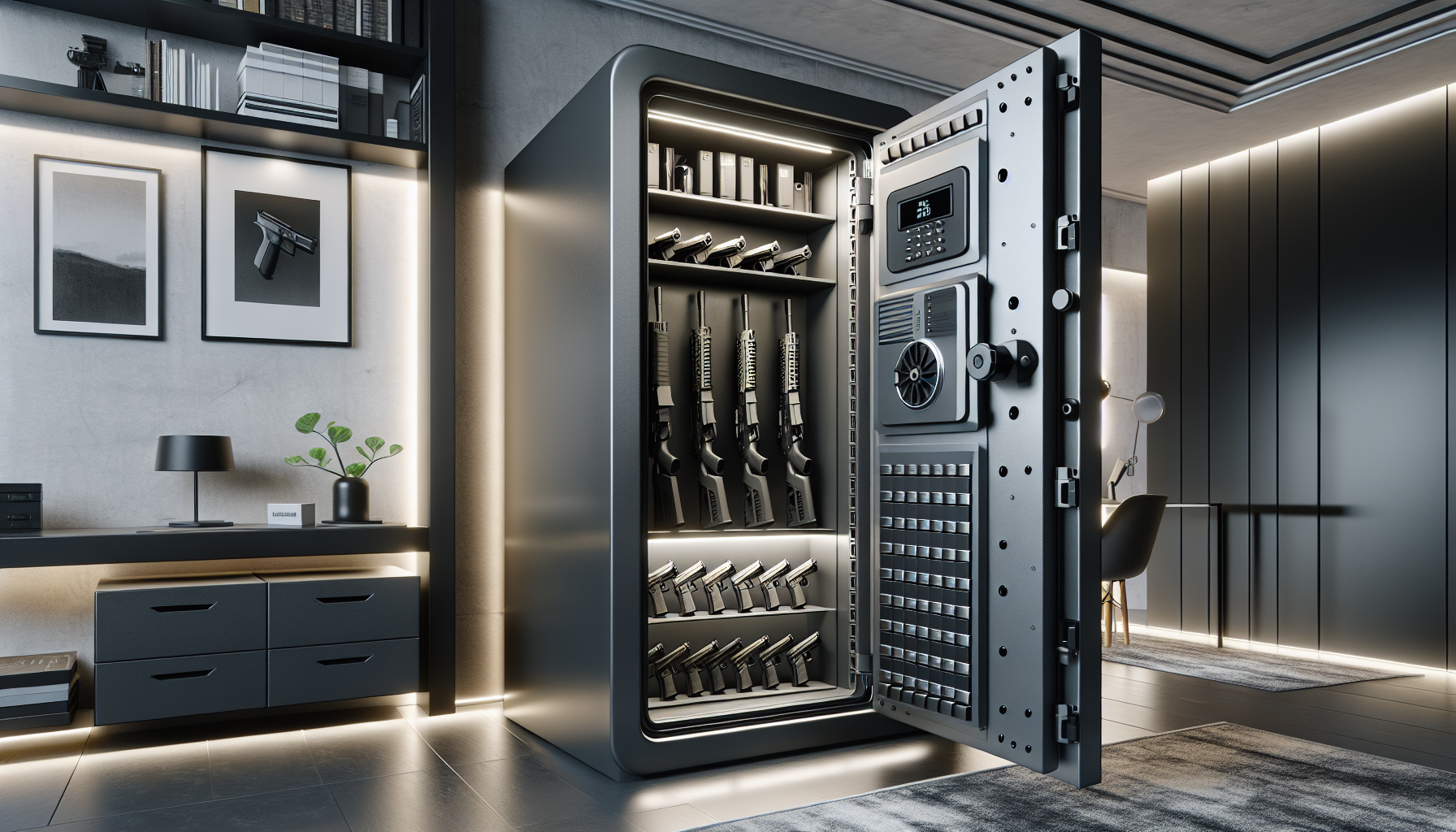
Choosing a gun safe with interior lighting features starts with understanding that lighting is not a cosmetic extra; it directly affects safe access, inventory control, and firearm safety. In practical use, a dark safe slows you down when identifying firearms, magazines, documents, or medical supplies stored on upper shelves and in door organizers. Interior lighting solves that problem, but the right solution depends on safe size, power source, fire protection, humidity control, and how often you open the door. A buying guide for gun safe lighting should therefore look beyond brightness alone and evaluate the entire storage system.
A gun safe is a secure steel enclosure designed to prevent unauthorized access, deter theft, and often provide fire resistance for firearms and valuables. Interior lighting refers to integrated or aftermarket illumination installed inside the safe, usually through LED strips, motion-activated bars, puck lights, or factory-wired kits. Buyers often assume any light kit will work in any safe. That assumption causes common problems I have seen repeatedly: weak adhesive strips falling off carpeted interiors, battery lights dying at the wrong time, cords interfering with door seals, and harsh cool-white LEDs creating glare on polished metal.
This topic matters because gun safes are long-term purchases, and lighting choices affect daily usability for years. A safe that is difficult to see into often becomes disorganized, and disorganization increases handling mistakes. Good lighting also supports maintenance. When I inspect a safe interior under strong, even LEDs, I can spot surface rust on a shotgun rib, a missing optic battery cap, or moisture collecting near the floor much faster than under a flashlight. For households storing handguns for defense, quick identification under stress matters even more.
As a hub for gun safe buying guides, this article explains how to choose a gun safe with interior lighting by covering the key decision points buyers need before comparing brands, reading reviews, or selecting accessories. You will learn which lighting types work best, how interior size and layout change lighting needs, what power options are most reliable, how lighting interacts with dehumidifiers and fire seals, and which mistakes to avoid before purchase. The goal is simple: buy a safe that is secure, visible inside, easy to organize, and practical for real use rather than showroom appeal.
Start with safe size, interior layout, and intended use
The first rule is that lighting should match the safe’s interior geometry. A compact handgun safe or under-bed safe needs a very different lighting approach than a 36-gun fire safe with shelving, barrel rests, door holsters, and document pockets. Small safes usually benefit from one focused light source, often motion-activated. Large safes need distributed light from vertical strips or multi-point kits so the lower corners and long-gun section are illuminated evenly. If the safe has a center divider, lighting on only one side will leave the opposite section dim.
Think about what you store and how you retrieve it. If the safe holds scoped rifles, optics, suppressors, passports, hard drives, and ammunition, you need lighting that reveals depth and labels clearly. In real installations, I usually recommend lighting mounted along both door-frame sides for long-gun safes because side lighting reduces shadows cast by barrels and shelves. Top-only lighting looks bright in product photos but often leaves the bottom half dark, especially when the safe is full. For document shelves, short horizontal lights under each shelf work better than one overhead strip.
Interior finish matters too. Safe interiors are commonly lined with gray or beige fabric over particle board or composite panels. Darker interiors absorb more light and require higher output. Carpeted interiors can also challenge adhesive-backed lights, especially in warm environments. If you are buying a safe for a garage, basement, or outbuilding, ask whether the lighting is mechanically fastened, magnet-mounted, or adhesive. Vibration, humidity, and temperature swings shorten the life of cheap stick-on kits.
Choose the right type of interior lighting
Most gun safe lighting falls into four categories: factory-installed LED systems, aftermarket LED strip kits, battery puck lights, and rechargeable motion lights. Factory-installed systems offer the cleanest look and typically route wiring away from shelves and door openings. They are best for premium safes from brands such as Liberty Safe, Browning, Fort Knox, Rhino Metals, and Vaultek, where interior layout and electrical access are considered in the design. If the safe already includes a power outlet kit, adding compatible lighting is usually straightforward.
Aftermarket LED strip kits are the most flexible choice for full-size safes. Good kits use low-heat LEDs, modular connectors, and door-activated motion sensors. They can be cut to length in some cases, but buyers should verify whether cutting is supported; many sealed kits are not designed for modification. I prefer diffused strips over exposed diode strips because they reduce hotspots and glare. Warm white or neutral white color temperatures, roughly 3000K to 4000K, make parkerized steel, wood stocks, and paper labels easier to see than harsh blue-white light.
Battery puck lights are cheap and easy to install, but they are usually a compromise. They work for bedside handgun safes or temporary setups, not for a primary long-gun safe used regularly. Their beam is narrow, batteries are easy to forget, and adhesive mounts fail often. Rechargeable motion lights are better than disposable puck lights, yet they still depend on charging discipline. For buyers who open the safe frequently and want dependable illumination every time, hardwired or plug-in LED systems are the more reliable option.
| Lighting option | Best for | Main advantages | Main limitations |
|---|---|---|---|
| Factory-installed LED system | Premium full-size safes | Clean integration, reliable wiring, polished appearance | Higher cost, fewer customization options |
| Aftermarket LED strip kit | Most long-gun safes | Even coverage, scalable, good value | Installation quality varies by kit and surface |
| Battery puck lights | Small safes, occasional use | Low cost, simple installation | Weak coverage, battery dependence, mount failures |
| Rechargeable motion light | Compact safes, renters | No wiring, reusable, easy to move | Needs charging, inconsistent runtime |
Evaluate power source, sensor design, and cable management
Power is where many buyers make the wrong decision. The best interior lighting setup is useless if it stops working when you need it. For full-size gun safes, plug-in power with a dedicated internal outlet is the most dependable method. Many quality safes include or offer electrical pass-through ports, allowing a power cord to enter without compromising the door seal. This setup also supports dehumidifier rods, rechargeable accessory docks, and interior outlets for optics or camera gear. If the safe does not include power access, ask how wiring is routed and whether drilling voids the fire warranty.
Sensor design matters just as much as the power source. Motion sensors should activate when the door opens, not after you wave your hand inside a crowded safe. Door-jamb switches and magnetic reed switches are more consistent than basic infrared sensors in large safes because they trigger immediately and do not depend on movement angle. If you store defensive firearms, that instant-on response is worth paying for. Delayed activation feels minor until you are reaching into a dark safe under stress.
Cable management should be treated as a buying criterion, not an afterthought. Loose wires snag on rifle slings, cleaning rods, and door organizers. They also make a safe look cluttered and can interfere with adjustable shelving. Good systems route wires in corners, behind trim, or along shelf edges with low-profile clips. Before buying, inspect interior photos closely. If the lighting kit appears tacked on rather than integrated, it probably will not age well. The same standard applies to switch placement: controls should be accessible but protected from accidental bumps.
Balance brightness, color temperature, and coverage
More brightness is not automatically better. What you need is even, usable illumination. In my experience, buyers are happiest with lighting that reveals the full safe interior without harsh reflection off stainless barrels, nickel-plated revolvers, or glossy scopes. This is why coverage pattern matters more than raw marketing claims. Few safe brands publish lumen figures, and when they do, total lumens can be misleading if all the output comes from one top strip. Distributed side lighting and shelf lighting outperform a single bright source in real use.
Color temperature changes how well you can identify finishes, labels, and corrosion. Warm white around 3000K creates a comfortable look and is excellent for wood stocks and documents, but it can feel dimmer in deep safes. Neutral white around 4000K is the best all-around choice because it balances clarity and contrast. Cool white above 5000K appears bright, yet it can wash out detail and produce glare. If you inspect firearms regularly, neutral white is typically the most practical specification.
Coverage should reach the floor, back wall, and door panel. This is especially important in safes using door-mounted handgun pouches or accessory pockets. I often see buyers add lighting only to the main compartment and then realize the door organizer remains shadowed. The better approach is to picture a full inventory check: can you clearly see serial number tags, desiccant packs, paperwork, and the back corners? If not, the lighting design is incomplete. A safe should be illuminated well enough that you do not need a flashlight for routine access.
Consider heat, humidity, fire protection, and long-term durability
Interior lighting must coexist with the environmental realities inside a gun safe. Fire-rated safes use expanding door seals and layered insulation materials such as gypsum board or proprietary composites. Any lighting installation has to respect those systems. Never assume you can drill through the body to route wires without consequences. On many safes, unauthorized modifications can reduce fire performance or void the manufacturer warranty. That is why buyers should prioritize safes with factory power access or approved accessory channels.
Humidity control is another key factor. Firearms stored in closed steel spaces are vulnerable to rust, especially in humid climates or unconditioned garages. Most serious gun owners use a desiccant canister, silica packs, or an electric dehumidifier rod such as a GoldenRod. Lighting should not block airflow near the floor, where dehumidifier rods are typically mounted, and wiring should not cross over moisture-control equipment. LEDs generate very little heat compared with incandescent bulbs, which is one reason they are the standard choice. Low heat output reduces risk to fabrics, documents, and temperature-sensitive accessories.
Durability depends on materials and installation method. Quality LED systems use thicker copper traces, better connectors, and stronger mounting channels than bargain kits sold generically online. If a light kit does not specify operating life, connector type, or replacement availability, treat that as a warning sign. Reputable manufacturers often cite LED lifespans of 30,000 to 50,000 hours under normal use. In a gun safe, actual service life depends more on adhesive integrity, switch reliability, and power stability than on the diode rating itself.
Compare brands, bundled features, and total ownership cost
When comparing gun safes with interior lighting features, look at the safe as a package rather than pricing the light kit in isolation. A lower-priced safe plus aftermarket lighting, outlet kit, dehumidifier, and organizer can end up costing more than a mid-tier model that includes integrated lighting and electrical access from the start. This is common when buyers compare warehouse-club safes to configured models from specialty brands. The headline price looks attractive until you add the components needed for the same usability.
Read the spec sheet carefully. Some brands advertise “interior lighting capable” when they really mean the safe has a power port or optional kit. Others include lights only on certain trim levels. Liberty Safe, Browning, and Fort Knox commonly offer lighting as standard or optional depending on series, while modular brands and imported cabinets may provide no dedicated routing at all. If you are shopping online, ask the seller whether the photos show the exact configuration being sold. Marketing images often display upgraded interiors not included in the base model.
Total ownership cost also includes replacement batteries, future accessory compatibility, and installation time. If you want a hub-level buying strategy, use this order: first choose the right security level and fire rating, then confirm interior dimensions and organization, then select the lighting and power setup that fits those choices. Lighting should support the safe’s purpose, not drive the purchase by itself. Once you narrow options, inspect warranty terms, verify electrical provisions, and buy from a dealer who can answer installation questions clearly. That approach leads to a safer, cleaner, more usable setup from day one.
The best gun safe with interior lighting features is the one that lets you access firearms and valuables quickly, see every section clearly, and maintain secure, organized storage over time. Buyers should focus on fit, not gimmicks. Match the lighting type to the safe size, prefer dependable power over disposable batteries for primary safes, choose neutral or warm-neutral LED color, and make sure coverage reaches shelves, corners, the floor, and door storage. Good lighting improves safety, inventory control, maintenance, and day-to-day convenience.
Just as important, interior lighting should be evaluated alongside power access, humidity control, fire protection, and interior layout. A well-lit safe that lacks proper cable routing or conflicts with a dehumidifier is poorly planned. A premium safe with integrated lighting, outlet access, and shelf-friendly illumination often delivers better long-term value than a cheaper model upgraded piecemeal. If you are building out a complete storage system under the broader Gun Safes & Safety category, this buying guide gives you the decision framework to compare models intelligently.
Use these criteria before you buy: identify your storage needs, confirm the safe’s interior geometry, compare lighting systems, check power and sensor design, and review durability and warranty details. Then shortlist models that meet both security and visibility requirements. If you are ready to move forward, compare your top options now and choose the gun safe that keeps everything protected, visible, and easy to manage.
Frequently Asked Questions
Why does interior lighting matter when choosing a gun safe?
Interior lighting matters because it improves visibility, speed, and safety every time you open the safe. In a dark interior, it is much harder to distinguish between firearms, magazines, ammunition, important documents, and emergency items stored on upper shelves or in door organizers. That can slow access when time matters and increase the chance of fumbling or moving items around unnecessarily. A well-lit safe lets you immediately identify what you need, verify where each item is stored, and maintain a more organized inventory over time.
Lighting is also important for routine use, not just emergencies. If you access your safe frequently, interior lights reduce frustration and help you avoid pulling multiple items out just to find one object in the back corner. For larger safes in particular, shadows can make even a neatly arranged setup difficult to use. Good interior lighting turns the safe into a practical storage system rather than a dark metal box. When comparing models, it helps to think of lighting as a functional feature tied directly to accessibility, firearm handling, and overall usability.
What type of interior lighting works best in a gun safe?
For most gun safe owners, LED lighting is the best option because it is efficient, bright, long-lasting, and produces very little heat. Low heat output is especially important in enclosed spaces where you want to protect firearms, optics, documents, and other valuables. LED systems are available in several formats, including light strips, puck lights, and modular kits. Strip lighting is often the most effective for gun safes because it can be mounted vertically along the door frame or interior sides to spread light evenly from top to bottom. That helps reduce harsh shadows and improves visibility across shelves, long guns, and door pockets.
It is also worth comparing motion-activated lighting to manual on/off systems. Motion-activated lights are convenient because they turn on when the door opens and shut off automatically, which helps preserve battery life or reduce unnecessary power use. Manual systems can still work well, especially if you want more control, but they are less convenient in quick-access situations. The best lighting setup is one that provides even coverage, uses dependable LED components, and fits the dimensions and interior layout of your safe without interfering with shelves, barrel rests, or door organizers.
Should I choose a gun safe with battery-powered lights or a built-in electrical outlet?
The right power source depends on how often you use the safe, where it is installed, and how much equipment you plan to run inside it. Battery-powered lights are easy to install and are a strong choice if you want a simple upgrade without routing power into the safe. They are especially useful for smaller safes or for owners who want motion-activated lighting with minimal setup. However, batteries require periodic replacement, and brightness can gradually weaken if the system is not maintained. If the safe is opened often, battery upkeep becomes a more important consideration.
A built-in electrical outlet or power pass-through is usually the better long-term solution for larger safes or more advanced setups. It gives you a reliable power source for interior lighting, dehumidifiers, rechargeable accessories, and sometimes even watch winders or electronic devices stored inside. This can be a major advantage if you are serious about both visibility and climate control. When evaluating powered safes, make sure the electrical access point is factory-designed or professionally integrated so it does not compromise fire protection or the safe’s structural integrity. In general, battery systems offer convenience and simplicity, while built-in power offers better scalability and less day-to-day maintenance.
How do interior lighting features affect fire protection and humidity control?
Interior lighting should complement, not compromise, the safe’s protective features. A quality gun safe needs to maintain its fire rating, door seal performance, and internal storage environment, so any lighting system should be installed in a way that does not interfere with insulation layers or create weak points in the body of the safe. This is one reason factory-installed lighting kits or manufacturer-approved retrofit kits are often the safest choice. They are typically designed to work with the safe’s layout and construction without undermining fire resistance.
Humidity control is just as important. Gun safes are enclosed environments, and moisture buildup can damage firearms, wood stocks, optics, documents, and other valuables. Interior lighting itself usually does not create a humidity problem if it is LED-based, but the overall setup must leave room for proper moisture management. If you plan to use a dehumidifier rod, desiccant system, or powered moisture-control device, make sure the lighting does not block airflow or occupy the only practical power source. The best gun safe configuration balances visibility, fire protection, and humidity control so that lighting improves usability without creating new storage risks.
What should I look for when comparing gun safes with interior lighting features?
Start by looking at how well the lighting matches the size and layout of the safe. A small safe may only need a compact LED strip or a pair of puck lights, but a taller or wider gun safe should have enough illumination to reach upper shelves, lower corners, and door-mounted storage. Pay attention to whether the light is evenly distributed or concentrated in one spot. Poorly placed lighting can leave large areas in shadow, which defeats the purpose. You should also consider whether the lighting is factory-installed, included as a kit, or something you will need to add later.
Beyond brightness, compare the power method, activation style, and compatibility with other interior features. Motion-sensing lights are convenient for quick access, while wired systems are often better for owners who use their safe regularly and want a more permanent solution. Make sure the lighting does not interfere with rifle placement, adjustable shelving, or document storage. It is also smart to evaluate the safe as a complete system: security rating, lock type, fire protection, interior capacity, shelving flexibility, humidity control options, and access speed all matter more than lighting alone. The best choice is a safe where interior lighting supports the way you actually store, organize, and retrieve firearms and valuables on a daily basis.