
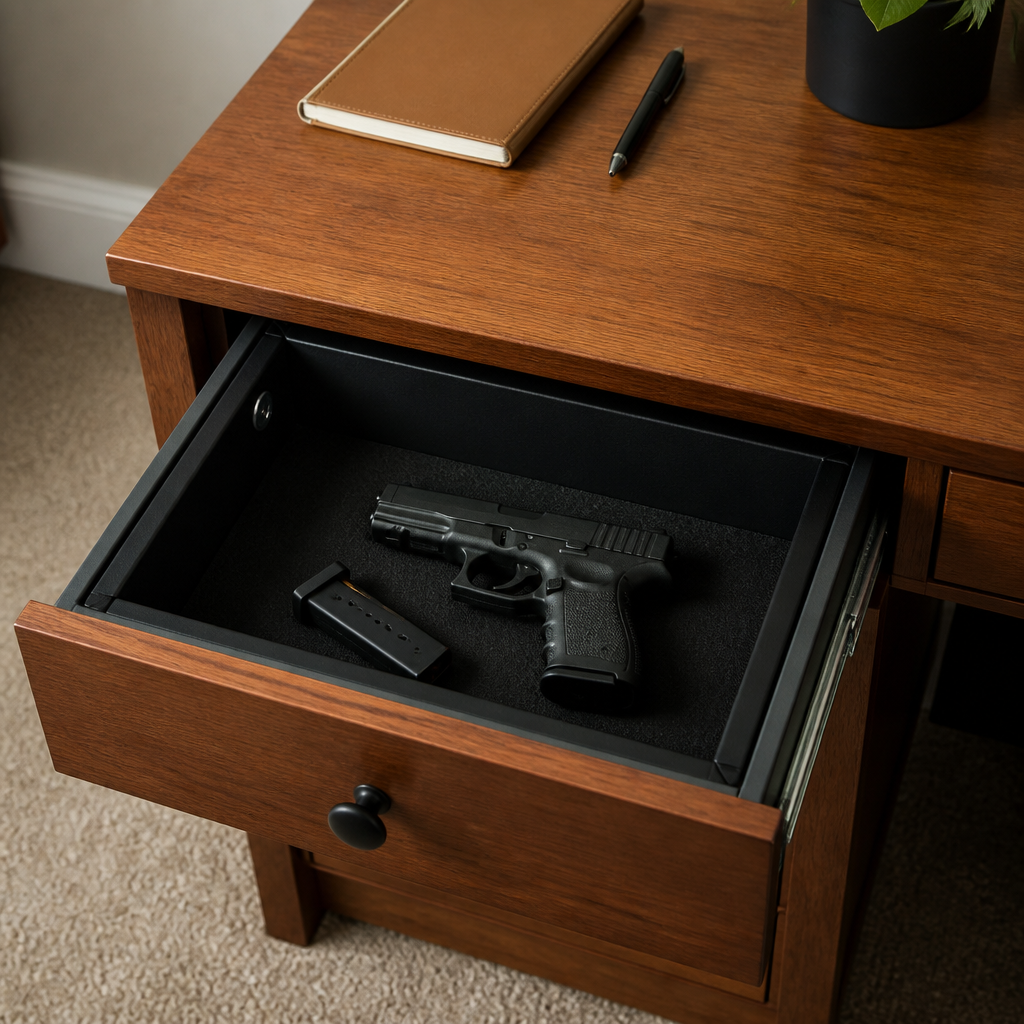
Hidden gun storage solves a specific problem: keeping a firearm secured, quickly reachable when lawful access is needed, and out of casual sight inside an ordinary room. Converting a desk drawer into a hidden gun safe is one of the most practical discreet gun storage solutions because a desk already belongs in a bedroom, office, den, or workshop, and a well-built drawer can conceal both a handgun and supporting gear without advertising what is inside. When I have planned concealed storage projects, the goal has never been theatrical secrecy alone. The real objective is layered security: delay unauthorized access, reduce visual exposure, maintain responsible control, and fit storage into the normal flow of daily life.
A desk drawer conversion is not the same as dropping a pistol into a drawer and calling it hidden. A true hidden gun safe uses reinforced structure, a dedicated lock, controlled access, and a retention layout that keeps the firearm stable. In practical terms, that usually means upgrading a drawer box, strengthening slide mounting points, adding steel or hardwood reinforcement, installing a mechanical or electronic lock, and creating a fitted interior insert for the firearm, spare magazine, flashlight, or documents. Some builds also use a false front, magnetic trigger release, RFID latch, or biometric lock, but concealment should never replace physical security. If a child, guest, burglar, or contractor can pull the drawer open with ordinary force, it is concealed storage, not a safe.
This topic matters because hidden and discreet gun storage sits at the intersection of home defense, child safety, theft prevention, and legal responsibility. Many gun owners need access that is faster than a closet safe but less conspicuous than a full-size freestanding unit. Apartment residents may not have room for a large safe. Professionals working from home may want a handgun close by without placing a visible lockbox on the desktop. At the same time, every hidden storage decision must account for local law, household risk, and the limits of furniture-based security. A converted desk drawer can be excellent for staged access in an occupied room, but it is not a substitute for a rated burglary safe for long-term storage of multiple firearms. Understanding that distinction is what separates a responsible solution from an unsafe shortcut.
What a desk drawer conversion can and cannot do
A desk drawer gun safe works best as a discreet access point for one defensive handgun or compact firearm, not as primary storage for an entire collection. Its strengths are concealment, convenience, and integration into existing furniture. A quality desk does not attract attention the way a dedicated gun cabinet can, especially in mixed-use spaces such as a home office or guest room. In one common setup, the top center drawer is converted to hold a compact pistol in a kydex-lined insert, with a hidden electronic latch mounted behind the face frame. From the room, nothing appears unusual. To the owner, access is predictable and repeatable.
Its limits are equally important. Most desks are made from particleboard, medium-density fiberboard, thin hardwood veneer, or lightweight joinery that was never designed to resist prying. Factory drawer slides often fail under side-load pressure, and standard cam locks on office furniture provide almost no meaningful resistance. Fire protection is usually absent unless specialty materials are added, and even then performance will not match a tested fire-rated safe. Environmental control is also limited; humidity swings in a home office can affect firearms over time unless desiccants or rust-prevention treatments are used. The most accurate way to think about a desk drawer safe is as an access layer within a broader gun storage plan, not a one-size-fits-all answer.
Choosing the right desk, drawer, and location
The best desk for a hidden gun safe conversion is heavy, structurally sound, and anchored by design or by hardware. Solid wood desks with frame-and-panel construction are ideal because they provide stronger mounting points for reinforcement and locks. Plywood carcasses can also work well if the drawer opening is framed properly. Cheap flat-pack desks are harder to upgrade because screws tear out of particleboard under stress. Before choosing a drawer, measure usable interior depth, width, and height, then compare those dimensions with the firearm, holster shell, or foam insert you intend to use. Leave room for fingers to grip the gun cleanly without snagging on the drawer lip.
Location matters as much as furniture quality. A desk drawer near the primary seated position offers fast access, but the room should also support safe muzzle orientation during retrieval and reholstering. Avoid drawers where the firearm would be pointed toward a common hallway, child play area, or neighboring apartment wall during access. If possible, place the desk where the back and sides are not easily reached by visitors, because hidden releases and rear access panels are vulnerable if someone can examine the furniture casually. In homes with children or frequent guests, the room itself should have an additional access control layer, such as a keyed office door, alarm contact, or monitored entry.
Core components of a secure hidden drawer safe
A secure conversion depends on a few nonnegotiable components: structural reinforcement, a dedicated locking mechanism, retention for the firearm, and resistance to simple pry attacks. Structural reinforcement usually starts with replacing weak drawer bottoms and backs. A thin stapled hardboard panel should be removed and replaced with thicker plywood or light-gauge steel backed by wood. The drawer face and side joints often need glue blocks, screws, or steel angle brackets so the box does not rack when pulled. I prefer to reinforce both the drawer and the cabinet opening, because a strong drawer mounted in a weak frame still fails quickly.
Lock choice determines how the safe functions day to day. Mechanical simplex-style pushbutton locks are durable and battery-free, but they require enough depth and careful mounting geometry. Electronic keypad latches are compact and common in custom furniture projects. RFID locks can be elegantly concealed, yet they create a dependency on tags and battery condition. Biometric options promise speed, but real-world performance varies with finger placement, skin condition, and sensor quality. For most desk drawer builds, a quality electronic latch with a backup key and low-battery alert is the most balanced option, provided the latch engages reinforced strike points rather than soft wood alone.
| Component | Best Practice | Why It Matters |
|---|---|---|
| Desk structure | Solid wood or quality plywood frame | Holds screws, brackets, and lock hardware under force |
| Drawer box | Reinforced sides, back, and bottom | Prevents racking, splitting, and bottom blowout |
| Slides | Heavy-duty full-extension ball-bearing slides | Supports added weight and improves reliable access |
| Lock | Electronic or mechanical lock with backup access | Secures contents while preserving emergency usability |
| Interior retention | Kydex insert, foam cutout, or bracketed holster | Keeps firearm stable and consistently oriented |
| Desk anchoring | Bolt desk to wall studs or floor when feasible | Reduces whole-unit theft and tampering |
How to convert a desk drawer into a hidden gun safe
Start by emptying the desk and removing the target drawer. Inspect how the drawer is built, how the slides mount, and whether the surrounding frame can accept reinforcement without affecting outward appearance. Replace weak slides with locking, full-extension ball-bearing slides rated for more weight than the finished drawer will carry. Add reinforcement to the drawer box using hardwood strips, plywood panels, or steel plates secured with screws and adhesive. If the desk front is thin, laminate a second panel behind the visible drawer face so the lock and strike have enough material to bite into. This first stage determines whether the conversion feels solid or flimsy for the life of the project.
Next, install the lock in a way that preserves concealment without compromising access. One proven method is an internal electronic latch mounted behind the face frame, released by a keypad hidden under the desktop edge or by an RFID reader placed behind a specific panel area. Another approach uses a mechanical release disguised as a normal desk feature, but hidden mechanical systems can become unreliable if tolerances are poor. After the lock is fitted, create the interior. Closed-cell polyethylene foam works better than soft upholstery foam because it resists compression and moisture. A molded kydex tray or mounted holster shell is even better for repeatable draw angle and trigger protection. Test the drawer from seated and standing positions, in light and low light, until opening, presentation, and re-securing are consistent.
Concealment techniques that stay practical
Effective concealment is subtle. The safest hidden drawer safe is one that looks boring, normal, and not worth inspecting. Matching factory hardware, preserving consistent drawer gaps, and avoiding visible modifications are more important than gadget-heavy tricks. False bottoms and hidden compartments can help with document storage, but for a defensive firearm they often slow access too much. A better approach is to make the entire drawer the secured compartment while ensuring the lock and release method are invisible to casual users. If the desk has multiple drawers, storing ordinary office items in neighboring spaces helps maintain a natural pattern.
Sound and motion also matter. Cheap latches click loudly, and loose inserts shift when the drawer opens. Felt lining on noncritical contact points, snug hardware tolerances, and a properly fitted insert reduce noise signatures that can reveal a compartment. Lighting should be considered as well. In a dark room, glowing keypads or obvious indicator lights can undermine concealment. I favor systems with dimmable indicators or no external lights at all. The best concealment measure, however, is behavior. Do not demonstrate the safe casually, and do not create routines that let others observe exactly how the drawer opens.
Safety, legal, and household considerations
Any article about hidden gun storage needs a direct safety point: concealed is not the same as child-resistant, and child-resistant is not the same as childproof. If minors live in or visit the home, the lock must resist guessing, bypass, and opportunistic tampering. Trigger coverage is mandatory, whether by a holster shell, retention bracket, or full storage insert. A loose pistol in a drawer is unacceptable because objects can enter the trigger guard during movement. Loaded versus unloaded storage depends on intended use, training level, household composition, and law, but the setup should be deliberate and documented in your own routine, not improvised day to day.
Legal requirements vary widely by jurisdiction. Some states and municipalities impose safe storage rules, negligence standards, or access-prevention laws, especially when children can gain entry. Employers may also have policies that affect firearms in home offices used for business. Insurance is another overlooked factor. A hidden drawer conversion may not satisfy policy requirements for theft loss reimbursement the way a listed residential security container might. That does not make the project useless; it means it should be matched to purpose. Use a desk drawer safe for staged, discreet access where lawful and appropriate, and use a larger rated safe elsewhere for bulk storage, high-value firearms, and long-term protection.
Building a complete hidden and discreet gun storage plan
A desk drawer safe is best understood as the hub entry point to broader hidden and discreet gun storage solutions. The same planning principles apply across nightstands, under-bed safes, wall compartments, closet integrations, bookcase inserts, and furniture safes: define the access need, assess unauthorized-user risk, reinforce structure, choose a proven lock, and control firearm orientation. In practice, I advise owners to map the home by use case. A quick-access location may belong in the office or bedroom, while a deeper-concealment location may hold documents, spare magazines, or a backup firearm. Every location should have one clear purpose rather than becoming a cluttered catchall.
The strongest plans use layers. A monitored alarm, solid doors, quality exterior locks, security cameras, and disciplined concealment habits reduce the chance that anyone even targets the furniture. Inside the room, the hidden drawer adds another barrier. Elsewhere in the home, a full-size safe or residential security container handles the jobs a desk never can: resisting extended attack, organizing multiple firearms, and protecting valuables at scale. If you are building this type of system, start with the desk drawer only after you define who must be kept out, how fast access must be, and what level of structural work you can do well. Done carefully, a converted desk drawer becomes a discreet, efficient, and responsible part of a complete gun safety strategy.
Converting a desk drawer into a hidden gun safe works when you treat the project as security engineering, not furniture tinkering. The essentials are straightforward: choose a sturdy desk, reinforce the drawer and frame, install a reliable lock, secure the firearm in a repeatable position, and place the setup where access is safe and lawful. That combination gives you the core benefit of hidden gun storage: a firearm that stays out of sight without being left unsecured or randomly stashed. It also supports the larger goal behind all discreet storage solutions, which is maintaining control over who can see, touch, or reach the firearm inside your home.
The biggest mistake is expecting concealment alone to do the job of a real safe. A desk drawer conversion can be excellent for staged access in a lived-in room, but it has limits in burglary resistance, fire protection, and total storage capacity. Once you respect those limits, the project becomes much easier to evaluate. Build for your actual environment, account for children and guests, follow local storage laws, and use the desk as one layer in a broader plan that includes a rated safe for primary storage. If you are ready to improve hidden and discreet gun storage, begin by auditing one desk, one room, and one realistic access need, then build from there with care.
Frequently Asked Questions
Is converting a desk drawer into a hidden gun safe actually secure enough for real-world use?
A desk drawer conversion can be a very practical layer of firearm security when it is built correctly, but its effectiveness depends entirely on the quality of the drawer, the lock, and the way the safe insert is anchored to the desk. A standard office drawer with a flimsy cam lock is not a gun safe. What makes the setup useful is upgrading the drawer into a reinforced compartment that resists casual discovery, unauthorized access, and quick grab-and-go theft while still allowing lawful users to reach the firearm quickly. In most cases, that means lining the interior with steel or installing a purpose-built lockbox inside the drawer, fastening it into the desk structure with carriage bolts or heavy-duty hardware, and replacing weak drawer slides or thin bottoms that could otherwise fail under weight or be pried apart.
The hidden aspect adds an important advantage because concealment reduces attention. Most theft is opportunistic. A firearm that is not visible and does not look like a firearm storage location is less likely to be targeted than a traditional obvious safe in some situations. That said, hidden storage is best understood as one part of a larger security plan, not a substitute for a true burglary-rated safe if you need high-level theft protection. For many homeowners, the best use case is securing a defensive handgun in a room where they spend time, such as a bedroom, office, or den, while keeping it out of casual sight and inaccessible to children, visitors, or unauthorized adults. If the build is done with reinforced materials, a reliable lock, and solid anchoring, it can be secure enough for quick-access home storage while remaining discreet and practical.
What kind of locking mechanism works best for a hidden gun drawer?
The best locking mechanism depends on how you balance speed, reliability, discretion, and power requirements. For most desk drawer hidden gun safe projects, the strongest options are electronic RFID locks, mechanical push-button locks, or hidden-release magnetic systems paired with an internal lockbox. RFID locks are popular because they preserve the clean appearance of the drawer front and can be opened quickly with a programmed card, fob, or tag. They are especially appealing when you want the drawer to look completely ordinary from the outside. However, they need quality components, proper installation, and a plan for battery replacement or backup entry.
Mechanical push-button locks are another strong option because they avoid battery dependence and can be very reliable over time. They are often slightly more visible unless mounted behind a false panel or used to secure an internal metal enclosure rather than the drawer face itself. Hidden magnetic release systems can work well for concealment, but they should not be the sole security measure if you need meaningful resistance to unauthorized access. They are better thought of as a stealth feature than as true stand-alone gun security.
In a real-world concealed storage build, a layered setup tends to work best. For example, the outer drawer remains visually normal, while an internal steel compartment is protected by a fast-access lock. That way, even if someone opens the drawer, the firearm is still secured. Whichever lock you choose, focus on consistent opening speed under stress, low false-failure risk, and a reliable override method. A lock that looks sophisticated but fails when batteries die, alignment shifts, or the room is dark is not a good choice for defensive storage. Test the system repeatedly before trusting it.
How do you reinforce a desk drawer so it can safely hold a firearm and related gear?
Reinforcement starts with recognizing that many desk drawers were never designed to support the weight of steel, ammunition, magazines, holsters, or a lockbox. The first step is evaluating the desk itself. Solid wood desks, plywood-built cabinetry, and well-constructed workshop furniture are usually much better candidates than particleboard furniture held together with staples and thin veneer. If the drawer box flexes, the bottom bows, or the slides feel loose, those issues should be addressed before adding any storage hardware.
A sound reinforcement plan usually includes upgrading the drawer bottom, strengthening the drawer box joints, improving the slide hardware, and anchoring the actual firearm compartment to structural parts of the desk. A thin hardboard drawer bottom should be replaced or overlaid with thicker plywood or metal. Drawer sides can be stiffened with steel angle brackets or hardwood strips, and slides should be replaced with heavy-duty full-extension locking slides if the original hardware is weak. Full extension is useful because it allows better access to the firearm and supporting gear without fumbling inside a shallow opening.
Inside the drawer, many people install a steel safe insert or lockbox rather than trying to turn the drawer itself into the only security barrier. That is often the smarter approach because it gives you real containment while preserving the desk’s normal appearance. Foam cutouts, magazine dividers, and low-profile organizers help prevent shifting and noise. Keep in mind that the goal is not just to hide the firearm, but to keep it stable, protected, and accessible. A drawer that rattles, sags, or jams when opened defeats the purpose. Reinforcement should make operation smoother and more dependable, not just heavier.
What should you store in a hidden desk drawer gun safe besides the firearm itself?
A hidden desk drawer safe works best when it is organized around a specific use case instead of becoming a catch-all compartment. In most setups, the firearm is the priority item, and everything else should support safe, efficient access. Common supporting items include a spare magazine or speed loader, a small flashlight, and possibly a compact trauma item if that fits your overall preparedness plan. If the drawer is intended for defensive access, layout matters more than quantity. The firearm should be positioned consistently with the grip oriented for a natural draw, and accessory placement should not interfere with your hand reaching the gun cleanly.
It is generally wise to avoid overpacking the drawer. Loose paperwork, pens, chargers, and general office items should not share the same space as the firearm compartment. Clutter slows access and increases the chance of snagging or accidental movement. A dedicated internal tray or foam insert can separate the handgun from spare magazines and other essential gear while reducing noise when the drawer opens. If you are using a lockbox inside the drawer, make sure the lid opens fully and nothing blocks the lock or hinge path.
Environmental protection also matters. Depending on the room, a small desiccant pack or corrosion-control insert may be worthwhile, especially in basements, workshops, or humid climates. Just as important, anything stored alongside the firearm should be selected with legal compliance and household safety in mind. The drawer should support secure storage, not create confusion or mixed-purpose use. A simple, disciplined setup is almost always better than a drawer filled with too many items that compromise speed and control.
What are the biggest mistakes to avoid when building a hidden gun safe into a desk drawer?
The biggest mistake is assuming concealment alone equals security. A drawer that looks ordinary but opens easily, can be removed from its slides, or contains an unsecured handgun is not a serious storage solution. Another common error is choosing the wrong desk. Lightweight furniture made from thin particleboard often cannot support reinforcement, heavy locking hardware, or repeated fast-access use. If the structure is weak, the project will always have limitations no matter how good the lock looks from the outside.
Poor hardware choices are another major problem. Weak drawer slides, cheap electronic locks, undersized screws, and thin sheet metal can all fail when you need them most. Many DIY builders also underestimate the importance of anchoring. If the internal safe box is not fastened into the desk frame or other structural members, a thief may be able to remove the whole unit quickly. Misjudging dimensions is another frequent issue. If the firearm barely fits, the drawer can bind, the optic can catch, or the lockbox lid may not open cleanly. Always measure for the actual firearm, any mounted light or optic, spare magazines, and the full swing or travel path of the access system.
Finally, one of the most overlooked mistakes is failing to practice and maintain the setup. A hidden drawer safe should be opened repeatedly under realistic conditions so you know how it behaves in low light, under stress, and from different body positions in the room. Batteries should be replaced on a schedule if electronic locks are used, screws should be checked for loosening, and the drawer should be kept free of clutter. A hidden storage project is successful only when it remains secure, discreet, and consistently functional over time.