
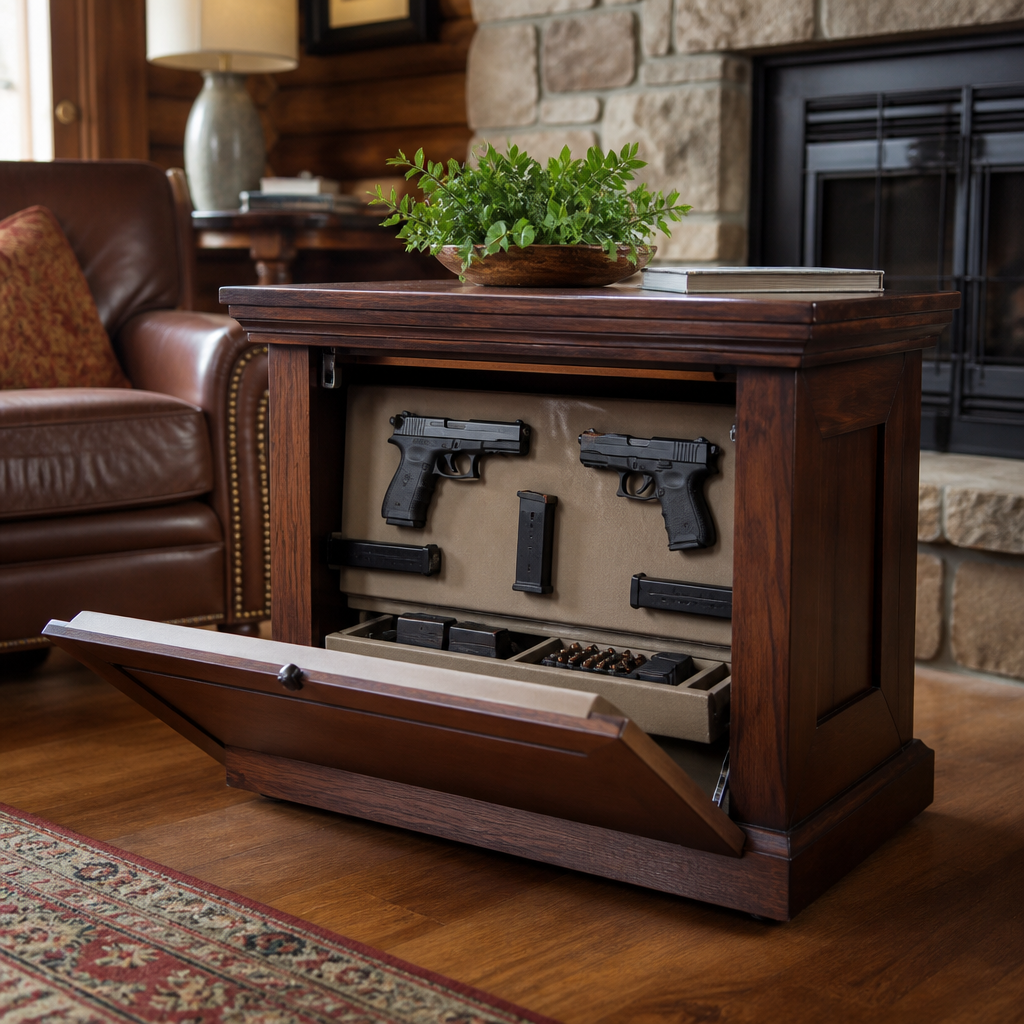
Concealment furniture gives gun owners a way to keep firearms secure, quickly accessible, and visually discreet inside everyday living spaces. Unlike a traditional freestanding safe, concealment furniture is designed to blend into a room as a mirror, bench, nightstand, shelf, coffee table, or wall cabinet while storing a handgun, shotgun, magazines, and related defensive tools behind a hidden compartment. In practice, the best concealment furniture balances three requirements that often compete with each other: safety from unauthorized access, speed of access during an emergency, and a realistic appearance that does not advertise what is inside.
I have evaluated hidden gun storage for bedrooms, entryways, living rooms, and home offices, and the same lesson comes up every time: discreet storage is only useful when it fits the owner’s actual routine. A parent with young children needs tamper resistance and reliable locking hardware. An apartment resident may need a low-profile option that avoids drilling into masonry. A homeowner building a layered home-defense plan may want a hidden long-gun cabinet in addition to a higher-security burglary-rated safe elsewhere in the house. Concealment furniture matters because many defensive firearms are kept for urgent access, yet leaving a gun unsecured on a shelf, in a drawer, or under a mattress creates obvious risk.
Before comparing products, define the category clearly. Hidden and discreet gun storage solutions include purpose-built concealment furniture, lockable wall shelves, hidden compartments integrated into existing furniture, under-bed vaults, and decorative fixtures such as mirrors or picture frames with rapid-access locking systems. This category overlaps with quick-access safes but is not identical to it. Most concealment furniture prioritizes blending into the environment, while a bedside biometric safe prioritizes pure access speed and stronger steel construction. The best setup often uses both.
This hub article covers how to choose concealment furniture, which designs work best in different rooms, what security features matter, where concealment furniture falls short, and how to integrate it into a broader gun storage plan. If you are researching hidden and discreet gun storage solutions, start here: understand the tradeoffs first, then match the furniture style, locking method, and mounting approach to your home, firearm type, and risk level.
What makes concealment furniture effective
Effective concealment furniture solves a practical problem: keeping a firearm nearby without leaving it exposed. The strongest products do four things well. First, they look ordinary at conversational distance and under normal lighting. Second, they use a locking system that resists casual discovery by children, guests, and burglars moving quickly through the home. Third, they secure the gun in a stable orientation so it can be retrieved without fumbling. Fourth, they mount or anchor in a way that prevents the entire unit from being carried away.
In field use, appearance matters more than many buyers expect. A “hidden” shelf that has oversized gaps, visible seams, obvious keypads, or tactical branding fails the basic disguise test. The best wall shelves and mirrors resemble conventional home decor sold by mainstream furniture retailers. Clean joinery, appropriate scale, and a finish that matches the room are not cosmetic extras; they are part of the security design because anything that draws attention undermines concealment.
Locking method is the second major variable. Common options include RFID locks, magnetic release systems, mechanical hidden latches, simplex push-button locks, electronic keypads, and biometric scanners. RFID and hidden magnetic locks preserve the discreet appearance well, but they depend on keeping the card, fob, or magnetic key accessible and organized. Biometric locks are fast when tuned correctly, but fingerprint readers can be inconsistent with dirty hands, sweat, or low batteries. Mechanical push-button locks generally sacrifice some concealment for long-term reliability. There is no universal winner; the best choice depends on whether your priority is speed, stealth, or redundancy.
Types of hidden and discreet gun storage solutions
Concealment furniture spans more than one form factor, and each type serves a different use case. Wall-mounted flag cases, framed mirrors, floating shelves, and picture-frame cabinets are common for storing a defensive handgun in a bedroom hallway, den, or home office. They use vertical space, keep the gun off surfaces children can reach, and work especially well where floor space is limited. Their weakness is installation quality: if mounting hardware misses studs or uses inadequate anchors, the security benefit collapses.
Nightstands, end tables, and bedside benches are popular because they place a firearm where many owners want it most: within reach during a nighttime break-in. Good bedside concealment furniture includes a locking compartment that opens consistently in darkness and holds the handgun in a repeatable orientation. Some models add interior motion lighting, foam retention, or charging ports, but those extras matter less than a lock you can operate under stress and a door that does not bind as humidity changes.
For long guns, larger concealment cabinets and storage benches can hide a short defensive shotgun or carbine in a mudroom, office, or bedroom. These products often use gas struts, drop-down fronts, or swing-out compartments. They require more planning because long guns need greater internal length and depth, and the furniture must still look proportionate to the room. A shallow wall mirror can hide a pistol easily; hiding a long gun discreetly without telegraphing the compartment is harder and typically more expensive.
Under-bed vaults and drawer vaults also belong in this subtopic even though they look less like traditional furniture. They are among the most discreet solutions because visitors rarely inspect them, and many use heavier-gauge steel than decorative concealment cabinets. In my experience, they are often the practical middle ground for owners who want more real security than a decorative hidden shelf can offer without placing a visible safe in the room.
| Storage type | Best use | Main advantage | Main limitation |
|---|---|---|---|
| Wall shelf or mirror | Handgun in shared living areas | Blends into decor | Lower steel strength than a safe |
| Nightstand or end table | Bedside access | Fast retrieval at night | Can attract attention if bulky |
| Bench or cabinet | Long gun storage | More internal space | Harder to disguise convincingly |
| Under-bed vault | Discrete higher-security access | Better steel construction | Less furniture-like appearance |
How to judge security, access, and build quality
The first rule is straightforward: concealment is not the same as security. A hidden compartment without a meaningful lock may stop a casual visitor, but it will not stop a determined child, a curious teenager, or a burglar with time. When assessing build quality, look for solid hardwood or quality plywood construction, concealed hinges that do not sag, precise panel alignment, and hardware from known suppliers rather than generic parts. For steel-lined units, ask about gauge thickness, weld quality, and whether the door frame resists prying.
Access speed should be tested against realistic conditions, not showroom assumptions. Can you open the unit one-handed? Can you reach the firearm while kneeling beside a bed or standing in a hallway? Does the door swing fully without hitting a lamp, bed frame, or wall? Can a spouse or other authorized adult operate the lock under stress? I always recommend dry runs with an unloaded firearm and dummy magazines before committing to a placement decision. Problems appear quickly when movement is restricted by furniture layout.
Build quality also shows up in details owners notice only after months of use. Soft-close hardware is nice, but the more important issues are lock consistency, battery access, resistance to seasonal wood movement, and secure interior retention. Foam inserts should not press the magazine release or interfere with optics. If you store a pistol with a weapon light or red dot, measure the exact dimensions. Many concealment cabinets are sized around a plain subcompact handgun and fit poorly once accessories are added.
Finally, secure installation is nonnegotiable. Anchoring concealment furniture to wall studs, floor joists, or substantial framing materially improves both safety and theft resistance. Manufacturers that provide robust mounting plates, lag hardware, and clear load ratings deserve more trust than brands that rely on vague assembly instructions and decorative brackets.
Best room-by-room choices for concealment furniture
The bedroom is usually the priority room because it is where many home-defense incidents begin at night. For most owners, the best concealment furniture here is either a rapid-access nightstand with a locked side compartment or a wall-mounted shelf positioned above normal child reach but still accessible from bed. If you need the fastest possible access, compare these options against a dedicated bedside handgun safe. Decorative furniture may look better, but a steel quick-access safe often provides better tamper resistance.
In living rooms and family rooms, disguise becomes more important because guests and service workers spend time there. A floating shelf, mirror, or framed decor cabinet tends to work better than a heavy end table that seems oddly difficult to move. Keep placement natural. A hidden flag case in a room with no related decor can look contrived; a shelf among books and framed photos is usually more convincing. Avoid placing concealment furniture at the visual center of the room where it invites scrutiny.
Entryways, mudrooms, and home offices are common secondary locations. An entry bench can discreetly store a compact firearm near the point of home access, while an office cabinet may support those who work from home and spend long hours away from the bedroom. For these areas, think carefully about traffic patterns. The best hidden storage spot is not necessarily the closest one to the door; it is the one you can reach safely without crossing exposed space or creating a confrontation over the firearm.
Bathrooms and kitchens are generally weak choices because humidity, steam, grease, and routine guest access create avoidable problems. Garages are also poor candidates unless climate control, rust prevention, and secure anchoring are handled properly. Concealment furniture performs best in stable indoor conditions where the hidden nature of the unit remains believable and the firearm is protected from corrosion.
Common mistakes and when to choose a real safe instead
The most common mistake is buying concealment furniture as a substitute for all other gun storage. It is not. If you own multiple firearms, valuables, or regulated items, you still need a true gun safe or secure vault for primary storage. Concealment furniture is best understood as a specialized access layer for one defensive firearm or one staged long gun, not as the sole security plan for a household collection.
Another frequent error is overvaluing invisibility and undervaluing child resistance. Children are observant, and repetitive adult behavior reveals patterns quickly. If a firearm is staged in concealment furniture, the lock must remain engaged every time, and the opening method must not be demonstrated casually. Likewise, avoid social media habits that expose hidden storage locations. The point of discreet gun storage is not the furniture itself; it is preserving controlled access.
Choose a real safe instead of concealment furniture when burglary resistance is your top concern, when local law imposes specific storage standards, when unauthorized access risk is high, or when you need fire protection. A UL-listed residential security container or a heavier safe from established brands such as Liberty, Fort Knox, Browning, or American Security offers a level of steel strength, locking depth, and often fire insulation that concealment furniture does not match. The tradeoff is visibility and reduced placement flexibility.
A strong home setup usually combines both categories: a main safe for bulk storage, ammunition management, documents, and off-body firearms, plus one carefully selected piece of concealment furniture or a quick-access vault for immediate defensive access. That layered approach is more realistic than expecting one product to solve every storage problem.
How to choose the best concealment furniture for your home
Start with the firearm, then the room, then the users. Measure the exact gun with any mounted optic, suppressor-height sights, or weapon light. Decide who is authorized to access it and who must be excluded. Map where you spend time, where children or guests circulate, and what wall structure or floor anchoring is available. Only after those decisions should you compare styles and finishes.
Prioritize products from manufacturers that publish dimensions, lock specifications, mounting requirements, and realistic photos of the interior. Read reviews for consistency issues, not just appearance. Ask whether the unit ships assembled, whether backup access exists if electronics fail, and whether replacement keys, RFID tags, or biometric modules are available. Good concealment furniture is defined by repeatable function, not novelty.
The best concealment furniture for storing guns securely is the piece that disappears into your routine while maintaining disciplined control. Pick one that matches your room, supports your firearm properly, anchors solidly, and opens reliably under stress. Then test it, maintain it, and integrate it with a broader gun safety plan. If you are building out hidden and discreet gun storage solutions for your home, use this hub as your starting point and move next to detailed comparisons for bedside units, wall-mounted cabinets, long-gun concealment options, and under-bed vaults.
Frequently Asked Questions
What is concealment furniture, and how is it different from a traditional gun safe?
Concealment furniture is functional home furniture designed with a hidden storage compartment for firearms and related gear. Instead of looking like a security device, it blends into normal living spaces as a mirror, bench, nightstand, shelf, coffee table, wall cabinet, or similar household piece. The main advantage is discretion. A visitor, contractor, or casual observer is far less likely to recognize it as firearm storage, which can reduce attention and help preserve privacy inside the home.
A traditional gun safe, by comparison, is built first and foremost for security, fire resistance, and large-capacity storage. Full-size safes are usually heavier, more difficult to move, and more resistant to forced entry. They are often the best solution for long-term storage of multiple firearms, ammunition, documents, and valuables. Concealment furniture serves a different purpose. It is typically chosen for faster access to a defensive firearm in a bedroom, living room, entryway, or office while keeping that firearm out of plain sight.
The best concealment furniture sits between open-access storage and a large secure safe. It gives gun owners a way to keep a handgun or long gun nearby, visually discreet, and organized, but buyers should understand that not all products offer the same level of locking strength, tamper resistance, or child resistance. That is why the best options focus on balancing three goals that often compete: security, speed of access, and seamless appearance. For many households, concealment furniture works best as part of a broader storage plan, with a primary safe for most firearms and a purpose-placed concealment unit for home-defense access.
Is concealment furniture actually secure enough for storing guns at home?
It can be, but the answer depends entirely on the quality of the furniture, the locking system, how it is installed, and who is in the home. High-quality concealment furniture can provide meaningful security for a defensive firearm when it includes a reliable lock, a sturdy hidden compartment, solid construction, and proper mounting to a wall or floor if the design calls for it. Some models use RFID, biometric, keypad, magnetic, or mechanical locking systems, and the better ones are designed so the compartment cannot be easily discovered or opened accidentally.
That said, concealment furniture should not automatically be viewed as equal to a heavy-duty gun safe. Most concealment pieces are optimized for discretion and access rather than maximum burglary resistance. If a determined intruder has time, tools, and privacy, a lightweight or poorly built concealment unit may be easier to defeat or remove than a bolted steel safe. That is why it is important to be realistic about threat level. For quick-access storage in occupied areas of the home, concealment furniture can be a practical and responsible option. For large collections, high-value firearms, or long periods away from home, a traditional safe still offers stronger protection.
Households with children, teens, frequent guests, caregivers, or service personnel should be especially careful. The best concealment furniture for these homes includes a genuine locking mechanism rather than a simple hidden latch, and it should be installed in a way that limits tipping, shifting, or easy removal. In short, concealment furniture can be secure enough when matched to the right use case, but security depends less on the category itself and more on build quality, lock design, placement, and responsible use.
What should I look for when choosing the best concealment furniture for gun storage?
The first thing to evaluate is the balance between access speed, concealment, and security. Many buyers focus on appearance alone, but the best concealment furniture does more than blend into a room. It should open quickly under stress, hold the firearm in a stable and usable orientation, and protect against unauthorized access. If the purpose is home defense, you want a compartment layout that allows you to retrieve the firearm smoothly without snagging on shelves, décor, charging cords, or stored accessories.
Construction quality matters just as much as the hidden design. Look for durable materials, tight joinery, reinforced internal compartments, and hardware that does not feel flimsy. A cheap concealment piece may look attractive in photos but fail under daily use, sag over time, or reveal its hidden compartment through rattling, uneven seams, or poor alignment. Solid mounting options are also important. Wall-mounted mirrors, cabinets, and shelves should attach securely to framing, and freestanding pieces should feel stable and substantial in the room.
You should also consider storage capacity and intended firearm type. Some concealment furniture is ideal for a single handgun and spare magazine, while other pieces are built for a short shotgun, AR-style rifle, medical kit, flashlight, and additional accessories. Measure carefully before buying, especially if the firearm has an optic, weapon light, sling, or extended magazine. A unit that technically fits the gun but makes retrieval awkward is not a good defensive solution.
Finally, pay close attention to the lock type and daily usability. Biometric access can be fast, but it should be reliable and backed up by keypad or manual entry. RFID can be convenient, but you need a consistent way to keep the tag available. Mechanical locks may be slower, but they avoid battery concerns. The best choice is the one that works dependably for your environment and level of training. In practical terms, the best concealment furniture is the piece you can access quickly, trust mechanically, and place naturally within your home without advertising what it stores.
Where should concealment furniture be placed in the home for the best mix of access and safety?
Placement should start with purpose. If the goal is defensive access at night, a concealment nightstand, headboard compartment, or wall mirror in the bedroom may make the most sense. If the priority is daytime access in a common area, a bench, coffee table, end table, or wall cabinet in the living room or home office may be more practical. The ideal location is one that keeps the firearm close to where it may realistically be needed while still maintaining control over who can approach it.
At the same time, good placement should never ignore safety. Concealment furniture should be positioned away from obvious child traffic, unsupervised play areas, and places where guests routinely set bags, coats, or personal items. It should also be located where the hidden access point can be used without obstruction. For example, a sliding panel should not be blocked by furniture, and a drop-down compartment should have enough clearance to open fully. In an emergency, even a well-designed concealment unit becomes a poor choice if the room layout interferes with retrieval.
Discretion is another key factor. The strongest concealment strategy is natural placement. A mirror should make sense where it hangs. A bench should look like it belongs in the entryway. A shelf should fit the room’s design. If the piece appears oddly placed, oversized for the space, or strangely empty of normal household use, it may draw more attention rather than less. Buyers should think like both a homeowner and an outsider: does this item look ordinary, and does it function naturally in the room?
For many people, the best approach is to use concealment furniture only in occupied, high-access areas and rely on a traditional safe elsewhere for primary storage. That way, the firearm intended for home defense stays discreet and available, while the rest of the collection remains under heavier security. Thoughtful placement is what turns concealment furniture from a novelty into a practical part of a responsible home-defense setup.
Can concealment furniture be a responsible option for homes with children or frequent visitors?
Yes, but only if it is selected and used with a very high standard of care. Concealment alone is not the same as secure storage. A hidden compartment may keep a firearm out of casual view, but responsible storage requires protection against curiosity, accidental discovery, and unauthorized access. In homes with children, teenagers, visitors, babysitters, housekeepers, or maintenance workers, concealment furniture should include a real locking system and should never rely solely on secrecy.
The best practice is to choose a model with dependable access control, mount it properly if required, and limit storage to the firearm and defensive tools you genuinely need nearby. Owners should test the lock regularly, replace batteries on schedule if the unit uses electronics, and verify that the firearm can be accessed quickly by authorized adults but not by anyone else. Training matters too. Every adult in the home should understand the safety plan, where firearms are located, and how access is controlled. If children are present, age-appropriate firearm safety education should be part of that plan, but it should never be treated as a substitute for secure storage.
It is also wise to think in layers. Concealment furniture can serve as one layer of quick-access storage, while a larger safe handles the rest of the firearms and valuables. Some gun owners also pair the furniture with room-level security measures such as alarms, cameras, reinforced doors, or strategic placement in less accessible parts of the room. These layered decisions help reduce the chance that a firearm is either discovered or reached by an unauthorized person.
Ultimately, concealment furniture can be a responsible option when it is used for the right purpose and with the right safeguards. The standard should be simple: the firearm must remain inaccessible to unauthorized users, immediately available to the responsible owner when needed, and stored in a way that