
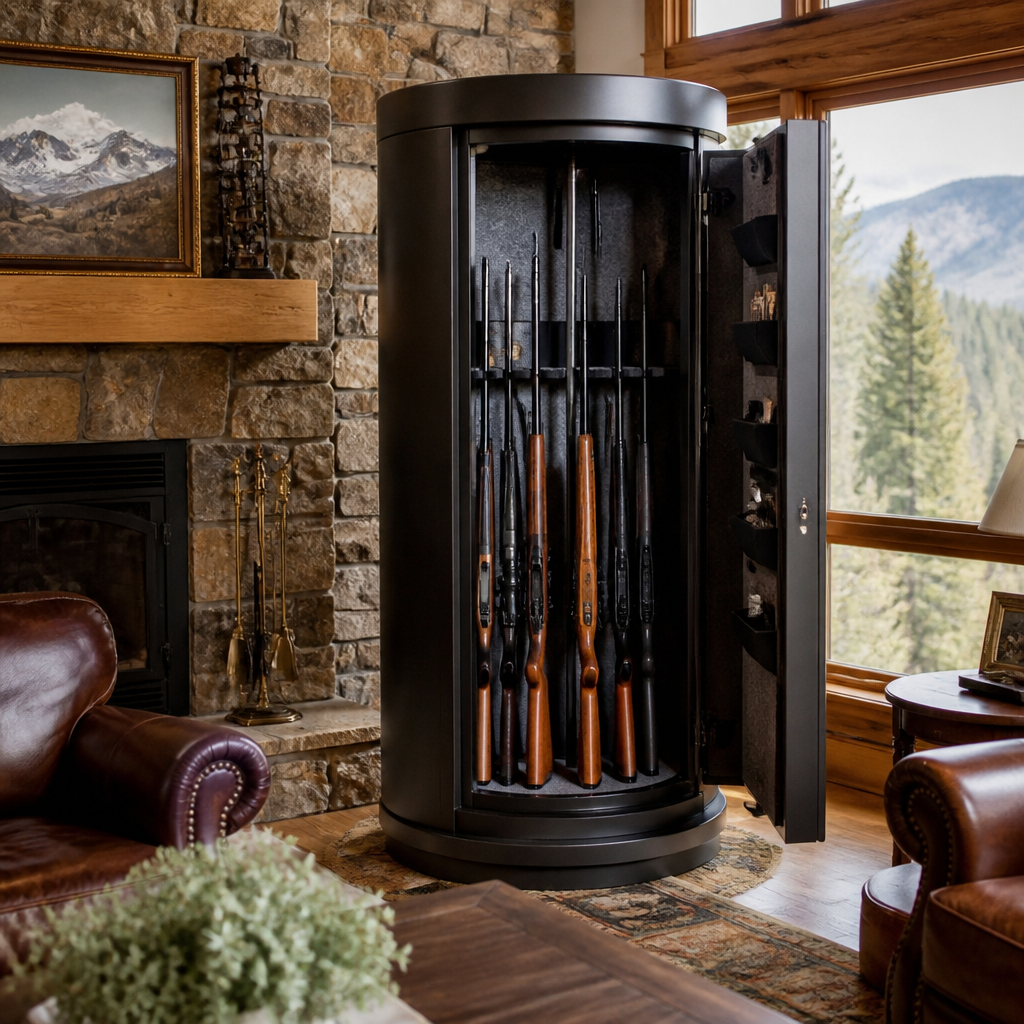
The Pendleton Revolution Safe is a 360-degree rotating gun safe designed to solve a common problem in firearms storage: how to keep long guns secure, organized, and quickly accessible without dedicating an entire wall to a traditional cabinet. In the gun safes and safety category, product reviews matter because buyers are not choosing décor; they are choosing a security device that may protect firearms, documents, optics, heirlooms, and, most importantly, unauthorized users from preventable harm. A strong review hub must therefore do more than repeat marketing claims. It should define the product class, explain how rotating safes differ from standard upright safes, and show where this model fits for homeowners, collectors, and anyone comparing premium storage options.
When I evaluate a rotating gun safe, I focus on five criteria first: burglary resistance, fire protection, storage efficiency, access speed, and installation demands. A 360-degree rotating gun safe uses a central spindle or motorized carousel layout so the interior can turn, bringing stored firearms or shelves to the user instead of forcing the user to reach deep into a fixed compartment. That sounds simple, but it changes floor planning, ergonomics, and use patterns in meaningful ways. In a bedroom closet, office corner, or hunting room, a rotating design can provide high density storage in a smaller footprint while keeping each slot easier to reach. The concept appeals especially to owners who want better access than a deep rectangular safe often provides.
This article serves as a sub-pillar hub for product reviews within gun safes and safety, with the Pendleton Revolution Safe as the central example. It covers what the safe is, who it suits, what features deserve scrutiny, how it compares with conventional gun safes, and what tradeoffs serious buyers should weigh before ordering. If you are asking practical questions such as “Is a rotating gun safe secure?”, “How many rifles can it store realistically?”, “Will it fit with scoped firearms?”, or “Is installation more complicated than a standard safe?”, those are the exact questions a review page should answer directly. By the end, you should know whether the Pendleton Revolution Safe belongs on your shortlist and what specifications to verify before spending premium-safe money.
What the Pendleton Revolution Safe Is and Why the Rotating Design Matters
The Pendleton Revolution Safe belongs to a specialized product category that blends a gun safe, a space-saving organizer, and in some configurations, a concealed furniture-style storage solution. The defining feature is full rotational access. Instead of opening a wide door and navigating rows of firearms set against the back wall, the user opens the unit and rotates the internal storage structure to bring each section forward. In practice, this can reduce blind spots, improve inventory visibility, and minimize the awkward movements common with tightly packed long gun safes. For owners storing rifles with optics, slings, bipods, or larger handguards, this visibility is not a cosmetic benefit; it reduces accidental bumps and snagging during retrieval.
Rotational storage matters because safe capacity claims are notoriously optimistic across the industry. A “24-gun” traditional safe may only hold that number if the firearms are slim, unscoped, and perfectly staggered. Once optics and accessories enter the equation, realistic capacity drops fast. A rotating platform can improve usable capacity because each firearm can be positioned with clearer spacing and approached from a better angle. This does not mean every rotating safe stores more than a conventional equivalent, but it often stores the same collection more practically. For households where rifles vary from AR-platform carbines to bolt actions and shotguns, that practical difference becomes the deciding factor.
Another reason the rotating design matters is room integration. Many safe buyers are balancing security with discretion. Large traditional safes are heavy and effective, but they can dominate a room and are difficult to place in tighter layouts. A vertical rotating safe can use depth differently, making it attractive for closets, studies, or multipurpose rooms where floor space is limited. The key is to verify not just the unit dimensions, but the clearance required for the door swing, the rotation mechanism, and user access. In my experience reviewing premium storage products, buyers who only measure the footprint often overlook functional clearance, then discover the safe technically fits but is frustrating to use daily.
Core Review Criteria: Security, Fire Protection, Locking Systems, and Build Quality
Any Pendleton Revolution Safe review must begin with security fundamentals rather than novelty. A rotating interior does not compensate for weak steel, poor lock protection, or inadequate anchoring. Buyers should examine steel gauge or plate thickness, pry resistance around the door, hardplate protection for the lock, relockers, hinge design, and anchor provisions. If a manufacturer does not clearly disclose construction details, ask. Serious safe makers specify body thickness, door structure, bolt count or bolt direction, and lock options. In firearm storage, concealment helps, but it is not a substitute for physical security. A rotating unit should still be judged by the same attack surfaces as any residential security container or heavier safe.
Fire protection deserves the same level of scrutiny. Manufacturers commonly advertise fire ratings using minutes and temperatures, but test standards vary. Some companies rely on independent testing; others use internal testing protocols. The practical question is not simply whether the Pendleton Revolution Safe is “fireproof,” because no residential safe is absolutely fireproof under every condition. The useful question is whether the unit offers credible fire resistance for the likely residential fire scenario and whether the seal, insulation, and door interface are designed consistently. Buyers storing paper records, passports, cash, suppressor paperwork, or digital media should also remember that paper, electronics, and magnetic media tolerate heat differently. A fire liner that protects steel and slows internal temperature rise may still be inadequate for sensitive digital storage.
Lock choice affects convenience and reliability. Most buyers choose between electronic keypad locks and mechanical dial locks, with some premium options offering biometric access or redundant entry methods. Electronic locks are usually faster and easier for daily access, especially when paired with a rotating system intended for convenience. Mechanical locks can offer long-term durability and independence from batteries, but they are slower and less appealing for frequent access. Biometric locks are attractive on paper, yet sensor quality varies widely. On a premium safe, I prefer a UL-rated electronic lock from a recognized manufacturer such as Sargent and Greenleaf or SecuRam over an unproven biometric system. A lock is not an accessory; it is the control point for the entire safe.
| Review Factor | What to Verify | Why It Matters |
|---|---|---|
| Steel construction | Body and door thickness, reinforcement, pry resistance | Determines burglary delay and structural rigidity |
| Lock system | UL listing, brand, override policy, battery access | Affects reliability, tamper resistance, and daily use |
| Fire protection | Fire rating method, seals, insulation type | Indicates how well contents may survive heat exposure |
| Capacity realism | Scoped rifle spacing, shelf adjustability, handgun storage | Prevents disappointment from inflated gun-count claims |
| Installation | Weight, anchoring points, clearance, power needs | Ensures the safe works safely in the intended room |
Storage Capacity, Interior Layout, and Real-World Usability
Capacity is where the Pendleton Revolution Safe will either justify its premium position or fall short for a given buyer. The right way to judge storage is not by the headline gun count but by the actual collection you own. A safe that works beautifully for a set of lever actions and shotguns may be cramped for modern sporting rifles with LPVOs, offset red dots, weapon lights, and suppressor-ready muzzle devices. The rotating layout helps because it presents each slot more directly to the user, but slot geometry still matters. Look for adjustable racks, barrel supports that accommodate optics height, and shelf modules that can be reconfigured for documents, pistols, magazines, or valuables.
Usability also includes retrieval speed. In a fixed safe, the firearm you want may be blocked by another rifle’s optic or sling. In a rotating design, one turn can bring the needed section into view with less reaching and less contact between guns. That is a meaningful advantage for collectors who access different firearms regularly for range use, hunting seasons, or maintenance. It also helps reduce cosmetic wear. Over time, repeated dragging, tilting, and bumping inside crowded safes can mark stocks, scrape turrets, and damage accessories. Better spacing and line-of-sight access are practical protections for the firearms themselves, not just conveniences for the owner.
Interior finish and lighting should not be dismissed as luxury features. A good interior liner reduces stock wear, while integrated lighting improves safe handling. In dim closets or offices, poor lighting increases the chance of mishandling. Some premium safes include motion-activated LEDs, dehumidifier pass-throughs, and power outlets for charging accessories or running humidity control devices. For anyone storing blued steel firearms, humidity management is nonnegotiable. A rotating safe with excellent access still needs desiccants, an electric dehumidifier, or a controlled room environment. Product reviews in this category should always connect convenience features back to safe handling and long-term corrosion prevention, because that is where real ownership experience shows up.
Pendleton Revolution Safe vs. Traditional Gun Safes
The strongest comparison point for the Pendleton Revolution Safe is the conventional rectangular upright gun safe sold by brands such as Liberty, Fort Knox, Browning, Cannon, and AMSEC. Traditional safes generally offer more familiar construction options, broader dealer availability, and often higher absolute storage volume at the same external width. They are also easier to compare because the market has established expectations around lock types, fire ratings, and body construction. If your top priority is maximum steel mass and a straightforward burglary-deterrent design, a conventional high-quality safe may still be the better fit. Simplicity has value, especially when long-term durability is the goal.
Where the Pendleton-style rotating safe stands out is organization and space efficiency in lived-in rooms. Instead of a giant block of steel that requires full frontal access, the rotating system can make better use of constrained spaces and provide a more refined user experience. For collectors who interact with their firearms frequently, that experience matters. I have seen buyers move from large box safes to more specialized systems because they were tired of digging through crowded rows to reach one rifle in the back. The rotating format turns storage into selection rather than excavation. That is not a gimmick. It is a legitimate ergonomic advantage when the mechanism is well built.
The tradeoff is complexity. A conventional safe is easier to understand and has fewer moving parts beyond the door, bolts, and lockwork. A rotating safe introduces a mechanism that must remain aligned, smooth, and durable over years of use. That does not make it unreliable by default, but it raises the importance of build quality, installation, and warranty support. Ask what parts are covered, whether the rotation system is manual or powered, how service is handled, and what maintenance is recommended. In product reviews, the best premium feature is the one that still works after ten years. Buyers should evaluate the Pendleton Revolution Safe with that long horizon in mind.
Who Should Buy It, What to Check Before Ordering, and How This Hub Supports Product Reviews
The Pendleton Revolution Safe is best suited to firearm owners who value access, organization, and efficient use of floor space as much as they value baseline security. That includes enthusiasts with mixed long-gun collections, homeowners creating a discreet office or closet installation, and collectors who want less handling friction when rotating through range rifles or seasonal hunting firearms. It can also suit buyers who care about presentation and furniture integration, provided they do not confuse visual discretion with security performance. The wrong buyer is someone seeking the cheapest gun storage, the highest raw gun count per dollar, or a unit intended to disappear into a garage corner with minimal planning.
Before ordering, verify dimensions, delivery logistics, floor load considerations, anchoring requirements, electrical needs if applicable, and realistic internal capacity based on your actual firearms. Measure optic heights, overall lengths, and accessory protrusions. Ask whether shelves can be repositioned later. Confirm lock brand, fire rating basis, warranty terms, and how replacement parts or service calls are handled. If possible, view a demonstration unit or request a detailed video showing full rotation with rifles installed. That single step often reveals more than a specification sheet because you can see spacing, access angles, and whether the mechanism operates smoothly under load. Premium safe purchases reward careful verification.
As a hub page for product reviews in gun safes and safety, this article provides the framework buyers should use across every review in the category. Start with construction and lock integrity. Move to fire performance. Then judge realistic storage, installation, and long-term usability. The Pendleton Revolution Safe earns attention because the 360-degree rotating format addresses real storage frustrations that traditional safes often leave unsolved. Whether it is the right choice depends on your room, your collection, and your tolerance for paying more for accessibility and organization. Use these review criteria consistently, compare models carefully, and choose the safe that protects your firearms while making secure storage easy enough to use every single day.
Frequently Asked Questions
What makes the Pendleton Revolution Safe different from a traditional gun cabinet or standard gun safe?
The biggest difference is the 360-degree rotating design. A traditional gun cabinet usually requires a wide swing area for doors and enough wall space to make every long gun easy to reach. The Pendleton Revolution Safe is built to solve that exact storage problem by using vertical space more efficiently and giving you rotational access to your firearms and gear. Instead of forcing you to stack rifles awkwardly in a fixed cabinet, this design helps keep long guns organized, visible, and easier to retrieve without consuming an entire section of the room.
That matters because accessibility and organization are not small conveniences in firearms storage. They directly affect how safely and confidently a user can store and handle firearms. When guns are crowded together, owners are more likely to bump optics, scratch finishes, tangle slings, or struggle to remove one firearm without disturbing others. A rotating safe can reduce that friction by making each position easier to access. For owners with multiple long guns, scoped rifles, shotguns, or accessories, that can be a major advantage over conventional cabinets that often become cramped faster than expected.
Another important distinction is the buying mindset. This is not a furniture purchase. It is a security decision. Shoppers in the gun safes and safety category are evaluating how well a product protects firearms, documents, optics, valuables, and unauthorized users from preventable harm. The Pendleton Revolution Safe stands out because it addresses both spatial efficiency and practical access while still serving the core purpose of secure storage. For people who want a more compact footprint without giving up order and usability, it offers a different approach than the standard rectangular safe or wall-length cabinet.
Is a rotating gun safe still secure enough for responsible firearms storage?
Yes, a rotating gun safe can absolutely be a responsible storage solution, provided it is designed with strong security fundamentals and used correctly. The rotation feature is about access and organization, not about reducing protection. What matters most is the overall construction quality: the locking system, steel thickness, hinge design, internal layout, anchoring capability, and how securely the unit controls access. A well-built rotating safe should still function as a true security device rather than just a display piece or organizer.
Responsible firearms storage means more than simply putting guns out of sight. It means restricting access from children, guests, thieves, and anyone not authorized to handle them. It also means reducing the risk of accidental handling and keeping firearms stable, protected, and separated in a way that limits unnecessary contact. If the Pendleton Revolution Safe includes a reliable lock and sturdy physical construction, the rotating mechanism should be viewed as an access feature layered onto the safe’s protective function, not as a compromise of that function.
As with any gun safe, real-world security also depends on setup and habits. Owners should place the safe in an appropriate location, follow installation guidance, and anchor it if the manufacturer recommends it. They should also store firearms unloaded when appropriate, secure ammunition according to their preferred safety practices and local laws, and control access credentials carefully. In other words, even an innovative design still works best when combined with common-sense safe storage principles. The safe itself is one layer of protection, and the user’s storage discipline is another.
Who is the Pendleton Revolution Safe best suited for?
The Pendleton Revolution Safe is especially appealing for firearm owners who need to store multiple long guns but do not want a bulky cabinet dominating an entire wall. That can include homeowners with limited floor space, collectors trying to keep rifles and shotguns organized, hunters with optics-equipped firearms, and practical users who want quicker access to specific guns without reshuffling everything inside a conventional safe. If your current cabinet feels overcrowded, inefficient, or frustrating to use, a rotating design may be a strong fit.
It is also well suited for buyers who care about organization just as much as raw capacity. Many firearm owners eventually discover that storage becomes complicated not because they lack a safe, but because the safe they own is difficult to use cleanly. Long barrels, slings, bipods, scopes, and accessories can all compete for space. A system that allows better separation and visibility can help preserve gear, reduce accidental knocks, and make routine access far less cumbersome. For owners protecting not only firearms but also important documents, heirlooms, optics, and other valuables, that improved organization can be a practical advantage day after day.
That said, the ideal buyer should still match the product to their exact needs. Consider how many long guns you own, whether you need room for handguns or documents, how much space you have in the room, and how often you access specific firearms. Also think about your priorities: maximum theft resistance, fast access, compact footprint, visual organization, or multi-purpose storage. The Pendleton Revolution Safe is best for someone who values secure storage but specifically wants a smarter layout and a more space-efficient way to manage long guns.
How does the 360-degree rotating feature improve access and organization in everyday use?
In everyday use, the rotating feature can make a meaningful difference because it changes how you interact with stored firearms. In many traditional safes, the rifle you want may be behind another firearm, tucked into a corner, or positioned so tightly that removing it risks bumping neighboring stocks or optics. A 360-degree rotating interior helps bring stored items to you rather than forcing you to reach deep into a static compartment. That can make the entire experience more controlled, more efficient, and less likely to result in careless handling.
Better access often leads to better organization. When firearm owners can clearly see where each long gun belongs, they are more likely to maintain consistent placement, keep accessories orderly, and avoid overcrowding. This is particularly helpful for households with several rifles or shotguns in regular rotation, such as hunting firearms, training rifles, or home-defense long guns stored according to the owner’s legal and safety requirements. A rotating layout can also help accommodate different firearm profiles by making it easier to position and retrieve items without constant shifting and re-stacking.
There is also a safety benefit in reducing unnecessary movement inside the safe. The less you have to maneuver one firearm around another, the lower the chance of striking a scope, tangling a sling, or fumbling a secure grip during retrieval. While no access system replaces safe gun handling practices, a more intuitive storage design can support those practices. For many buyers, that is the real advantage of the Pendleton Revolution Safe: it is not just a novel feature, but a practical solution to the everyday frustrations that come with storing long guns in a limited space.
What should buyers evaluate before purchasing the Pendleton Revolution Safe?
Before buying, start with the fundamentals: size, capacity, and placement. Measure the intended location carefully, including ceiling clearance, surrounding furniture, and any space needed to open or operate the unit comfortably. Because this safe is designed to maximize accessibility through rotation, you will want to confirm that the room layout allows you to use that feature as intended. Also compare the stated capacity with the actual profile of your firearms. Capacity numbers can be optimistic if your collection includes larger stocks, mounted optics, slings, bipods, or other accessories that take up extra space.
Next, look closely at security and construction details. Buyers in this category should pay attention to lock type, material quality, internal supports, finish durability, and anchoring options. Since a gun safe is meant to protect not just firearms but also valuables, documents, and unauthorized users from preventable harm, construction quality matters at least as much as convenience. Read product reviews with a critical eye and focus on comments about stability, ease of use, long-term reliability, and whether the organization system works well in real homes rather than only in showroom conditions.
Finally, think about your use case over time. Are you buying for today’s collection, or for the next five to ten years? Will the safe hold only long guns, or do you also want room for documents, optics, ammunition-related accessories, or family valuables? How important is rapid access compared with maximum storage density? The best purchase is the one that fits your space, your safety priorities, and your collection habits without forcing compromise later. The Pendleton Revolution Safe can be an excellent option for buyers who want a compact, organized, and more accessible approach to firearm storage, but the smartest decision always comes from matching the product’s strengths to your real-world needs.