
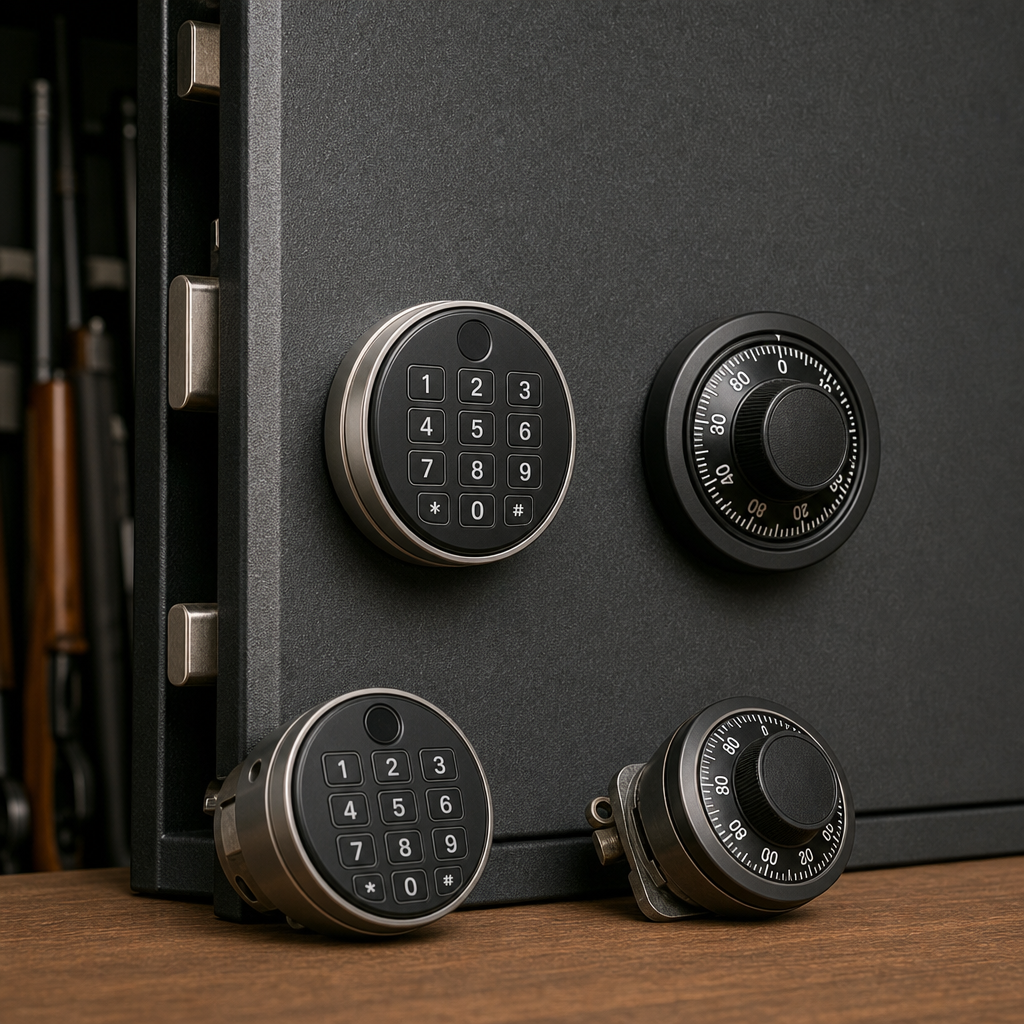
Upgrading your gun safe’s lock is one of the most practical custom and DIY gun safe modifications because it changes how quickly you can access firearms, how reliably the safe resists tampering, and how confidently you can manage long-term security. In the gun safes and safety category, a lock upgrade sits at the center of the broader modification conversation: owners rarely stop at replacing a dial or keypad. They usually evaluate boltwork alignment, door panel organization, dehumidification, anchoring, interior lighting, fire seal condition, and emergency access planning at the same time. That is why this article serves as a hub for custom and DIY gun safe modifications, with the lock decision as the anchor point. A mechanical lock uses physical components such as a dial, spindle, cam, wheel pack, and fence to retract a lock bolt. An electronic lock uses a keypad, circuit board, motor or solenoid, and battery power to release the mechanism after a valid code. Both can be secure, both can fail, and both have installation constraints that matter more than marketing claims.
I have worked on safe retrofits where the lock change looked simple on paper but exposed bigger issues: stripped mounting holes, relocker interference, sagging doors, dead keypads caused by battery corrosion, and mechanical dials mounted slightly off center that became frustrating to use. Those real-world details are why this topic matters. A poorly chosen upgrade can reduce reliability or void the safe’s warranty, while the right upgrade can improve access speed, usability for different household members, and serviceability over the life of the safe. For owners comparing electronic versus mechanical options, the correct answer depends on risk tolerance, usage frequency, environment, and willingness to perform maintenance.
Why lock upgrades are the core of custom and DIY gun safe modifications
A lock upgrade is the hub modification because every other change to a gun safe interacts with access control. If you add motion-activated lighting, a door organizer, rifle rods, handgun hangers, or humidity control, you are making the safe more useful only after it opens consistently. If you anchor a safe in concrete or build cabinetry around it, future lock servicing becomes harder, so the initial lock choice matters even more. In practice, most owners start searching for custom and DIY gun safe modifications when the factory lock becomes the weak point. Common complaints include slow dial entry under stress, a low-end keypad that misses presses, a lockout caused by a drained nine-volt battery, or simple dissatisfaction with a builder-grade lock on an otherwise solid safe body.
Upgrading also creates a natural inspection point. When the back cover of the door comes off, you can evaluate boltwork wear, relock device placement, linkage adjustment, insulation shedding, and internal clearance for accessories. On several retrofit jobs, I found that the lock itself was not the only issue. One safe had a sticky electronic lock, but the real problem was a misaligned handle cam that loaded the boltwork and made opening inconsistent. Another had a mechanical dial blamed for “slipping,” when in reality the spindle set screw had loosened. Looking at the entire system is what separates a useful modification from a cosmetic one.
Electronic gun safe locks: strengths, limitations, and best use cases
Electronic gun safe locks are popular because they are fast, intuitive, and easy for multiple authorized users to operate. On a practical level, they usually offer quicker entry than a traditional three-wheel combination dial. For defensive access, that speed matters. Many modern electronic safe locks allow one-touch wake-up, six-digit combinations, silent entry modes, penalty lockouts after repeated bad attempts, and battery access from the exterior keypad. Reputable names in this segment include SecuRam, Sargent and Greenleaf, AMSEC, and La Gard. Some models are UL Type 1 listed, which is the baseline many owners should look for when choosing a replacement lock rather than a generic keypad sourced only on price.
The advantages are straightforward. First, code changes are easier, so owners are more likely to update combinations after a move, household change, contractor visit, or suspected exposure. Second, accessibility is better for users who struggle with fine dial manipulation, low light, or arthritis. Third, temporary user management is possible on some systems, which is useful if a spouse, business partner, or estate executor needs controlled access. In homes where the safe is opened daily, electronic locks reduce friction enough that owners actually secure firearms consistently instead of leaving the safe cracked open out of convenience.
The limitations are just as real. Electronic locks depend on batteries, keypad durability, and circuit integrity. Cheap units fail more often from worn membrane buttons, battery contact corrosion, ribbon cable damage, or weak solenoids. They can also be less forgiving of poor installation. Pinched cables, overtightened keypad screws, and incorrect cable routing near moving boltwork create intermittent faults that are difficult to diagnose. Heat and humidity are additional concerns. In garages, workshops, and unconditioned spaces, battery life can drop and condensation can damage contacts. Electronic locks are excellent for frequent access, but they demand disciplined maintenance and quality parts.
Mechanical gun safe locks: strengths, limitations, and who should choose them
Mechanical locks remain the benchmark for long-term durability and independence from batteries. A quality Group 2 or better mechanical lock from Sargent and Greenleaf, La Gard, or AMSEC can operate for decades with minimal intervention if it is properly mounted and not abused. The classic design uses a dial connected through a spindle to a wheel pack. When the correct sequence aligns the wheel gates, the fence drops and the bolt can retract. That sounds old-fashioned, but the design has enduring value because it is predictable, repairable, and well understood by professional safe technicians.
The best reason to choose a mechanical lock is reliability over time in variable environments. Owners with safes in cabins, hunting properties, detached shops, or low-maintenance storage rooms often prefer mechanical options because there is no battery to monitor and no keypad electronics to degrade. Mechanical locks also appeal to users who open the safe less often and prioritize simplicity over speed. In my experience, a well-installed dial lock tolerates long dormant periods better than a bargain electronic unit. When the safe might sit untouched for months, mechanical designs often age more gracefully.
The tradeoff is access speed and user error. Mechanical locks require accurate dialing, and many access complaints are not failures at all; they are dialing mistakes caused by rushing, poor dial indexing, or incomplete handle pressure release before entering the combination. Under stress, this matters. Family members who rarely practice with a dial can struggle badly. Mechanical locks also take longer to change unless they are key-change designs, and some owners never update combinations because the process feels intimidating. If defensive access in seconds is your priority, a traditional dial may feel too slow unless you train regularly.
Electronic vs. mechanical: direct comparison for DIY lock upgrades
When owners ask which lock is better, the honest answer is that the safer choice depends on how the gun safe is used. Electronic locks are usually better for high-frequency access, shared use, and quick code changes. Mechanical locks are usually better for low-frequency access, environmental resilience, and long service life with less routine attention. The important distinction is not only convenience versus durability. It is also the owner’s maintenance behavior. People who reliably replace batteries on schedule and test codes monthly do well with electronic locks. People who prefer systems they can ignore for long periods tend to do better with mechanical locks.
| Factor | Electronic Lock | Mechanical Lock |
|---|---|---|
| Access speed | Fast, usually seconds | Slower, requires precise dialing |
| Code changes | Easy on most models | Moderate; varies by design |
| Power needs | Battery dependent | No battery required |
| Long-term maintenance | Battery checks and keypad inspection | Occasional service, little routine upkeep |
| Environmental tolerance | Good with quality units, but electronics are sensitive | Generally stronger in harsh storage conditions |
| Best fit | Frequent access, multiple users | Infrequent access, maximum simplicity |
For a DIY retrofit, compatibility matters as much as preference. Many residential gun safes use a standard lock footprint, often the industry two-hole mounting pattern for swing-bolt or dead-bolt locks, but not all doors have the same internal clearance. Before ordering, confirm bolt direction, spindle hole placement, keypad ring diameter, and interference with relockers or hardplate. If the safe has warranty coverage, verify whether owner-installed lock replacement voids it. Several manufacturers require authorized service for lock changes, especially on fire-lined doors where trim removal can damage seals or upholstery panels.
How to plan a lock upgrade without creating new safety problems
A careful lock upgrade begins with identification, not shopping. Record the safe brand, model, door thickness, current lock model, lock bolt type, and any relock devices visible behind the interior panel. Photograph cable routing, mounting screw locations, and linkage orientation before touching anything. Then decide whether the project is a true DIY job. Replacing a standard electronic lock with another standard electronic lock can be straightforward on some safes. Converting from electronic to mechanical, or vice versa, often requires more precision because spindle length, dial ring placement, and lock handing must be correct.
The main safety rule is simple: never close and lock the door with a new lock until you have tested it repeatedly while the door is open. I usually recommend at least ten complete open-close cycles with the bolts extended and retracted, plus repeated code or combination verification. That catches cable interference, mounting misalignment, and bolt pressure issues before they become a lockout. Use fresh branded batteries in electronic locks, not loose bargain cells. For mechanical locks, verify dial index accuracy and smooth contact points. If anything binds, stop and correct it. Forcing safe components is how minor retrofit mistakes turn into expensive drilling jobs.
This planning stage is also when broader custom and DIY gun safe modifications make sense. Add LED lighting while the panel is off. Replace adhesive door holsters with a proper organizer. Install a goldenrod or desiccant system to protect finishes. Check anchor bolts and shim the safe if the door swings on its own, because an out-of-level body changes how the boltwork feels. These linked upgrades improve the whole system rather than just the lock face.
Common mistakes, service realities, and when to call a safe technician
The most common DIY mistake is treating all safe locks as interchangeable. They are not. A lock may fit the mounting pattern and still fail because the bolt throw is wrong, the cable path crosses moving linkage, or the keypad base collides with decorative trim. Another frequent mistake is buying an unlisted generic electronic lock online with no meaningful support, no documented certification, and inconsistent quality control. Saving a small amount on the front end is not worth the risk of a lockout on a safe holding defensive firearms, documents, optics, and serialized equipment.
Owners also underestimate service realities. Mechanical locks can drift out of tolerance if the dial ring loosens or the safe door takes a hard hit during a move. Electronic locks can appear dead when the issue is actually handle pressure binding the lock bolt. A technician brings more than installation skill; they understand diagnostics, drill-point maps, relock behavior, and post-opening repair standards. If your safe has a glass relocker, custom hardplate, or unknown internals, professional service is the prudent path. The same applies if the safe stores NFA items, estate documents, or irreplaceable family records where a lockout carries larger consequences.
The most reliable upgrade strategy is to choose a quality lock matched to your access pattern, install it carefully, test it thoroughly, and treat the lock as one part of a complete gun safe system. If you open your safe often and want simple user management, a well-made electronic lock is usually the right answer. If you value battery-free operation and long-interval dependability, a mechanical lock remains hard to beat. From there, build out the rest of your custom and DIY gun safe modifications thoughtfully: organization, moisture control, anchoring, lighting, and periodic inspection all contribute to real security. Review your safe’s current setup, identify the weak point, and make your next upgrade with a full-system mindset.
Frequently Asked Questions
1. Is an electronic lock or a mechanical lock better for a gun safe upgrade?
Neither option is universally “better” for every gun safe owner, because the right choice depends on how you prioritize speed, simplicity, maintenance, and long-term use. Electronic locks are popular because they offer fast access, easy code changes, and straightforward day-to-day operation. If you need quick entry for defensive firearms, an electronic keypad is often the more convenient upgrade. Many owners also prefer the ability to set and change combinations without dealing with the slower process of dialing a mechanical lock. In a household where access needs may change over time, that flexibility can be a major advantage.
Mechanical locks, on the other hand, are valued for their durability, battery-free operation, and proven track record over decades of use. A quality mechanical dial lock has fewer electronic components that can fail, which appeals to owners who prioritize long-term reliability over convenience. If your safe is used mainly for secure storage rather than rapid access, a mechanical lock can be an excellent fit. It is also a strong option for owners who want to avoid concerns about dead batteries, keypad wear, or electronic component failure.
From a security standpoint, both lock types can provide strong protection when they are high-quality models installed correctly on a well-built safe. The lock itself is only one part of the overall system. Boltwork alignment, relocker function, door fitment, hardplate protection, and proper installation all influence how secure the safe remains after the upgrade. In practical terms, the best decision comes down to your use case: choose electronic if fast access and simple code management matter most, and choose mechanical if you prefer a traditional, low-maintenance system with a long service life.
2. Does upgrading a gun safe lock actually improve security, or is it mostly about convenience?
A lock upgrade can improve both security and convenience, but the outcome depends on what you are replacing and how the upgrade is handled. If your safe currently has an aging, inconsistent, or builder-grade lock, upgrading to a better electronic or mechanical model can absolutely improve resistance to manipulation, increase reliability, and reduce the chance of lockout due to wear or failure. Many older safes and entry-level models come with locks that function adequately but are not ideal for long-term heavy use. Replacing them with a reputable lock from a trusted manufacturer can make the safe more dependable and easier to use every day.
That said, convenience is often the first reason owners consider the upgrade. An electronic lock can dramatically reduce access time, especially compared with a traditional dial. That speed matters if the safe stores firearms intended for emergency access. A mechanical lock can also improve confidence if the original electronic keypad has become unreliable or if the owner wants a simpler system with fewer failure points. In that sense, security and convenience are closely tied together: a lock that works consistently and suits your routine is one you are more likely to use properly.
It is also important to understand the limits of a lock upgrade. A better lock does not turn a lightly built safe into a high-security vault. If the body steel is thin, the door has poor reinforcement, or the boltwork is misaligned, the lock alone will not solve those broader weaknesses. That is why lock replacement is often part of a larger modification plan that includes checking door seal compression, verifying bolt travel, improving interior organization, and addressing moisture control with dehumidification. The most effective upgrades treat the safe as a complete system rather than focusing only on the keypad or dial.
3. Can I replace my gun safe lock myself, or should I hire a professional locksmith?
Some gun safe owners can handle a lock replacement as a DIY project, but whether that is a good idea depends on the safe’s design, the replacement lock, and your comfort level working with security hardware. In simple cases, especially when replacing one standard lock footprint with another compatible model, the process may look straightforward. However, gun safe lock upgrades are more precise than they appear. The lock body, spindle or keypad assembly, mounting pattern, relocker interface, and boltwork engagement all need to be correct. A small installation error can lead to unreliable operation, incomplete bolt retraction, accidental lockout, or damage to the door mechanism.
Hiring a qualified safe technician or locksmith is often the smarter route, especially for higher-value safes or primary defensive storage. A professional can confirm compatibility, inspect the internal mechanism, align the lock properly, and test repeated openings before the safe is returned to service. This is especially important when upgrading from one lock type to another, such as switching from mechanical to electronic. Even if the mounting holes line up, the internal clearances, cable routing, and relocker positioning may require adjustment. Professional installation also helps preserve manufacturer warranty coverage in cases where unauthorized modifications could create problems later.
If you do pursue a DIY installation, the most important rule is to work slowly and test everything with the safe door open before closing and locking it. Verify combination entry multiple times, confirm that the boltwork moves smoothly, and ensure the lock consistently opens and secures the safe without hesitation. This is also a good time to inspect related components such as handle movement, door panel clearance, shelf interference, and interior accessory placement. Lock upgrades often reveal small issues elsewhere in the safe, and catching them early is far better than discovering them after the door is shut.
4. Are electronic gun safe locks reliable enough for long-term use, especially compared with mechanical dials?
Modern electronic gun safe locks can be very reliable for long-term use, but their reliability depends heavily on quality, installation, and maintenance habits. A well-made electronic lock from a respected manufacturer is not just a convenience feature; it is a serious security component designed for repeated use. Many electronic locks perform very well over years of service, especially when paired with fresh batteries, correct installation, and protection from moisture and physical abuse. For owners who access the safe regularly, electronic locks can actually reduce user error because entering a code is often simpler and more consistent than dialing an exact combination sequence.
Mechanical locks still hold an advantage in perceived long-term simplicity because they do not rely on batteries, circuits, or keypads. That makes them especially appealing in low-maintenance storage environments, long-term backup safes, or situations where the owner wants the most traditional and self-contained locking method possible. A quality mechanical dial can last for decades with very little attention beyond occasional inspection and proper use. For many owners, that old-school dependability is the biggest selling point.
In real-world ownership, the question is less about whether electronic locks are inherently unreliable and more about whether the owner is willing to manage them properly. Battery replacement should be proactive rather than reactive, and the keypad should be kept clean and protected from impact. Safe placement also matters. In humid environments, dehumidification and climate control help protect the safe’s contents and can also support the longevity of lock components. If you want rapid access and are willing to stay ahead of basic maintenance, an electronic lock is a strong long-term option. If you want maximum simplicity and minimal dependency on power, a mechanical lock remains one of the most trusted upgrades available.
5. What should I consider before upgrading my gun safe lock as part of a broader safe modification plan?
Before upgrading your gun safe lock, start by identifying what problem you are actually trying to solve. Some owners want faster access, others want greater confidence in reliability, and others are responding to a failing lock or an outdated mechanism. Defining that goal helps determine whether an electronic or mechanical option makes more sense and whether a lock upgrade alone will address the issue. For example, if the real frustration is awkward access to stored firearms, interior door panel organization and shelf layout may matter almost as much as the lock itself. If the concern is long-term storage conditions, dehumidification and seal performance should be reviewed alongside the lock upgrade.
You should also assess the safe’s current hardware and construction. Not every safe is equally suitable for every type of lock conversion. Confirm compatibility with the door’s mounting pattern, boltwork arrangement, and relocker system. Evaluate whether the handle and locking bolts move smoothly, whether the door closes squarely, and whether there is any binding that might place extra stress on the new lock. This is especially important because owners often discover that what seemed like a lock problem was partly caused by poor boltwork alignment or door fitment. Upgrading the lock without correcting those issues may not deliver the reliability improvement you expect.
Finally, think about how the upgrade fits into the safe’s overall role in your security plan. A gun safe is not just a lockbox; it is part of a broader firearm storage system that may include anchored placement, controlled humidity, organized access to long guns and handguns, and periodic inspection of moving parts. If you are already opening the door panel to work on the lock, it is the ideal time to inspect interior layouts, refresh lighting, check for rust risk, and verify that all hardware is functioning properly. The best gun safe modifications work together, and a lock upgrade is often most valuable when it is treated as the centerpiece of a complete, well-planned improvement strategy.