
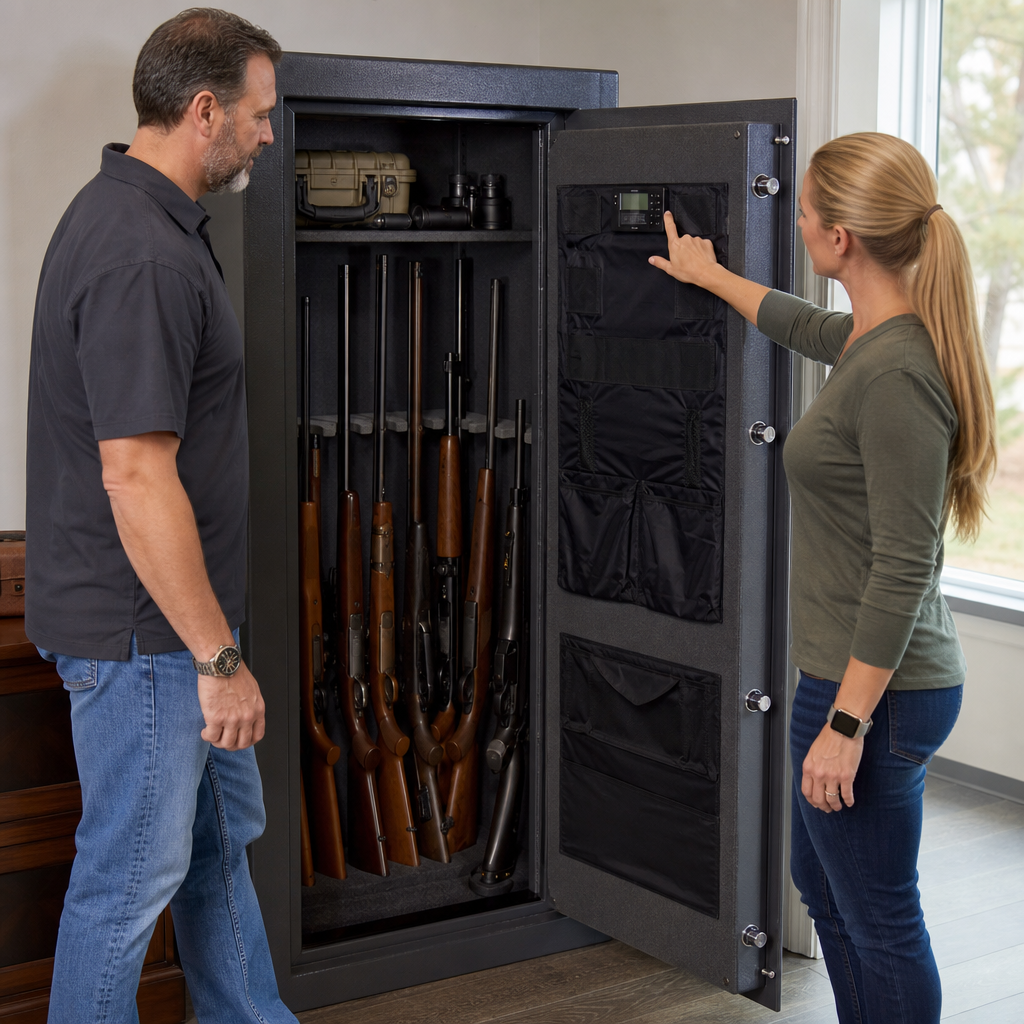
Choosing the best gun safes that feature multi-user access for shared security starts with a practical question: how do two or more authorized people gain fast, reliable entry without weakening control? In shared homes, family properties, ranches, hunting camps, firearms businesses, and training facilities, a single-owner locking model often creates friction. One person has the key, one person knows the combination, and everyone else either waits or creates unsafe workarounds. Multi-user access solves that by allowing distinct credentials for multiple authorized users while preserving auditability, secure storage, and controlled permissions.
In this buying guide hub, multi-user access means a safe can store more than one valid code, fingerprint, credential, or managed user profile. Shared security means access is distributed intentionally, with clear rules for who can open the safe, when, and under what conditions. The best gun safes in this category balance burglary resistance, fire protection, lock reliability, interior capacity, and user management. They also reduce common household failures I have seen repeatedly: backup keys left unsecured, master codes shared too widely, batteries ignored until lockout, and biometric readers enrolled poorly. If you are comparing options for a primary household safe, a secondary quick-access model, or a commercial-grade cabinet with logged access, the buying decision should start with risk, user count, and retrieval speed.
This topic matters because firearm storage is no longer a one-user purchase. Many buyers need shared access between spouses, adult family members, business partners, range officers, or designated emergency users. At the same time, the stakes are high. The right safe must deter theft, prevent unauthorized access by children or visitors, support safe gun storage practices, and still allow dependable entry under stress. As the hub for gun safe buying guides, this article explains what multi-user access really includes, which features matter most, where smart and traditional systems differ, and how to choose a model that fits both your firearms and your access policy.
What Multi-User Access Actually Means in a Gun Safe
Not every electronic or biometric safe truly supports multi-user access. Many products advertise keypad entry but only allow one active code plus a backup override key. That is not the same as a genuine multi-user platform. A true multi-user gun safe usually supports multiple PINs, multiple enrolled fingerprints, administrator and standard-user roles, or app-based credential assignment. On higher-end models, especially those using commercial-style locks from brands such as Sargent and Greenleaf, SecuRam, or La Gard, administrators can add and delete users without resetting the entire lock. That matters when access changes after an employee leaves, a family arrangement changes, or a credential may have been exposed.
In practice, there are four common forms of shared access. First is the multi-code keypad, where each user receives a unique PIN. Second is biometrics, where several authorized fingerprints are stored. Third is RFID or token-based access, more common in specialty storage than full-size long-gun safes. Fourth is app-connected credential management, where administrators issue, revoke, or monitor access through a secure mobile system. Each has strengths and weaknesses. Multi-code systems are straightforward and durable. Biometrics are fast but depend heavily on sensor quality and proper finger enrollment. App-managed systems can be excellent for accountability, but they introduce dependency on software support, cybersecurity practices, and power management.
The practical buying lesson is simple: ask how many users the lock supports, whether user roles are separate, whether credentials can be deleted individually, and whether there is an access log. If a product page does not answer those questions, it is not a true multi-user buying guide candidate. For shared security, granularity matters more than marketing language.
Core Buying Criteria: Security, Fire Protection, Access Control, and Capacity
The best gun safe is never just about the lock. I evaluate shared-access models using four pillars: physical security, fire resistance, access architecture, and usable storage. Physical security starts with steel thickness, door construction, hardplate protecting the lock, relockers, internal hinges or protected external hinges, and anchor capability. A safe with multi-user access but thin steel and poor boltwork is simply an organized weak point. For residential gun safes, body steel often ranges from 14 gauge on entry-level models to 10 gauge, 7 gauge, or thicker on premium units. Heavier steel generally improves pry resistance, though total design matters as much as gauge alone.
Fire protection should be read carefully. Manufacturers often advertise 30-, 60-, 90-, or 120-minute ratings at temperatures such as 1,200 or 1,400 degrees Fahrenheit, but test methods vary widely. Independent verification is stronger than internal marketing claims. For many buyers, fire lining protects documents and optics as much as firearms, but it also affects interior dimensions and weight. If your shared household safe stores passports, suppressor paperwork where lawful, or irreplaceable records, interior heat and humidity management deserve attention alongside theft resistance.
Access control is where this buying guide becomes specific. Good shared-access safes let one administrator maintain ownership while assigning limited access to others. Better systems allow temporary users, duress features, lockout after repeated failed entries, and event logs. Capacity is the final filter. Real-world capacity is usually lower than the advertised gun count, especially with optics, slings, bipods, pistol racks, and document shelves. Buyers who need space for twelve scoped rifles should not shop a nominal twelve-gun cabinet; they should look at eighteen- to twenty-four-gun interiors with configurable shelving. Shared use increases clutter, so extra space is not a luxury. It is part of safe operation.
Comparing Lock Types for Shared Security
Different lock technologies change how multi-user access works day to day. Mechanical dial locks remain reliable and long-lived, but they are poor fits for shared access because changing users means changing and redistributing one combination. Electronic keypad locks are the most balanced option for most buyers. They can support multiple users, code changes are straightforward, and quality locks from established manufacturers have predictable service support. Biometric locks deliver the fastest entry when users are enrolled properly, but inexpensive readers often fail under dry skin, dirty fingers, or poor angle placement. Smart locks with app control can be excellent for administration and monitoring, though only when implemented by a reputable manufacturer with secure firmware practices.
| Lock type | Best use case | Advantages | Limitations |
|---|---|---|---|
| Mechanical dial | Single-owner long-term storage | No batteries, proven longevity | Poor shared management, slower access |
| Electronic keypad | Most shared households | Multiple codes, easy changes, fast entry | Battery maintenance required |
| Biometric | Fast defensive access for several users | Quick entry, no code sharing | Sensor quality varies, enrollment matters |
| App-connected smart lock | Users needing logs and remote administration | Credential control, notifications, audit trail | Software dependence, higher complexity |
My recommendation for most families is a UL-listed electronic lock or a premium biometric-plus-keypad system from a recognized safe manufacturer. For businesses, lodges, and training operations, user-level management and event logging move from convenient to essential. In those environments, speed matters less than accountability.
Best Use Cases: Homes, Ranches, Businesses, and Shared Retreats
Multi-user access is not one scenario. In a household, the common requirement is two adults who need lawful access without sharing a single code indefinitely. A spouse may need emergency access, while the primary owner still wants code rotation and a separate administrator function. In that case, a full-size long-gun safe with dual credential support and interior handgun organization is usually the best answer. A bedside biometric safe may complement it, but it should not replace primary storage.
On ranches and rural properties, the pattern changes. Firearms may be used for predator control, pest management, or seasonal hunting access by several authorized adults. Here, dust resistance, battery discipline, and heavier construction matter because safes are often installed in utility rooms, shops, or outbuildings. I strongly favor anchored, higher-mass units with keypad access over bargain biometric products in these environments. Dirt and temperature swings expose weak electronics quickly.
For firearm retailers, instructors, and range operations, shared security is an accountability issue first and a convenience issue second. The safe should support individual user assignment, credential revocation, and preferably logged openings. That is where commercial lock platforms outperform generic consumer electronics. If multiple staff members access inventory or rental firearms, the safe should fit into a written access policy just like alarm codes and key control.
Vacation properties and hunting cabins create another risk profile. Multiple authorized users may visit intermittently, but long periods pass with no one on site. In that setting, remote alerts, tamper notifications, humidity control, and revocable temporary codes are especially valuable. If connectivity is unreliable, prioritize a standalone lock with dependable local credential management over a cloud-first system that becomes awkward offline.
Brands, Build Quality, and Features Worth Paying For
When buyers search for the best gun safes that feature multi-user access for shared security, they often compare brand names before they compare construction. That is backwards. Start with steel, lock pedigree, boltwork, and warranty support, then evaluate branding. Established residential manufacturers such as Fort Knox, Liberty Safe, Browning, Rhino Metals under the Ironworks and Kodiak lines, Winchester, Sports Afield, and Cannon offer various electronic and biometric options, though not every model in every line supports true multi-user administration. Vaultek stands out in the handgun and modular accessory space for app-based control and activity logs, while Hornady RAPiD products are better suited to quick-access secondary storage than primary long-gun capacity.
Features worth paying for include a lock from a recognized supplier, an internal power option or accessible external battery contact, independent relockers, anchor hardware, door organization, LED lighting, dehumidifier pass-throughs, and an interior layout that can adapt as your collection changes. Features that are often overvalued include inflated gun-capacity claims, decorative door panels, and app features without meaningful lock management. A phone notification is useful; a robust local lock that still works flawlessly after years of use is more useful.
I also look closely at serviceability. Can the lock be replaced by a qualified technician? Does the manufacturer provide clear override procedures? Is customer support domestic and reachable? Shared security increases the consequences of lock failure because several people may depend on access continuity. A safe is not a disposable gadget. Buy as if you may own it for twenty years.
Installation, Access Policies, and Common Buyer Mistakes
Even the best gun safe performs poorly if it is installed badly or managed casually. First, anchor it. A 700-pound safe is still vulnerable if thieves can tip it, attack its weaker surfaces, or remove it with equipment. Concrete anchoring is ideal; serious wood-floor installations require structural planning. Place the safe where the door can open fully, humidity can be managed, and sight lines from windows or public-facing areas are limited. Avoid garages unless climate and corrosion are addressed intentionally.
Second, create an access policy. In family settings, decide who gets administrator status, how often codes change, what happens after guests stay in the home, and where backup credentials are stored. In business settings, document user assignment, credential revocation, battery replacement intervals, and opening procedures. Most failures I see are not caused by sophisticated attacks. They come from master codes shared too broadly, fingerprints never re-enrolled after setup, dead batteries, and override keys hidden in obvious places like desk drawers near the safe.
Third, test the system the way it will actually be used. Enroll multiple fingers per authorized person. Practice opening in low light. Confirm that all users can access long guns without snagging optics or slings. Verify that fire lining does not crush your real storage plan. Use a hygrometer and dehumidifier if the environment demands it. Shared security is operational, not theoretical. A buying guide should end in routines that work under normal days and stressful ones.
The best gun safes that feature multi-user access for shared security are the models that combine strong physical protection with disciplined credential management. For most homes, that means a full-size anchored safe with a high-quality electronic keypad lock, enough interior space for actual rather than advertised capacity, and a fire rating you can evaluate critically. For fast-access needs, premium biometric systems can work well, but only when backed by dependable construction and proper enrollment. For businesses and high-accountability environments, user roles and access logs are not optional features; they are the reason to buy a multi-user system in the first place.
As the hub for gun safe buying guides, the central takeaway is simple: buy for the way access is shared, not just for the way the safe looks on a spec sheet. Count users, define roles, verify lock capabilities, and match the safe to your risk environment. Prioritize steel, lock quality, anchoring, and service support before cosmetic extras. If you do that, you will end up with a safe that protects firearms, supports responsible ownership, and reduces the failure points that appear when several authorized people rely on one storage system.
Your next step is practical. List your user count, firearm count, preferred lock type, installation location, and required fire rating, then compare models against those criteria before you shop by price alone. That approach leads to a better gun safe and safer shared access over the long term.
Frequently Asked Questions
What does multi-user access mean in a gun safe, and why is it useful for shared security?
Multi-user access means a gun safe can be configured for more than one authorized person to open it without relying on a single shared key or one universal code. Depending on the model, that can include multiple keypad PINs, several fingerprints, app-based permissions, RFID credentials, mechanical override access, or administrator and secondary-user profiles. The main advantage is simple: more than one trusted person can get fast access when needed, while the safe still maintains a clear structure for control and accountability.
That matters in real-world settings where firearms are used and stored by more than one responsible adult. In a shared home, one spouse may need access when the other is away. At a ranch, hunting camp, or family property, different users may need scheduled or practical access to long guns, handguns, or gear. In a business, range, or training environment, managers may need to grant access to selected staff without handing out one combination to everyone. A single-user safe often leads to friction, delays, and poor habits, such as leaving the safe open, hiding a backup key nearby, or sharing one code too broadly. Multi-user access is designed to reduce those problems.
The best systems do more than allow multiple entries. They help separate convenience from control. Some safes let one administrator enroll and remove users, assign temporary codes, or track access events. That is especially valuable when personnel changes, guests come and go, or a user should only have access for a limited time. In short, multi-user access is useful because it makes shared firearm storage more practical without abandoning the security structure that a safe is supposed to provide.
Which types of locking systems are best for a multi-user gun safe?
The best locking system depends on the environment, the number of users, and how much oversight you want. Electronic keypad locks are often the most common choice for multi-user access because they can support multiple PINs, allow quick code changes, and generally make user management straightforward. For families or small teams, a quality electronic lock can strike an excellent balance between speed, reliability, and flexibility. The key is to choose a well-built lock from a reputable manufacturer rather than treating all electronic locks as equal.
Biometric locks can also work very well, particularly when fast access matters. A biometric safe may store multiple fingerprints, allowing several authorized users to open the door without memorizing a code. That can be a strong option in shared homes or defensive-use scenarios. However, biometric performance depends heavily on sensor quality, enrollment accuracy, and environmental conditions. Dirty fingers, worn fingerprints, cold weather, and poor scanner design can reduce reliability. For that reason, the strongest biometric multi-user safes usually also include a keypad or override method rather than relying on fingerprint access alone.
Smart-enabled safes with app-based management are becoming more attractive for advanced users. These may offer remote notifications, audit trails, temporary credentials, and administrator controls. In commercial or semi-commercial settings, those features can be very useful. Still, buyers should evaluate cybersecurity, firmware support, and whether the safe remains fully functional if wireless features are disabled. Mechanical dial locks remain respected for long-term durability, but they are generally less convenient for true multi-user management because changing combinations is slower and assigning separate user credentials is limited. For most people seeking shared security, a high-quality electronic or hybrid biometric-electronic system is usually the most practical choice.
How can you give multiple people access to a gun safe without losing control over who gets in?
The most effective approach is to choose a safe with layered permissions and then use those features intentionally. A good multi-user gun safe should allow one person to act as the administrator. That person can enroll users, delete access credentials, reset codes, and manage backup methods. Instead of giving every user the same code, each authorized person should have a unique credential whenever possible. That could mean individual PINs, separate fingerprints, individual RFID tags, or named app accounts. Unique credentials improve accountability and make it easier to revoke access for one person without disrupting everyone else.
It is also smart to match access levels to actual responsibility. Not every user needs the same privileges. In a household, two adults may have full access while older teenagers may have none, depending on laws, maturity, and family policy. In a business or training facility, a manager may control administration while staff receive operational access only during working hours. Some advanced safes support time-based permissions, access logs, or temporary credentials for limited use cases. Those features help maintain control while still avoiding the bottleneck of one owner controlling every entry.
Physical security habits matter just as much as digital permissions. Keep backup keys secured separately, not hidden near the safe. Update or remove credentials immediately when a user moves out, changes roles, or should no longer have access. Place the safe in a location that reduces observation of code entry, and anchor it properly so the focus stays on controlled access, not just lock convenience. Multi-user access does not mean relaxed oversight. It works best when convenience is combined with clear rules, credential separation, and regular review of who should still be authorized.
Are multi-user gun safes as secure and reliable as traditional single-user models?
They can be, provided you buy a well-made safe and evaluate the entire design rather than just the headline feature. Multi-user access by itself does not make a safe weaker. Security depends on construction quality, lock integrity, bolt design, pry resistance, body and door thickness, hinge protection, anchoring capability, fire protection, and the quality of the access-control system. A poorly built safe with advanced user features is still a poor safe. On the other hand, a robust model from a trusted brand can offer strong physical security and well-managed multi-user access at the same time.
Reliability comes down to engineering and redundancy. Electronic and biometric locks sometimes make buyers nervous, but many modern systems are dependable when properly maintained. The better models include low-battery warnings, external power support, backup entry options, and stable programming interfaces. Reliability also improves when users follow basic maintenance practices such as replacing batteries on schedule, keeping sensors clean, testing credentials periodically, and confirming that all enrolled users can open the safe before they actually need to. A traditional mechanical dial is still valued for simplicity, but it is not automatically the better choice if multiple people need quick, frequent, controlled access.
The better question is not whether multi-user safes are inherently secure, but whether the specific safe is designed for your use case. If several authorized people need regular access, forcing everyone through a single-user system can create unsafe behavior that undermines real-world security. In that sense, a strong multi-user safe may be safer in practice because it supports how the safe will actually be used. When evaluating options, focus on build quality, lock reputation, emergency backup features, and how well the access system fits the number and type of users involved.
What should you look for when choosing the best gun safe with multi-user access for a home, ranch, or business?
Start with the access structure. Ask how many users the safe supports, whether each user can have a unique credential, and whether one administrator can manage permissions. If shared security is the goal, those are foundational features. After that, consider how quickly authorized users need to get in. A bedside handgun safe may prioritize rapid biometric or keypad access, while a larger long-gun safe for a ranch or business may prioritize multiple PINs, audit trails, and broader internal storage. The right answer depends on whether the safe is primarily for emergency access, routine use, inventory control, or all three.
Next, evaluate physical protection. Multi-user convenience should never distract from the core job of a gun safe: resisting theft and unauthorized access. Look at steel thickness, door construction, locking bolts, anti-pry features, hard plate protection, relockers, internal hinges versus reinforced external hinges, and whether the safe can be securely anchored. If fire resistance matters, review the fire rating carefully and understand who tested it and under what conditions. Interior layout also matters in shared settings. Adjustable shelving, separate compartments, door organizers, and handgun racks can make it easier for multiple users to access what they need without creating disorder.
Finally, pay attention to long-term management and support. A strong multi-user safe should be easy to reprogram when household members change, employees leave, or access policies evolve. Look for dependable customer support, clear programming instructions, replacement part availability, and a solid warranty. If the safe includes smart features, review app quality, update support, and whether the safe still works well without network connectivity. The best choice is usually the model that combines durable construction, straightforward user management, and the right level of speed for the environment. In a shared-security setup, that balance is what turns a safe from a storage box into a dependable access-control tool.