
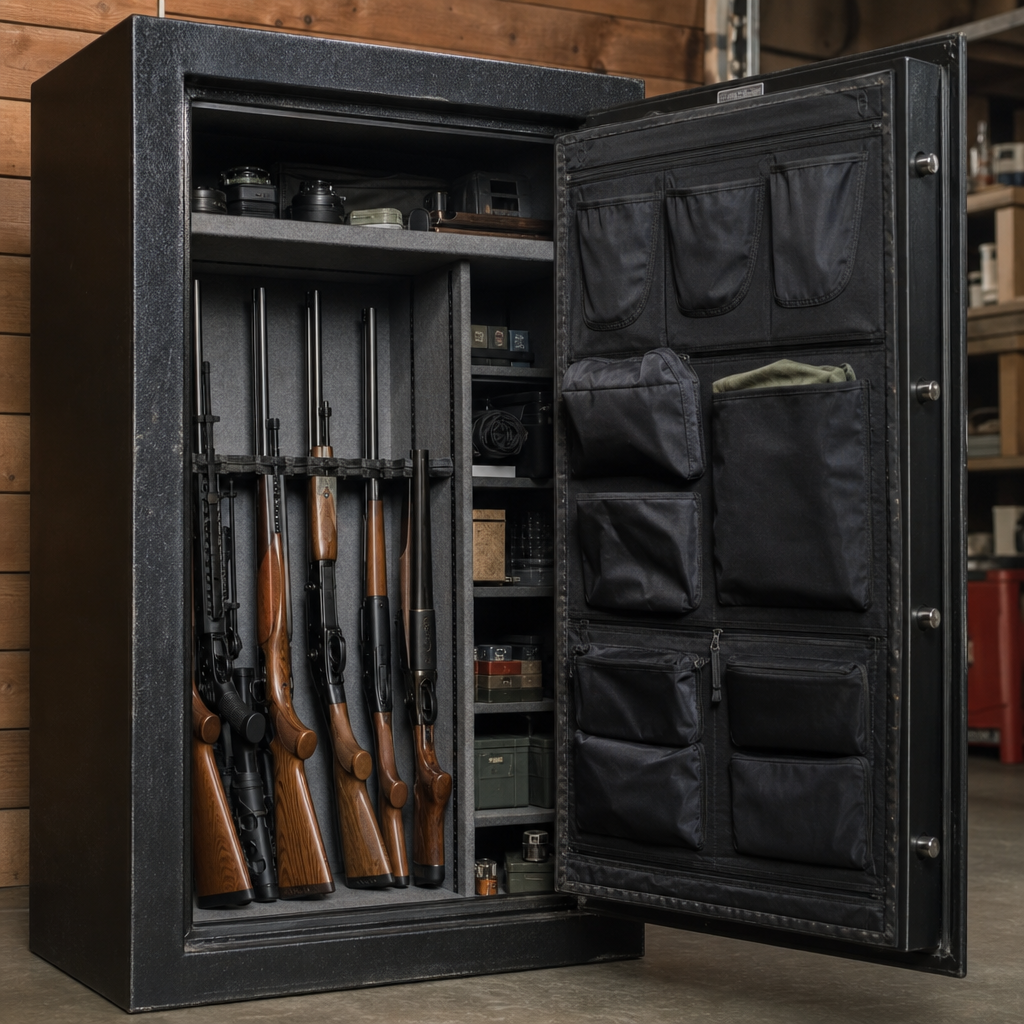
A gun safe’s fire rating is only useful if the fireproofing inside the safe still performs as designed, and many owners do not realize that heat exposure, moisture, age, poor installation, and damaged seals can quietly reduce that protection long before a house fire puts it to the test. When I inspect safes for owners after moves, remodels, garage flooding, or near-miss fire events, I usually find the same problem: people trust the label on the door but have never checked the materials and conditions that make that rating possible. Fireproofing in this context means the system of insulation, door seals, body construction, seams, and locking geometry that slows heat transfer and helps keep interior temperatures below the point where firearms, documents, optics, and ammunition components are damaged. Disaster-resistant storage goes one step further by considering smoke, humidity, water from sprinklers or fire hoses, impact during structural collapse, and corrosion after an emergency. This matters because firearms are expensive, legally sensitive, and often tied to irreplaceable records such as tax stamps, serial number logs, trust paperwork, and family documents. A safe that survived ten uneventful years in a climate-controlled room may perform very differently after being stored in a damp garage, bolted through an unsealed concrete slab, or exposed to repeated summer heat swings. Knowing how to check whether your gun safe’s fireproofing is still effective helps you decide whether simple maintenance is enough, whether a warranty claim is realistic, or whether replacement is the safer choice.
Understand what the fire rating actually means
The first step is reading the rating correctly. Most consumer gun safes advertise something like 30, 45, 60, 75, 90, or 120 minutes at a stated external temperature, often 1,200°F to 1,800°F. That number does not mean the safe is indestructible or that everything inside will be unharmed after that duration. It means the manufacturer claims the safe’s interior stayed below a target temperature under a specific test method. In document safes, the classic benchmark is keeping paper below about 350°F. For digital media safes, the limit is much lower. Firearms complicate the picture because wood stocks, scopes, lubricants, polymer parts, and ammunition packaging can be damaged at temperatures well below the point where steel receivers fail. I advise owners to get the original model documentation and identify three things: the duration, the external test temperature, and whether the rating came from an independent lab such as UL or from the manufacturer’s internal testing. An independent UL Class rating on a true record safe is different from a marketing claim on a residential gun safe. That does not automatically make the gun safe bad, but it tells you how cautious you should be when judging long-term reliability.
Inspect the insulation, door seal, and body for visible degradation
Once you understand the rating, inspect the components that create it. Many gun safes rely on layers of gypsum-based fireboard in the door and walls. Gypsum contains chemically bound water that slows heat transfer when heated, but that board can crack, sag, absorb moisture, or separate from mounting points over time. Start with the door panel if it is removable according to the manufacturer’s instructions. Look for crumbling board, loose fasteners, rust staining, warped interior panels, and a chalky residue that suggests repeated dampness. Then examine the door perimeter seal. Expanding intumescent seals are designed to swell under high heat and close gaps that would otherwise admit smoke and flame. If the seal is brittle, peeling, compressed flat, moldy, or partly detached at the corners, the safe may no longer close its heat path as intended. Check body seams, hinge areas, anchor holes, and any cable pass-through or dehumidifier opening. Every penetration is a possible route for heat and smoke. In my experience, the most overlooked failure points are drilled holes for aftermarket lighting or power cords and door liners that were removed and reinstalled poorly. Even a small gap matters because fire protection depends on the whole system, not just the insulation board thickness.
Check for environmental damage from humidity, flooding, and heat cycling
Fireproofing often deteriorates indirectly through environmental exposure rather than direct fire. Safes kept in garages, basements, shops, and vacation properties face wider humidity swings than owners expect. Moisture can wick into gypsum layers, corrode steel skins from the inside, weaken adhesives, and promote mildew around seals and interior fabric. Repeated heat cycling also stresses welds, door alignment, and composite layers. A safe in an unconditioned garage in Texas, Arizona, or Florida may see internal cavity temperatures high enough to age adhesives faster than a safe in a bedroom closet. Flooding is another major concern. Even shallow standing water can soak the bottom insulation, especially around anchor bolt holes. If your safe has ever sat in water, assume the lower fireboard and carpeting may be compromised until inspected. Look for rust blooming at the base, swelling beneath carpet, musty odor, salt-like mineral residue, and staining around bolt-down points. A simple hygrometer inside the safe can also reveal chronic moisture issues. If relative humidity repeatedly climbs above about 60 percent without a clear reason, suspect water intrusion, failed sealing, or inadequate room conditions. Fire resistance and corrosion control are linked; once interior moisture management fails, the safe is already moving away from its original protection standard.
Assess fit, alignment, and closing pressure
A fire-safe door must close squarely and consistently. If the body has shifted on an uneven floor, if anchor bolts are overtightened on an irregular slab, or if the safe was dropped during a move, the door gap can change enough to affect seal compression. Open and close the door several times. It should latch smoothly without scraping, rising, or sagging. Check the reveal around the perimeter; inconsistent spacing can indicate frame distortion. On safes with external hinges, remember that the hinge itself may not create the fire seal; the critical area is the door edge and frame contact inside the body. Place a thin strip of paper at several points around the perimeter and close the door gently according to the maker’s guidance. Uneven resistance when pulling the strip can suggest inconsistent seal contact. This is not a certified fire test, but it is a useful maintenance check. Also inspect locking bolts for full extension and retraction. A misadjusted mechanism can keep the door from seating fully. I have seen safes that looked fine from the front but had one top corner standing slightly proud because interior shelves were installed incorrectly and interfered with closure. In that condition, smoke and hot gases would exploit the gap quickly.
| Checkpoint | What to look for | Why it matters | Action |
|---|---|---|---|
| Fire seal | Cracks, peeling, flattening, mold, missing corners | Compromised smoke and heat expansion barrier | Replace with manufacturer-approved seal kit |
| Interior panels | Warping, looseness, chalking, stains, soft spots | Possible damaged or wet fireboard | Open panel only if approved; document and call maker |
| Door alignment | Uneven gaps, rubbing, latch resistance, sag | Poor seal compression and heat leakage | Re-level safe; schedule service if frame is distorted |
| Base and anchors | Rust, mineral deposits, wet carpet, unsealed holes | Water intrusion into lower insulation layers | Dry area, reseal penetrations, inspect for hidden damage |
| Past heat exposure | Paint discoloration, odor, hardened seal, warped trim | Near-fire event may have partially spent materials | Request factory evaluation or replacement guidance |
Verify the manufacturer, test standard, and serviceability
If you want a reliable answer, trace the safe back to its documentation. Find the model number, serial number, purchase date, and manual. Then confirm what test standard was used and what replacement parts are available. Many owners are surprised to learn that some brands sell replacement door seals, interior panels, and reliner kits, while others treat the safe as non-serviceable once fire materials are disturbed. Contact the manufacturer directly and ask whether your specific model used gypsum board, poured composite insulation, or another barrier system, and whether they recommend any periodic inspection interval. Ask whether exposure to basement flooding, high humidity, or nearby heat voids the rating. Reputable manufacturers can usually explain how the rating was developed and what post-incident signs justify replacement. If the company cannot identify the test basis, cannot provide part numbers, and cannot tell you how to evaluate a soaked or heat-exposed unit, that uncertainty should factor into your risk decision. I also recommend checking whether the safe had a California DOJ listing, UL lock listing, or any recognized burglary or fire certification, because documented compliance usually correlates with better technical support. Serviceability matters. A safe with a worn seal that can be replaced correctly is far more trustworthy than one with hidden damage and no parts path.
Look for evidence of prior fire or near-fire exposure
A safe does not need to sit in open flame to suffer damage that reduces future performance. In house fires and garage fires, radiant heat, smoke acids, and rapid cooling from hose streams can degrade finishes and internal components even when the structure around the safe remains standing. If your safe was in a room adjacent to a fire, inspect the exterior paint for blistering, browning, or unusual dullness. Smell matters too; a persistent smoky or chemical odor after cleaning can indicate that smoke penetrated the door gap or vent points. Examine plastic trim, keypad bezels, interior organizer pockets, and adhesive-backed accessories. Deformation, brittleness, or glue failure often appears before structural damage becomes obvious. Pay attention to the seal after any heat event. Intumescent material may harden, swell unevenly, or separate from its channel after partial activation. In practice, once a safe has experienced significant heat, I treat the original fire rating as suspect unless the manufacturer specifically approves continued use after inspection. This is especially true for composite systems that rely on moisture content or bonded layers. Fire protection materials are not always reusable after thermal stress. A safe can still function mechanically as a theft deterrent while no longer offering the same level of thermal protection, and owners should not assume those two qualities rise and fall together.
Balance inspection findings with what you store inside
Effective evaluation depends on the contents, not just the safe. If you store only modern steel firearms for short periods and maintain detailed off-site records, your tolerance for uncertainty may be different from someone storing suppressor paperwork, antique wood-stocked rifles, hard drives, family passports, and insurance documents. Paper chars around 451°F, but practical document protection standards aim much lower because discoloration and brittleness happen earlier. Optics, batteries, lubricants, polymer frames, and wood finishes can degrade faster than bare steel. Ammunition stored in a safe during a fire usually presents less dramatic risk than movies suggest, but primers, powder, and packaging can still be damaged by heat and moisture and should be evaluated carefully after an incident. The best disaster-resistant storage strategy is layered. Keep the gun safe in the driest interior part of the home, use a monitored dehumidifier or desiccant system, elevate vulnerable items above the safe floor, and place critical legal documents in a listed document or media container inside the gun safe if compatible with space and access needs. For owners building a broader protection plan, this hub topic naturally connects to installation, humidity control, anchoring, and post-disaster recovery. The key principle is simple: the more sensitive the contents, the less acceptable an uncertain fire barrier becomes.
When maintenance is enough and when replacement is the smart move
Not every concern means you need a new safe. Routine maintenance is often sufficient when the problems are limited to a worn seal, surface rust, failed caulk around an anchor penetration, minor door adjustment, or interior moisture control. Use only manufacturer-approved replacement seals and follow door-panel removal procedures exactly, because drilling, trimming, or substituting materials can undermine the fire system. Replacement becomes the smarter choice when the safe has been submerged, exposed to meaningful heat, shows internal insulation collapse, has persistent mold or odor within wall cavities, cannot be aligned to seal evenly, or comes from a brand that cannot document its rating or support repairs. I tell owners to think in terms of replacement cost versus consequence. A mid-priced safe may cost far less than the value of a single precision rifle, a tax stamp collection, or the administrative burden of reconstructing serial number records after a loss. If you are unsure, document the condition with photos, humidity readings, and model information, then ask the manufacturer or a qualified safe technician for a written assessment. Checking your gun safe’s fireproofing is not paranoia; it is basic stewardship of firearms, records, and family property. Inspect the safe now, correct any weak points, and upgrade if the evidence shows your current protection can no longer be trusted.
Frequently Asked Questions
How can I tell if my gun safe’s fireproofing may no longer be effective?
The first thing to understand is that fire protection in a gun safe is not something you can verify just by looking at the fire rating sticker on the door. That label reflects how the safe performed when it was manufactured and tested, not necessarily how it performs today after years of use, changing temperatures, humidity, moving, or minor damage. In practical inspections, the most common warning signs are swollen or warped interior panels, rust inside the body, musty odors, visible water staining, cracked door seals, and areas where drywall-based fire lining appears soft, crumbling, or separated from the steel shell. If your safe has been in a garage, basement, outbuilding, or other damp environment, those signs matter even more because moisture can quietly degrade the fire-resistant materials over time.
You should also think about the safe’s history. If it has been exposed to a nearby fire, heavy smoke, flooding, roof leaks, garage humidity, or even a rough move where it was laid on its side or dropped, the internal fire barrier may have been compromised without obvious external damage. Many safes use layered gypsum board, fireboard, or insulation systems hidden behind fabric or interior paneling, so deterioration is often concealed. A good real-world check includes inspecting the door seal for cracks or compression loss, looking for gaps around panel edges, checking whether the door still closes evenly, and paying attention to any new corrosion or interior dampness. If you see multiple warning signs, it is reasonable to assume the fireproofing may not be performing as designed and to have the safe professionally evaluated.
Does moisture or flooding really reduce the fire resistance of a gun safe?
Yes, absolutely. Moisture is one of the most overlooked threats to a gun safe’s fire protection. Many residential gun safes rely on fire-resistant board materials that are designed to slow heat transfer, and in many cases those materials are vulnerable to water intrusion, repeated humidity cycles, or long-term damp storage conditions. When moisture gets into the insulation or fire lining, it can cause swelling, softening, separation, mold growth, fastener corrosion, and breakdown of adhesives that hold the internal layers in place. Even if the steel exterior still looks solid, the internal structure that provides the fire barrier may no longer be intact.
Flooding is even more serious. If a safe sat in standing water, was exposed to garage flooding, or developed hidden condensation for months, the fireproofing should be treated with caution until inspected. Water can wick upward into the lining, remain trapped behind interior upholstery, and damage door seals that are meant to expand or resist heat at critical temperatures. In some cases, the safe may continue to function as a secure storage container while offering significantly reduced fire performance. That is why after any flooding event, heavy moisture exposure, or persistent humidity problem, it is smart to inspect the interior thoroughly, dry the unit properly, replace compromised seals if possible, and consult the manufacturer or a qualified safe technician if you suspect the fire lining was saturated.
What parts of the safe should I inspect if I want to check its fireproofing condition?
Start with the door seal area, because it is one of the most important and accessible components. Look for intumescent seals or heat-activated gaskets that are cracked, brittle, loose, flattened, torn, or missing in sections. These seals help block heat and smoke from entering around the door gap during a fire, so damage here matters. Next, inspect the door alignment and closure. If the door sags, binds, or no longer seals evenly, the fire barrier around the opening may not perform correctly under heat. Also check the frame for dents, impact damage, or signs that the safe body has twisted slightly after a move or installation on an uneven surface.
Inside the safe, remove shelves or interior panels if the design allows it without causing damage. Look for staining, soft spots, bubbling, panel separation, powdery debris, rust streaks, mildew, or exposed board edges. Pay attention to corners, fastener points, and the ceiling panel, since moisture and heat exposure often show up there first. If the safe has a hole for electrical access, dehumidifier cords, or anchoring points, inspect those areas closely because poor sealing around openings can affect both moisture control and fire resistance. Finally, review the exterior environment. A safe installed against a damp wall, directly on bare concrete, or in a hot garage with large temperature swings may be aging faster internally than you realize. A careful inspection is not just about what the safe looks like today, but whether the conditions around it have been quietly working against its fireproofing for years.
Can a gun safe still be secure against theft but no longer offer reliable fire protection?
Yes, and that is exactly what catches many owners off guard. Burglary resistance and fire resistance are related only in the sense that they exist in the same product. A safe can still have a solid lock, functioning bolts, and heavy steel construction while its internal fire barrier has been weakened by age, moisture, impact, or damaged seals. In other words, it may continue to do a decent job resisting unauthorized access while doing a much poorer job protecting firearms, documents, optics, and valuables from high heat during a house fire.
This is especially common in older residential safes or units that have lived in garages, basements, workshops, or barns. Owners often judge the safe by how sturdy it feels, whether the lock works, and whether the paint still looks good. But fire performance depends on hidden materials remaining intact and on the door perimeter sealing correctly when temperatures rise. If those materials have shifted, absorbed moisture, cracked, or deteriorated, the safe may still feel “strong” while no longer matching its original fire rating. That is why evaluating fireproofing requires a different mindset than evaluating security. You are not just asking whether the door locks; you are asking whether the entire insulated enclosure would still slow heat long enough to protect the contents under real fire conditions.
When should I have my gun safe professionally inspected or consider replacing it?
You should strongly consider a professional inspection if the safe has been through any event that could affect hidden fireproofing materials. That includes a move where the safe was tipped, dropped, or dragged; a remodeling project that exposed it to dust, vibration, or moisture; a garage or basement flood; a nearby fire or smoke event; long-term storage in a damp environment; visible seal damage; interior rust; or unexplained warping and panel movement. Professional inspection is also wise for older safes when you do not know the model details, construction method, or service history. A qualified safe technician or manufacturer representative may be able to assess door seal condition, alignment, structural distortion, and signs of compromised internal lining that most owners would miss.
Replacement becomes the better option when the safe shows multiple red flags, when internal materials are clearly deteriorating, when replacement parts are unavailable, or when repair costs approach the value of a better-rated unit. It is also worth replacing a safe if the original fire rating was modest to begin with and your storage needs have become more demanding. Fire ratings on entry-level residential gun safes vary widely, and some are more marketing-driven than owners realize. If you store valuable firearms, suppressors, optics, hard-to-replace documents, or sentimental items, upgrading to a quality safe with better fire construction, verified testing information, and improved moisture management can be a smart long-term decision. In short, if there is real doubt about the condition of the fire barrier, do not rely on hope or on the old label alone. Either confirm its condition professionally or move to a safer solution.