
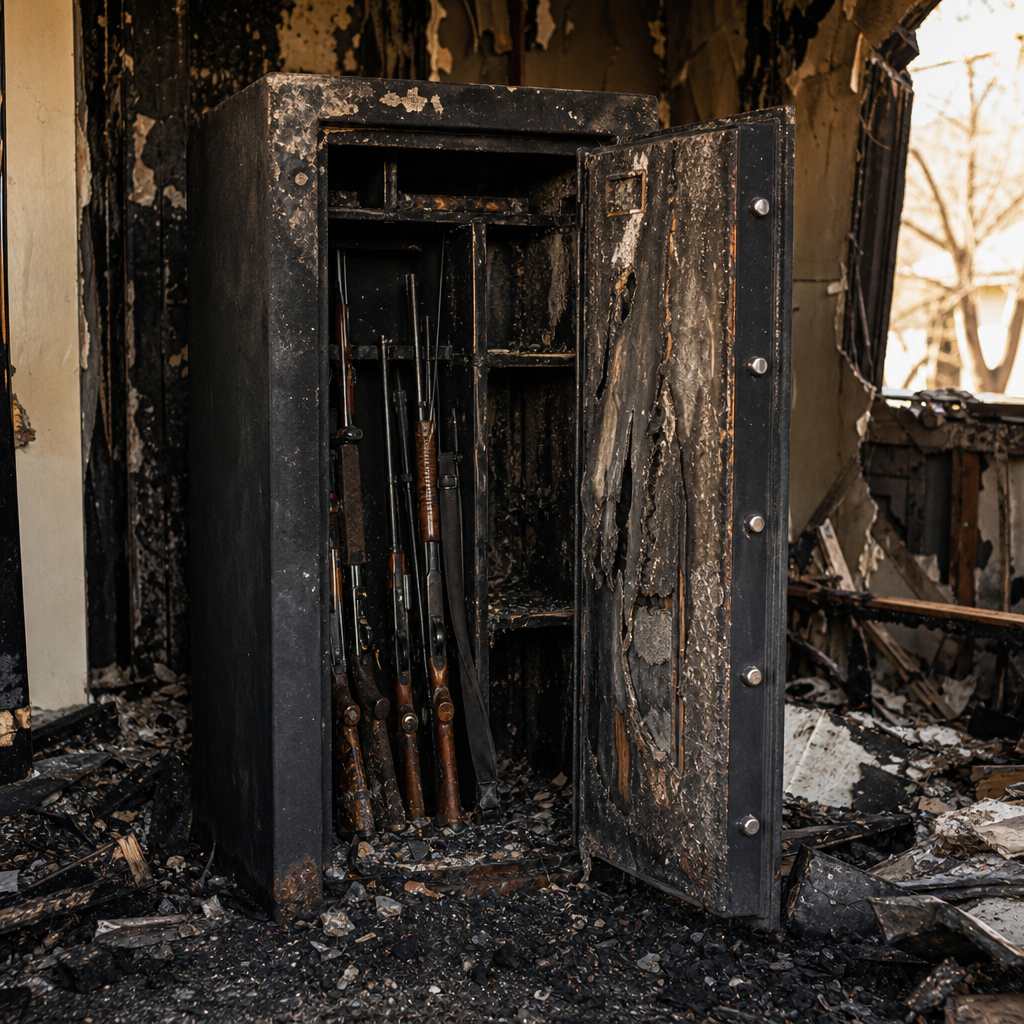
If your gun safe has been exposed to fire, your first priorities are personal safety, structural safety, and preservation of evidence, not opening the door immediately to check the contents. Fire changes steel, destroys seals, traps heat, and often leaves behind water, corrosive soot, and unstable debris. A “fireproof” safe is not literally proof against all temperatures or durations; it is a rated enclosure designed to delay heat transfer under specific test conditions. Disaster-resistant storage is the broader category that includes fire ratings, water resistance, smoke protection, theft resistance, anchoring, and post-event recovery planning. This matters because many owners assume a safe that survived the flames automatically protected what was inside. In practice, damage often comes from what happens after the fire: steam intrusion, acidic residue, warped doors, wet insulation, and rushed handling. I have worked through post-fire safe inspections where firearms looked intact at first glance but developed rust in hidden recesses within days. The right response can preserve insurance claims, prevent accidental discharge hazards, and greatly improve the odds of recovering firearms, documents, optics, and heirlooms.
A gun safe exposed to fire should be treated as compromised until assessed. Heat can weaken locking components, damage relockers, and alter lubricants. Electronic locks may fail immediately or much later because insulation trapped moisture around the keypad cavity. Long guns can lose stock finish, optics can delaminate, and ammunition can become unreliable even when it did not visibly cook off. The safe itself may also have lost its protective properties for any future event. This hub article explains what to do in the first hours, how to evaluate fireproof and disaster-resistant storage, when to involve locksmiths, restorers, insurers, and law enforcement, and how to decide whether a safe can be reused. It also serves as a roadmap for deeper topics within Gun Safes & Safety, including fire ratings, humidity control, waterproofing limits, placement strategy, and long-term maintenance after smoke or water exposure.
Immediate steps after a fire: secure the scene and document everything
Do not approach the safe until firefighters or the incident commander confirm the structure is safe to enter. Hidden hot spots, weakened floors, falling drywall, and energized circuits are common after a house fire. Once access is permitted, photograph the room before moving anything. Capture wide shots showing where the safe stood, then close-ups of the door, lock area, hinges, serial number, anchoring points, and any visible warping or soot patterns. These images help insurers, manufacturers, and restoration specialists determine exposure severity. If firearms were stored inside, note the expected make, model, and serial numbers from your records rather than forcing the safe open to verify them immediately.
Contact your insurer early and ask whether they want an adjuster, a contents specialist, or a cause-and-origin investigator to inspect before the safe is opened. If the fire may involve theft, arson, or missing firearms, notify law enforcement as well. In many claims, chain of custody matters. I recommend creating a simple incident log with times, names, and instructions received. That record becomes invaluable if there is disagreement later about whether the safe was opened professionally, whether items were removed, or whether corrosion occurred because drying was delayed. If the exterior is still warm, leave it closed. Opening a hot safe can create a sudden temperature shift that damages finishes, optics, paper records, and adhesives even more than the fire itself.
How fire affects a gun safe and everything inside it
Most residential gun safes use layered steel with gypsum-based fireboard or poured insulation intended to release moisture and slow internal temperature rise during a standardized burn. Common fire ratings, when honestly tested, specify an internal temperature ceiling for a set duration, often 30, 60, 90, or 120 minutes. The problem is that not all ratings are equal. Some come from independent laboratories such as UL, while many are manufacturer-generated tests using different furnace profiles. In real fires, temperatures, duration, ventilation, and suppression vary wildly. A safe located in a flashover room, above a basement fire, or under collapsing framing may endure stresses far beyond its label.
Inside the safe, damage follows several paths. Heat degrades gun oils and can bake them into sticky varnish. Soot is chemically aggressive; residues from burned plastics, insulation, and household chemicals can become acidic when combined with firefighting water or humidity. Wood stocks may crack as they dry unevenly. Polymer frames can warp at temperatures lower than many owners expect. Ammunition is a special case. SAAMI notes that loose cartridges exposed to fire generally do not behave like chambered rounds, but heat can still ruin primers, powder stability, and case integrity. Treat all ammunition from a fire-exposed safe as suspect until assessed by a qualified professional or disposed of through approved hazardous methods.
| Component | Typical fire-related risk | What to do |
|---|---|---|
| Safe door seal | Heat expansion, cracking, smoke leakage | Inspect and replace before reuse |
| Electronic lock | Moisture intrusion, melted wiring, delayed failure | Have lock tested or replaced by a safe technician |
| Firearms | Corrosion, lubricant breakdown, hidden heat damage | Unload, document, dry, and inspect mechanically |
| Ammunition | Primer and powder degradation | Segregate and evaluate for disposal |
| Documents and optics | Steam damage, delamination, haze | Air-dry carefully and seek specialty restoration |
Should you open the safe right away?
Usually, no. If the safe is cool to the touch, structurally accessible, and your insurer or investigator has cleared you to proceed, opening may be appropriate, but it should still be planned. A warped frame or stressed boltwork can bind abruptly. Forcing the handle can break internal components and complicate a claim. If the safe uses an electronic lock, battery replacement may not be enough because heat and moisture often damage the keypad ribbon or lock body. Mechanical dial locks tolerate heat better, but soot and water can still enter through spindle openings. When I have handled these situations, the least expensive path was often a controlled opening by a safe technician, not improvisation with pry bars or grinders.
If opening is approved, wear nitrile gloves, eye protection, and an N95 or better respirator because soot residue can contain toxic combustion byproducts. Open the door slowly and be prepared for a rush of humid, contaminated air. Do not remove everything at once. Photograph the contents in place first. Then remove firearms individually, keeping each item associated with its original location if possible. That helps determine which side of the safe took the most heat and whether damage correlates with door gaps, top panel exposure, or pooled water at the bottom. If the interior feels damp, prioritize drying and stabilization over cosmetic cleaning. Corrosion starts quickly, especially under grips, buttplates, optic caps, and sling hardware.
How to handle firearms, ammunition, and valuables after exposure
Every firearm removed from a fire-exposed safe should be treated as loaded until verified otherwise. Move to a clean, dry work area away from open flames and away from any compromised ammunition. Record serial numbers and condition notes. If the firearm is collectible, unusually valuable, or legally sensitive, stop before disassembly and consult a qualified gunsmith or conservator. For ordinary modern firearms, basic field stripping to remove moisture and contaminated lubricant is often appropriate, but avoid aggressive polishing or refinishing before the insurance process is complete. Original condition, even when damaged, may be relevant to value and restoration options.
Use clean absorbent cloths to blot away moisture and loose soot. Do not scrub soot into metal or wood pores. A light application of a proven corrosion inhibitor such as Break-Free CLP, Eezox, CorrosionX, or a comparable protectant can stabilize metal temporarily, but restoration should follow. Ultrasonic cleaning is useful for some metal parts, while wood stocks and optics need specialized care. Scopes often suffer internal fogging or adhesive failure in reticles and lens groups; many manufacturers can evaluate whether service is possible. Suppressors, magazines, and holsters also deserve attention because trapped moisture inside closed spaces can produce hidden rust or mold.
For ammunition, the conservative approach is segregation and expert evaluation. Heat exposure can alter burn characteristics long before cartridges show obvious deformation. If boxes are soaked, charred, smoke-saturated, or exposed to elevated heat for an unknown duration, do not rely on them for defensive or hunting use. Local fire departments, hazardous waste programs, shooting ranges, or law enforcement agencies may provide disposal guidance depending on jurisdiction. The same caution applies to documents, passports, cash, and digital media stored in the safe. Paper may survive flame yet still be destroyed by steam. Freeze-drying and document restoration services can sometimes recover records if they are handled promptly and not allowed to mold.
When to call a locksmith, safe technician, or restoration specialist
A general locksmith is not always the right expert for a fire-exposed gun safe. Look for a technician who regularly services safes, understands relockers and hardplates, and can document entry method and lock condition. Organizations such as SAVTA help identify trained safe and vault technicians. Manufacturers can also recommend authorized service partners and specify whether opening will void any remaining warranty. If the safe is anchored into concrete that spalled during the fire, or if the floor system shifted, a structural contractor may be needed before removal. Heavy safes become dangerous quickly when their base is no longer level.
For contents restoration, choose specialists by category. Firearms should go to a qualified gunsmith familiar with corrosion assessment, headspace, bore inspection, and the legal handling of serialized items. Fine wood stocks, leather slings, and historic firearms may need a conservator rather than a refinishing shop. Electronics, hard drives, and optical devices often benefit from dedicated data-recovery or optics service centers. The key is sequencing: stabilize first, document second, restore third. Owners who rush straight to cleaning often erase evidence of heat exposure, reduce collectible value, and make it harder to prove loss severity.
Insurance, records, and legal considerations for gun safe losses
Insurance recovery depends heavily on documentation. Many homeowners policies place sublimits on firearms, often far below the value of a serious collection unless a scheduled personal property rider or separate policy is in place. Accessories, optics, tax stamps, and ammunition may be classified differently from the firearms themselves. Keep purchase receipts, appraisals, photographs, and serial number inventories offsite or in encrypted cloud storage. After a fire, provide the insurer with a complete list, but avoid discarding damaged items until the adjuster authorizes it. Salvage rights can affect whether you may keep, restore, or surrender damaged property after payment.
If any firearm is missing after the event, report it according to applicable federal, state, and local requirements. Dealers have specific ATF reporting obligations, and private owners may face state-level duties depending on jurisdiction. NFA items require especially careful recordkeeping if forms, trust documents, or serialized devices were damaged. If you move firearms to temporary storage during remediation, ensure that storage remains lawful and secure. In multi-occupant homes, document who had access before and after the fire. Small gaps in recordkeeping become major problems when a claim involves high-value collections or suspected theft during cleanup.
Can a fire-exposed gun safe be reused?
Sometimes, but often it should not be trusted for future fire protection. A safe can look solid externally while its insulation has cracked, shifted, or released moisture unevenly. Intumescent seals may have expanded and then hardened or separated. Door alignment can change by fractions of an inch, enough to reduce smoke resistance and locking reliability. After significant fire exposure, I generally advise owners to view the safe as a recovery container, not a fully rated protective device, unless the manufacturer or a qualified technician confirms otherwise. Replacement is frequently the prudent choice, especially for residential security containers where the margin of protection was modest to begin with.
Evaluate reuse with four questions. Was the safe independently fire-rated, and under what standard? How intense and prolonged was the fire in that room? Did the lock, handle, hinges, or frame show heat distortion or water intrusion? And are you willing to store irreplaceable firearms in a container with unknown residual performance? If replacement is needed, use the event as a design reset. Consider a model with a documented fire rating, thicker steel, better boltwork, replaceable door seals, dehumidification options, and anchoring that matches the slab or floor system. Placement matters too. A safe against an exterior wall on a concrete slab usually fares better than one in a garage corner with fuel, solvents, or direct flame pathways nearby.
Building a stronger fireproof and disaster-resistant storage plan
The best response to a burned safe is a better storage system afterward. Start with realistic threat modeling. For many owners, the main risks are not total incineration but smoke, sprinkler water, firefighting runoff, and humidity after a near miss. Choose a safe with a meaningful fire rating from a credible source, then layer protections: desiccants or an electric dehumidifier rod, document pouches rated for media or paper, waterproof containers for records, and offsite backups for serial numbers and appraisals. Do not store loaded firearms loosely against foam that can trap moisture. Use racks or sleeves that allow airflow and periodic inspection.
Household preparation matters as much as the safe. Install interconnected smoke alarms, maintain extinguishers, and reduce fuel load around the safe by keeping paint, gasoline, propane, and bulk solvents elsewhere. Bolt the safe down, but also think about location relative to likely fire paths, roof collapse zones, and water pooling. A first-floor slab location away from kitchens, garages, and furnace rooms is usually wiser than an upper-floor closet. Review your insurance annually, especially after adding optics, night vision, suppressors, or collectible firearms. Finally, create a post-disaster checklist now, before you need it: who to call, where records are stored, which restoration vendors you trust, and how firearms will be inventoried and moved. That planning turns a chaotic fire scene into a manageable recovery process.
If your gun safe has been exposed to fire, slow down, secure the scene, document everything, and treat both the safe and its contents as potentially compromised. Heat, water, soot, and delayed corrosion do more damage than many owners realize, and the first 24 to 72 hours often determine whether firearms and valuables can be saved. Professional help matters: a safe technician for controlled entry, a gunsmith or conservator for stabilization, and an insurer who has complete records. Just as important, a fire event should change how you evaluate fireproof and disaster-resistant storage going forward. Ratings, placement, dehumidification, offsite records, and realistic insurance limits all work together.
This hub for Fireproof and Disaster-Resistant Storage is meant to guide your next steps and point you toward deeper topics across Gun Safes & Safety, from comparing fire ratings to managing humidity and choosing better safe locations. The central lesson is simple: surviving the fire is only the beginning; proper recovery and smarter storage determine the real outcome. Review your current setup, update your inventory, and make a replacement or restoration plan before the next emergency tests it.
Frequently Asked Questions
1. What should I do first if my gun safe has been exposed to fire?
Your first steps should focus on life safety, structural safety, and documentation. Do not rush to open the safe the moment the fire is out. Even if the exterior looks intact, the safe and everything around it may still be extremely hot, structurally unstable, or contaminated by soot, smoke residue, and firefighting water. Make sure everyone is safe, follow instructions from the fire department, and do not re-enter the area until it has been declared safe. If the building suffered significant fire damage, falling debris, weakened flooring, hidden hot spots, and compromised electrical systems may pose greater immediate risks than the safe itself.
Once the scene is secure, document the safe in place before moving or opening it. Take clear photos and videos of the room, the safe’s exterior, serial numbers, visible damage, and surrounding fire conditions. This is important for insurance claims and may also matter if the firearms inside are part of any legal inventory, estate record, or law enforcement report. If possible, contact your insurance carrier early and ask whether they want an adjuster, restoration specialist, or safe technician involved before the safe is opened. In many cases, preserving the scene and creating a clear record of the damage will save time, reduce disputes, and protect the value of any claim.
It is also wise to contact the safe manufacturer or a qualified safe technician before doing anything that could worsen the damage. Fire exposure can warp metal, destroy door seals, damage locking systems, and leave internal heat trapped for hours. Opening the door too soon can sometimes introduce oxygen and moisture into a still-hot interior environment, which may accelerate damage to firearms, documents, optics, and other sensitive items. The safest approach is to slow down, verify the area is secure, document everything, and get professional guidance before trying to access the contents.
2. Should I open the gun safe immediately to check whether my firearms and valuables survived?
In most cases, no. It is usually better to wait until the safe has cooled and the area has been assessed by the appropriate professionals. A gun safe that has been through a fire may still be retaining significant heat inside even after the surrounding room feels cooler. Fire-resistant safes are designed to slow heat transfer, not eliminate it completely, so the interior may remain dangerously hot long after the flames are gone. Opening the door immediately can expose contents to a sudden rush of oxygen, humidity, and contaminated air, all of which can make post-fire damage worse.
There is also a practical safety issue. The lock, relocker, boltwork, hinges, and door frame may have been distorted by heat. If you force a damaged lock or pry on the door, you can destroy evidence of what happened, complicate insurance claims, and make later professional opening or repair much more difficult. In some situations, the door may be under tension or the safe may have shifted on an unstable floor. That means an impulsive attempt to open it could create injury risks in addition to property damage.
If the contents include irreplaceable paper records, family heirlooms, NFA paperwork, cash, or firearms with collectible value, controlled opening is even more important. A qualified safe technician, restoration company, or manufacturer-approved service provider may recommend a specific waiting period and handling procedure based on the safe’s fire rating and the severity of the fire. The key point is that “checking quickly” often feels urgent, but patience usually gives you a better chance of preserving what is inside.
3. If the safe is labeled fireproof or fire-resistant, does that mean the contents should be fine?
Not necessarily. A “fireproof” safe is not literally immune to all fire conditions. Most consumer gun safes are more accurately described as fire-resistant or fire-rated, meaning they are tested to delay heat transfer for a certain amount of time under specific laboratory conditions. Real house fires do not always match those tests. Temperature, fire duration, room ventilation, fuel load, collapse of surrounding structure, and the amount of direct flame contact can all change the outcome. A safe that performs well in a standardized test can still suffer major damage in a severe or prolonged fire event.
It is also important to understand what the fire rating is intended to protect. Some ratings focus on paper survival, not necessarily firearms, optics, electronics, photos, ammunition, or magnetic media. Firearms can be harmed by heat, steam, chemical soot, and later corrosion even if the safe prevented total burn-through. Wood stocks may crack or swell. Finishes can blister. Optics and electronics can fail. Ammunition may be compromised. Important documents can absorb moisture and become fragile. In other words, the contents may survive in some form but still require professional restoration, inspection, or replacement.
Another common misconception is that if the safe door still opens and closes, the safe must be usable. Fire can weaken steel, damage the insulating barrier, destroy intumescent door seals, and affect lock reliability. Even if the contents look acceptable at first glance, the safe itself may no longer provide the level of protection it did before the fire. After any significant fire exposure, assume both the safe and its contents need careful evaluation rather than assuming the fire label guarantees full protection.
4. How should I handle firearms, ammunition, and other contents after the safe is opened?
Handle everything as if it may be heat-damaged, water-damaged, and chemically contaminated. Wear gloves, and if there is heavy soot or residue, consider respiratory protection appropriate for post-fire cleanup conditions. Remove items carefully and document them as they come out. Take photos of each firearm, accessory, document, and valuable item before attempting any cleaning. This preserves evidence for insurance and creates a record of condition. Keep damaged contents organized and avoid mixing them with unaffected items from elsewhere in the home.
For firearms, do not assume they are safe to fire just because they appear mostly normal. Heat can affect metal temper, springs, optics, lubricants, polymer parts, and ammunition. Soot and extinguishing chemicals can also trigger rapid corrosion, especially when combined with trapped moisture. As a first step, unload each firearm if it can be done safely, then place it in a dry, controlled environment. Light surface stabilization may be appropriate, but do not perform aggressive polishing, refinishing, or disassembly beyond your competence before the items have been documented and, if needed, inspected by a qualified gunsmith. Antique, collectible, or high-value firearms should be evaluated by a specialist familiar with restoration versus value loss.
Ammunition deserves extra caution. Exposure to fire, high heat, water, and suppressants can make ammunition unreliable or unsafe. Separate it from other salvage items and consult local fire authorities, a qualified armorer, or hazardous waste guidance if there is any question about disposal. For documents, photos, and electronic media, use a disaster restoration professional if possible, since improper drying or cleaning can cause permanent damage. The overall rule is simple: stabilize first, document thoroughly, and then involve the right professionals before deciding what can be restored, what must be replaced, and what should never be used again.
5. Can a gun safe be repaired and reused after a fire, or should it be replaced?
That depends on the severity of the fire exposure, but in many cases a safe that has been significantly involved in a fire should be replaced rather than trusted for future protection. Heat can alter the safe’s steel, compromise welds, distort the door opening, and destroy the fire-protective materials and seals that are essential to its rated performance. The lock and boltwork may also have suffered hidden damage. A safe can look surprisingly intact from the outside while having lost much of its security and fire resistance internally.
A professional assessment is the best next step. Start with the manufacturer if the brand is still in business, or contact a reputable safe technician who has post-fire experience. They can determine whether the lock can be serviced, whether the body or door has warped, whether the insulation and seals have failed, and whether the unit is worth repairing at all. In some limited cases, minor smoke or water exposure without major heat involvement may leave the safe serviceable after proper maintenance. But if the safe experienced direct flame, severe heating, structural collapse around it, or obvious distortion, replacement is usually the smarter and safer decision.
Insurance may help guide that choice as well. Many policies will cover not only the contents but also the damaged safe itself, subject to limits and documentation requirements. Keep all photos, serial numbers, purchase records, and technician reports. If replacement is needed, use the event as an opportunity to reassess your storage setup. Consider a safe with an independently verified fire rating, better placement within the home, improved humidity control, and anchoring in a location less vulnerable to intense fuel loads. A fire-exposed safe should never be trusted again simply because it still has a door and a lock; it should be trusted only if a qualified expert confirms it remains structurally and functionally sound.