
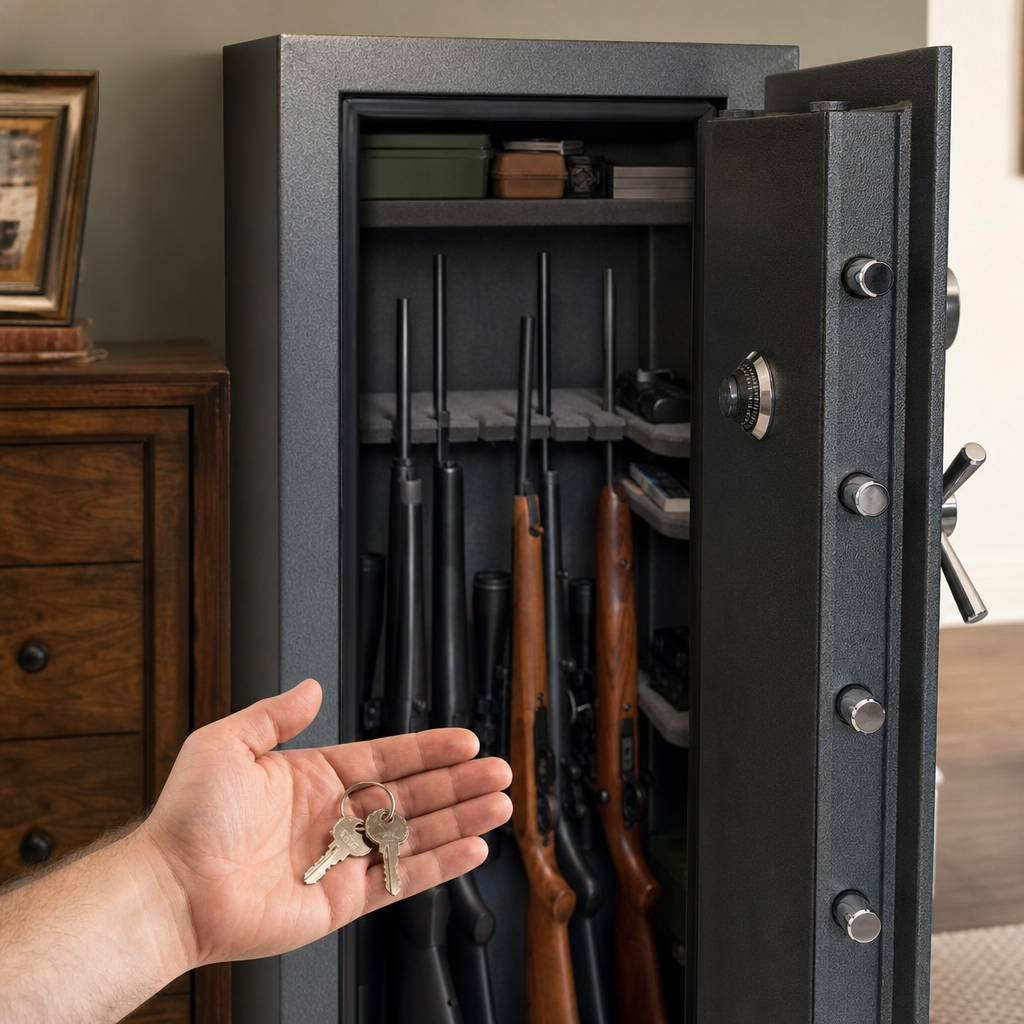
Does a gun safe need a backup key? In most cases, yes, a backup key is a practical emergency access feature, but it is not automatically the safest or best choice for every owner. The right answer depends on your safe’s lock type, your household risk profile, your access needs, and how well you manage key control. I have worked with handgun vaults, long-gun safes, and commercial-grade burglary safes for years, and the biggest mistakes I see come from myths: that any backup key weakens security, that electronic locks always fail, or that a heavy safe alone guarantees protection. This guide explains what a backup key does, when it helps, when it creates risk, and how it fits into the broader category of gun safe myths and misconceptions. If you are evaluating a biometric safe, keypad safe, dial lock, or hybrid design, you need clear answers, because safe access affects theft prevention, child safety, emergency readiness, and legal compliance in states with secure storage laws.
What a backup key actually means on a gun safe
A backup key is a secondary override method that lets you open a gun safe if the primary lock cannot be used. On many handgun safes, especially bedside models, the primary method is an electronic keypad or biometric scanner, while the backup key operates a concealed mechanical cylinder behind a cap or trim plate. On some long-gun safes, the situation is reversed: the main lock may be mechanical, with a secondary override for service access. The key point is simple: a backup key is not a universal sign of poor quality. It is a design choice that trades a small amount of attack surface for redundancy.
The misconception starts when buyers treat all backup key systems as equal. They are not. A tubular override key on a low-cost imported pistol safe is very different from a restricted keyway on a better-built vault. The lock body, key control, relocker design, hard plate protection, and concealment of the keyway all matter. If the override lock can be raked open with basic tools, that is a legitimate security concern. If the key cylinder is shielded, pick resistant, and integrated into a tested locking system, the risk changes substantially.
Another common misunderstanding is that the word “safe” means the product has been independently tested to a recognized burglary standard. Many consumer gun safes are better described as residential security containers. Standards from UL, California DOJ handgun safe rosters, and ASTM-related testing protocols give more useful guidance than marketing labels alone. In practice, I advise buyers to evaluate lock construction, steel thickness, bolt design, pry resistance, and mounting provisions before fixating on whether a backup key exists at all.
Why some gun owners want a backup key
The strongest argument for a backup key is reliability under stress. Batteries die. Keypads fail. Biometric readers reject dirty, wet, or injured fingers. After enough service calls and troubleshooting sessions, I can say with confidence that electronics are usually dependable when maintained properly, but they are not infallible. Redundancy matters, especially if the safe stores a defensive handgun intended for rapid but authorized access.
A backup key is also useful for households with multiple authorized users. A spouse may know the code but forget it after months without use. An older family member may struggle with a biometric sensor. During a lockout, the override key can prevent destructive entry, expensive locksmith work, or shipping a locked safe back to the manufacturer. This matters more than many buyers expect. Some compact safes are not economically repairable once the lock fails, and replacing them costs more than choosing a better model upfront.
There is also a power-outage myth worth correcting. Most electronic gun safes do not depend on wall power; they typically use internal batteries and store the code in nonvolatile memory. A blackout alone rarely locks an owner out. The real issue is battery neglect, corrosion in the battery compartment, damaged keypad membranes, or cheap internal solenoids. In those situations, a backup key can be the difference between immediate access and a long delay.
That said, the need for a backup key rises or falls with use case. A bedside handgun safe that may need to open at 3 a.m. has different requirements than a bolted-down long-gun safe in a climate-controlled room. Quick-access applications benefit more from redundant entry than archival storage does. Matching the lock system to the purpose is more important than following blanket advice.
When a backup key can reduce security
A backup key can reduce security if the override mechanism is cheaply made, poorly hidden, or badly managed by the owner. This is where many gun safe myths begin: someone sees a low-end safe opened quickly with a wafer key attack online and concludes that every keyed override is unsafe. The specific problem is not the concept of a backup key; it is weak implementation.
Here are the most common failure points I see in real products and real homes.
| Issue | Why it matters | Better practice |
|---|---|---|
| Low-security key cylinder | Can be picked, bypassed, or impressioned faster than the keypad can be attacked | Choose a model with a shielded, higher-quality cylinder and documented resistance features |
| Hidden key stored nearby | Defeats the purpose of secure storage if a child, guest, or burglar finds it | Store the override key off-site or in a separate locked location |
| Visible keyway location | Gives an attacker an obvious point of attack | Prefer concealed keyways behind trim or magnetic covers |
| No anchoring | A thief can remove the entire safe and attack the key system later | Bolt the safe to framing, concrete, or approved mounting points |
| Cheap safe body construction | Thin steel and weak doors make the lock debate secondary | Prioritize overall construction, not just entry method |
The key management issue deserves emphasis. I have seen owners keep the override key in the same nightstand drawer as the safe, taped under the safe, or inside the closet where the safe sits. That turns a controlled emergency feature into a convenience vulnerability. A backup key is only as secure as the owner’s habits. If there are children in the home, poor key storage can undermine every other safety measure you took seriously.
Electronic, biometric, and mechanical locks: which systems really need key overrides?
Electronic keypad locks benefit most clearly from backup keys because their common failure modes are predictable: dead batteries, keypad wear, damaged contacts, and internal lock failure. A quality electronic lock from a recognized manufacturer can last for years, but the consumer market includes many inexpensive units with inconsistent quality control. If you buy an entry-level electronic handgun safe, a backup key is often a sensible safeguard, provided the override cylinder is not the weakest part of the design.
Biometric locks are more complicated. Fingerprint safes are convenient, but environmental conditions matter. Dry skin, cuts, oil, sweat, and sensor contamination can reduce first-attempt success rates. Better biometric safes combine fingerprint access with keypad entry, giving you two non-key options before using an override key. In my experience, that hybrid arrangement is stronger than relying on biometrics alone. It gives speed, redundancy, and less dependence on perfect finger placement during stress.
Mechanical dial locks usually do not need backup keys because their core advantage is independence from batteries and electronics. Properly maintained, they are durable and stable over long periods. Their tradeoff is slower access and a steeper learning curve. They are excellent for larger gun safes where fast defensive access is not the primary goal. Direct-drive mechanical locks and premium commercial lock bodies can be extremely reliable, but they are not immune to user error, wear, or service issues. They simply fail differently, and less often.
For many buyers, the best question is not “Does a gun safe need a backup key?” but “What failure mode am I designing around?” If the safe secures a defensive handgun, redundant access methods matter. If the safe stores hunting rifles, documents, and heirlooms, build quality and fire protection may matter more than override speed.
Gun safe myths and misconceptions every buyer should understand
This subtopic confuses buyers because marketing oversimplifies the decision. Myth one: heavier always means safer. Weight helps, but steel gauge, door construction, internal hinges versus external hinges, bolt engagement, and anchoring matter more. An unanchored 500-pound cabinet can still be tipped, pried, or removed with a dolly. Myth two: biometric access is instant and flawless. In reality, quality varies widely, and enrollment quality determines much of day-to-day performance.
Myth three: fire ratings are comparable across brands. They often are not. Some manufacturers publish internal tests; others reference third-party protocols. Temperature thresholds and duration claims differ. Myth four: any DOJ-approved handgun safe is equally secure against burglary. That approval generally addresses baseline safety and unauthorized access criteria, not high-end burglary resistance. Myth five: if a safe has a backup key, burglars will always exploit it first. Skilled thieves exploit the weakest available path, which may be the thin sidewall, anchor points, exposed hinge area, or simple opportunity to carry the unit away.
Myth six: you can hide a safe instead of mounting it. Concealment helps, but it does not replace anchoring. Myth seven: storing a defensive firearm loaded inside a quick-access safe is inherently reckless. It can be safe and appropriate if the container resists unauthorized access, the owner trains consistently, and local law allows that configuration. Myth eight: all locksmiths are equally qualified to service gun safes. Safe work is a specialty. Before hiring anyone, verify experience with residential security containers, electronic safe locks, and nondestructive opening methods.
When buyers understand these misconceptions, the backup key question becomes easier. It stops being an emotional symbol of safety or danger and becomes a technical detail within a larger security system.
How to decide whether your gun safe should have a backup key
Start with your threat model. If your main concern is keeping children and casual visitors out, a high-quality quick-access safe with a well-designed backup key may be ideal. If your concern is smash-and-grab burglary, prioritize anchoring, steel thickness, concealed placement, and a lock system with fewer vulnerable external features. If you live in a humid environment, think about corrosion protection, dehumidification, and maintenance because neglected components fail more often than advertised.
Next, assess access urgency. For bedside use, I usually recommend at least two access methods. That may be biometric plus keypad, or keypad plus key, or biometric plus key if the biometric system is from a strong manufacturer and tested extensively by the owner. For a closet or basement long-gun safe, a mechanical dial or quality electronic lock without a consumer-style key override can be perfectly reasonable.
Then evaluate your own habits honestly. Are you disciplined enough to store the backup key separately, change batteries on schedule, test the lock monthly, and keep access codes private? Security products fail in ordinary ways: deferred maintenance, ignored warning beeps, forgotten combinations, and casual key storage. The best lock on paper will not compensate for poor routine.
Finally, compare brands by construction and support, not just features. Look for clear warranty terms, available replacement parts, customer service responsiveness, and evidence that the manufacturer will support lock issues after the sale. In real ownership, post-purchase support often determines whether a lock problem is a minor inconvenience or a serious access failure.
Best practices if your gun safe includes a backup key
If your gun safe has a backup key, treat it like a controlled credential, not a convenience accessory. Do not store it in the same room unless it is inside a separate locked container with its own access control. Record the key code or replacement information in your household inventory. Test the override method when you first buy the safe, then retest it periodically so you are not learning under pressure.
Replace batteries proactively, not after a low-battery warning. Use name-brand alkaline batteries if the manufacturer specifies them, and avoid mixing old and new cells. Keep the keyway clean and protected according to the manual; do not lubricate cylinders indiscriminately with products that attract debris. If the safe is portable, bolt it down whenever possible. Quick-access handgun safes are commonly defeated by theft of the entire unit, not sophisticated lock attacks.
If you have children, combine the safe with household rules, supervised firearms education appropriate to age, and routine checks to confirm the firearm is secured after each use. A gun safe is part of a layered safety plan, not a substitute for responsible handling. That principle matters more than the presence or absence of an override key.
A gun safe does not always need a backup key, but many owners benefit from one when it is paired with solid construction and strict key control. The real lesson behind gun safe myths and misconceptions is that no single feature determines security. A weak safe with a backup key is a problem, but a well-built safe with a protected override can be a smart, reliable choice. Focus on the whole system: lock quality, safe construction, anchoring, maintenance, and storage habits. If you are building out your Gun Safes & Safety plan, use this page as your starting point, then review the related subtopic articles on lock types, fire ratings, anchoring, and child-access prevention so you can choose a safe that fits your actual risks.
Frequently Asked Questions
Does a gun safe really need a backup key?
In most cases, yes, a backup key is a smart emergency-access feature, but it is not automatically the right choice for every gun owner. Whether a backup key makes sense depends on the type of lock on the safe, how quickly you may need access, who lives in the home, and how disciplined you are about key control. For many owners, a backup key adds peace of mind because electronic locks can suffer from dead batteries, keypad failure, programming issues, or user lockouts. In those situations, a properly controlled override key can keep you from being locked out of your own safe at the worst possible moment.
That said, a backup key is only beneficial if it does not create a new vulnerability. A hidden key that is poorly stored, left in a nightstand, or known to multiple people can weaken the entire security plan. In homes with children, frequent visitors, roommates, or contractors coming and going, key management matters just as much as lock quality. A safe without a backup key is not automatically more secure, and a safe with one is not automatically less secure. The better question is whether the safe’s overall design, lock quality, and your storage habits work together to balance emergency access with unauthorized-access prevention.
Does a backup key make a gun safe less secure?
Not necessarily. This is one of the biggest myths in the gun safe market. A backup key can reduce security if it is badly implemented by the manufacturer or badly managed by the owner, but its mere existence does not automatically make a safe unsafe. What matters is the quality of the override mechanism, whether it is shielded against manipulation, how resistant the safe is to physical attack, and where the key is stored. A cheap lock with an exposed tubular override keyway can be more concerning than a well-designed backup key system integrated into a solid locking platform.
Real-world security is about the entire system, not one feature in isolation. If the safe is a basic handgun vault designed mainly for quick access, a backup key may be a reasonable tradeoff for reliability. If the safe is intended for higher-security burglary protection, fire resistance, or long-term firearm storage, buyers should pay much closer attention to lock construction, keyway shielding, relocker features, hard plate protection, and the reputation of the manufacturer. In other words, a backup key is not the problem by itself. Poor engineering, weak materials, and sloppy key control are the real issues. A high-quality safe with a well-managed backup key can be more practical and just as responsible as a safe without one.
When is a backup key especially useful on a gun safe?
A backup key is especially useful when the safe relies on electronics and you cannot tolerate the risk of a lockout. This is common with bedside handgun vaults, biometric safes, and keypad-entry models used for defensive firearms. Batteries die, fingerprints fail to read, keypads wear out, and electronic components occasionally malfunction. In those cases, a backup key can serve as a reliable secondary entry method that keeps the safe functional when the primary lock does not cooperate. It can also help during setup, code resets, inherited-safe situations, or after long periods of nonuse.
It is also valuable for owners who live in remote areas, travel often, or store critical documents and valuables alongside firearms. If a lock failure happens, waiting for a locksmith or manufacturer support may not be practical. A backup key can reduce downtime and stress. However, it is most useful when the owner plans ahead. That means testing the key when the safe is first installed, confirming that it works smoothly, storing it in a secure separate location, and making sure only authorized adults know where it is. A backup key is an emergency tool, not something that should be casually accessible.
Where should you store a gun safe backup key?
You should store a gun safe backup key somewhere secure, separate from the safe, and inaccessible to unauthorized people. The worst place is usually “near the safe” in an obvious hiding spot such as a dresser drawer, under a mattress, in the same room, or taped behind furniture. Those locations may feel convenient, but they are exactly where a child, guest, burglar, or curious family member is likely to find them. If someone can discover the key during a routine search of the room, the backup key has become a liability.
Better options include a small separate lockbox, a bank safe deposit box, a concealed and access-controlled storage location, or with a highly trusted person who does not live in the home, depending on your risk profile and access needs. Some owners keep the key in a second secure container that requires a different credential to open. That approach preserves emergency access while reducing the chance of accidental discovery. The right storage method depends on how urgently you may need the key versus how concerned you are about unauthorized access. The key principle is simple: if the backup key is easy for you to grab impulsively, it may also be too easy for the wrong person to find.
What should you look for if you want a gun safe with a backup key?
If you want a gun safe with a backup key, look beyond the marketing label and evaluate how the override system is designed. Start with the lock type and intended use of the safe. A bedside handgun vault prioritizes fast access and may reasonably include a key override, while a larger long-gun safe or commercial-grade burglary safe may call for a more security-focused locking setup. Examine whether the keyway is concealed, whether the lock has anti-manipulation features, and whether the manufacturer has a strong track record for reliability. Read independent reviews, not just product listings, and pay attention to reports of lock failures, weak keyways, or poor customer support.
You should also consider steel thickness, door construction, boltwork, pry resistance, mounting options, and whether the safe can be bolted down. A backup key should never distract from the more important question of whether the safe itself is well built. Good key control policy matters too. Before buying, decide who will know the key location, how it will be stored, and what your fallback plan is if both the electronic system and your memory fail. The best choice is usually a safe that matches your actual use case: fast-entry defensive access, secure long-term storage, or higher-end asset protection. A backup key can be a very practical feature, but only when it is part of a well-thought-out overall security plan.