
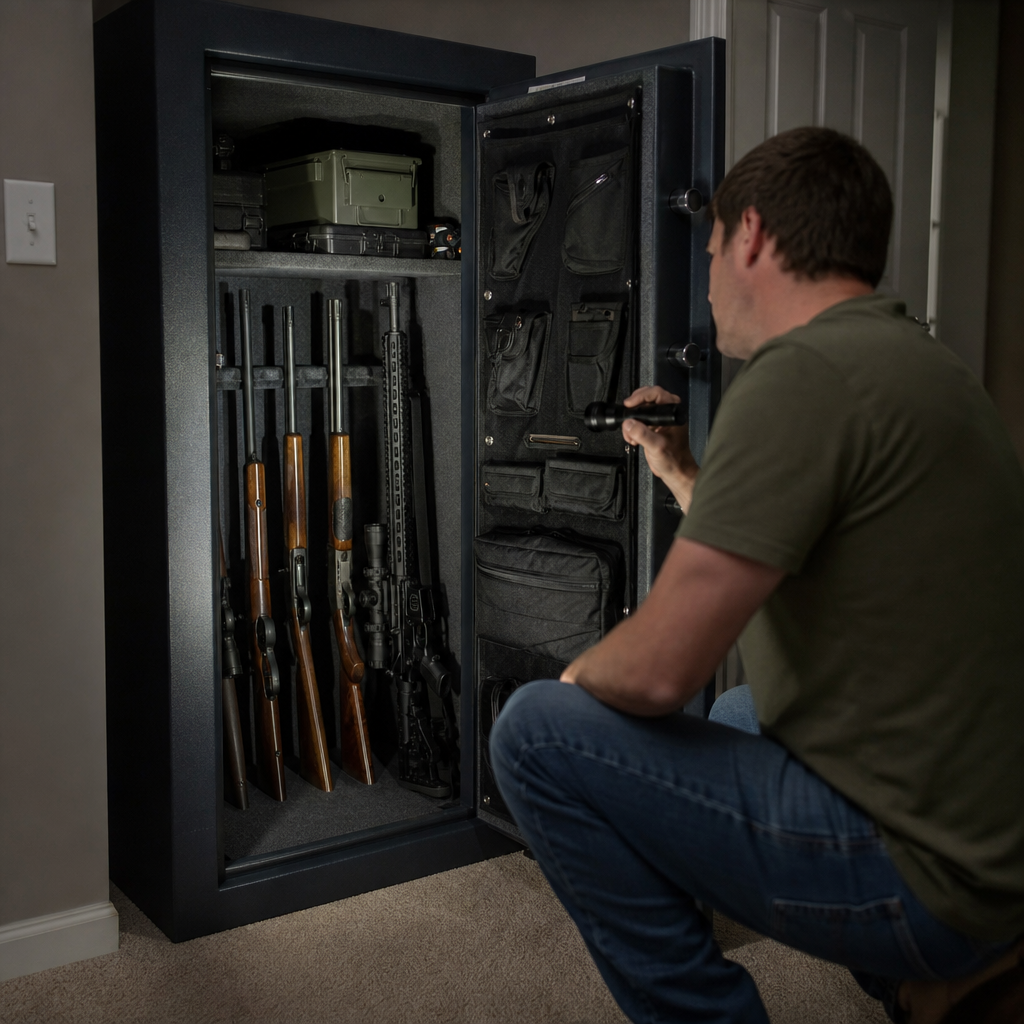
Electronic gun safes are often judged by a single anxious question: can a power outage disable them? The short answer is usually no, but the complete answer matters because it shapes how owners choose, install, maintain, and trust a safe that protects firearms from theft, unauthorized access, and accidental handling. In my experience working with residential security hardware and reviewing gun safe lock systems, the myth persists because people assume an electronic keypad works like a house appliance. Most quality gun safes do not rely on household electricity at all. They typically use an internal battery-powered lock, and that design changes the risk picture completely.
To understand the issue clearly, define the key terms first. An electronic gun safe uses a digital lock operated by a keypad, biometric reader, or touchscreen. A power outage means utility power to the home has failed. A battery failure is different: it means the lock’s onboard battery no longer has enough voltage to actuate the solenoid or motor that retracts the boltwork. A lockout is a condition where the user cannot open the safe through normal authorized operation. These distinctions are essential because many people blame “the power going out” when the actual cause is a dead 9-volt battery, neglected maintenance, a damaged keypad, or user error.
This topic matters because gun safes sit at the intersection of security and emergency access. Owners need confidence that a defensive firearm remains available when authorized adults need it, while staying inaccessible to children, visitors, or thieves. Misunderstanding how electronic locks work can lead to poor buying decisions, unsafe storage habits, or panic during an outage. It also fuels broader myths about gun safe reliability, fire claims, waterproof claims, lock manipulation, and so-called universal override codes. As a hub for gun safe myths and misconceptions, this guide explains what really happens during an outage, where electronic safes can fail, how mechanical and electronic options compare, and which maintenance steps actually prevent lockouts.
Why a home power outage usually does not disable an electronic gun safe
Most electronic gun safes are self-powered. The keypad and lock body run on one or more batteries, commonly a 9-volt or AA battery pack mounted inside or accessible from the exterior keypad. Because the lock is not hardwired to the electrical grid, a neighborhood blackout typically has no effect on the safe’s ability to open. Enter the correct code, and the lock’s internal mechanism retracts just as it would during normal conditions. This is the core fact that debunks the headline myth.
There are exceptions, but they are not the norm in the consumer gun safe market. A few high-end vault rooms, commercial access systems, or integrated smart-home security setups may involve wall power, backup transformers, or remote monitoring features. Even then, the locking mechanism itself commonly retains battery backup or fail-secure design. In standard bedside handgun safes, closet rifle safes, and large freestanding residential security containers, utility power loss alone is not what prevents access.
The confusion often starts with the user interface. A glowing keypad, biometric scanner, or illuminated display feels electronic in the same way a plugged-in appliance feels electronic. But the lock architecture is closer to a stand-alone access control device. When batteries are healthy, the lock stores enough local power to verify credentials and release the blocking device. If the home loses power but the battery remains good, the safe still works. If the battery dies during the same storm, people connect the two events and draw the wrong conclusion.
What can actually stop an electronic gun safe from opening
Battery depletion is the most common cause of electronic lock trouble. Many owners install a battery on day one and forget it for years. By the time the low-battery indicator appears, corrosion, weak voltage under load, or cold storage conditions may already affect performance. Premium lock brands such as Sargent and Greenleaf, SecuRam, and LaGard generally provide warning signals, but warnings are useful only if the owner responds quickly with a fresh, name-brand alkaline battery. Rechargeable batteries can create issues because some deliver lower nominal voltage or inconsistent discharge curves.
Mechanical binding is another frequent problem that gets mistaken for lock failure. Safe doors are heavy, and pressure on the boltwork can keep the handle from turning even after the lock releases. Overloaded door shelves, slight floor shifts, improper shimming, or a safe installed out of level can all create resistance. I have seen owners punch the code repeatedly when the real fix was to pull or push the door slightly while turning the handle to relieve bolt pressure.
User error remains surprisingly common. Codes are entered too quickly, digits are transposed, and audit delays are misunderstood as lockouts. Some electronic locks impose a penalty timeout after several bad attempts, which can make the owner assume the safe has been disabled. Biometric safes add another layer of misconception: dirty sensors, dry skin, cuts, or poor enrollment can prevent recognition, but a backup PIN usually still works.
| Issue | What owners assume | What is usually true | Best fix |
|---|---|---|---|
| Home blackout | The safe lost power | The lock runs on batteries, not wall current | Test keypad and verify battery condition |
| Dead battery | The electronics suddenly failed | Voltage dropped below operating threshold | Replace with fresh alkaline battery |
| Handle will not turn | The code was rejected | Bolt pressure or door misalignment is binding | Relieve pressure and check installation level |
| Fingerprint not accepted | Biometric safe is broken | Sensor or enrollment issue is blocking match | Use backup PIN and re-enroll prints |
| Repeated beeps or timeout | The safe disabled itself permanently | Wrong-code penalty delay is active | Wait prescribed interval and retry carefully |
How electronic locks are designed for security and emergency access
Electronic gun safe locks are normally fail-secure, not fail-open. That means loss of power does not cause the door to unlock automatically. This design is intentional. If a dead battery or severed power line opened a safe, the product would be unusable as a security device. Instead, the lock stays locked until valid credentials are entered and enough battery power is available to actuate the internal lock mechanism. For firearm storage, that is the correct security behavior.
Many consumer models also include emergency battery jump contacts on the keypad. If the internal battery is dead and the compartment is behind the door, the owner can hold a fresh 9-volt battery to external terminals long enough to power the keypad and unlock the safe. Other designs put the battery tray on the outside of the door so replacement is simple without opening the unit first. These features are worth checking before purchase because they directly affect recovery from neglect.
Some safes add override keys, but this area is misunderstood. An override key is not automatically a flaw; it is a tradeoff. On budget handgun safes, tubular key overrides can be convenient if electronics fail. On higher-security long-gun safes, many owners prefer no override key because any physical bypass path creates an additional attack surface. Better designs depend on a robust UL-listed electronic lock and a documented lock replacement process handled by a locksmith or safe technician if failure occurs.
Comparing electronic and mechanical gun safe locks without the usual myths
A common misconception says mechanical dial locks are always more reliable than electronic locks. That is too simplistic. Mechanical locks have a long service history and no batteries, which many owners value. They also tend to tolerate neglect better over long periods. However, they are slower to open, harder for some users to manipulate under stress, and more prone to user mistakes involving dialing sequence. They can also drift out of adjustment, wear internally, or require service after years of use.
Electronic locks trade battery dependence for speed, easier code changes, and simpler daily access. For quick-access handgun safes, electronics are often the practical choice because they can open in seconds in low light. On full-size gun safes, electronic keypads are popular because they avoid the slower left-right dialing process of a Group 2 mechanical lock. The best choice depends on use case: defensive access, long-term storage, multiple authorized users, and comfort with periodic battery replacement.
In practical terms, neither system is maintenance-free and neither is universally superior. A quality mechanical lock from a respected manufacturer can run for decades, but it still benefits from periodic inspection. A quality electronic lock can be extremely dependable if the owner replaces batteries annually, tests operation monthly, and avoids bargain-grade components. The myth to reject is that “electronic” means fragile while “mechanical” means foolproof. Security hardware is only as reliable as its design, installation, and upkeep.
Other gun safe myths every buyer should question
The power outage myth belongs to a wider cluster of gun safe misunderstandings. One of the biggest is that a “fireproof gun safe” makes contents immune to any fire. In reality, fire ratings vary by temperature, duration, testing method, and whether the claim comes from an independent lab or a manufacturer’s internal standard. Paper chars around 451 degrees Fahrenheit, but firearms, optics, ammunition packaging, and electronic accessories respond differently to heat, steam, and smoke. A 30-minute rating at 1200 degrees Fahrenheit is not equivalent to a 90-minute rating at 1680 degrees, and neither guarantees protection in every house fire.
Another myth says a heavier safe is always a more secure safe. Weight matters because mass slows theft, especially smash-and-grab attacks, but steel thickness, door construction, lock protection, relockers, anchor points, and pry resistance matter just as much. Many residential security containers use thinner steel than buyers expect. A safe that weighs 500 pounds but is not bolted down can still be tipped, moved with appliance dollies, or attacked in a garage. Anchoring is one of the highest-value upgrades any owner can make.
A third misconception is that any safe with a keypad has a secret factory code that burglars know. Reputable manufacturers do not ship consumer safes with a universal user code that opens every unit in the field. Default programming procedures exist, but they are meant to be changed during setup. Problems arise when buyers leave default combinations unchanged, buy unknown off-brand imports with poor documentation, or trust viral videos that confuse one defective model with an entire category.
How to choose, maintain, and test an electronic gun safe the right way
Start with lock pedigree. Look for established lock makers, clear warranty terms, and meaningful specifications. For larger safes, ask whether the lock is UL listed and whether service parts are available through trained technicians. For quick-access handgun safes, test the keypad spacing, button feel, and backup entry method in person if possible. A cramped keypad that causes input errors at night is not a minor inconvenience; it is a real access problem.
Install the safe on a level surface and anchor it according to manufacturer guidance using appropriate concrete or lag hardware. Poor installation creates alignment and pry vulnerabilities that owners often misdiagnose as lock defects. Then build a maintenance routine. Replace batteries on a schedule, not only when alerts appear. Once a year is a sensible baseline for frequently used safes; every six months is reasonable for biometric models or critical defensive storage. Use quality alkaline batteries from major brands and record the replacement date inside your maintenance log.
Test the safe monthly with the door open. Confirm the code works, the handle retracts smoothly, and the battery indicator shows normal status. If the safe has fingerprints enrolled, test each authorized user and re-enroll if recognition declines. Keep the backup key, override instructions, serial number, and manufacturer contact information in a separate secure location. If you ever need professional help, those details save time and reduce the chance of destructive entry.
For this gun safe myths and misconceptions hub, the central lesson is straightforward: buy based on engineering, not folklore. Understand what “power” actually means in lock design, separate household outages from battery failure, and evaluate every claim—fire rating, pry resistance, waterproofing, biometric speed, override convenience, and warranty support—with the same skepticism. A good electronic gun safe is not disabled by a blackout. It is disabled by poor maintenance, weak design, or unrealistic expectations. Choose carefully, test regularly, and review the rest of this subtopic to compare lock types, fire claims, and safe construction before your next purchase.
Frequently Asked Questions
Can a power outage disable an electronic gun safe?
In most cases, no. A household power outage usually does not disable an electronic gun safe because the lock is typically powered by an internal battery, not by your home’s electrical system. That is the key point many owners miss. Electronic safe locks are generally designed as self-contained systems, so even if the lights go out, the keypad and locking mechanism can still function normally as long as the battery has enough charge. This is very different from devices that rely on wall power, Wi-Fi, or a home alarm panel to operate.
What can create problems is not the outage itself, but confusion about how the safe gets power. If a safe owner assumes the lock depends on household electricity, they may worry unnecessarily during a blackout. On the other hand, if they ignore battery maintenance, they may later blame a dead keypad on the outage when the real issue is simply a depleted battery. In practical terms, an electronic gun safe is far more likely to be affected by neglected batteries, damaged wiring inside the lock assembly, moisture, corrosion, or keypad failure than by a neighborhood power loss. So the honest answer is that a power outage by itself usually does not disable the safe, but poor maintenance can leave the safe unable to open at the worst possible time.
How do electronic gun safes keep working when the electricity is out?
Most electronic gun safes use a battery-powered lock system. The keypad, control board, and release mechanism draw low-voltage power from batteries housed either behind the keypad, inside the door panel, or in an accessible battery compartment. Because these locks are built to operate independently of your home’s electrical supply, they continue functioning during blackouts just as they would on any normal day. That independence is intentional, since safe manufacturers know owners need reliable access regardless of storms, utility failures, or emergency conditions.
It also helps to understand that the electronic portion of the safe usually does not “hold” the door shut by constant power. In many designs, the door remains locked through mechanical components such as bolts and a lock body, while the electronics simply authorize the unlocking action when the correct code is entered. In other words, the battery powers the decision and release process, not continuous door retention. That is why a temporary loss of household electricity does not cause the safe to unlock, lock permanently, or suddenly fail. If the batteries are healthy, the lock behaves normally. If the batteries are weak, you may notice warning beeps, dim display response, delayed unlocking, or an unresponsive keypad, all of which are battery-related symptoms rather than blackout-related failures.
What happens if the battery in an electronic gun safe dies during or after a power outage?
If the battery dies, the safe may become temporarily inaccessible until power is restored to the lock, but that still is not the same as the outage disabling the safe. In this scenario, the problem is the dead battery, not the utility interruption. Many quality electronic gun safes provide low-battery warnings well before total failure, giving owners time to replace the battery proactively. Ignoring those warnings is one of the most common reasons people end up locked out at inconvenient moments.
Many models also include backup access options. Depending on the manufacturer and lock type, this may mean an external battery connection point, a backup key, or a higher-end redundant system combining electronic and mechanical access. An external battery contact allows you to temporarily energize the keypad from outside the safe long enough to enter your code and open the door. A backup key can offer another layer of access, though it must be stored securely so it does not undermine the safe’s purpose. If your safe has neither feature, battery replacement before failure becomes even more important. The best practice is simple: know your lock model, read the owner’s manual, replace batteries on a regular schedule, and test the lock while the door is open after every battery change. That routine matters far more than worrying about the next blackout.
Are some electronic gun safes more reliable than others during emergencies?
Absolutely. Reliability during emergencies depends less on whether the safe is electronic and more on the quality of the lock, the design of the safe, and the owner’s maintenance habits. Better electronic locks tend to have clearer low-battery alerts, more dependable circuitry, stronger keypads, better protection from accidental lockouts, and more consistent performance under stress. Cheap entry-level safes may still work fine for many owners, but lower-cost electronics can be less durable over time, especially in environments with humidity, dust, temperature swings, or frequent use.
Features worth evaluating include UL-listed or otherwise reputable lock certifications, easily accessible battery compartments, documented override procedures, responsive customer support, and a strong track record from the manufacturer. It is also smart to think beyond the lock itself. In an emergency, fast and dependable access matters, but so do fire protection, pry resistance, anchor points, and resistance to tampering by unauthorized users. A well-built safe with a reliable electronic lock and a sensible backup plan is often a better real-world choice than a poorly built safe with a simple mechanical dial. Electronic safes are not inherently unreliable during outages; the difference usually comes down to product quality and owner preparation.
What should gun owners do to make sure an electronic safe stays accessible during a blackout?
Start with preventive maintenance. Replace the batteries on a schedule rather than waiting for failure, and use high-quality batteries recommended by the manufacturer. Test the keypad and lock operation regularly with the door open so you can confirm the code works, the lock responds quickly, and any warning signals are noticed early. If the safe includes a backup key, verify that it works and store it in a secure but separate location. If the lock uses an external battery jump feature, learn exactly how it works before you ever need it. Preparation removes most of the anxiety people associate with electronic safes.
Installation and environment matter too. Keep the safe in a dry, stable location to reduce the chance of corrosion or electronic degradation. Save the model number, lock type, serial number, and customer service contact information in a secure place. Read the manual instead of guessing how the safe behaves under low power conditions. If this safe protects firearms for home defense, think realistically about access speed and contingency planning during storms or utility failures. The best approach is not to avoid electronic safes altogether, but to treat them like any other critical security device: maintain them, understand them, and verify they work before an emergency puts that trust to the test.