
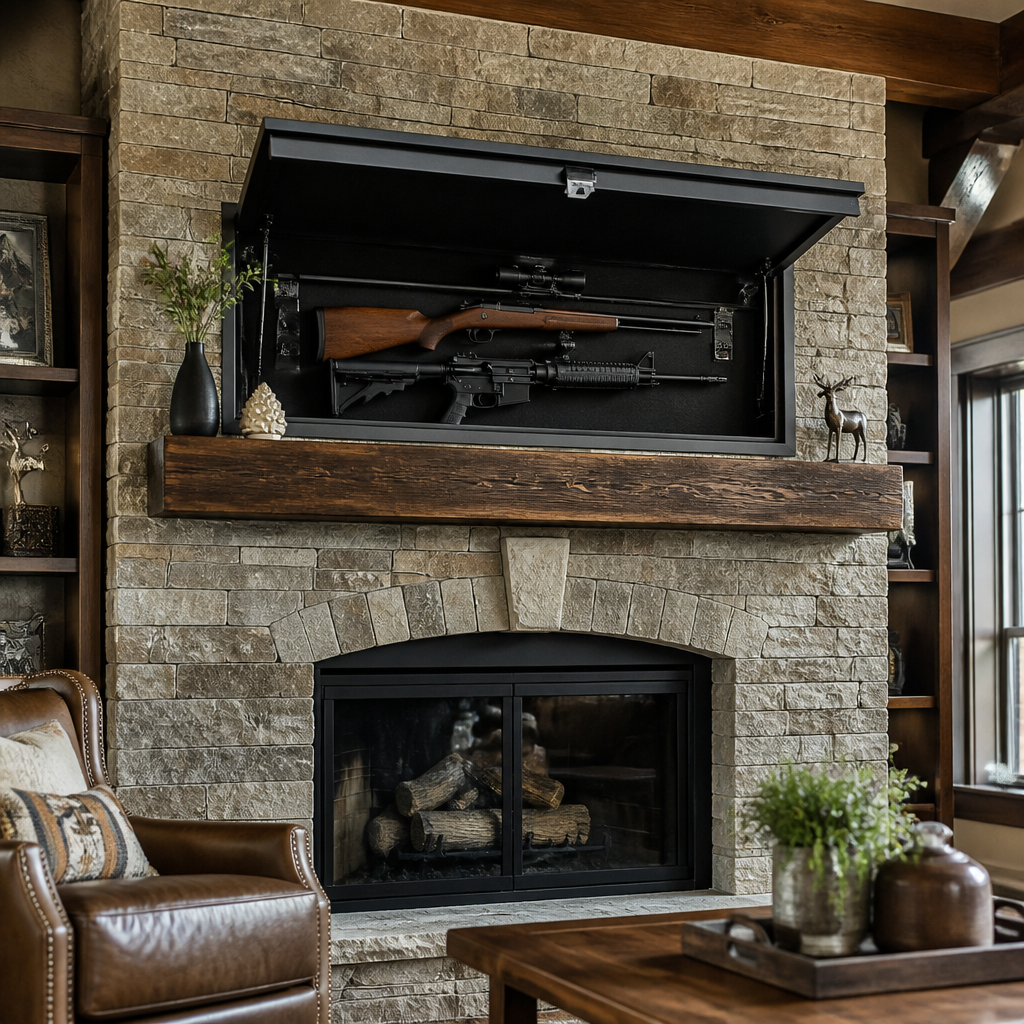
A mantel gun safe gives firearm owners a way to keep defensive weapons close, concealed, and protected in one of the most visible rooms in a home. The best mantel gun safes for storing firearms above fireplaces combine hidden access, child resistance, solid locking hardware, and installation methods that account for heat, weight, and the structure of the mantel itself. In practice, this category sits inside a broader family of hidden and discreet gun storage solutions that also includes concealment shelves, under-bed safes, in-wall cabinets, mirror safes, and furniture-integrated lockboxes. As a sub-pillar topic within gun safes and safety, mantel storage matters because it solves a specific problem: fast access in a living area without leaving a handgun or carbine exposed.
Not every fireplace setup is appropriate for firearm storage, and that is the first point many buyers miss. A true mantel gun safe is usually a hidden compartment built into or disguised as a mantel shelf, surround, or decorative overmantel. Some are purpose-built products with RFID or biometric locks. Others are custom carpentry projects that incorporate a steel lockbox behind wood facing. The best options are not chosen by appearance alone. They are evaluated by interior dimensions, gauge of steel, lock reliability, opening speed, anchor points, firebox clearance, and whether heat from the fireplace could degrade lubricants, ammunition, optics, batteries, or the safe’s electronics over time.
From firsthand work evaluating residential firearm storage, I have found that buyers often start with aesthetics and only later ask the structural and safety questions that actually determine whether a unit is viable. Above-fireplace storage can be effective, but only when it is installed on a fireplace that runs cool enough at the mantel, when the firearm is compatible with the compartment dimensions, and when the lock can be opened consistently under stress. A hidden compartment that warps from repeated heat cycles or an electronic latch that fails after battery neglect is worse than a simpler safe placed elsewhere. The goal is discreet readiness, not novelty.
This guide explains how to choose the best mantel gun safe, which features matter most, how fireplace type changes the decision, and how mantel storage fits into a complete hidden firearm storage plan. It also acts as the main hub for hidden and discreet gun storage solutions by showing where mantel safes excel and where alternatives make more sense.
What makes a mantel gun safe worth buying
The best mantel gun safes do four jobs at once: conceal the firearm, prevent unauthorized access, protect the gun from environmental stress, and allow practical retrieval. Concealment alone is not security. A hollow decorative shelf with a magnetic catch may hide a pistol from casual visitors, but it is not a safe if a child or burglar can open it without a credential. For a product to qualify as a serious option, it should include a steel enclosure or reinforced locking compartment, a tamper-resistant opening mechanism, and secure anchoring into studs, masonry, or a structural mantel frame.
Access method matters because the use case is usually defensive storage in a common area. RFID locks are popular in concealment furniture because they open quickly and allow the safe exterior to remain visually clean. Biometric locks can work well if the scanner is high quality and enrolled correctly, but inexpensive fingerprint readers are notoriously inconsistent with dry skin, dirty fingers, or hurried placement. Mechanical simplex-style locks are slower to disguise in decorative furniture, yet they remain one of the most dependable options because they do not rely on batteries. If an electronic lock is used, it should always have a backup key or backup power access.
Interior layout is another decisive feature. Many mantel safes are sized for one or two handguns, spare magazines, and a small light. Some deeper custom units hold a short-barreled rifle or folding PCC, but that requires careful planning around local laws, room geometry, and safe depth. Foam inserts should support the firearm without pressing on optics or activating controls. Soft-lined interiors reduce finish wear, but the steel shell underneath is what provides meaningful resistance against pry attacks.
Fireplace heat, materials, and installation risks
The biggest technical issue with storing firearms above fireplaces is heat. Wood-burning fireplaces and some gas units can raise temperatures at the mantel enough to affect wood finishes, adhesives, batteries, optics, and lubricants. Before installing any safe, measure real operating temperatures at the exact mounting point during a full burn cycle. An infrared thermometer helps, but a contact probe or data logger is better because it captures temperature over time rather than a single surface snapshot. Many mantel manufacturers and building codes specify minimum clearances between the firebox opening and combustible trim. Those clearance rules are about fire safety, not firearm storage suitability, so passing code does not automatically mean the location is ideal for guns or ammunition.
Masonry fireplaces, zero-clearance factory-built units, and electric fireplaces behave differently. Electric fireplaces usually present the least thermal risk at the mantel because their heat output is often front-vented and comparatively moderate, though models vary. Gas fireplaces can still create substantial heat pockets inside enclosed millwork if ventilation is poor. Wood-burning fireplaces produce the broadest temperature swings and soot exposure. In several inspections I have done, the face of a mantel remained only warm to the touch while the cavity behind decorative trim became much hotter because warm air was trapped. That hidden buildup can shorten battery life in electronic locks and damage foam inserts.
Installation also determines long-term reliability. Mantel assemblies are not always structural. Some decorative mantels are little more than hollow shells attached to cleats. A safe loaded with a steel box, handgun, magazines, and locking hardware can become surprisingly heavy, especially if a drop-down door shifts weight outward during opening. The safe must be anchored to framing or masonry with hardware rated for the load and the material. If the product is a concealment shelf mounted above an existing mantel rather than integrated into it, use lag bolts into studs or approved masonry anchors, and verify that the opening arc will not strike tile, stone, or trim.
Best types of hidden and discreet gun storage for mantel areas
Mantel gun safes are only one part of hidden firearm storage, and understanding the broader category helps buyers choose intelligently. In living rooms and family rooms, the most common options are mantel safes, concealment shelves, framed-art safes, mirror safes, and in-wall compartments hidden behind décor. Each serves a different balance of access speed, security, capacity, and installation complexity. Mantel safes stand out when homeowners want to use otherwise wasted space above a fireplace while keeping a defensive handgun near the room where they spend the most time.
Concealment shelves are usually easier to install than a custom mantel build because they mount like heavy floating shelves and include a hidden drop-down compartment. They work well when the actual fireplace mantel is too hot or too shallow for safe firearm storage. In-wall safes offer better theft resistance when recessed between studs and properly anchored, but they need adequate wall depth and may not fit above masonry fireplace surrounds. Furniture-integrated lockboxes, such as end-table safes or lift-top coffee tables, reduce heat concerns entirely, though they can be easier for guests to inspect up close. Under-bed safes are excellent for bedroom access but do not solve the living-room readiness problem.
| Storage type | Best use | Main advantage | Main limitation |
|---|---|---|---|
| Mantel gun safe | Living room defensive access | Uses discreet central-room space | Heat and structural constraints |
| Concealment shelf | Fast-access pistol storage | Simple retrofit installation | Usually less internal capacity |
| In-wall safe | Hidden long-term secure storage | Better theft resistance when recessed | Requires suitable wall cavity |
| Mirror or art safe | High-disguise vertical storage | Blends into décor naturally | Can be slower to access |
| Furniture safe | Rooms where wall mounting is impractical | No fireplace heat exposure | Consumes floor space |
As a hub topic, hidden and discreet gun storage should be approached as a room-by-room planning exercise. Above-fireplace storage is strong for concealment and convenience, but it should be paired with other solutions in the home. A quick-access bedroom safe, a larger anchored safe for primary storage, and a carefully chosen living-room concealment option together create a safer overall system than relying on one hidden compartment for every firearm-related need.
How to evaluate security, speed, and child resistance
The core buying question is simple: how secure does the compartment need to be relative to how fast it must open? A mantel gun safe used for a loaded home-defense pistol demands both. That means buyers should examine steel thickness, hinge protection, latch design, and whether the door can be pried from the exposed edge. Thin-gauge furniture panels with a token lock are not enough. At minimum, look for a real steel lockbox housed within the decorative surround, not just wood acting as the barrier.
Child resistance requires more than concealment. Children are naturally observant, and “secret” compartments often become less secret over time. A safe should require an RFID tag, valid fingerprint, keypad code, or mechanical combination rather than a simple push latch. It should also auto-lock after closing and retain settings after battery changes. Some better models include tamper alerts or interior LEDs that aid safe handling in low light. If the unit uses biometric access, enroll multiple fingers from both hands and test access after washing or drying your hands, because real-world conditions reveal weaknesses that showroom demos hide.
Speed should be measured realistically. Can you open the compartment from your usual seat on the couch? Can a right-handed and left-handed adult both reach it safely? Is the firearm oriented for a full firing grip on retrieval, or does the door geometry force awkward handling? In my testing of concealment furniture, the fastest units were not always the most sophisticated. They were the ones with consistent latches, predictable door travel, and enough interior clearance to draw the firearm without snagging sights or mounted lights.
Choosing size, capacity, and firearm compatibility
Most mantel gun safes are best for handguns, not full-length firearms. Even when a manufacturer advertises compatibility with compact carbines or takedown platforms, buyers should confirm exact internal dimensions and allow space for optics, sling hardware, and magazine shape. A pistol with a slide-mounted optic and weapon light can need significantly more clearance than the same model in factory configuration. Measure the firearm at its widest and tallest points, then compare those numbers to the usable interior, not just the external product dimensions.
Ammunition storage deserves separate thought. Small quantities of loaded magazines stored with the firearm are common in quick-access compartments, but bulk ammunition should stay in a cooler, drier location. Heat cycling is the concern above fireplaces, not merely peak temperature. Repeated warming and cooling can affect packaging, primers over very long periods, and the longevity of electronics stored alongside ammunition. A practical approach is to keep the ready firearm and limited support gear in the mantel safe while placing reserves in a dedicated locked cabinet or full-size safe elsewhere in the house.
Capacity planning also includes future changes. If you may switch from a subcompact pistol to a full-size handgun with optic and light, buy for that footprint now. If you intend to store legal documents, a suppressor where lawful, or a compact medical kit alongside the firearm, verify partition flexibility. The best discreet storage solutions are not just hidden; they are dimensioned around the way the gun is actually configured and used.
Recommended buying criteria and common mistakes
When narrowing the best mantel gun safe options, prioritize verified lock performance, concealed steel construction, proper anchoring provisions, and safe thermal conditions at the install site. Reputable concealment brands often publish dimensions, lock type, weight, and mounting guidance, but the best results usually come from treating the listed product as a starting point rather than a complete answer. Ask whether replacement keys are controlled, whether the RFID system supports multiple tags, whether the battery compartment is accessible without exposing the firearm, and whether customer support stocks replacement struts, hinges, or latch components.
The most common mistake is assuming hidden equals secure. The second is ignoring fireplace heat. The third is choosing based on exterior style without checking access ergonomics. Other frequent errors include mounting into drywall alone, overloading a decorative shelf, storing a firearm with a chamber flag or trigger lock that defeats the point of defensive access, and failing to practice retrieval with an unloaded firearm. Buyers also underestimate maintenance. Electronic locks need battery schedules, hinges need periodic inspection, and interiors should be checked for dust, lint, or signs of heat-related adhesive failure.
If this article is your entry point into hidden and discreet gun storage solutions, use it as the hub for a broader plan. Compare mantel safes with concealment shelves for adjacent walls, in-wall safes for hallways or studies, furniture safes for rooms without structural mounting options, and full-size burglary-rated safes for primary storage. The best setup is layered: discreet access where it is needed, stronger long-term security where capacity matters, and consistent safe handling procedures everywhere.
The best mantel gun safes for storing firearms above fireplaces succeed when they balance concealment, quick access, and real security without ignoring heat or installation realities. They are most effective on fireplace setups that remain thermally stable at the mounting point, with a steel lockbox, dependable locking method, and anchoring into structural material. For many homeowners, a mantel safe is an excellent living-room solution for a ready handgun, but it is rarely the only storage answer a household should rely on.
The bigger lesson from hidden and discreet gun storage solutions is that every room presents a different tradeoff. Mantel safes maximize concealment in a central gathering area. Concealment shelves simplify retrofits. In-wall safes improve stealth and theft resistance. Furniture safes avoid fireplace heat. Full-size safes remain essential for primary storage, larger collections, and broader protection against burglary. Choosing well means matching the storage type to the room, the firearm, the access need, and the people in the home.
Start by measuring your mantel area, checking real operating temperatures, and listing the exact firearm setup you want to store. Then compare hidden storage products against those requirements instead of shopping by appearance alone. A discreet safe that opens reliably and is installed correctly will serve you far better than a decorative compartment that only looks clever.
Frequently Asked Questions
Are mantel gun safes safe to install above a fireplace?
They can be, but only when the safe, the mantel, and the fireplace setup are evaluated as a system rather than as separate parts. The biggest issue is heat. A mantel may seem cool to the touch during normal use, yet the wall cavity, mantel shelf, and surrounding trim can still experience temperature swings that affect firearms, ammunition, optics, electronics, and locking components over time. Before installing any mantel gun safe, homeowners should confirm how much heat actually reaches the installation area during fireplace use, especially with wood-burning units, gas fireplaces with strong radiant output, or decorative surrounds that trap warmth near the shelf.
Structural support is equally important. A loaded safe is much heavier than most decorative mantel accessories, and the combined weight of the enclosure, mounting hardware, and firearm can exceed what a hollow decorative mantel or lightly fastened trim was designed to hold. The best installations anchor into framing members or masonry and account for the weight rating of the mantel itself. If the safe is recessed, the wall cavity depth, stud spacing, venting, and any electrical or gas components in the wall should be checked before cutting or drilling.
There is also a practical safety question: whether the location supports secure, controlled access. A mantel safe should open in a way that allows an adult to retrieve a firearm efficiently without making the gun visible to children or guests. In short, a mantel gun safe can be a smart storage solution above a fireplace, but only if heat exposure, load-bearing capacity, code considerations, and safe access are all addressed during planning and installation.
What features should I look for in the best mantel gun safe?
The best mantel gun safes balance concealment, security, speed, and durability. Start with the locking system. Many buyers prefer fast-access options such as biometric readers, RFID entry, or electronic keypads, but those features should be backed up by a mechanical override in case of dead batteries or electronic failure. The lock should feel solid, not flimsy, and the door or concealment panel should open consistently without sticking or rattling.
Construction quality matters just as much as the lock. Look for steel-bodied safes or reinforced hidden compartments with tamper-resistant hinges, solid internal mounting points, and hardware designed to resist pry attempts. Child resistance is a major priority in a room where family members and visitors gather, so avoid decorative concealment products that hide a firearm but do little to prevent unauthorized access. A true safe or secure locking compartment is more appropriate than a simple hidden shelf for most households.
Capacity and fit should match the firearm you plan to store. A compact handgun with a weapon light, spare magazine, or small defensive accessories may require more internal room than expected. Soft interior lining, adjustable retention, and organized storage can help protect the firearm and keep it accessible in a consistent orientation. If the unit sits above a working fireplace, materials should also tolerate environmental changes better than low-grade particle board or weak finishes.
Finally, pay attention to installation design. The strongest products either integrate securely into wall framing or mount with hardware appropriate for the mantel structure. A good mantel gun safe should feel intentionally engineered for concealment and retention, not like a decorative box repurposed for firearm storage. When those elements come together, you get a hidden storage solution that is discreet, dependable, and practical for defensive use.
Will heat from the fireplace damage the firearm or the safe?
It can, depending on how much heat reaches the mantel area and how often the fireplace is used. Firearms are made of metal, polymers, springs, coatings, lubricants, and sometimes electronic accessories such as red dots or lights. Repeated heat exposure can dry out lubrication, accelerate finish wear, affect optics and batteries, and create conditions that encourage condensation when the area cools back down. Even if the firearm itself remains functional, the long-term reliability of the lock, electronics, and internal lining may suffer if the safe is installed where temperatures fluctuate too dramatically.
The type of fireplace makes a difference. Wood-burning fireplaces often produce more aggressive radiant and convective heat than many electric units, while some gas fireplaces generate substantial heat directly around the surround and mantel. In some homes, the mantel shelf remains relatively protected because of design and clearance; in others, the area above the firebox gets surprisingly warm. That is why real-world temperature testing is valuable. Homeowners should monitor the exact installation spot during and after fireplace use instead of assuming it is safe based only on general product descriptions.
If heat is a concern, there are several ways to reduce risk. Choose a location with verified safe temperature levels, install insulation or shielding only where appropriate and code-compliant, limit storage of heat-sensitive accessories, and maintain the firearm more frequently. Some owners ultimately decide that a nearby hidden compartment in the same room, but not directly above the fireplace, is the better compromise. The key point is that concealment should never outweigh environmental suitability. A mantel gun safe works best when the fireplace area supports stable conditions for both the firearm and the safe’s hardware.
Are mantel gun safes a good option for homes with children?
They can be a very good option, but only if the unit provides real security and is used consistently. The phrase “hidden” does not mean “childproof.” A firearm stored behind a decorative panel or inside an unsecured compartment may be out of sight, but that alone is not adequate protection in a home with children. A proper mantel gun safe should include a reliable locking mechanism, sturdy construction, and mounting that prevents the unit from being removed or defeated easily.
One reason mantel gun safes appeal to parents is that they place the firearm in a location that is elevated, discreet, and integrated into a room where adults often spend time. That can support quick access for defensive purposes while reducing casual visibility. However, responsible storage still requires more than product choice. Children should be taught age-appropriate firearm safety, access methods should remain private, backup keys or override tools should be secured separately, and the firearm should always be returned to the safe immediately after handling.
Parents should also think through daily-use realities. If guests, babysitters, or extended family members spend time in the home, the safe should resist accidental discovery and unauthorized operation. Biometric access can be helpful for speed, but it should be tested regularly and not treated as infallible. The best setup is one that combines hidden placement, a robust lock, secure installation, and consistent household habits. When those pieces are in place, a mantel gun safe can be part of a safer firearm storage strategy in family homes.
How does a mantel gun safe compare to other hidden gun storage options?
A mantel gun safe occupies a unique niche within the broader world of hidden and discreet firearm storage. Compared with bedside safes, under-bed drawers, wall safes, concealment furniture, and picture-frame compartments, a mantel safe is especially attractive for homeowners who want defensive access in a main living area without leaving a firearm visible. It makes use of a prominent architectural feature that many people would not immediately associate with gun storage, which can improve concealment when the design is done well.
Its biggest advantages are location and discretion. In homes where the living room or family room is the central gathering space, storing a defensive handgun in a mantel safe can make more practical sense than keeping it in a bedroom safe across the house. At the same time, a well-built mantel unit can blend into décor better than some obvious concealment furniture pieces. That said, it is not automatically the best option for every home. Fireplaces introduce variables that other storage locations often avoid, including heat exposure, clearance concerns, and structural limitations in the mantel or chimney surround.
By comparison, a dedicated wall safe in a cooler interior wall may offer stronger environmental protection, while a quick-access bedside safe may provide faster nighttime access. Concealment shelves and furniture can be visually subtle, but some offer less real security than a steel safe with proper locking hardware. The best choice depends on where access is needed most, how much physical security the household requires, and whether the installation environment is suitable for long-term firearm storage. For many owners, a mantel gun safe is an excellent room-specific solution, but it should be evaluated alongside other hidden storage options rather than chosen on appearance alone.