
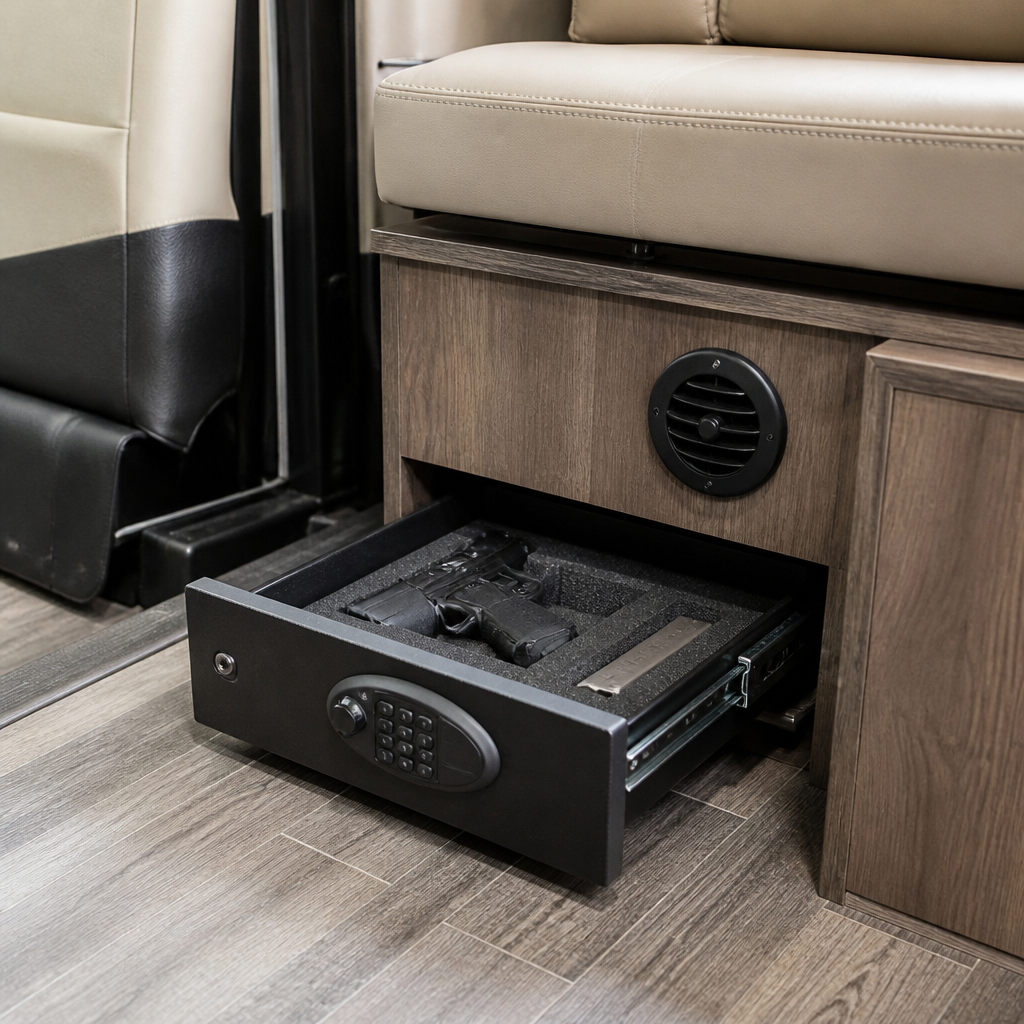
RV and camper owners face a storage problem that looks simple until they live with it: how do you keep a firearm secure, quickly accessible, protected from theft, and out of sight inside a small, mobile space? The best discreet gun safes for RV and camper owners solve all four problems at once by combining concealment, physical security, and practical fit within the realities of life on the road. In this context, “discreet” means a safe or lockbox that does not obviously look like firearm storage, is hidden in a low-visibility location, or is integrated into furniture, cabinetry, or a vehicle structure. “Hidden gun storage solutions” includes purpose-built concealment safes, under-bed boxes, console vaults, false-bottom compartments, lockable drawer inserts, and compact quick-access handgun safes mounted in overlooked spaces.
This matters because RVs and campers are uniquely vulnerable. They are frequently left unattended at trailheads, fuel stops, grocery stores, campgrounds, and repair shops. Their walls, doors, and windows are generally less resistant than those in fixed homes, and they often contain obvious signs of travel schedules and high-value gear. A firearm stored loosely in a drawer, backpack, or factory cabinet is not secure against smash-and-grab theft, vibration during travel, moisture swings, or unauthorized access by children and guests. I have worked with mobile owners who assumed “out of sight” was enough, only to realize that the first places a thief checks are obvious cubbies, bedside drawers, and overhead bins.
A discreet gun safe for an RV needs more than a lock. It should anchor to a structural member or reinforced surface, resist prying, stay shut over rough roads, fit the owner’s firearm and carry method, and remain functional in tight quarters. It should also match the owner’s travel pattern, from weekend campers carrying one defensive handgun to full-time RV families managing layered security and variable state laws. This guide covers the main hidden and discreet gun storage solutions, explains where each works best, and gives you a practical framework for choosing a setup that is secure, low-profile, and realistic for life in a moving home.
What makes a gun safe discreet and RV-ready
A gun safe is discreet when it avoids attention before and during a break-in. In an RV, that usually means one of three approaches: concealment by appearance, concealment by placement, or concealment by integration. Appearance-based concealment includes safes disguised as ordinary objects or built behind a panel. Placement-based concealment means mounting a compact safe under a bed platform, inside a dinette bench, behind hanging clothes, or under a driver or passenger seat. Integration means using a custom insert in an existing cabinet, drawer, or nightstand area so the locking container blends with the coach interior. The strongest options combine concealment with real steel, robust locking hardware, and solid anchoring.
RV-ready storage must also account for constant vibration, changing temperatures, dust, and humidity. Many low-cost bedside safes marketed for apartments fail in campers because their thin shells flex, their electronic keypads are sensitive to moisture, or their mounts loosen over washboard roads. A good mobile setup uses at least 12-gauge to 14-gauge steel for small handgun boxes, internal hinges when possible, anti-pry lips, and mounting points that can be backed by steel plates or tied into framing. Gas struts, drawer slides, and magnetic panels should be tested under motion, not just when parked. If a compartment opens after fifty miles of rough road, it was never secure.
Access method matters too. Biometric safes are popular, but not all fingerprint readers perform well with dusty fingers, cold weather, or aging sensors. In practice, I recommend owners prioritize a quality simplex-style mechanical lock, a proven electronic keypad with backup key, or a premium biometric model from a reputable brand tested repeatedly in real conditions. Fast access is important for defensive use, but reliability matters more. If a safe opens in 1.2 seconds in a lab and fails after a humid week near the coast, it is the wrong choice for travel.
Best discreet gun safe types for RV and camper owners
The best category for most owners is the compact quick-access handgun safe mounted in a concealed location. Models from Vaultek, Fort Knox, V-Line, and Hornady are common choices because they are small enough for under-bed platforms, bench seats, and wardrobe bases while still offering meaningful steel thickness and dependable locking systems. A quick-access box works especially well for solo travelers and couples who carry a primary defensive handgun and want rapid nighttime access without leaving the gun exposed. The key is disciplined placement: hidden from casual view, reachable from sleeping or seated positions, and firmly bolted down.
Under-bed gun safes are the next strong option, especially in fifth wheels, travel trailers, and motorhomes with dedicated bed platforms. These safes maximize dead space and can hold one or more handguns, important documents, and sometimes a broken-down long gun depending on dimensions. The strongest versions use slide-out drawers with internal locking bolts and full-length steel housings. They are not truly invisible, but when installed under a bed skirt or platform panel they are rarely discovered quickly. For many full-timers, this is the best balance of capacity, concealment, and day-to-day usability.
Console vaults and seat-mounted lockboxes are ideal for camper vans, truck campers, and tow vehicles that double as the owner’s local transport. If you leave the RV in a campground and take the truck into town, the most useful discreet safe may be the one installed in the vehicle center console or under a rear seat. Brands such as Console Vault and Tuffy Products build fitted units for specific vehicle models, giving better theft resistance than cable-locked universal boxes. These are especially valuable during transitions, which is when firearms are often mishandled or temporarily stashed in poor locations.
Concealment furniture and hidden compartments appeal to owners who want maximum discretion, but quality varies widely. A mirror safe, shelf safe, or hidden cabinet insert can work well in larger rigs with residential-style interiors, yet many concealment products prioritize the “secret compartment” idea over actual security. If the hidden panel is easy to remove and the lockbox behind it is thin, the concealment is cosmetic. Better solutions use a proper steel container behind the disguised opening. Think of concealment furniture as a layer that delays discovery, not a replacement for steel, lock quality, and anchoring.
How to choose the right safe for space, access, and threat level
The right discreet gun safe starts with your actual use case. Ask four direct questions: What firearm are you securing? How quickly must you access it? Who else enters the RV? How often is the rig left unattended? A weekend couple carrying one compact pistol has different needs than a family traveling full time with children, frequent visitors, and a tow vehicle. In my experience, bad purchases happen when owners shop by brand hype or lock type instead of these use conditions. A safe should fit the gun, the space, and the daily routine without creating shortcuts that lead to unsafe storage.
Size and clearance are critical in campers because a safe that technically fits can still be impractical. Measure the firearm with its light, optic, or holster if stored that way. Then measure the opening path, not just the compartment footprint. I have seen excellent safes become unusable because the lid hit a bed frame, a drawer front, or a seat base. For under-bed and bench installations, account for bedding, lift mechanisms, and access from your usual body position. If you must kneel awkwardly, move cushions, or open two barriers before reaching the safe, your “quick-access” plan will fail under stress.
Threat level should drive construction standards. In a low-risk use case, a premium lockbox hidden well and anchored properly may be enough to defeat opportunistic theft and unauthorized handling. In higher-risk scenarios, such as extended boondocking, predictable travel routines, or urban overnight parking, step up to heavier steel, stronger boltwork, and a more deeply concealed mounting location. Also think about selective visibility. Service technicians, campground neighbors, and social media followers should never learn where valuables are stored. Discreet storage works best when paired with discreet behavior.
| Safe Type | Best For | Main Advantage | Main Limitation |
|---|---|---|---|
| Compact quick-access handgun safe | Most RV bedrooms and dinettes | Fast access and flexible mounting | Limited capacity |
| Under-bed drawer safe | Full-time RVs and larger trailers | Uses dead space and adds storage volume | Heavier and harder to install |
| Console vault or seat box | Camper vans and tow vehicles | Strong transition security off-campsite | Vehicle-specific fit required |
| Hidden compartment with steel insert | Owners prioritizing concealment | Lowest visual profile | Quality varies widely |
Where to install a hidden gun safe in an RV or camper
The best location is the one that balances concealment, anchor strength, and repeatable access. In trailers and fifth wheels, strong candidates include under the bed platform near the bedside, inside a dinette bench backed by framing, beneath a fixed sofa base, and inside a wardrobe toe-kick area with a reinforced false panel. In motorhomes, seat pedestals, bed bases, and certain cabinetry adjacent to steel substructures can work well. In camper vans, under-seat bases and rear platform bed framing are often the strongest and most practical locations. Avoid thin luan-backed cabinets, removable decorative panels, and overhead compartments with weak attachment points.
Anchoring deserves more attention than most owners give it. An RV safe that is not bolted properly is just expensive luggage. Use through-bolts with large washers or steel backing plates whenever possible. If mounting to wood, reinforce the area and verify you are not relying only on plywood skins or particle board. If mounting near tanks, wiring, propane lines, or slide mechanisms, inspect the hidden side before drilling. I strongly prefer backing plates because they spread load and reduce pull-through risk on rough roads. Threadlocker on hardware is also smart in mobile installations.
Concealment should not compromise emergency access. A safe hidden behind hanging clothes in a wardrobe may seem ideal until you try to reach it at 2 a.m. A false-bottom dinette bench may work beautifully for long-term storage but poorly for immediate defensive access. Split your storage if needed. Many experienced travelers keep one fast-access safe near the sleeping area and a second, deeper-concealment locked container for spare firearms or sensitive items. That layered approach is often better than forcing one safe to do every job.
Key features, legal considerations, and common mistakes
For this subtopic, several features separate a worthwhile discreet gun safe from a weak one. Look for steel thickness that resists hand-tool attacks, anti-pry overlap around the door, concealed or protected hinges, tamper alerts on electronic models, interior padding that prevents optic damage, and power options suited to travel. If you choose a rechargeable electronic safe, confirm standby life and charging method. If you choose a biometric model, test multiple fingers and verify reliable enrollment. For long guns in compact campers, takedown-capable firearms and modular interior foam often make secure hidden storage much easier than trying to fit a full-length rifle.
Legal issues matter because RV owners cross jurisdictions. Firearm transport, loaded storage, magazine restrictions, and access rules can vary by state, park authority, tribal land, or Canadian border requirements. A discreet safe does not override those laws. Before a long route, verify rules for each state and any federal or private property along the way. If children travel with you, storage standards become even more important; several states impose criminal penalties for negligent access. Documentation, serial-number records, and insurance photos should be stored separately, ideally in encrypted digital form and a second physical location.
The biggest mistakes are predictable. Owners buy a safe that is too large to operate comfortably, too small for the firearm with accessories, or too light to resist prying. They rely on a cable around a seat frame when a bolted mount was possible. They hide a firearm in a factory cabinet with a magnetic child latch and call it secure. They choose a gimmick concealment piece with weak steel. They fail to test access in darkness, while seated, or under travel conditions. The best discreet gun storage solutions are boring in the best sense: strong, repeatable, quiet, and invisible to everyone except the owner who needs them.
The best discreet gun safes for RV and camper owners are the ones that fit real travel life, not showroom assumptions. Hidden and discreet gun storage solutions work when they combine three things: genuine steel security, thoughtful concealment, and installation that respects the structure and rhythm of a mobile home. For most owners, that means a compact quick-access handgun safe or under-bed drawer safe anchored in a low-visibility location, with a secondary vehicle or deep-storage option if travel patterns require it. The exact format can vary, but the principle does not: concealment helps, yet a firearm in an RV must still be locked in a properly mounted container.
If you use this article as your hub for hidden gun storage, focus next on the practical subtopics that shape a purchase: the best under-bed gun safes for travel trailers, console vault options for tow vehicles and camper vans, biometric versus mechanical lock performance in humid environments, and step-by-step mounting methods for thin-walled RV cabinetry. Those details determine whether a safe is merely hidden or actually secure. Start by measuring your space, mapping your access path, and identifying one anchored location you can trust. Then choose a discreet safe that matches your firearm, your floor plan, and the way you really travel.
Frequently Asked Questions
What makes a gun safe “discreet” for RV and camper owners?
A discreet gun safe for an RV or camper is more than just a small lockbox. It is a storage solution designed to stay out of obvious view, blend into the interior, and avoid drawing attention from guests, service technicians, campground neighbors, or potential thieves. In practical terms, that usually means the safe can be hidden inside a bench seat, under a bed platform, inside a wardrobe, behind a false panel, or integrated into furniture without looking like traditional firearm storage. The goal is concealment without sacrificing actual security.
For RV and camper owners, discretion matters because the space is compact and highly visible. Unlike a conventional home, there are fewer closets, fewer permanent walls, and fewer truly private storage areas. If a safe is sitting in plain sight under a dinette or strapped near the driver’s seat, it may technically secure a firearm, but it is not especially discreet. The best options combine a low-profile form factor with mounting flexibility, allowing the safe to fit into overlooked spaces while still being anchored to something structurally sound.
It is also important to understand that discreet does not mean disguised novelty storage. While hidden-compartment products can have a role, a quality RV gun safe should still provide solid lock construction, durable steel, reliable mounting points, and a practical opening method. In other words, the safe should not obviously look like firearm storage, but it still needs to function like real security equipment. The most effective discreet safes balance concealment, theft resistance, and quick access in a way that fits the realities of mobile living.
What type of gun safe works best in a small RV or camper?
In most cases, the best choice for a small RV or camper is a compact, vehicle-style handgun safe or a slim vertical lockbox that can be securely mounted inside an enclosed compartment. Full-size residential safes are usually too heavy, too bulky, and too difficult to anchor properly in a recreational vehicle. They can also create weight-distribution problems, which is a serious consideration in smaller trailers, camper vans, and motorhomes. Compact safes are generally easier to place discreetly and more realistic for the structure of an RV.
For handgun owners, low-profile quick-access safes are often the most practical. These models are designed to fit under seats, inside nightstands, within bed platforms, or in storage cubbies. Look for steel construction, reinforced locking points, and a mounting system that works with the available materials in your rig. Biometrics, keypad entry, and simplex-style mechanical locks can all be good options depending on your priorities, but reliability matters more than features. A simple lock that works every time is often better than a more complex one that becomes temperamental in varying temperatures or road conditions.
If you need to store a longer firearm, the challenge increases because rifles and shotguns take up much more space and are harder to conceal in a compact mobile layout. In that situation, owners often look for narrow vertical cabinets, under-bed long-gun storage, or custom-integrated locking compartments. The best option depends on your floorplan, but the same principles apply: secure mounting, hidden placement, and a shape that fits the space without advertising what is inside. In a mobile environment, the best safe is usually the one that matches both your firearm and your RV’s actual storage geometry.
How should a gun safe be mounted inside an RV or camper for real security?
Mounting is one of the most important parts of choosing a discreet gun safe for an RV or camper. A safe that is hidden but not properly anchored can still be stolen quickly if someone finds it. In a mobile living space, you also have the added issue of vibration, shifting loads, and movement during travel. That means the safe must not only resist theft, but also stay secure while the vehicle is in motion. A well-mounted safe should feel like a fixed part of the RV rather than an accessory sitting in storage.
The ideal mounting point is a structurally solid area such as reinforced flooring, a metal frame component, a seat base with substantial support, or a cabinet section backed by durable material. Thin decorative paneling alone is usually not enough. Many RV interiors are made with lightweight construction materials, so owners need to be careful not to assume that any surface can support a safe. Before drilling or bolting anything in place, it is wise to confirm what is behind the mounting area, including wiring, plumbing, propane lines, ducting, and tank locations. In an RV, hidden systems often run through places that look empty at first glance.
Whenever possible, use the manufacturer’s recommended hardware and installation method, and consider professional help if you are unsure about the structure of your camper or motorhome. A discreet safe should also be mounted in a position that allows the door to open fully and the firearm to be retrieved safely under stress. Security is not just about making theft harder; it is also about making access reliable when needed. The strongest setup combines hidden placement, solid anchoring, safe clearance for operation, and a location that does not interfere with everyday use of the RV.
Are biometric gun safes a good choice for life on the road?
Biometric gun safes can be a very good option for RV and camper owners, but only if the model is high quality and has a strong reputation for consistent performance. The main appeal is obvious: quick access without needing to fumble for a key or remember a code, which can be especially useful in a dark sleeping area or a tight floorplan. In a small mobile space where every second and every movement matters, that convenience can be a real advantage.
That said, life on the road introduces conditions that can affect electronics. Temperature swings, humidity, dust, vibration, and inconsistent power management are all common in RV travel. A cheap biometric safe may work fine in a climate-controlled bedroom and perform poorly after months of bouncing down highways, sitting in summer heat, or dealing with condensation in shoulder seasons. That is why experienced buyers focus less on the idea of biometric access and more on build quality, fingerprint reader reliability, battery life, and the presence of a dependable backup entry method.
The best approach is to choose a biometric safe only if it also includes a well-designed keypad or mechanical override and if you are willing to test it regularly. Enroll multiple fingerprints, replace batteries on a schedule rather than waiting for failure, and practice opening it in realistic conditions. For some RV owners, a mechanical push-button lock may offer more long-term confidence. For others, a premium biometric model provides the right mix of speed and convenience. The right answer depends on your tolerance for electronics, how often you access the safe, and whether the unit has proven itself under mobile, real-world conditions.
What should RV and camper owners consider besides concealment when choosing a discreet gun safe?
Concealment is important, but it should never be the only factor. A discreet gun safe also needs to match your travel habits, your storage space, your firearm type, and your day-to-day routine inside the RV. For example, a safe hidden deep under a bed platform may be excellent for theft deterrence, but not very practical if you want fast access at night. On the other hand, a quick-access safe mounted near the sleeping area may be more functional, but it has to be positioned carefully so it stays out of casual view. The best setup is the one that aligns concealment with how you actually live on the road.
You should also evaluate size, weight, lock type, corrosion resistance, and interior protection. RVs often experience moisture fluctuations, so padded interiors and basic rust resistance can matter more than many buyers expect. A safe that is too heavy may strain lightweight cabinetry or affect cargo capacity, while a safe that is too small may force awkward storage that slows access or risks damage to the firearm. It is also worth thinking about whether you need room for a spare magazine, important documents, or other valuables, since many RV owners prefer one secure storage point for multiple essential items.
Finally, legal compliance and responsible storage practices should always be part of the decision. Firearm transport and storage laws can vary by state, campground policy, and travel route, so RV owners should understand the rules that apply wherever they are going. A good discreet safe helps support lawful, responsible ownership by keeping the firearm secured from unauthorized access, reducing visibility, and limiting theft risk while traveling or parked. In the end, the best discreet gun safe for an RV or camper is not just hidden well; it is secure, dependable, appropriately mounted, and genuinely usable in the unique environment of life on the road.