
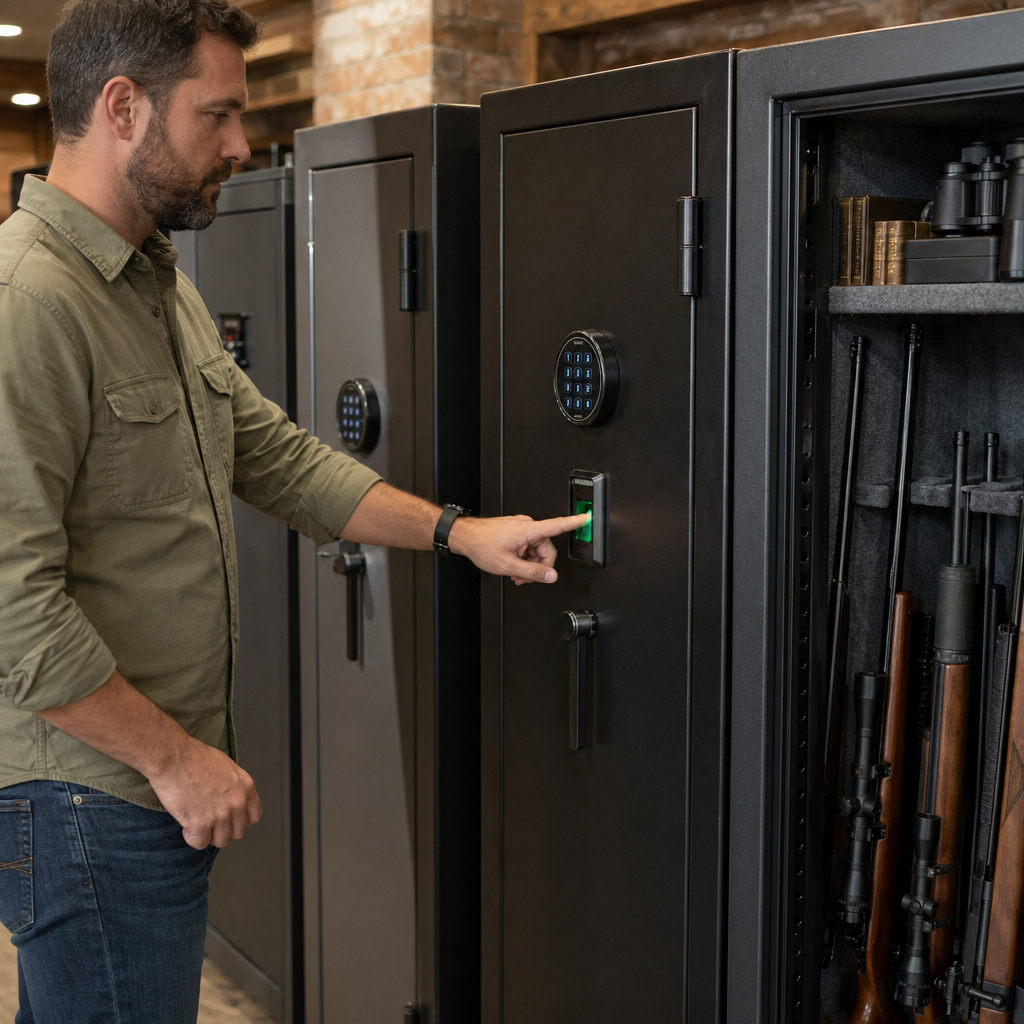
Choosing between gun safes that offer dual access with PIN and biometric entry requires more than comparing price tags, because the best safe is the one that opens reliably under stress, resists unauthorized access, fits your firearms, and supports safe storage habits at home. In practical terms, dual access means the lock can be opened through two independent methods: a numeric keypad using a personal identification number and a biometric reader, usually a fingerprint scanner. This category matters because it combines speed and redundancy. If a fingerprint fails because of moisture, dirt, or an awkward angle, the PIN still works. If a user forgets the code under pressure, enrolled fingerprints may provide faster access. For households balancing quick defensive access with child safety, theft deterrence, and legal compliance, that redundancy is often the deciding feature.
Within the broader gun safes and safety category, buying guides for dual-access safes serve as a hub because buyers rarely need one answer. They need a framework: lock reliability, fire ratings, steel thickness, mounting, capacity, power management, and brand support all affect the ownership experience. I have tested handgun vaults and full-size rifle safes in stores, at trade events, and during home installations, and the same lesson appears every time: the lock gets attention first, but the body, door construction, and user setup determine whether the safe remains useful after the novelty wears off. A responsive scanner is valuable, yet it cannot compensate for thin steel, poor hinge protection, or a safe so cramped that owners stop using it correctly.
For searchers asking which gun safe is best, whether biometric safes are reliable, or how PIN and fingerprint entry compare, the direct answer is this: dual-access safes are best for owners who want fast retrieval without relying on a single point of failure, but they should be chosen according to use case. A bedside pistol safe needs different strengths than a 24-gun cabinet in a garage. This guide explains how to evaluate both. It also helps readers navigate related buying guides on handgun safes, rifle safes, fireproof models, quick-access bedside units, and long-term storage options, making it the central reference point for the buying-guides branch of the topic.
What Dual Access Really Means in a Gun Safe
Not every safe advertised as biometric and keypad-equipped delivers equal performance. In this market, dual access usually means two electronic credentials linked to the same lock body: fingerprint authentication and a keypad PIN. Some models add a hidden tubular key or mechanical override, but that is different from the primary dual-access design. Buyers should confirm whether both methods are fully operational under battery power, whether failed biometric attempts trigger lockout timers, and how many user fingerprints and PIN changes the system supports. A serious household safe should let more than one authorized adult enroll prints, and it should allow code changes without sending the unit back to the manufacturer.
Fingerprint performance varies by sensor type. Capacitive sensors, common in better handgun vaults, read ridge patterns through electrical differences and usually outperform cheaper optical readers in low-light or dusty conditions. However, no biometric system is perfect. Cuts, dry skin, sweat, lotion, and finger placement all affect recognition. That is why the PIN matters. A keypad provides a stable fallback that is less sensitive to environmental conditions. In my experience, a good dual-access safe feels predictable after setup. You can place a finger naturally, hear a decisive motor action, and still know the code path is available if conditions are poor. Predictability is more important than headline unlock speed.
Another overlooked point is lock behavior after multiple failures. Better safes impose a short penalty after repeated incorrect code entries or unrecognized fingerprint scans. This slows casual tampering and protects against brute-force guessing, but it can also frustrate rushed users who have not practiced. For that reason, buyers should learn the exact lockout rules before purchasing. If a product page does not specify them, treat that as a warning sign. Transparent manufacturers publish battery type, memory capacity, false rejection behavior, and emergency access procedures. Those details tell you more about long-term reliability than polished product photos ever will.
How to Compare Build Quality Beyond the Lock
A dual-access lock is only one layer of protection. The safe body determines resistance to pry attacks, smash-and-grab theft, and environmental hazards. Start with steel thickness. Many affordable handgun safes use 16-gauge or 14-gauge steel, while sturdier options move to 12-gauge or thicker. On full-size gun safes, bodies are often listed by gauge and doors by plate thickness or composite construction. Thicker steel generally means better resistance, though design matters too. Reinforced door edges, internal hinges with anti-pry tabs, and robust bolt engagement often provide more real-world security than marketing labels such as “military style” or “tactical.”
Door design deserves particular attention. A safe with a flimsy door and a strong lock can still fail under leverage. Look for recessed doors, continuous welds where possible, solid locking bolts, and minimal gaps around the frame. For full-size safes, examine whether bolts engage on multiple sides of the door and whether dead bars protect the hinge side. For small quick-access safes, pay attention to lid flex and how the latch engages the body. I have seen budget bedside vaults with fast electronics but enough lid movement to make me question durability. A well-built unit feels rigid when closed, with no rattling keypad or spongy hinge action.
Mounting is equally important. A 25-pound handgun safe that is not bolted down can simply be carried away. Most reputable models include pre-drilled anchor holes and hardware, or at least instructions for mounting to a nightstand, floor, wall stud, or vehicle bracket. Full-size safes should be anchored to concrete or substantial framing whenever possible. Underwriters Laboratories has long influenced residential security expectations, and while many consumer gun safes do not carry full UL burglary ratings, construction clues still matter. If a manufacturer avoids discussing steel gauge, bolt count, and anchor provisions, assume the omission is intentional.
PIN vs Biometric Entry: Speed, Reliability, and User Fit
Buyers often ask whether biometric entry is better than a keypad. The best answer is that each solves a different problem. Biometric access is usually faster when the user is stationary, enrolled correctly, and the sensor is clean. A keypad is more reliable across changing conditions and easier to share with a spouse or another authorized adult. In testing, fingerprint readers feel quickest during routine daytime use, while keypads feel more dependable after disrupted sleep, sweaty hands, or awkward arm angles. That is why dual access is attractive: it removes the need to choose one compromise over another.
Use case should drive the decision. For a bedside handgun safe, one-handed access and tactile keypad layout matter almost as much as scanner speed. Raised buttons, backlighting, and distinct confirmation tones help in darkness. For a closet rifle safe, speed is less critical than user management, backup access, and battery life. A family with two trained adults may benefit from multiple fingerprints plus a memorized household protocol for code storage and periodic updates. A single owner in a humid climate may prioritize a keypad-first routine with biometric backup. Personal habits matter. The safest lock is the one you can operate correctly every time.
| Buying factor | What to look for | Why it matters |
|---|---|---|
| Fingerprint system | Capacitive sensor, multiple enrolled prints, quick rescan | Improves recognition and reduces failure under stress |
| Keypad design | Backlit keys, tactile layout, simple code programming | Supports reliable entry in darkness or when biometrics fail |
| Steel and door build | 12-gauge or thicker where possible, anti-pry features | Prevents electronics from being the only line of defense |
| Power and backup | Common batteries, low-battery alerts, mechanical override if offered | Reduces lockout risk during long ownership |
| Mounting | Pre-drilled anchors, clear hardware guidance | Stops thieves from removing the whole safe |
| Interior fit | Foam protection, shelf flexibility, optic-ready clearance | Keeps firearms usable and prevents owners from overstuffing |
False acceptance and false rejection rates are also worth understanding. A false acceptance is when the scanner admits an unauthorized print; a false rejection is when it denies an authorized one. Manufacturers rarely present these figures with enough context for ordinary buyers, so practical testing and reviewer consistency matter more than isolated claims. Read owner reports carefully. If many users mention needing several attempts, that safe may still be adequate as a secondary-access option but less ideal for primary rapid entry. Conversely, if owners consistently report clean recognition after proper enrollment, the scanner is likely mature enough for home-defense use.
Features That Matter Most in a Buying Guide
A strong buying guide should move beyond lock type and cover storage realities. Capacity is the first trap. “Holds 12 rifles” often assumes no optics, no slings, no AR-style magazines, and tight spacing. In practice, owners should buy a safe rated for more guns than they currently own. Handgun safes need the same realism. If you use a weapon light, red dot, suppressor-height sights, or an extended magazine, verify interior clearance. Foam inserts that cradle a plain pistol may not fit an accessorized one. A dual-access safe is only useful if your firearm fits naturally and can be retrieved without snagging.
Fire protection is another common source of confusion. Fire ratings vary widely because testing protocols differ. Some brands cite independent lab testing, while others rely on internal methods. A rating such as 30 minutes at 1200 degrees Fahrenheit is not equivalent to a one-hour rating from a more rigorous standard. For many buyers, especially those focused on quick-access bedroom storage, burglary resistance and child prevention may matter more than fire endurance. For larger long-gun safes storing documents, suppressors, and heirloom firearms, fire lining, expanding door seals, and humidity control become more important. Context decides which specification deserves priority.
Power management often separates a safe that feels dependable from one that becomes annoying. Most dual-access handgun safes use AA or AAA batteries; some use 9-volt systems, rechargeable packs, or external emergency contacts. Favor common batteries and clear low-power warnings. A safe that goes silent with little notice is a maintenance problem waiting to happen. I recommend replacing batteries on a fixed schedule rather than waiting for alerts. Also check whether battery replacement requires the safe to be open. The best designs place the compartment externally, allowing preventive maintenance without exposing contents or risking a lockout.
Finally, consider the ecosystem around the purchase. Good brands publish manuals, offer replacement parts, answer support calls, and keep lock procedures consistent across model lines. Names such as Fort Knox, Vaultek, Liberty Safe, Hornady, and Barska are frequently compared, but brand reputation should be filtered through the exact product tier. Every manufacturer has stronger and weaker lines. A well-written buying guide helps readers compare tiers, intended use, and support quality rather than treating brand names as guarantees. That broader perspective is what makes a hub article valuable within the buying-guides section of a gun safes and safety site.
Best Uses, Common Mistakes, and Smart Buying Paths
Dual-access safes work best in three scenarios. First, they excel as quick-access handgun safes for responsible adults who need defensive readiness while preventing child access. Second, they fit shared-access households where two adults need separate fingerprints but a common code protocol. Third, they make sense for owners who want electronic convenience without trusting a single method. They are less ideal when buyers expect electronics alone to create security. A poorly mounted bedside vault can be stolen, and a thin-walled long-gun cabinet with a fancy scanner is still a thin-walled cabinet. Matching the safe to the risk is the smart buying path.
The most common mistake I see is buying too small and too cheaply, then compensating with wishful thinking. Owners squeeze in guns with attached optics, skip anchoring because installation feels inconvenient, and never test the biometric reader under realistic conditions. Another mistake is failing to enroll the same finger multiple times from slightly different angles. Many manufacturers recommend doing exactly that because it improves recognition during rushed access. Buyers should also practice opening the safe in darkness, with their support hand, and from the position they will actually use. Reliability is not just a product trait; it is also a training outcome.
For readers using this page as a hub for buying guides, the practical next step is simple: shortlist models by intended use, then compare lock redundancy, steel construction, mounting options, interior fit, and support reputation in that order. If you need a bedside safe, focus on one-hand access, scanner consistency, and anchorability. If you need a larger family safe, prioritize body strength, shelving, humidity control, and realistic capacity. Dual access with PIN and biometric entry is worth paying for when it adds dependable redundancy, not just flash. Use this guide to narrow the field, then move to the specific handgun, rifle, fire-rated, or quick-access buying guides that match your setup and buy once with confidence.
Frequently Asked Questions
1. What does “dual access” really mean on a gun safe, and why does it matter?
Dual access means the safe can be opened using two separate entry methods: a PIN entered on a keypad and a biometric credential, usually a fingerprint scan. That matters because it gives you both speed and redundancy. In real-world use, a biometric reader may be the fastest option when you need immediate access, while the keypad serves as a dependable backup if the scanner has trouble reading a wet, dirty, or poorly positioned finger. The reverse is also true: if you forget a code under stress, a properly enrolled fingerprint may still get you in quickly.
This setup is especially valuable in a home-defense context because safe access is not just about convenience. It is about consistency under less-than-ideal conditions. A lock that works well in a quiet showroom may perform differently at night, in low light, or when your hands are sweaty, cold, or shaking. A true dual-access safe reduces the risk of being locked out by giving you two independent ways to open the door. That is a practical advantage over a single-method safe, not just a marketing feature.
It also matters from a household safety standpoint. Different authorized users may prefer different access methods. One person may trust a memorized PIN, while another may value the speed of a fingerprint scanner. In either case, the goal is the same: secure storage that still allows fast access for authorized adults. When comparing options, buyers should confirm that both systems are fully functional and not just “backup” features hidden behind complicated programming. The best dual-access gun safes make both methods easy to set up, easy to use, and reliable over time.
2. Is biometric entry actually reliable enough for a gun safe, or should I trust a PIN more?
Biometric entry can be reliable, but the quality of the scanner and the way the safe is designed make a major difference. High-quality fingerprint readers can work very well when fingers are properly enrolled and the sensor is responsive, but they are not all equal. Lower-end scanners may struggle with partial prints, dry skin, moisture, dirt, or inconsistent finger placement. That is why a biometric lock should be judged on real performance, not just the fact that it includes fingerprint access. Response time, enrollment quality, false rejection rates, and consistent operation matter far more than a spec sheet headline.
A PIN keypad is often viewed as the more predictable access method because it does not depend on skin condition or sensor accuracy. If you know the code and the keypad is functioning correctly, you can usually expect a consistent result. However, that does not automatically make a keypad better in every situation. Under stress, some users may fumble the sequence, hit the wrong button, or take longer than expected. By contrast, a reliable biometric reader can be faster and more intuitive, especially when seconds matter.
The smartest way to view the comparison is not biometric versus PIN, but biometric plus PIN. A dual-access safe gives you the strengths of both systems. If the scanner reads quickly, great—you have rapid entry. If it does not, you still have the keypad. For buyers, the best approach is to prioritize proven reliability: look for safes with strong user reviews focused on lock performance, easy fingerprint enrollment, consistent unlock speed, and a keypad that remains usable in darkness. In short, biometric entry can be very useful, but it is best when supported by a dependable PIN option rather than treated as the only way in.
3. What features should I compare besides the lock type when choosing between dual-access gun safes?
Lock type is important, but it is only one part of the buying decision. Build quality should be near the top of the list. That includes steel thickness, door construction, pry resistance, hinge design, internal locking bolts, and how solid the safe feels overall. A fast-opening lock is valuable, but not if the container itself is easy to force open. A gun safe should slow down or deter unauthorized access, especially from children, guests, or opportunistic thieves inside the home. Comparing security construction is just as important as comparing electronics.
Size and layout also deserve close attention. Many buyers focus on the number of firearms a safe claims to hold, but manufacturer capacity ratings are often optimistic. The practical question is whether the safe can store your firearms with optics, lights, spare magazines, documents, or other valuables without becoming cramped or disorganized. If the interior is too tight, it can make access slower and safe storage habits worse. Adjustable shelving, barrel rests, door organizers, and padded interiors can make a meaningful difference in everyday use.
You should also compare power options, backup access, and overall ease of operation. Many electronic safes run on batteries, so it is important to know how battery replacement works, whether there is a low-battery warning, and whether the safe includes an emergency override key or external power contact. The interface matters too. A keypad should be easy to see and press. The biometric reader should be positioned naturally. The door should open smoothly, and the interior should be accessible without awkward hand placement. If the safe is intended for quick access, these details are not minor—they are central to how well it performs.
Finally, consider how the safe will be installed and used in your home. A compact bedside safe serves a different purpose than a larger long-gun safe in a closet or garage. Mounting options, weight, anchoring points, fire protection claims, humidity control compatibility, and placement within the home all affect the safe’s real value. The best choice is the one that matches your firearms, your space, your security priorities, and how quickly you may need authorized access.
4. Are dual-access gun safes secure enough to prevent unauthorized access by children or intruders?
A well-made dual-access gun safe can be an effective part of preventing unauthorized access, but security depends on more than having two unlocking methods. First, the safe must be properly built. Thin metal, weak locking mechanisms, poor-quality electronic components, or flimsy backup key systems can undermine the entire product. A secure safe should have solid construction, a resistant door design, and a lock system that does not open easily through accidental contact, casual tampering, or simple tools.
For child safety, the biggest advantage of a gun safe is controlled access. A child cannot simply pick it up and open it if the safe is mounted correctly and the code and fingerprints are managed responsibly. That said, owners still need good security habits. Do not share PINs unnecessarily. Do not use obvious codes. Do not leave override keys in accessible drawers nearby. If the safe allows multiple fingerprints, make sure only authorized adults are enrolled. Security features are only as strong as the habits behind them.
Against intruders, the safe’s role is often to delay, deter, and restrict access rather than guarantee absolute theft prevention. Smaller quick-access safes, for example, are primarily designed to keep firearms secured but available for lawful owners. They are not usually equivalent to heavy, high-security vaults. That is why bolting the safe to a solid surface is so important. An intruder may not be able to open a mounted safe quickly, but an unsecured unit could potentially be removed. Anchoring, discreet placement, and selecting a model with stronger anti-pry construction can significantly improve real-world security.
In short, yes, dual-access gun safes can be secure enough for their intended purpose, but buyers should think in layers. Lock technology matters, safe construction matters, anchoring matters, and user habits matter. The most secure setup combines a reliable safe, smart installation, and disciplined access control inside the home.
5. How can I tell which dual-access gun safe will open reliably under stress and in everyday use?
The best indicator is not the product description—it is a combination of design quality, hands-on usability, and evidence from real users. Reliability under stress means the safe should open quickly and consistently when conditions are not perfect. Look for safes with a responsive biometric sensor, intuitive fingerprint placement, a keypad with well-spaced buttons, and a door mechanism that releases cleanly without sticking. If possible, test the safe in person. Try the fingerprint reader from different angles. Use the keypad without looking directly at it. Open it multiple times in a row. Repetition often reveals problems that a single demo will hide.
Pay close attention to setup and enrollment quality. A biometric safe is only as good as the fingerprints stored in it. Strong models make enrollment simple and allow multiple scans of the same finger to improve recognition. Some also allow several authorized users. In everyday use, you want a safe that reads quickly on the first attempt most of the time, not one that requires perfect finger placement and repeated tries. Likewise, the PIN system should be easy to program, easy to remember, and responsive when entered at normal speed. Laggy keypads or confusing programming menus are red flags.
User reviews can be especially helpful if you focus on the right details. Look beyond overall star ratings and search for comments about opening speed, sensor consistency, battery life, low-light usability, false rejections, and long-term durability. Reviews written after months of ownership are often more useful than first-impression comments. If many users report that the biometric reader became inconsistent or the keypad failed after routine use, that should carry weight. If reviews consistently mention fast entry and dependable backup access, that is a