
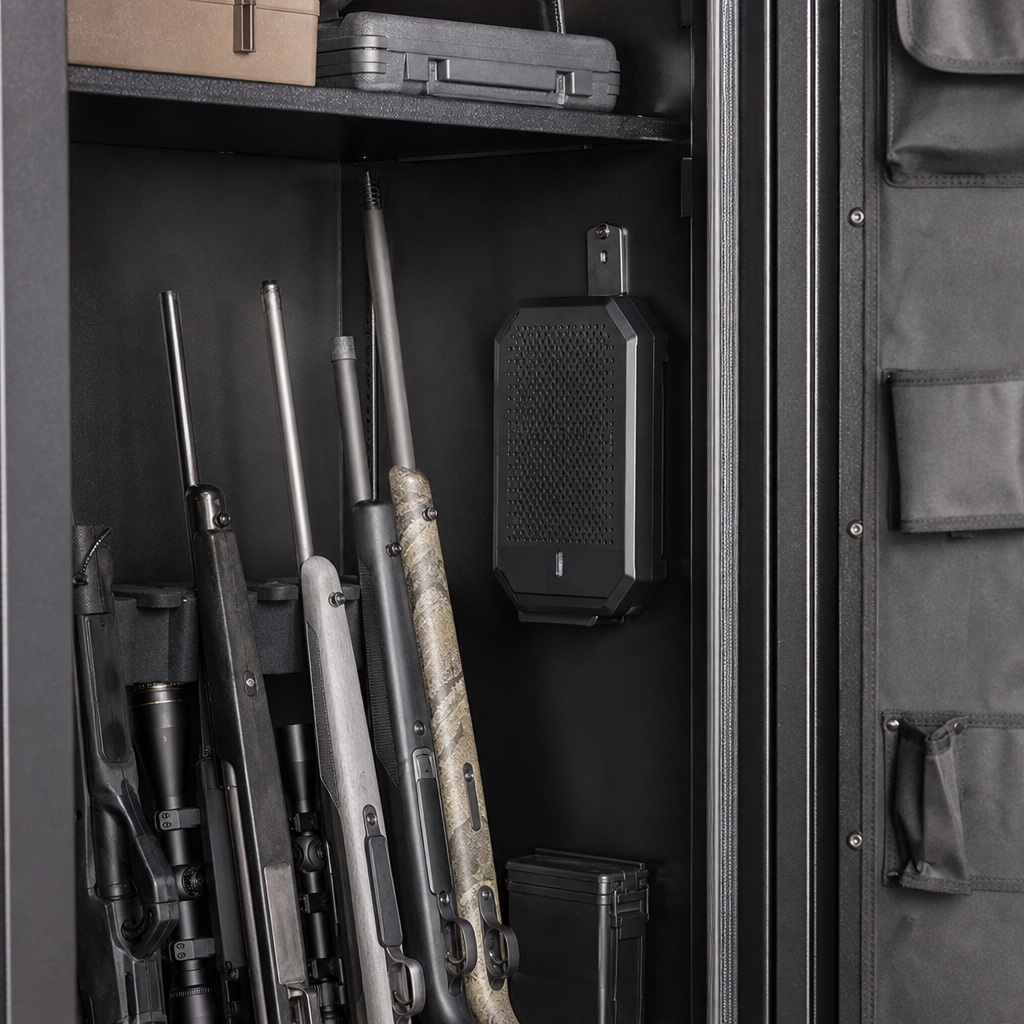
Adding a dehumidifier to your gun safe usually makes a real difference, but the size of that difference depends on your climate, the safe’s seal, and how you store firearms, optics, ammunition, and paperwork. In my experience setting up residential safes and troubleshooting rust complaints, the biggest misconception is that a heavy steel safe automatically protects contents from moisture. It does not. A gun safe slows environmental change and reduces unauthorized access, yet trapped humidity can remain high enough to corrode blued steel, pit bores, spot nickel finishes, swell wood stocks, and grow mildew on slings or documents. That is why the question is not whether moisture control matters, but which method works best and what myths cause owners to underestimate the risk.
A dehumidifier, in this context, is any device or material intended to lower relative humidity inside the safe. The two most common types are electric heating rods, often sold under brand names such as GoldenRod, and rechargeable desiccants such as silica gel canisters. Relative humidity, abbreviated RH, measures the amount of moisture in air compared with the maximum air can hold at a given temperature. Corrosion risk rises when humid air repeatedly contacts cooler metal surfaces, especially during temperature swings. Many firearm owners aim to keep safe humidity around 40 to 50 percent RH. That range is low enough to reduce rust and mildew risk while avoiding excessively dry conditions that can stress some wood components over time.
This topic matters because gun safe myths are expensive. I have seen owners assume factory carpeting prevents rust, that storing guns in silicone socks eliminates every problem, or that a box of desiccant tossed into a corner lasts forever. Those beliefs fail when summer humidity spikes, basement temperatures fluctuate, or a tightly packed safe restricts airflow. The result can be rust under grips, haze inside optics, tarnished magazines, degraded leather, and insurance headaches. As a hub for gun safe myths and misconceptions, this article explains what a dehumidifier actually does, when it is necessary, what it cannot fix, and how it fits into broader safe storage practices. If you want a direct answer: yes, adding a dehumidifier often helps significantly, but only as part of a complete moisture-control strategy.
Why Gun Safes Get Damp Even When They Look Sealed
Many owners picture a gun safe as a dry vault, but safes commonly trap moisture instead of removing it. Every time the door opens, room air enters. If that air is humid and the safe is in a garage, basement, or closet on an exterior wall, the internal environment can remain damp for long periods. Steel also responds quickly to temperature changes. When the safe interior or the guns themselves sit below the dew point of incoming air, condensation can form on metal surfaces even if you never see visible water droplets. This is especially common after weather fronts, seasonal transitions, or heating and cooling cycles inside the home.
Fire liners and door seals can create another misunderstanding. Fire protection materials are designed to resist heat transfer and, in some models, expand during a fire. They are not humidity-management systems. In fact, new safes sometimes release residual moisture or odors from insulation, adhesives, and interior fabrics during early use. Owners who place a new safe in a humid basement and immediately load it with firearms may unknowingly create a stable, enclosed environment for corrosion. A safe can be excellent at preventing theft and still be mediocre at moisture control.
Internal packing density matters too. Long guns stored closely together reduce air circulation around barrel channels, sling studs, and action recesses. Foam inserts, soft cases, and leather holsters can hold moisture against the firearm. I advise owners never to store guns long term in foam-lined hard cases inside a safe unless the case is specifically designed for low-moisture storage and the humidity is monitored. Foam and leather are notorious for trapping dampness, salts, and tanning chemicals that accelerate finish damage.
What a Dehumidifier Actually Does Inside a Gun Safe
An electric rod dehumidifier does not pull water into a reservoir like a portable room unit. Instead, it gently warms the air at the bottom of the safe a few degrees, creating convection. That slight temperature increase reduces relative humidity and keeps interior surfaces a bit warmer than the surrounding dew point conditions. In practical terms, it lowers the chance that moisture in the air will condense on steel. This is why heating rods are effective in larger safes and in spaces with recurring temperature swings. They are simple, continuous, and low maintenance, but they require access to power through a safe pass-through or door gap designed for a cord.
Desiccants work differently. Silica gel and similar materials physically adsorb moisture from the air. They are useful in smaller enclosures, in safes without power, or as supplemental protection near sensitive contents. Rechargeable canisters are heated in an oven or plugged into the wall to drive off absorbed moisture before being returned to the safe. They can perform well, but capacity is limited. In a damp basement or frequently opened safe, a small desiccant unit saturates quickly and gives owners false confidence if it is not recharged on schedule.
The central point is that either method can make a difference because both reduce the moisture available to attack metal and organic materials. The wrong expectation is that a dehumidifier creates a maintenance-free microclimate regardless of conditions. It does not. If the safe leaks humid air, sits against concrete, or contains wet items after a rainy range trip, humidity control must work harder. A dehumidifier is prevention, not magic.
Common Gun Safe Myths and the Reality Behind Them
The most persistent myth is that heavier safes are automatically drier safes. Weight generally reflects steel thickness, fireboard, and construction, not active moisture control. A 1,000-pound safe in a Gulf Coast garage can have worse humidity than a lighter safe in a climate-controlled bedroom with a heating rod and hygrometer. Another myth says modern firearm finishes eliminate rust risk. Cerakote, nitriding, phosphate, stainless steel, and hard chrome improve resistance, but none make a firearm immune. Springs, screws, bores, magazine interiors, and small carbon-steel parts still corrode.
A third myth is that once you add desiccant, the problem is solved permanently. Desiccant has a finite adsorption capacity. Without monitoring, owners often discover saturation only after spotting rust on the underside of a shotgun rib or around sight screws. A fourth myth is that ammunition should be stored bone dry at all costs. Extremely dry conditions are not usually harmful to cartridges, but the practical target is stability, not extremes. Very low RH is unnecessary for most home safes and may be less comfortable for wood-stocked collectibles than a stable midrange level.
There is also a widespread belief that if rust has not appeared within the first few months, no protection is needed. Corrosion is often slow and hidden. It forms under fingerprints, inside chambers, beneath scope rings, under recoil pads, and in unused magazines. Finally, many owners assume oil alone is enough. Protective films help, but oil cannot offset persistent condensation cycles inside an enclosed cabinet.
| Myth | Reality | Practical Fix |
|---|---|---|
| A heavy safe stays dry by itself | Mass and fire lining do not remove humidity | Use a hygrometer and moisture-control device |
| Desiccant lasts indefinitely | It saturates and must be recharged or replaced | Track recharge intervals based on season |
| Stainless or coated guns cannot rust | Protective finishes reduce but do not eliminate corrosion | Wipe down metal and inspect hidden areas |
| Foam cases are fine inside safes | Foam can trap moisture against metal | Store firearms exposed to circulating air |
| No visible rust means no humidity problem | Corrosion often starts in concealed spots | Inspect bores, screws, magazines, and optics |
How to Choose the Right Moisture-Control Setup
The best setup starts with measuring conditions. Install a digital hygrometer, ideally one with min-max memory, so you can see how humidity changes between openings. Brands vary, but accuracy matters more than marketing. In a standard full-size safe in a conditioned room, an electric rod paired with a hygrometer is often the most reliable baseline. The rod runs continuously, requires little attention, and is especially effective where ambient humidity is moderate but temperature swings occur. For example, a safe in an upstairs closet in the Mid-Atlantic may remain stable year-round with this arrangement.
If your safe is in a basement, garage, outbuilding, or coastal home, use layered control. That usually means controlling the room first with an HVAC system or room dehumidifier, then stabilizing the safe with an internal rod and optional desiccant. This hierarchy matters because no internal device can fully overcome an extremely wet surrounding environment. In one basement installation I evaluated, room humidity hovered near 68 percent RH in summer. The owner kept replacing desiccant packs, yet rust returned. After adding a room dehumidifier and raising the safe off the slab with a sealed platform, the safe interior dropped into the mid-40s and the problem stopped.
Collection type also changes the recommendation. Wood-stocked hunting rifles, blued revolvers, collectible military arms, optics, tax stamps, and important documents all benefit from stable humidity. If you own suppressors, night vision, or precision scopes, stability matters as much as the average RH number. Rapid swings stress seals and invite internal fogging. For small pistol safes or lockboxes, rechargeable desiccants may be enough if the box is indoors and opened infrequently. For large safes, rods usually deliver better consistency than relying on compact desiccant alone.
Best Practices Beyond the Dehumidifier
Moisture control works best when paired with disciplined storage habits. Before returning firearms to the safe, wipe all metal with a clean cloth and an appropriate protectant, especially after handling with bare hands. Salts and acids from fingerprints create localized corrosion cells. After a wet hunt or humid range day, let guns acclimate and dry fully before storage. Check bores, chamber flags, magazines, and suppressor mounts for trapped moisture. Never put a damp soft case, wet sling, or muddy bipod into the safe and expect an internal dehumidifier to neutralize the problem quickly.
Safe placement matters more than many buyers realize. Avoid direct contact with concrete floors, which can transmit moisture and temperature swings. A sealed riser, composite shims, or manufacturer-approved platform helps. Keep the safe away from exterior walls if possible, and ensure some air movement in the room. Do not overpack shelves with paper goods, leather gear, and foam inserts that absorb moisture. If you store documents, use archival sleeves or sealed containers suitable for valuables rather than assuming the safe interior is automatically protective.
Maintenance should be scheduled, not improvised. Check hygrometer readings weekly at first, then monthly once patterns are clear. Recharge desiccants on a calendar. Test electrical rods periodically to confirm warmth and power continuity. During seasonal changes, inspect vulnerable firearms closely: under grips, around muzzle crowns, inside magazine tubes, under scope caps, and at sling swivel studs. These habits turn a dehumidifier from a gadget into an effective preservation system.
When a Dehumidifier Is Not Enough
There are limits. If your safe sits in an unconditioned shed in Florida, on a basement slab with active water intrusion, or in a garage where temperatures swing dramatically, an internal dehumidifier may reduce risk without solving it. In those cases, the correct fix is environmental control around the safe. Use a room dehumidifier sized by pint capacity, improve drainage, seal foundation issues, and verify air circulation. If humidity remains high, consider relocating the safe indoors. Protecting firearms starts with the building envelope as much as the safe itself.
You should also adjust expectations for neglected collections. If firearms already show active rust, moisture control alone will not reverse existing damage. Rust must be assessed, stabilized, and cleaned using methods appropriate to the finish and value of the firearm. Likewise, if a safe’s door seal is damaged or cord routing prevents proper closure, repair those issues first. A dehumidifier can only manage the environment it is given. For most owners, though, the answer remains clear: adding a dehumidifier really does make a difference, especially when paired with monitoring, good placement, and routine inspection. If you are building out your gun safe and safety plan, start with a hygrometer, choose the right moisture-control method, and make humidity management a standard part of responsible storage.
Frequently Asked Questions
Does adding a dehumidifier to your gun safe really make a noticeable difference?
Yes, in most cases it makes a meaningful difference, especially if you store blued firearms, optics, ammunition, documents, or any gear with metal parts inside the safe for long periods. A common mistake is assuming that because a gun safe is made of heavy steel and feels secure, it also keeps moisture away. In reality, a safe is better described as a controlled enclosure than a dry environment. It slows down changes in temperature and humidity, but it can also trap damp air inside. Once that moisture is in the safe, it may linger around firearms, magazines, scopes, slings, and paperwork longer than people expect.
The actual benefit depends on several factors. Climate matters a lot. In humid regions, basements, garages, and homes without strong climate control, a dehumidifier can be one of the simplest and most effective ways to reduce the risk of rust, mildew, fogging, and moisture damage. The safe’s seal also matters. A tightly sealed safe can help keep outside humidity from constantly entering, but if damp air gets trapped inside after the door has been opened, that same seal can keep the humidity in. Storage habits matter too. Putting away a firearm after range use, hunting in wet weather, or bringing a cold gun into a warm room can introduce condensation risk quickly.
In practical terms, a dehumidifier helps stabilize the environment inside the safe and lowers the chance that moisture will sit on metal surfaces long enough to cause corrosion. It is not a magic fix, and it does not replace basic maintenance like wiping firearms down with a rust preventive, but it absolutely can reduce the conditions that lead to problems. For many owners, the difference is not dramatic overnight. Instead, it shows up as fewer rust spots, less musty odor, better preservation of optics and paperwork, and more confidence that valuables are staying in good condition over time.
What kind of moisture problems can happen inside a gun safe if you do not use a dehumidifier?
The most obvious problem is rust, but that is only part of the story. Firearms with blued finishes, carbon steel parts, exposed screws, springs, and internal components are all vulnerable when humidity stays elevated. Surface rust may start as tiny orange or brown specks in easy-to-miss areas such as under the stock line, around sling studs, beneath scope rings, inside the action, or along the muzzle. If left alone, that corrosion can spread and become harder to remove without affecting the finish.
Optics can suffer too. Even when a scope or red dot is sealed, moisture in the safe can contribute to corrosion on mounting hardware, battery contacts, adjustment caps, and exterior metal surfaces. Leather slings, holsters, and soft cases can absorb that moisture and hold it against firearms, which often makes the problem worse. Ammunition generally tolerates ordinary household conditions fairly well, but long-term exposure to high humidity is still not ideal, particularly for cardboard packaging, primers, and metal cases. Documents, serial number records, tax stamps, passports, and other paperwork stored in the safe can curl, discolor, or develop a musty smell if humidity remains high.
Another issue people overlook is temperature-related condensation. If a firearm or other metal item is cooler than the surrounding air, moisture can condense on it the same way water forms on a cold drink. This can happen when a safe is in a garage, basement, exterior wall closet, or room with fluctuating temperatures. A dehumidifier helps reduce that risk by lowering humidity and, depending on the type used, sometimes slightly warming the interior air. Without humidity control, the safe may protect against theft while quietly creating a better environment for corrosion than the room outside it.
Which is better for a gun safe: an electric dehumidifier rod or rechargeable desiccant?
Both can work well, and the better choice depends on the safe’s location, size, and how much moisture you are fighting. An electric dehumidifier rod is often the most convenient option for a larger safe in a home where power is available. These rods work by gently warming the air inside the safe, which helps create circulation and reduces the likelihood that moisture will settle on cooler metal surfaces. They are low maintenance, always on, and particularly useful for safes in humid climates or in areas with repeated temperature swings. For many gun owners, a quality rod is the easiest set-it-and-forget-it solution.
Rechargeable desiccant units, silica gel canisters, and other moisture absorbers are a good option when power is not available or when you want an additional layer of protection. They physically absorb moisture from the air, but they have a limited capacity and must be recharged or replaced regularly. In a dry climate, a desiccant product may be enough on its own, especially in a smaller safe that is not opened often. In a damp basement or coastal environment, however, desiccant alone may saturate quickly and lose effectiveness if you are not diligent about maintenance.
In real-world use, many people get the best results by combining methods. An electric rod provides continuous control, while a desiccant pack helps catch moisture spikes after opening the door or storing recently handled gear. The key is not just buying a product, but matching it to your conditions. If your safe is in a climate-controlled room and you open it only occasionally, you may need very little intervention. If your safe sits in a garage through seasonal swings or in a humid home, stronger and more consistent moisture control is usually worth it. Whatever you choose, it helps to verify performance with a small hygrometer inside the safe rather than guessing.
How do you know if your gun safe actually needs a dehumidifier?
The best way to know is to measure the humidity inside the safe instead of relying on assumptions. A compact digital hygrometer is inexpensive and gives you a much clearer picture of what is happening. If you consistently see relative humidity staying higher than ideal, especially over long periods, a dehumidifier is a smart addition. Many gun owners aim for a moderate humidity range that is dry enough to discourage corrosion but not so extreme that it causes unnecessary stress on wood stocks, grips, or other materials. The exact target can vary, but the broader point is that stable, moderate humidity is far better than repeated damp swings.
There are also practical warning signs. If you notice a musty odor when opening the safe, minor rust specks on screws or barrels, foggy-looking spots on metal, dampness on documents, or leather items that feel clammy, the safe likely has a humidity issue. You should also pay attention to the safe’s location. Units placed in basements, garages, utility rooms, or against exterior walls often need humidity control more than safes kept in conditioned interior spaces. Frequent access can matter too. Every time the door opens, outside air enters, and in a humid environment that can repeatedly recharge the moisture level inside.
Another clue is your own routine. If you store firearms right after carrying them, hunting with them, or bringing them in from outdoors, you may be introducing moisture regularly. The same applies if you keep foam-lined cases, fabric sleeves, or leather accessories inside the safe, because those materials can hold humidity close to metal surfaces. In short, if you care about long-term preservation and want to reduce the chance of corrosion, adding a dehumidifier is usually a low-cost, high-value improvement. Measuring humidity first simply helps you choose the right type and confirm that it is doing its job.
Is a dehumidifier alone enough to protect firearms and valuables inside a gun safe?
No, a dehumidifier is important, but it works best as one part of a complete storage routine. Think of it as environmental control, not total protection. Even in a well-managed safe, firearms still need basic preventive care. Metal surfaces should be wiped down with a suitable protectant, especially after handling, because fingerprints can leave salts and oils that encourage corrosion. Firearms exposed to rain, snow, sweat, or range conditions should be dried and inspected before being stored. If a gun goes into the safe already carrying moisture, the dehumidifier may help over time, but you are still starting from a bad position.
How you organize the safe also matters. Avoid crowding items tightly together because restricted airflow can create micro-environments where moisture lingers. Try not to store guns in soft cases, socks, or foam for long-term storage unless the materials are specifically designed for that purpose, because many fabrics and foams can trap humidity against the finish. Keep ammunition in appropriate containers, and protect important documents with sleeves or dedicated document storage if they will remain in the safe for extended periods. If your safe has power access, adding interior lighting and a hygrometer can also make it easier to monitor conditions and catch problems early.
Finally, consistency matters more than any single product. A dehumidifier makes a real difference because it addresses one of the biggest hidden threats inside a safe: trapped moisture. But the strongest results come from combining that with a reasonably climate-controlled location, routine inspection, proper firearm maintenance, and smart storage habits. When those pieces work together, your safe becomes much better at doing what owners expect it to do, which is not just secure your firearms and valuables, but preserve them in good condition for the long term.