
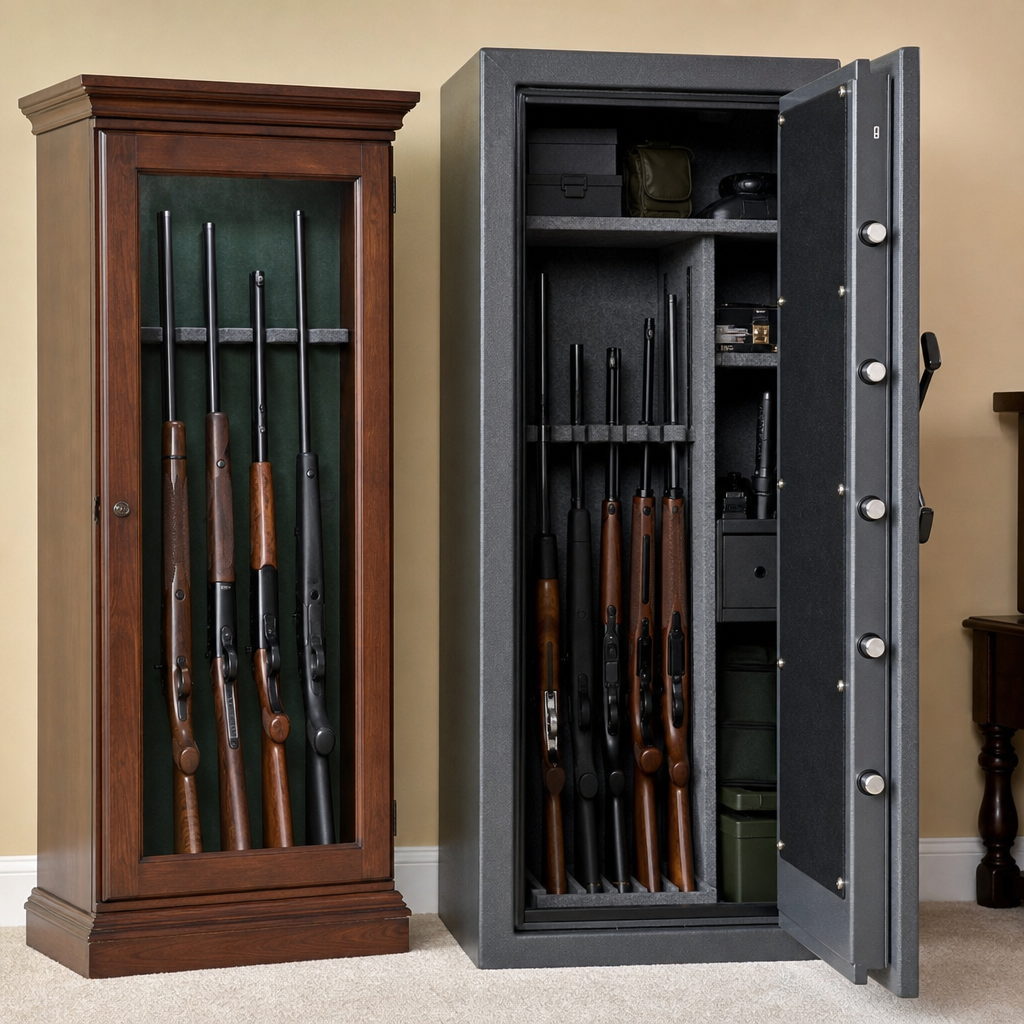
Are gun cabinets just as secure as gun safes? In most cases, no. A gun cabinet and a gun safe serve different security levels, use different construction methods, and protect against different risks. After years of evaluating firearm storage setups for homes, workshops, and hunting properties, I have found that people often compare them as if they are interchangeable. They are not. A steel cabinet can be a practical part of a responsible storage plan, but it does not usually deliver the burglary resistance, fire protection, or layered locking performance of a true gun safe. That difference matters because secure firearm storage is about more than preventing unauthorized access. It also affects theft risk, child safety, insurance eligibility, compliance with local laws, and long term protection for valuable rifles, shotguns, and handguns.
To compare them properly, define the terms first. A gun cabinet is typically a lighter gauge steel enclosure designed to organize and restrict casual access to firearms. It often uses a simple key lock or basic electronic lock, has exposed seams, and can usually be moved by two adults. A gun safe is heavier, uses thicker steel or composite construction, often includes reinforced doors and locking bolts, may have independent lock certifications, and sometimes carries a published fire rating. In the security industry, “safe” is not just a marketing word. It implies a higher standard of resistance to forced entry and environmental threats. The confusion starts because many products sold online blur these lines, and some are advertised as safes even when their build resembles a cabinet more than a burglary-resistant container.
This topic matters because bad assumptions lead to weak storage decisions. One of the most common gun safe myths is that any locked steel box provides the same protection. Another misconception is that fire ratings, pry resistance, and lock quality are minor details. They are not minor. They determine how long a storage unit can resist attack, how well it protects optics and wood stocks, and whether it gives police, insurers, or family members confidence after an incident. As a hub article in the broader gun safes and safety conversation, this guide explains where cabinets fit, where safes clearly outperform them, and which myths routinely mislead buyers who are trying to balance cost, convenience, and real security.
What a Gun Cabinet Does Well, and Where It Falls Short
A gun cabinet is best understood as controlled-access storage, not high-security storage. It keeps firearms upright, organized, and out of immediate reach. For a household that needs to prevent casual handling by visitors or slow down access by older children, a cabinet is better than a closet or under-bed arrangement. Many cabinets also fit well in apartments, hunting cabins, garages, or utility rooms where floor loading, budget, and installation flexibility matter. Brands such as Stack-On and SecureIt have popularized cabinet-style products because they solve practical storage problems at a lower cost and with less hassle than a 600-pound safe.
However, the security ceiling is lower. Most cabinets use thinner steel than true safes, often in the range of sheet metal that can be bent, cut, or pried with common hand tools. Doors may have simple cam locks, fewer locking points, and less reinforcement around the frame. If the unit is not bolted down, a thief may remove the entire cabinet and force it open elsewhere. Even when anchored, many cabinets can be defeated more quickly than a quality safe because their sidewalls, hinges, and door gaps are more vulnerable. In plain terms, a cabinet is designed to deter opportunistic access. A safe is designed to resist deliberate attack.
That distinction becomes critical in real-world burglary patterns. Residential theft is often fast. Thieves want cash, jewelry, firearms, and portable electronics. A storage unit that can be opened in minutes with pry bars or battery tools is fundamentally different from one that forces noise, time, and risk. I have seen owners assume that “locked is locked,” only to learn after a break-in that the cabinet protected against children but not against criminals. That is not a failure of the concept; it is a mismatch between product type and threat model.
How Gun Safes Deliver Higher Security
A true gun safe protects through layered resistance. First, it uses heavier material. Steel thickness matters because pry attacks target flex points, door edges, and body seams. A body built from 12-gauge steel or thicker generally offers meaningfully better resistance than the lighter material common in cabinets, and higher-end models may go beyond that. Second, safes rely on reinforced door structures with multiple locking bolts that engage the frame on several sides. Third, many safes use recognized lock systems from manufacturers such as Sargent and Greenleaf or SecuRam, with UL-listed components that meet known performance standards. These details are not cosmetic. Together, they raise the difficulty of brute-force entry.
Fire protection is another major dividing line. Many gun safes include gypsum-based or composite insulation layers and a stated fire rating, commonly expressed as a duration at a given temperature, such as 30, 60, or 90 minutes. Fire ratings are not perfectly standardized across all brands, and buyers should read the testing basis carefully, but the presence of engineered insulation and heat-expanding seals is a significant advantage over typical cabinets. Fire damage is not limited to flames. Heat, smoke, and humidity spikes can ruin bluing, optics, stocks, slings, and important documents stored with the firearms.
Weight and anchoring also contribute to security. A 700-pound safe that is anchored into concrete is far harder to remove than a 120-pound cabinet. That changes the economics of theft. Burglars prefer speed. Every extra minute increases the chance of detection. When buyers ask me whether a safe is worth the premium, I point to this reality: a storage unit does not need to be invincible; it needs to make the attack slower, louder, and less likely to succeed before the intruder gives up or gets interrupted.
Common Gun Safe Myths and Misconceptions
The first myth is that gun cabinets and gun safes are equally secure if both lock. Locking is only one element of security. Construction quality, lock protection, weld quality, door fit, relocker design, hinge design, and anchoring all matter. A weak enclosure with a functional lock is still weak. The second myth is that all fire ratings mean the same thing. They do not. Some brands test internally; others reference independent laboratories; some ratings protect paper better than wood and optics. Buyers should ask how the rating was achieved, not just whether a sticker appears on the door.
The third myth is that a heavier safe is automatically a better safe. Weight often correlates with better material or more insulation, but not always. Added drywall can increase weight without improving burglary resistance. The fourth myth is that electronic locks are unreliable while mechanical dial locks are always superior. In practice, both can be excellent when sourced from reputable manufacturers and maintained properly. Electronic locks offer speed and multiple user codes; mechanical locks avoid battery dependence. The better choice depends on household use, not internet folklore.
The fifth myth is that a safe eliminates every risk. No residential container is absolute protection. Attackers with time, privacy, and power tools can defeat many units. Moisture can still become a problem if the interior is unmanaged. Poor installation can undermine a premium safe. Responsible storage requires layers: proper anchoring, dehumidification, discreet placement, alarm coverage, and inventory records. The sixth myth is that cabinets are useless. That is also false. A cabinet can be appropriate when the main goal is organization and basic access control, especially when paired with cable locks, separate ammunition storage, and a monitored security system.
| Feature | Typical Gun Cabinet | Typical Gun Safe |
|---|---|---|
| Steel construction | Lighter sheet steel | Thicker steel or composite body |
| Locking system | Basic key or simple electronic lock | Reinforced lock, multiple bolts, often certified components |
| Burglary resistance | Deters casual access | Resists pry and forced-entry attacks longer |
| Fire protection | Usually none or minimal | Commonly includes insulation and fire seals |
| Weight and portability | Relatively easy to move | Heavy and harder to remove, especially anchored |
| Best use case | Budget organization and basic restriction | Theft deterrence, child safety, and asset protection |
How to Choose Based on Risk, Budget, and Firearm Value
The right choice starts with a threat assessment. If you own one or two utility long guns, live alone, rent an upper-floor apartment, and mainly want to prevent casual access, a cabinet may be a rational starting point. If you have children in the home, frequent visitors, collectible firearms, suppressors, handguns, or a known burglary risk, a safe is usually the better answer. The more attractive your firearms are to thieves, and the greater the consequences of loss, the less sense it makes to treat a cabinet as equivalent protection.
Budget matters, but buyers often underestimate the cost of inadequate storage. Replacing a stolen hunting rifle, optic, and serialized accessories can exceed the price gap between a cabinet and a decent entry-level safe. Insurance may not fully cover collectibles, custom builds, or sentimental value. Some insurers also look more favorably on proper safes, especially for high-value collections. When I help owners compare options, I encourage them to calculate replacement cost, not just purchase cost. That shift usually clarifies the decision quickly.
Also consider installation realities. A safe requires floor planning, delivery coordination, and anchoring. In some homes, a slab or reinforced location is straightforward; in others, stairs, narrow turns, or load concerns complicate the process. Cabinets win on convenience. Safes win on security. If the budget only allows a cabinet today, choose one that can be bolted down, place it out of obvious sight, keep ammunition separately secured, and plan an upgrade path. If you can buy only once, prioritize steel quality, a credible lock, anchor capability, and honest fire documentation over cosmetic door panels or marketing claims about gun count.
Best Practices for Any Firearm Storage Setup
Whether you choose a cabinet or a safe, installation and maintenance determine how much protection you actually get. Anchor the unit according to the manufacturer’s instructions, ideally into concrete or substantial structural members. Use a goldenrod-style dehumidifier or desiccant system to control humidity, especially in basements or seasonal properties. Store firearms clean and lightly protected with appropriate corrosion prevention. Keep an inventory with serial numbers, photos, and receipts in a separate secure location or encrypted cloud account. If a theft or fire occurs, that documentation is indispensable.
Placement matters too. The best location is discreet, dry, and difficult to attack with leverage or privacy. Avoid obvious garage placements unless climate control and concealment are strong. Layer the storage unit with home security measures such as monitored alarms, motion lighting, door sensors, and cameras. For households with children, do not rely on secrecy. Use age-appropriate education and redundant safeguards. For defensive firearms that must remain accessible, consider a dedicated quick-access handgun safe in addition to a main long-gun safe. Different firearms can require different storage solutions.
Finally, ignore marketing shorthand and inspect specifics. Ask about steel gauge, bolt count, lock brand, fire test methodology, seal type, hinge design, interior adjustability, and warranty support. Read independent reviews from owners who discuss attempted break-ins, delivery quality, and long-term lock reliability. The core lesson is simple: gun cabinets and gun safes are not the same category of protection, even though both can play a role in responsible firearm storage. Choose the product that matches your real risk, not the one that merely looks secure in a product photo.
Gun cabinets are useful, but they are generally not just as secure as gun safes. Cabinets help with organization, basic unauthorized-access prevention, and affordability. Safes add meaningful burglary resistance, better lock protection, greater anchoring value, and often real fire protection. That difference is the heart of many gun safe myths and misconceptions. People focus on the presence of a lock and ignore the engineering around it. Once you compare steel thickness, door design, fire insulation, and removal risk, the gap becomes clear.
The practical takeaway is to match storage to consequences. If theft, child access, fire exposure, or collection value would create serious harm, a quality gun safe is usually the correct investment. If a cabinet fits your current constraints, use it with clear eyes and add layers: anchoring, humidity control, separate ammunition storage, alarms, and a planned upgrade. Better storage decisions start with honest definitions and realistic expectations, not product labels.
Use this page as your starting point for the broader gun safes and safety topic, then review the related articles in this subtopic to compare lock types, fire ratings, installation methods, and common buying mistakes before you purchase your next storage solution.
Frequently Asked Questions
Are gun cabinets just as secure as gun safes?
In most situations, no. Gun cabinets and gun safes are built for different levels of protection, and that difference matters when you are trying to prevent theft, unauthorized access, or damage. A typical gun cabinet is made from thinner steel, uses simpler locking systems, and is designed more for basic organization and deterrence than for serious forced-entry resistance. A gun safe, especially a well-built model, usually has heavier steel, reinforced doors, more robust locking bolts, and construction intended to resist prying, drilling, and extended break-in attempts.
That does not mean a cabinet has no value. A cabinet can still be a responsible upgrade over leaving firearms unsecured in a closet or under a bed. It can keep guns out of immediate reach, improve organization, and add a basic barrier for children, visitors, or opportunistic thieves. But if the question is whether it offers the same level of security as a true gun safe, the answer is generally no. For higher-risk environments, valuable collections, or homes where burglary resistance is a top priority, a safe is usually the better choice.
What are the biggest security differences between a gun cabinet and a gun safe?
The biggest differences come down to steel thickness, door design, lock strength, and resistance to attack. Most gun cabinets rely on lighter-gauge steel and a simpler frame. That makes them easier to move, easier to fit into tight spaces, and often more affordable, but also easier to pry open or physically remove. A gun safe, by comparison, is typically built with much heavier steel and a more rigid body, which significantly improves its ability to withstand forced entry.
Door construction is another major distinction. Many cabinets have straightforward locking doors with limited reinforcement. A quality gun safe often has a thick door, internal or external hinges designed for strength, and multiple locking bolts that engage the frame at several points. This creates a more secure seal and makes it harder for a thief to attack one weak corner and gain entry quickly.
Locks also vary widely. Cabinets often use simple key locks or basic electronic locks. Safes may use higher-grade mechanical or electronic locks paired with stronger boltwork. In practical terms, that means a safe is usually built to slow a determined intruder, while a cabinet is more likely to deter only casual access. That distinction is important because most real-world theft prevention depends on time, noise, and effort. The longer a storage unit resists attack, the better your odds that the thief gives up or gets interrupted.
When is a gun cabinet a practical choice for firearm storage?
A gun cabinet can be a practical choice when your goal is to improve basic security, maintain organization, and store firearms responsibly within a tighter budget. For example, if you need a dedicated place to keep hunting rifles locked away from children or guests, a cabinet may be far better than no locked storage at all. It can also make sense in lower-risk locations, seasonal properties, workshops, or utility spaces where you want a compact storage solution without the weight and cost of a large safe.
Cabinets are also useful for owners who already have layered security in place. If the home has monitored alarms, reinforced doors, cameras, and controlled access, a cabinet may function as one part of a broader system. In those cases, the cabinet is not being asked to do everything on its own. It is serving as a controlled storage point inside a protected environment.
That said, a cabinet works best when expectations are realistic. It should not be treated as equal to a burglary-rated safe. If you choose a cabinet, it is wise to anchor it securely, keep it out of obvious view, and avoid discussing firearm storage locations openly. Those steps can make a meaningful difference, but they do not change the fact that a cabinet is generally a lighter-duty solution than a true safe.
Do gun safes offer better protection against fire and theft?
Yes, in general gun safes offer substantially better protection against both theft and fire, though the level of protection depends on the specific model. From a theft standpoint, the heavier construction, stronger locks, reinforced doors, and greater overall mass of a safe make it much more difficult to break into or carry away. A large safe that is properly anchored can be a serious obstacle even for a determined burglar, especially compared with a lighter cabinet that may be more vulnerable to prying tools or quick removal.
Fire protection is another area where safes often have a clear advantage. Many gun safes include fire-resistant materials, heat-expanding door seals, and tested fire ratings that indicate how long the interior may stay below a certain temperature under fire conditions. Most standard gun cabinets do not provide meaningful fire protection. They may protect firearms from dust, minor bumps, and casual handling, but they are not usually built to shield the contents from high heat, smoke infiltration, or prolonged exposure during a house fire.
Still, not every product labeled as a safe performs the same way. Some entry-level models focus more on appearance than true security, while some premium safes deliver significantly stronger burglary and fire resistance. The key is to evaluate the actual specifications, construction, lock type, weight, anchoring options, and any verified ratings rather than relying only on marketing language.
How can I make either a gun cabinet or a gun safe more secure?
No matter which option you choose, installation and overall security planning matter a great deal. Start by anchoring the cabinet or safe to the floor or wall structure whenever possible. This is especially important for cabinets, since lighter units can otherwise be tipped, moved, or removed entirely. Location matters too. Placing the unit in a concealed, low-traffic area can reduce visibility and make forced entry more difficult for an intruder working under time pressure.
Layered security is also one of the smartest upgrades you can make. Alarms, cameras, reinforced exterior doors, motion lighting, and monitored entry points all improve the effectiveness of your firearm storage. The goal is to create multiple barriers so that the cabinet or safe is not your only line of defense. In real-world burglary prevention, each additional obstacle increases the chances that a thief abandons the attempt.
You should also manage access carefully. Keep keys secured, use strong lock codes, and limit who knows where firearms are stored. Inside the unit, consider separate locking compartments, trigger locks, or cable locks for added control, especially if children are present. For humidity and long-term firearm condition, add a dehumidifier or desiccant system as needed. In short, even the best safe benefits from proper setup, and even a basic cabinet becomes more effective when it is anchored, concealed, and backed by a thoughtful home security plan.