
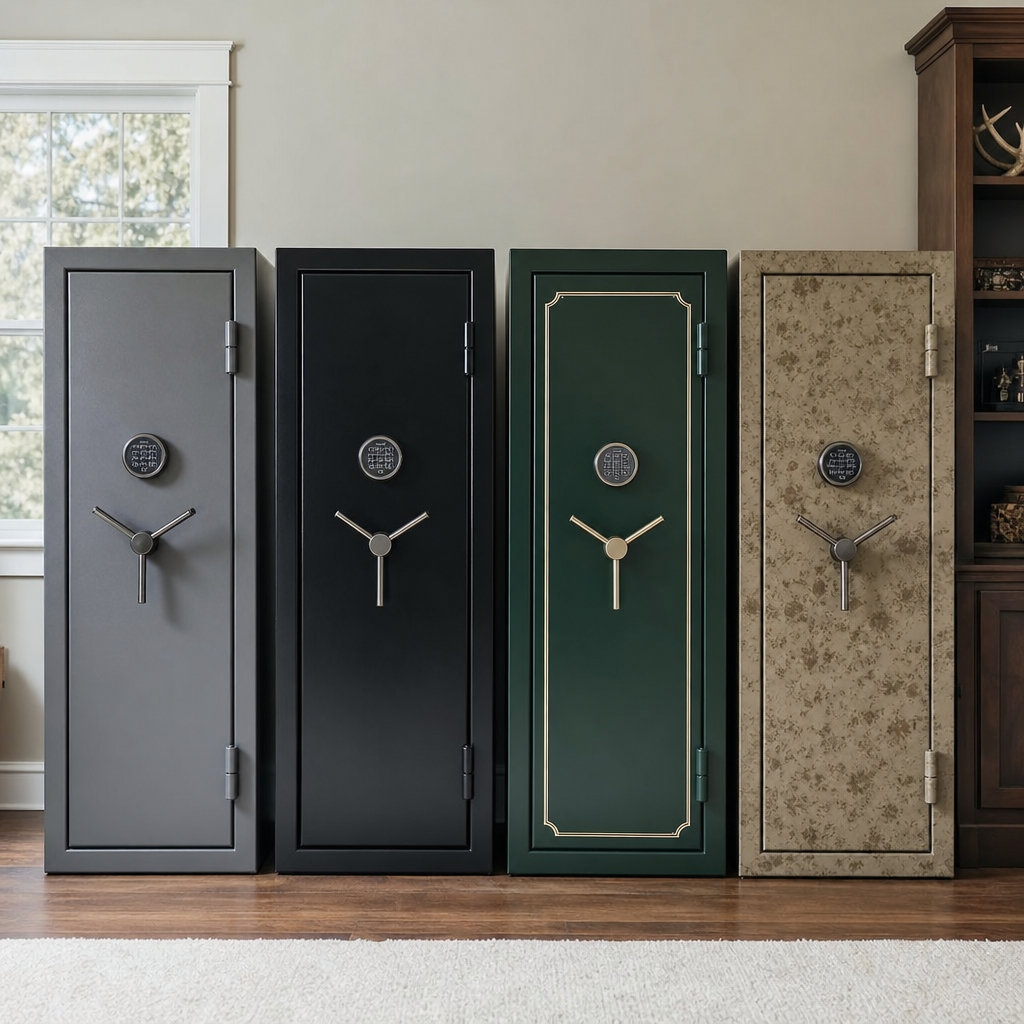
Many buyers assume the color, texture, or gloss level of a gun safe says something important about its strength, but that belief confuses appearance with security. In practical terms, a gun safe’s color is the pigment or coating shade applied to the exterior, while the finish is the surface treatment, such as textured powder coat, high-gloss paint, wrinkle coat, or faux wood paneling. Security, by contrast, is determined by steel thickness, door construction, locking mechanism, boltwork, relockers, anchoring, fire insulation design, and how the safe is installed. Understanding that difference matters because cosmetic marketing often distracts shoppers from the features that actually resist theft, unauthorized access, corrosion, and wear.
I have evaluated safes on showroom floors, in residential installations, and after attempted break-ins, and I have never seen a burglar stopped by a black matte finish. I have, however, seen thin-bodied cabinets dressed up with attractive paint and impressive branding sell faster than heavier, less flashy units with better lock protection and stronger door frames. That gap between perception and performance is why the question matters. People shopping in the broader gun safes and safety category often encounter confident claims about tactical coatings, discreet colors, or premium automotive-style finishes. Some of those claims have a kernel of truth, especially around corrosion resistance and concealment, but most do not describe burglary protection.
This article serves as a hub for common gun safe myths and misconceptions, starting with the specific question of whether color or finish affects security and expanding into the broader buying errors that this myth encourages. The short answer is clear: color does not make a gun safe stronger, and finish only affects security indirectly in limited situations, such as visibility, maintenance, and environmental durability. A quality finish can help a safe resist rust, blend into a room, and hold up to years of use. It cannot compensate for 14-gauge steel, weak locking bolts, exposed hinges without dead bars, poor anchor points, or a bad installation. If you want a safe that protects firearms, documents, and family safety, judge the engineering first and the cosmetics second.
What Actually Determines Gun Safe Security
The core factors behind gun safe security are measurable. Body steel thickness, commonly expressed in gauge, affects resistance to prying and cutting; lower gauge numbers mean thicker steel. Many residential gun safes use 12-gauge to 14-gauge bodies, while stronger models may use 10-gauge, 7-gauge, or composite construction with multiple steel layers. Door design matters just as much. A thick door skin paired with a reinforced frame, robust hardplate, drill-resistant steel around the lock, and active relockers offers far more protection than decorative exterior panels. Lock type also matters, but not in the simplistic mechanical-good, electronic-bad way often repeated online. High-quality UL-listed mechanical and electronic locks both perform well when properly installed and maintained.
Burglary resistance also depends on the boltwork and the way force is transferred across the frame. Marketing materials often highlight the number of locking bolts, but bolt count is less important than bolt diameter, engagement depth, and frame rigidity. I have opened safes with many flashy bolts that still flexed under pry pressure because the body was thin and the door jamb weak. Anchor holes and anchoring hardware are equally critical. A safe that is not anchored can be tipped, moved, or attacked from angles that make prying easier. Location matters too. A closet corner installation on a concrete slab with minimal exposed sides gives a thief less working space than a freestanding safe in an open garage. None of these fundamentals are improved by choosing bronze instead of black, or gloss instead of textured paint.
Independent ratings provide a better signal than cosmetics. For example, Underwriters Laboratories burglary ratings such as TL-15 and TL-30 indicate tested resistance against tool attacks, though many consumer gun safes do not carry those certifications because true burglary-rated construction is expensive and heavy. California Department of Justice approval addresses firearm safety device standards, but that is not the same as robust burglary protection. Fire ratings also vary widely by manufacturer methodology, so a printed number on a brochure should be read carefully. When comparing gun safe myths and misconceptions, this is one of the biggest: shoppers often treat decorative features as evidence of quality because the technical specifications are harder to interpret. Security lives in the steel, lock protection, and installation details.
How Color and Finish Matter Indirectly
Although color and finish do not directly increase break-in resistance, they can affect a safe’s real-world performance in indirect ways. First, finish quality influences corrosion resistance. Powder coating, when properly applied over prepared steel, creates a durable surface that resists chips, scratches, and moisture better than some basic painted finishes. In humid basements, coastal homes, or garages with temperature swings, a poor coating can fail, exposing bare metal that begins to rust. Rust does not instantly make a safe insecure, but over years it can compromise hinges, fasteners, interior components, and the owner’s willingness to maintain the unit. Pair a good finish with a dehumidifier rod, silica packs, and stable humidity, and you reduce a genuine risk to firearms and safe longevity.
Second, color affects visibility and concealment. A bright glossy safe displayed prominently in a room can become a visual focal point. A low-sheen neutral safe placed within cabinetry, a closet, or a utility room is less noticeable to visitors, contractors, or opportunistic thieves. That does not mean camouflage equals security, but discretion is a recognized layer of residential protection. In security planning, reducing target awareness is useful. A beige or gray safe that disappears into its surroundings may receive less attention than a high-contrast “tactical” model with logos and chrome accents. I have seen homeowners choose finishes that matched wall tones or built-in cabinets specifically to lower visual interest, and that is a sensible decision.
Third, surface texture changes wear patterns. Textured finishes hide fingerprints, dust, and minor scratches better than gloss. In homes with children, frequent access, or garage placement, that matters because maintenance becomes easier and the safe looks less abused over time. A well-kept safe is more likely to remain properly used and serviced. There is also a narrow point about lighting. High-gloss finishes can reflect light through a doorway and make the safe more visible. Matte or textured coatings generally attract less attention. These are practical considerations, not burglary ratings.
| Feature | What It Changes | What It Does Not Change |
|---|---|---|
| Exterior color | Visibility, room fit, discretion | Steel strength, pry resistance, lock protection |
| Powder-coated finish | Corrosion resistance, scratch durability | Burglary rating, boltwork quality, relocker performance |
| Textured surface | Fingerprint control, cosmetic wear, glare reduction | Door thickness, body gauge, anchoring strength |
| Gloss decorative paint | Appearance, reflectivity, showroom appeal | Attack resistance, fire construction, frame rigidity |
Common Gun Safe Myths and Misconceptions Buyers Should Ignore
The color myth usually travels with several other misconceptions, and treating this article as a hub means connecting them. Myth one: heavier always means more secure. Weight can indicate thicker steel or more fireboard, but it can also come from interior shelving, concrete-based insulation, or oversized dimensions rather than burglary strength. Myth two: more locking bolts equal better security. As noted earlier, bolt count is easy to market and easy to misunderstand. Myth three: external hinges are weak. In reality, many well-designed safes use external hinges and compensate with dead bars or interlocking door profiles, allowing a wider door swing without sacrificing security. Myth four: a fire rating from any brand can be compared directly to another. Testing methods differ, and not every manufacturer uses the same standards or disclosures.
Myth five is especially common in online forums: any safe with a “tactical” look must be a premium defensive product. This is where finish and branding distort judgment. Black textured coatings, military-style fonts, flag graphics, and aggressive handle designs often create an impression of ruggedness. None of that replaces a detailed review of steel gauge, lock listing, hardplate, relockers, continuous welds, or anchor pattern. Myth six: electronic locks are unreliable and mechanical dials are always superior. In practice, modern UL-listed electronic locks from established makers such as Sargent and Greenleaf, SecuRam, or La Gard can be very dependable, provided batteries are replaced and the keypad is protected from abuse. Mechanical locks remain excellent, but they are not automatically safer for every household.
Myth seven: any gun safe on a retailer floor is secure enough if it has a big price tag. Price reflects brand positioning, finish upgrades, interiors, dealer margins, and delivery complexity, not just security engineering. I have seen expensive safes where most of the cost increase came from high-end paint, door panel organizers, and elaborate interiors rather than thicker steel. Myth eight: once a safe is purchased, security is solved. Actual protection depends on anchoring, room placement, humidity control, access management, and whether backup keys, combinations, or override codes are stored carelessly. The biggest mistake buyers make is focusing on what they can see first, such as color and finish, instead of what a burglar would attack first, such as edges, corners, lock areas, and anchor points.
How to Evaluate a Gun Safe Beyond the Cosmetic Layer
A better buying process starts with a checklist. Ask for the body steel thickness, door steel thickness, total door construction, lock brand, whether the lock is UL listed, whether there is a hardplate protecting the lock, whether relockers are included, and how the boltwork engages the frame. Confirm the safe’s weight, exterior dimensions, interior dimensions, and the number and size of anchor holes. If a dealer cannot answer these questions clearly, treat that as a warning. On inspection, look at weld quality, door gaps, handle play, shelf support strength, and the fit of the interior liner. On models marketed for fire protection, ask what testing protocol was used and whether the rating refers to external temperature, internal temperature threshold, and duration.
Then evaluate the installation environment. A safe in a climate-controlled interior room usually faces different risks than one in a detached garage, barn, or basement. In harsher environments, finish quality matters more because corrosion risk rises, but even then the finish is one element of a larger preservation strategy. Use a GoldenRod or comparable dehumidifier, monitor humidity with a hygrometer, and avoid direct concrete contact when manufacturer guidance recommends spacing or sealing. Think about who sees the safe, who knows the combination, and how quickly the safe must open under stress. That operational reality should drive lock choice, not aesthetic preference. For many owners, the right answer is a subdued, durable finish combined with better steel, better anchoring, and better access discipline. Choose cosmetics last, after the specifications already meet your security standard.
Conclusion: Security Comes From Construction, Not Paint
The answer to the headline question is straightforward. The color of a gun safe does not affect its security, and the finish affects security only indirectly through concealment, corrosion resistance, and long-term durability. Those factors matter, but they do not make a weak safe strong. If you remember one principle from this gun safe myths and misconceptions hub, make it this: cosmetics influence ownership experience, while construction determines protection. Steel gauge, door design, lock quality, relockers, hardplate, anchoring, and placement are the features that stop attacks and limit unauthorized access.
That distinction helps buyers avoid expensive mistakes. A textured powder-coated safe in a discreet color can be a smart choice because it wears well and attracts less attention, but it is only a smart security purchase if the underlying safe is competently built. Likewise, an attractive gloss finish is not a problem if the engineering is solid; it just should not be mistaken for evidence of superior protection. When you compare models, strip away the branding language and look for objective specifications, recognized components, and installation details you can verify. Ask direct questions, read the rating language carefully, and prioritize real resistance over showroom appeal.
As you continue researching gun safes and safety, use this page as your starting point for separating myths from measurable facts. Review the specifications that matter, compare safes by construction and lock protection, and choose a finish that fits your environment only after the security fundamentals are right. That approach leads to a safer home, better firearm storage, and a purchase you will trust for years.
Frequently Asked Questions
Does the color of a gun safe have any effect on how secure it is?
No. The color of a gun safe does not make it more or less secure. Color is simply the exterior shade created by paint, powder coating, or another decorative coating. Whether a safe is black, gray, tan, bronze, or finished to look like wood, that visual choice does not change the safe’s resistance to forced entry. What actually determines security is the structure underneath the coating: the thickness and quality of the steel, the way the door is built, the strength of the hinges and frame, the locking mechanism, the boltwork, the relockers, and any certified fire or burglary ratings the safe may carry.
This misunderstanding is common because people often associate darker, more industrial-looking safes with toughness and lighter or more decorative safes with weaker construction. In reality, a high-security safe can have a glossy showroom finish, and a budget safe can have a rough tactical texture. Appearance may influence buyer perception, but it does not change the protective performance of the safe. If security is the priority, buyers should focus on construction specifications and independent testing rather than the paint color.
Can the finish of a gun safe, such as textured powder coat or high-gloss paint, improve protection against break-ins?
Not in any meaningful burglary-resistant sense. A finish like textured powder coat, wrinkle coat, or high-gloss paint mainly affects durability, appearance, and maintenance, not the core security of the safe. A powder-coated finish may hold up better against scratches, corrosion, and everyday wear than a cheaper painted surface, which is useful for preserving the exterior over time. However, it does not make the steel harder to cut, the door more pry-resistant, or the lock more resistant to manipulation.
That said, finish can contribute indirectly to long-term condition. A durable coating can help protect the safe from rust or environmental wear, especially in garages, basements, or humid climates. Preventing corrosion matters because long-term rust can eventually affect exterior surfaces and, in neglected cases, hardware performance. But that is a maintenance issue, not a direct anti-theft feature. When evaluating break-in protection, it is far more important to ask about body steel gauge, plate steel in the door, hard plates protecting the lock, active locking bolts, and whether the safe has anti-pry design features.
Why do some gun safes look more “secure” than others if appearance does not determine strength?
Many safes are designed to project a certain image, and manufacturers know that visual cues strongly influence buying decisions. Matte black finishes, textured coatings, angular styling, heavy-looking handles, and oversized hinges can all create the impression of ruggedness. On the other hand, safes with decorative gloss finishes, graphic scenes, or furniture-style exteriors may be perceived as less serious, even when they are built to similar or higher standards. This is a classic case of appearance shaping perception more than performance.
Actual security is less about what looks imposing and more about what resists attack. A safe’s real strength comes from the engineering hidden behind the exterior: reinforced door edges, solid frame design, quality welds, internal hinge protection or robust external hinge design, hardplate shielding, relockers, and lock quality. A safe with a simple appearance and strong construction can outperform a more aggressive-looking model built from thinner materials. Shoppers should treat design and finish as cosmetic features and use published specifications, weight, certifications, and build details to judge how secure a safe really is.
Are there any situations where color or finish matters when choosing a gun safe?
Yes, but those situations involve practicality, aesthetics, and maintenance rather than direct security. For example, if the safe will be placed in a visible part of the home, buyers may prefer a finish that matches furniture, flooring, or room décor. In a garage or workshop, a textured or matte finish may be more forgiving of dust, fingerprints, and minor scuffs. In humid areas, a high-quality powder-coated finish may be worth prioritizing because it can better resist moisture-related wear than lower-grade coatings.
Color can also matter for discretion. Some owners want a safe that blends into its environment and attracts less attention, while others prefer a bold appearance. A faux wood or furniture-style finish may help conceal the safe in a living space, while a standard industrial finish may be perfectly fine in a utility room. None of these choices increase the safe’s resistance to attack, but they can affect ownership satisfaction, upkeep, and placement strategy. In short, color and finish matter for fit and function in the home, just not for the safe’s underlying ability to stop theft.
What should buyers look at instead of color or finish when comparing gun safe security?
Buyers should start with the structural and mechanical features that directly affect burglary resistance. Important factors include steel thickness in both the body and the door, overall weight, door construction, bolt coverage, lock type, relockers, hardplate protection, and anti-pry design. Heavier safes with thicker steel and stronger doors generally offer better resistance to cutting, prying, and brute-force attacks. It is also wise to look for recognized ratings or certifications when available, since those provide a more objective basis for comparison than marketing language alone.
Installation matters too. Even a well-built safe can be more vulnerable if it is not properly anchored. Bolting the safe to a concrete floor or other suitable structure can significantly improve real-world security by making removal much harder. Buyers should also consider where the safe will be placed, whether it will be hidden or exposed, and what kind of humidity control or fire protection is needed. The best approach is to treat color and finish as final cosmetic decisions after the important questions are answered: How strong is the steel? How secure is the lock and boltwork? Has the safe been tested? And will it be installed in a way that maximizes its protective value?