
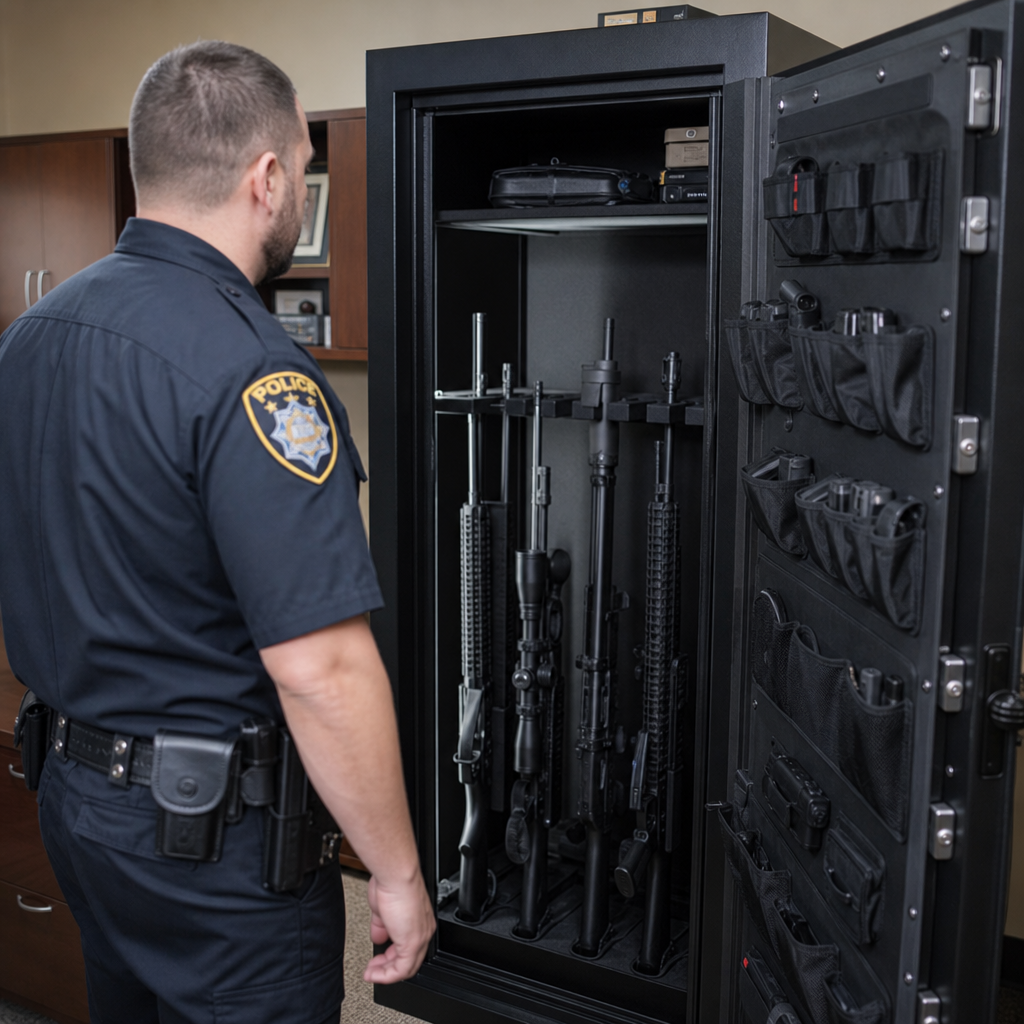
Gun safes for law enforcement professionals must do more than lock firearms away; they have to balance rapid duty access, evidence-grade accountability, home safety, and resistance to theft, fire, and unauthorized handling. In practical terms, that means a police officer’s safe is not the same product a casual range shooter needs. Law enforcement work introduces shift schedules, department-issued weapons, body armor, patrol rifles, backup pistols, sensitive documents, and a constant need to control access around family members, visitors, contractors, or fellow officers. When evaluating gun safes and safety for this audience, the core question is straightforward: which features most directly support readiness without compromising security?
For this buyer persona, a few key terms matter. A quick-access safe is a compact unit designed to open in seconds, usually with a simplex lock, keypad, RFID credential, or biometric reader. A full-size gun safe stores long guns, handguns, magazines, armor, and gear in a heavier cabinet or safe body, often with fire lining and anchor points. Residential Security Container, commonly abbreviated RSC, is a common classification under UL 1037 for burglary resistance in the consumer market, but buyers should understand that many products marketed as safes are technically containers with limited test ratings. Gauge refers to steel thickness, and lower numbers mean thicker steel. Locking bolts, relockers, hard plates, pry resistance, and anchor hardware all affect real break-in performance.
This topic matters because law enforcement professionals live with higher stakes than most gun owners. A stolen duty pistol can become a public safety event, a departmental liability issue, and a personal career problem. A poorly chosen bedside safe can fail under stress at two in the morning. A large safe without thoughtful interior layout can push rifles, optics, and paperwork into unsafe clutter. I have worked with officers who bought based on advertised gun counts and regretted it within weeks; a “24-gun safe” often holds far fewer rifles once optics, slings, and plate carriers enter the picture. The right buying approach starts with persona-specific needs, not marketing labels, and that is why this hub article maps the full landscape of gun safe buyer personas for law enforcement professionals.
Why law enforcement is a distinct gun safe buyer persona
Law enforcement professionals form a distinct buyer persona because their storage requirements combine personal ownership with professional obligation. Patrol officers often need a rapid-access handgun safe in the bedroom and a larger anchored safe elsewhere for long guns, less-lethal tools, credentials, training ammunition, and off-duty firearms. Detectives may prioritize document security and discreet placement in smaller homes. SWAT officers frequently need room for short-barreled rifles, suppressors where lawful, helmets, and armor. Federal agents, corrections officers, probation officers, and school resource officers each bring different shift patterns and deployment routines, but they share one common reality: the safe must support repeated daily use under time pressure.
Another difference is exposure to risk. Officers are sometimes publicly identifiable through uniforms, marked vehicles, social media traces, or local knowledge. That can elevate targeted burglary risk compared with a private citizen who keeps gun ownership less visible. There is also a chain-of-responsibility mindset in law enforcement that changes how buyers assess features. Redundancy, auditability, and predictable access matter. A lock that works ninety-eight percent of the time may be acceptable for a jewelry box; it is unacceptable for a duty weapon. This is why many experienced officers still favor mechanical simplex locks for bedside handgun safes and established lock brands such as Sargent and Greenleaf or SecuRam on larger units.
Home life also shapes this persona. Many officers have spouses, children, or extended family in the household. Some bring gear home after long shifts and need a repeatable storage routine that is secure even when exhausted. In those cases, interior organization is not a luxury feature. Door organizers, handgun racks, labeled magazine bins, dehumidification, and dedicated shelves for badge wallets or body-worn camera accessories reduce mishandling and speed retrieval. A good gun safe for a law enforcement household creates order, and order improves safety.
The features that matter most in a law enforcement gun safe
The most important features for law enforcement buyers are steel thickness, lock reliability, pry resistance, anchoring capability, speed of access, realistic capacity, and interior flexibility. Steel thickness deserves attention first because it directly affects resistance to sidewall attacks. Many entry-level cabinets use 14- or 16-gauge steel bodies, which are better than nothing but vulnerable to aggressive prying or cutting. For a primary home safe storing duty and personal firearms, 12-gauge steel is a practical minimum, while 10-gauge or thicker offers a meaningful upgrade. Door construction matters just as much. Composite doors can be effective if they include robust plates, hard plates, and solid bolt engagement, but thin cosmetic doors with oversized external hinges are not equivalent.
Lock choice should match the use case. For a bedside handgun safe, mechanical simplex locks remain one of the most dependable options because they do not rely on batteries, fingerprints, or touchscreens. Electronic keypads can also work well when sourced from reputable manufacturers and maintained with fresh batteries, but officers should test them in darkness and under stress. Biometric access is best treated as a convenience layer, not the sole entry method, because fingerprint performance can degrade with sweat, cuts, moisture, or poor finger placement. On full-size safes, a UL-listed electronic lock from a trusted brand is often the best balance between daily convenience and controlled access.
Fire protection should be evaluated with skepticism and specifics. Many manufacturers advertise ninety minutes or two hours of fire protection, but those claims may come from proprietary tests rather than independent certification. Ask what temperature profile was used, whether the safe was tested with internal thermocouples, and whether the door seals expand under heat. Fireboard lining adds insulation, yet it also adds weight and can reduce interior dimensions. For officers storing paper records, passports, and digital media, internal temperature matters more than the headline number because paper chars around 451 degrees Fahrenheit and some electronics fail at lower thresholds.
| Feature | Why it matters for law enforcement | What to look for |
|---|---|---|
| Steel body thickness | Resists pry and smash attacks on duty and personal firearms | 12-gauge minimum, 10-gauge preferred for primary safe |
| Lock system | Determines speed and reliability under stress | Simplex for quick access, UL-listed keypad or mechanical dial for full-size safe |
| Anchoring | Prevents whole-safe theft, a common residential burglary tactic | Factory anchor holes, concrete anchors, reinforced floor placement |
| Interior layout | Supports organized storage of rifles, pistols, armor, and documents | Adjustable shelves, door panel storage, handgun hangers, power access |
| Fire protection | Protects records, backup optics, and valuables during house fires | Detailed test data, heat-expanding seals, credible ratings |
Anchoring is nonnegotiable. In residential burglaries, thieves often target smaller safes by removing the entire unit and opening it elsewhere. I have seen compact safes carried out because owners trusted weight alone. Every full-size safe and most handgun safes should be bolted to concrete or a structurally sound substrate using manufacturer-approved hardware. If installation is on a wood floor, reinforcement and joist placement matter. Placement inside a closet alcove or corner can also reduce pry leverage. Security is not just the safe’s specification sheet; it is the complete installed system.
Matching safe types to real-world law enforcement roles
Patrol officers usually benefit from a two-safe strategy. The first safe is a fast bedside or closet-mounted handgun unit for the duty pistol and perhaps a backup gun. The second is a larger long-gun safe for patrol rifles, shotguns, ammunition, armor, and personal firearms. This setup keeps immediate access separate from bulk storage, reducing the temptation to leave a duty weapon unsecured after a long shift. For many patrol households, this is the most functional and safest configuration.
Detectives and plainclothes personnel often need discretion as much as capacity. A safe hidden in cabinetry, a closet, or a low-traffic room can be advantageous, especially in urban homes or apartments where floor loading, visibility, and delivery logistics matter. In those settings, external dimensions and swing clearance should be measured before purchase. Compact rifle safes from brands such as SecureIt appeal to some buyers because they prioritize organization and fast retrieval, though they generally do not match the burglary resistance of heavier traditional safes. The tradeoff should be made consciously.
SWAT, tactical, and firearms instructor personas need deeper storage planning. Optics, chest rigs, helmets, gas masks, breaching tools, and multiple long guns overwhelm generic interiors quickly. These buyers should prioritize taller interiors, modular shelves, rifle barrel supports, and door storage that does not interfere with scoped rifles. Competitive or high-volume training shooters in law enforcement also benefit from separate ammunition storage planning. Large ammo quantities add weight, and concentrated shelf loads can exceed flimsy interiors. Reinforced shelving and distributed weight are practical concerns, not minor details.
Retired officers represent another important buyer persona within this hub. They may no longer need instant access to duty gear, but they often retain valuable firearms, memorabilia, credentials, and documents. Their priorities can shift toward fire protection, ease of use, and simpler lock operation if arthritis or vision changes affect dexterity. A large dial or well-spaced electronic keypad may serve them better than a small biometric reader. Gun safe buyer personas change over a career, and the safest choice at age thirty-five may not be the best at sixty-five.
Common buying mistakes and how professionals avoid them
The most common mistake is buying for advertised capacity instead of actual loadout. Manufacturers count slim long guns without optics, bipods, lights, or slings. In reality, an officer with six rifles may need the footprint of a “12-gun” or “18-gun” safe just to avoid crowding. Crowding causes stock damage, snagging, and unsafe handling when retrieving one firearm from a packed row. Buy for at least thirty to fifty percent more space than your current collection requires, especially if your role may add equipment over time.
Another mistake is overvaluing biometrics. Fingerprint readers have improved, but they are still vulnerable to false rejects from dirty sensors, dry skin, gloves, or rushed placement. If a biometric safe is chosen, it should include a proven secondary method such as keypad or key override, and that backup should be tested regularly. Officers should also practice opening any safe one-handed and in darkness. If a feature cannot perform during a groggy 3 a.m. wake-up, it is not a strength.
Shoppers also underestimate humidity control. In many regions, especially the Southeast and Gulf Coast, enclosed safes can trap moisture that damages blued steel, optics hardware, paperwork, and leather gear. A dehumidifier rod, desiccant system, and hygrometer are low-cost additions with high value. Finally, many buyers ignore delivery and installation. A 700-pound safe placed badly is less secure than a 500-pound safe properly anchored in a constrained location. Professional installation, concealed placement, and door swing planning prevent expensive mistakes and improve long-term use.
How to evaluate brands, ratings, and long-term value
Brand reputation matters, but it should be filtered through construction details and service history. Liberty, Fort Knox, AMSEC, Browning, Rhino Metals, Vaultek, V-Line, and SecureIt each serve different parts of the market. No single brand is best for every law enforcement persona. AMSEC and Fort Knox are frequently strong choices when buyers prioritize heavier steel and higher-tier construction. V-Line is widely respected for mechanical quick-access handgun safes. Vaultek has earned attention for modern access features and app-connected models, though connected features should never replace core physical security. The best approach is to compare model-specific specifications rather than shopping by logo alone.
Independent ratings deserve close review. UL-listed locks provide more confidence than generic lock claims. California Department of Justice approvals can indicate compliance for certain handgun safety standards, but they are not substitutes for serious burglary resistance. Fire ratings should be treated as comparative data, not guarantees. Warranty support, parts availability, and lock replacement service also affect long-term value. I advise buyers to call customer service before purchasing. Response quality often reveals how the company will behave years later when a lock fails, a keypad dies, or replacement shelves are needed.
For law enforcement professionals, the best gun safe is the one that secures duty and personal firearms consistently, opens predictably under stress, and fits the realities of the home and the job. Start by defining your buyer persona honestly: patrol officer, detective, tactical operator, retiree, apartment dweller, parent, collector, or some combination. Then prioritize steel, lock reliability, anchoring, realistic capacity, and interior organization over marketing claims. Fire protection and smart features are valuable, but only after the fundamentals are right.
As the central guide to gun safe buyer personas within the broader gun safes and safety category, this article should help narrow your next step. Measure your space, list every firearm and piece of gear you need to store, decide what requires immediate access, and compare models against those needs. A disciplined buying process produces a safer home, better readiness, and fewer regrets. Use this hub as your starting point, then move into role-specific and safe-type comparisons to choose with confidence.
Frequently Asked Questions
What makes a gun safe for law enforcement professionals different from a standard residential gun safe?
A gun safe for law enforcement use has to solve a different set of problems than a basic home safe designed for occasional recreational access. Officers, deputies, detectives, federal agents, corrections personnel, and other armed professionals often need fast, reliable access to duty weapons during odd hours, before or after shifts, and sometimes under extreme stress. That means the safe must support quick entry without sacrificing security. A casual owner may be fine with slower access and simpler storage needs, but a law enforcement professional often has to secure a duty pistol, backup handgun, patrol rifle or shotgun, ammunition, credentials, sensitive paperwork, and sometimes body armor or other mission-critical gear in one organized location.
Another major difference is accountability. Law enforcement professionals may be responsible for department-issued firearms, personally owned duty-approved weapons, badge-related materials, and documents that cannot be left unsecured. A suitable safe should help maintain controlled storage, clear organization, and reduced risk of unauthorized handling by family members, visitors, contractors, or thieves. In many cases, the safe also needs to support a ready-to-deploy routine, where holsters, spare magazines, lights, optics, and armor can be staged in a practical way rather than piled into a generic cabinet.
Construction quality also matters more. Thin metal cabinets and entry-level safes may deter casual access, but they are usually not enough for professionals who need real pry resistance, secure boltwork, solid locking systems, and the ability to anchor the safe properly. Fire protection, tamper resistance, reliable hinges, reinforced doors, and long-term durability all become more important when the contents include expensive and professionally necessary equipment. In short, law enforcement buyers should think less in terms of “basic firearm storage” and more in terms of a secure-duty equipment hub that balances speed, protection, organization, and accountability.
Which locking system is best for a law enforcement gun safe: biometric, keypad, mechanical, or something else?
The best locking system for a law enforcement gun safe is usually the one that delivers the strongest combination of speed, consistency, and backup access in real-world conditions. For many professionals, an electronic keypad is the most balanced option. A quality keypad lock allows fast entry in low light, does not depend on perfect finger placement, and can be very efficient when a user is coming home after a shift and needs to secure or retrieve a duty weapon quickly. Better models also offer lockout protections, tamper alerts, and dependable internal components from established lock manufacturers.
Biometric locks are appealing because they can be extremely fast, but their quality varies widely. In ideal conditions, a good biometric reader can work very well. However, law enforcement work is not ideal-condition work. Wet hands, dirty fingers, glove use, cuts, cold weather, and repeated rushed entries can all affect fingerprint recognition. That does not mean biometric access should be ruled out, but it does mean professionals should be cautious about relying on cheap biometric systems as the sole means of entry. If biometric access is chosen, it should come from a reputable manufacturer and ideally be paired with a keypad or mechanical override.
Mechanical dial locks remain respected for long-term reliability and resistance to electronic failure, but they are usually slower to open. For a patrol officer, investigator, or armed plainclothes professional who values rapid access before a shift or in a home-defense emergency, that delay may be a meaningful drawback. Mechanical locks still make sense for long-term storage, lower-frequency access, or users who prioritize simplicity over speed.
In practice, many law enforcement professionals prefer either a high-quality electronic keypad safe or a dual-access design that combines keypad and biometric entry with a reliable backup method. The most important thing is not choosing the trendiest lock; it is choosing one that can be opened quickly, repeatedly, and confidently when fatigue, stress, darkness, and time pressure are all factors. Reliability testing, battery accessibility, emergency override design, and the reputation of the locking system should weigh more heavily than marketing claims.
What size and interior layout should law enforcement professionals look for in a gun safe?
The right size depends on both current duty gear and future expansion, and that second part is where many buyers underestimate their needs. A law enforcement professional may start by thinking only about a duty pistol, but quickly realize the safe also needs space for a patrol rifle, shotgun, backup handgun, armor carrier, helmet, spare magazines, less-lethal tools, optics, important records, and valuables. If the safe is too small, gear becomes crowded, disorganized, and slower to access. For professionals who work irregular schedules and may need to gear up quickly, poor organization is more than an inconvenience; it can become a readiness issue.
Interior layout matters just as much as overall capacity. Adjustable shelving, dedicated long-gun racks, handgun organizers, door-mounted storage, document compartments, and accessory bins can dramatically improve day-to-day use. An officer should be able to separate firearms from paperwork, keep loaded magazines where lawful and practical, protect optics from unnecessary impact, and stage equipment so that frequently used items are easy to reach. A good interior should support a logical workflow: secure the duty weapon at the end of shift, store credentials or sensitive documents in a protected section, and retrieve necessary gear efficiently before heading back out.
Long-gun owners should also pay close attention to usable interior depth and height, especially if patrol rifles have mounted optics, lights, slings, or muzzle devices. Some safes advertise generous capacity numbers that do not reflect realistic use with duty-configured firearms. The same goes for door clearance and shelf placement. A rifle with an optic or a shotgun with side saddle storage can require more room than expected. If body armor or plate carriers will be stored inside, vertical space becomes even more important.
As a rule, it is usually smarter to buy more safe than you think you need. A larger, well-organized safe gives a law enforcement professional room to manage current weapons, future equipment changes, and personal valuables without sacrificing accessibility. The safest setup is one where every critical item has a stable, intentional place.
How important are fire protection, theft resistance, and anchoring for a police officer’s gun safe?
They are extremely important, because a law enforcement safe has to protect against more than simple unauthorized access. Theft resistance matters because duty weapons, backup guns, and patrol rifles can be especially attractive to criminals. A safe should have solid steel construction, reinforced locking areas, substantial locking bolts, pry-resistant door design, and a body that is difficult to attack quickly with common tools. But even a heavy safe can be compromised if it is not anchored. Proper bolting to a concrete floor or another appropriate structural surface is one of the most important security upgrades a buyer can make. It prevents thieves from tipping, moving, or removing the entire safe for later attack.
Fire protection is also a critical consideration, especially when the contents include not just firearms but credentials, legal records, insurance papers, digital media, and irreplaceable documents. Fire ratings should be evaluated carefully. Buyers should look beyond vague marketing language and consider the tested temperature rating, duration, seal quality, and overall construction. While no safe makes contents invulnerable under every fire condition, a better-built unit can buy valuable time and significantly improve the odds that firearms, records, and duty-related materials survive a house fire.
For law enforcement professionals, theft resistance and fire protection should be viewed together rather than as separate checkboxes. A safe that opens quickly but uses weak materials may fail when it matters most. Likewise, a safe with an impressive fire label but poor real-world burglary resistance may not be the right answer. The goal is balanced protection: strong construction, dependable locking, smart placement in the home, solid anchoring, and enough fire performance to protect both weapons and associated materials. In practical terms, professionals should avoid treating the safe as a simple box and instead view it as part of an overall security plan for the home and for department-related responsibilities.
What features matter most for quick access while still maintaining home safety and professional accountability?
The most valuable quick-access features are the ones that improve speed without inviting mistakes. For law enforcement professionals, that usually starts with a dependable lock that opens consistently under stress, followed by an interior layout that supports immediate recognition and retrieval of the correct firearm or gear. Interior lighting is a surprisingly important feature, especially for officers arriving home late, gearing up before dawn, or checking equipment in low-light conditions. Good lighting reduces fumbling, helps confirm that weapons are secured properly, and supports safer handling overall.
Door organizers, handgun holsters, magazine racks, and clearly separated storage zones also matter. A duty pistol should not be buried behind paperwork, and a backup gun should not be loose among unrelated gear. Organized storage supports accountability because the user can quickly confirm what is present, what is missing, and whether everything has been returned to its proper place. That is especially useful for professionals managing issued equipment, personal firearms, ammunition, and sensitive credentials at the same time.
Home safety adds another layer. If children, teenagers, guests, or service workers may be in the residence, the safe should prevent casual or accidental access while still allowing the officer to respond quickly if needed. Some professionals use a two-tier strategy: a larger primary safe for full equipment storage and a smaller rapid-access safe for the immediate duty handgun. That approach can work very well