
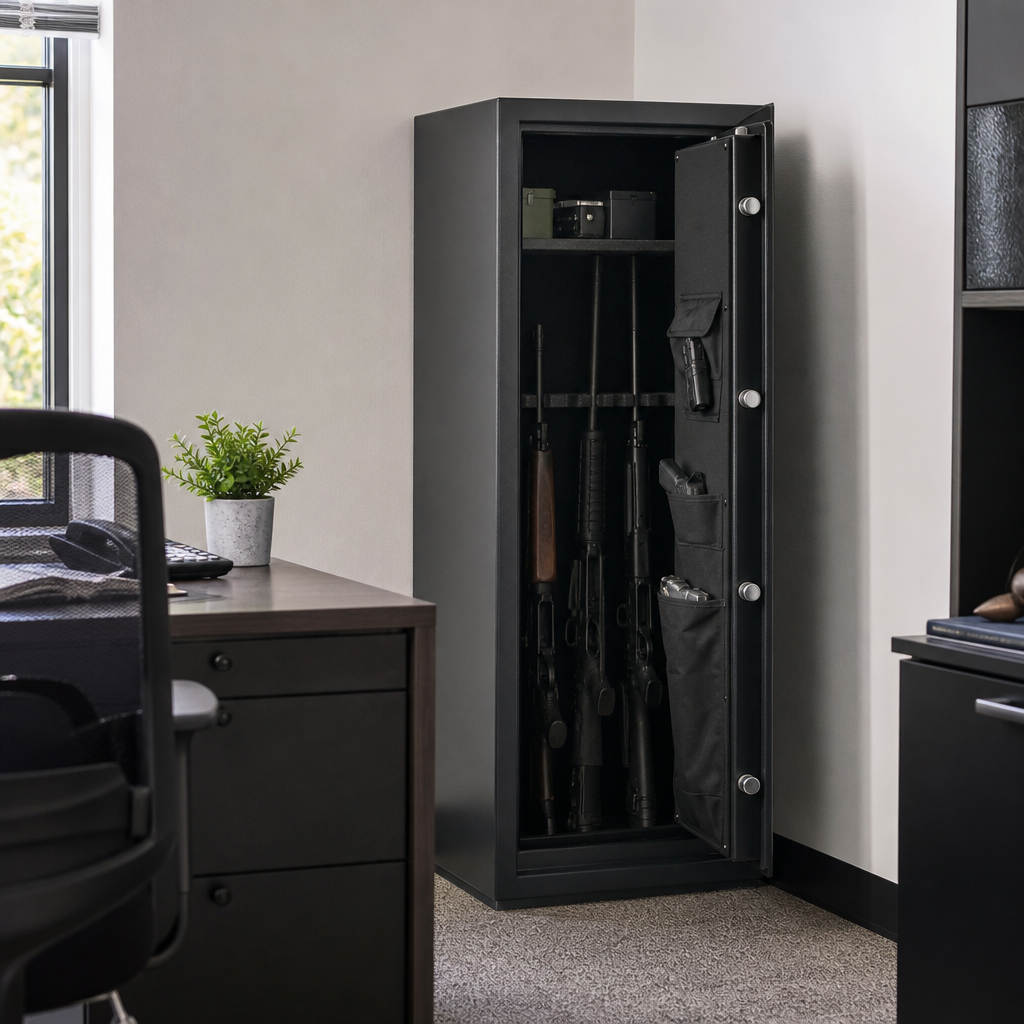
Choosing the best gun safe for an office starts with understanding that office storage is not the same as home storage. In a workplace, a safe may need to protect a defensive handgun, secure sensitive documents, control employee access, satisfy insurance requirements, and fit within a professional environment without attracting attention. That mix of security, discretion, fire resistance, and access control changes which models make sense. A bulky hunting-safe built for a garage often performs poorly in an office, while a thin lockbox designed for a nightstand may fail basic commercial expectations.
When I evaluate office gun safes, I focus on five terms. Burglary resistance refers to how well the safe delays forced entry using pry tools, cutting tools, and attacks on the door or body. Fire rating indicates how long the interior stays below a defined temperature, commonly 350 degrees Fahrenheit, during a standardized test. Access control covers who can open the safe and how reliably they can do it under stress. Anchoring means bolting the safe to concrete or structural framing so it cannot simply be carried away. Capacity is not just the number of firearms; it includes room for holsters, spare magazines, legal paperwork, cash, and records.
This topic matters because office gun storage creates higher stakes than many buyers expect. A stolen office firearm can expose a company to liability, reputational damage, insurance claims, and workplace safety concerns. An unlocked or poorly secured firearm can also create internal risk if cleaning staff, contractors, or unauthorized employees gain access. In my experience, most office buyers initially overvalue quick access and undervalue installation, audit trails, and concealment. The best office safe is usually one that fits a defined use case: executive office carry storage, reception-area emergency access, retail back-office security, or dual storage for weapons and records.
This guide serves as a hub for gun safe comparisons and brand spotlights, so it compares leading brands and explains how to narrow the field. The strongest office choices typically come from established names such as Fort Knox, Liberty Safe, Vaultek, SnapSafe, Hornady, Hollon, AMSEC, and Steelwater. Each brand excels in different areas. Some lead in heavy steel construction and customization, some in smart access and compact form factors, and others in commercial-grade burglary or fire protection. The right answer depends less on marketing claims and more on matching the safe’s construction, lock type, rating, and footprint to your office risk profile.
What Makes a Gun Safe Suitable for an Office
An office gun safe should be compact enough for discreet placement yet strong enough to resist a quick smash-and-grab attack. That usually means heavier steel than consumer lockboxes, a reinforced door, quality lock bolts, and a design that supports permanent anchoring. In practical terms, I look for at least 12-gauge steel on serious office cabinets and substantially thicker construction on premium burglary-oriented models. Door design matters as much as body steel. Many break-ins succeed because the door frame flexes under prying, not because the body is cut open.
Office placement changes priorities. A private executive office may allow a larger under-desk or closet-mounted safe. A medical practice, law office, or accounting firm may need a quieter installation that also protects client files. Retail offices often need faster opening and stronger anti-theft design because staff turnover, back-door access, and cash handling increase exposure. For these settings, interior organization is underrated. A handgun safe with a document shelf or a compact fire safe with handgun-ready holster inserts is often more useful than a single-purpose box.
The lock matters too. Mechanical dial locks remain dependable and avoid battery concerns, but they are slower and less practical for frequent access. Electronic keypad locks dominate office use because they are fast, familiar, and easy to manage. Biometric locks can work well for a single authorized user, but fingerprint sensors vary widely by brand, environmental conditions, and skin dryness. In my testing across multiple compact safes, the best systems combine biometric access with a keypad backup and a physical override key. Redundancy is essential in a business setting where lockout is unacceptable.
Core Buying Criteria: Steel, Fire, Size, and Installation
The best office gun safe is the one that survives realistic attacks and fits the room without compromising operations. Start with steel thickness and door construction. A compact safe made from 16-gauge steel may stop casual tampering, but it is vulnerable to determined prying. For a professional office, I recommend stepping up to heavier steel and a recessed door where possible. Next, evaluate the lock. UL-listed electronic locks from proven manufacturers offer a better baseline than generic no-name keypads. If the safe will hold records as well as firearms, fire protection becomes more important, but remember that many fire ratings are manufacturer-developed rather than independently verified.
Installation is where many otherwise good purchases fail. A two-hundred-pound safe is not secure if two people can tilt it onto a dolly and wheel it out. Bolting to concrete is best. If the office is on an upper floor, anchoring through structural framing or using a secure built-in cabinet matters. I also advise buyers to think about visibility lines. A safe visible during routine meetings or through glass walls invites questions and attention. The best placement is often inside a credenza, closet, millwork enclosure, or locked back-office room, while still allowing the door to open fully.
| Brand | Best Office Use | Standout Strength | Main Tradeoff |
|---|---|---|---|
| Vaultek | Executive office handgun access | Fast smart-entry features and compact design | Less burglary mass than full-size safes |
| AMSEC | Commercial offices needing stronger security | Proven burglary and fire options | Higher cost and heavier installation |
| Fort Knox | Premium private offices | Customization and heavy steel construction | Longer lead times on some builds |
| Liberty Safe | General business use with mixed storage | Broad dealer network and balanced features | Not every model suits compact spaces |
| Hollon | Fire-focused office storage | Strong fire-oriented models and solid value | Model selection varies by dealer |
| Hornady | Under-desk and rapid-access storage | Practical compact handgun safes | Limited long-gun or document capacity |
| SnapSafe | Closet or modular office installation | Modular delivery for difficult spaces | Assembly required after delivery |
| Steelwater | Value-oriented larger office setups | Feature-rich specs for the price | Fit and finish can vary by line |
Top Brands Compared for Office Use
AMSEC is one of the safest recommendations when a buyer wants commercial credibility. The company is well known in the security industry for burglary safes, fire safes, and cash-handling equipment, and that heritage matters. For an office, AMSEC models often stand out because the lock and body feel purpose-built rather than retail-optimized. Their BF series is frequently discussed because it blends a steel security body with respectable fire protection. If your office stores a handgun alongside contracts, media, or small valuables, AMSEC is often the brand I mention first when security outranks aesthetics.
Fort Knox is a premium choice for buyers who want heavy construction and customization. In executive environments where a safe may be integrated into millwork or a high-end office suite, Fort Knox offers finish options, interior layouts, and upgraded steel packages that make sense. These safes are not the most budget-friendly route, but they are serious equipment. Liberty Safe sits slightly more mainstream and offers broad availability through dealers, which helps if you want to compare sizes in person. Liberty’s stronger models work well for private offices, though buyers should avoid assuming every Liberty line has the same security level.
Vaultek dominates the conversation around compact smart safes, especially for handgun storage in a desk, credenza, or closet. For office users who prioritize quick authorized access, features such as biometric entry, keypad entry, Bluetooth management on selected models, and interior lighting are practical. The RS and MX lines have strong brand recognition, but office buyers should distinguish between convenience and true burglary resistance. Vaultek is excellent for rapid-access handgun control, particularly where discretion matters, yet it should be anchored and selected with realistic expectations about attack resistance.
Hornady and SnapSafe both fill useful niches. Hornady’s rapid-access handgun safes are straightforward, widely available, and easy to deploy under desks or inside cabinets. They are often a good fit for a solo professional who carries daily and needs secure temporary storage during client meetings. SnapSafe is valuable when delivery access is difficult, such as upstairs offices, narrow corridors, or leased spaces where a welded safe cannot be moved easily. Their modular designs solve a real problem many buyers discover too late: a safe that cannot physically reach the room is not a viable option.
Best Choices by Office Scenario
For a private executive office, the best gun safe is often a compact but high-quality handgun or mixed-use safe mounted inside a credenza or closet. A Vaultek if quick access leads the requirement, or an AMSEC or Fort Knox compact model if theft resistance comes first, are usually the strongest choices. In law firms, CPA offices, and medical practices, I typically recommend a fire-capable safe with separate interior organization for documents and a defensive handgun. These businesses already manage confidentiality risk, so combining firearm security with records protection is efficient and easier to justify to leadership.
For retail back offices, theft risk rises because more people may know cash and valuables are present. In these environments, a heavier AMSEC, Hollon, or Steelwater model with robust anchoring is often smarter than a sleek biometric safe. Quick access still matters, but resisting employee theft or after-hours burglary matters more. For shared offices or workplaces with multiple authorized users, prioritize an electronic keypad with managed code control over a biometric-only system. Fingerprint enrollment can become messy when staff change. Code rotation and access logs, where available, are easier to administer consistently.
If the office is leased, modularity and removability can shape the decision. SnapSafe becomes attractive because it can be assembled in place and removed without demolition. If noise, dust, or contractor traffic are concerns, installation timing also matters. I have seen buyers delay anchoring because they plan a future renovation; that is a mistake. An unanchored safe is temporary security at best. Even compact units should be secured immediately, ideally with tamper-resistant hardware and professional installation documented for insurance purposes.
Common Mistakes and How to Avoid Them
The first mistake is buying by advertised gun count. A “20-gun” safe rarely stores twenty firearms in practical conditions, and in an office that number is irrelevant anyway. Focus on usable interior dimensions and shelf layout. The second mistake is treating fire ratings as directly comparable across all brands. Unless a rating comes from an independent testing framework, compare carefully and read the testing conditions. The third mistake is ignoring lock quality. A well-built body paired with a weak lock undermines the whole purchase.
Another common error is overlooking policy and legal alignment. Some offices need written authorization rules, separate key custody procedures, or insurer approval for firearm storage. A safe purchase should sit inside a broader office safety plan that covers who can access the firearm, when it may be stored, how maintenance is handled, and what happens if an employee leaves. Finally, do not forget concealment. The safest-looking safe can still become a target if delivery, placement, or daily use make it obvious.
How This Hub Helps You Compare Gun Safe Brands
As a sub-pillar within Gun Safes and Safety, this page should help you decide which deeper comparisons to read next. If you are weighing AMSEC against Fort Knox, the real question is whether you need commercial-grade emphasis or premium customization. If you are choosing Vaultek versus Hornady, the decision usually comes down to advanced smart features versus simpler rapid access. If Liberty, Hollon, Steelwater, or SnapSafe are on your shortlist, compare them by installation constraints, fire needs, and dealer support rather than headline specs alone.
The best gun safe for an office is not one universal model. It is the safe that matches your office layout, threat profile, access needs, and installation reality. For most businesses, that means buying from an established brand, choosing heavier construction than a typical home lockbox, insisting on proper anchoring, and balancing quick access with administrative control. Start by defining your office scenario, narrow the field to two or three brands, and then compare exact models with measurements, lock options, and verified installation plans before you buy.
Frequently Asked Questions
What should I look for in the best gun safe for an office?
The best gun safe for an office should balance security, discretion, quick access, and a professional appearance. Unlike a large residential gun safe designed for long guns and basement storage, an office gun safe usually needs to fit under a desk, inside a credenza, in a closet, or within a private office without drawing attention. That means size, mounting options, and exterior styling matter just as much as theft resistance. A good office model should be compact enough to integrate into the workspace while still offering strong steel construction, a pry-resistant door, and a reliable lock.
Access control is another major factor. In an office setting, you may need to keep a defensive handgun available to an owner or authorized executive while preventing access by employees, cleaning crews, visitors, or contractors. Biometric, keypad, and RFID-enabled safes can all work well, but the best choice depends on how quickly you need access and how many authorized users there are. For businesses that require tighter control, a model with an audit trail, multiple user codes, or managed access features may be worth considering.
Fire protection and document storage can also matter more in an office than many buyers expect. If the safe will hold paper files, backup drives, contracts, cash, or confidential records alongside a firearm, you may want a model with at least some tested fire resistance or separate compartments for valuables. Finally, be sure to consider insurance requirements, local laws, and company policies. The best office gun safe is not simply the strongest one on the market; it is the one that fits your workspace, secures the firearm from unauthorized access, supports compliance needs, and allows you to retrieve it when necessary.
Are biometric gun safes a good choice for office use?
Biometric gun safes can be an excellent choice for office use, especially when speed and limited authorized access are priorities. In a workplace environment, the appeal of biometric entry is obvious: an authorized user can often open the safe in seconds without fumbling for a key or remembering a code under stress. For executives, business owners, or professionals who keep a defensive handgun secured nearby, that convenience can make a real difference. Many modern biometric safes also allow multiple fingerprint enrollments, which is useful if more than one authorized person may need access.
That said, not all biometric safes are created equal. Lower-quality fingerprint readers can be inconsistent, particularly if fingers are wet, dirty, dry, or positioned incorrectly. In an office, where reliability is essential, it is smart to focus on established brands with proven reader performance and a backup entry method such as a keypad or override key. A biometric safe should never be chosen based on speed alone. The lock should be matched by solid steel construction, secure mounting capability, and a design that resists prying or smash-and-grab theft.
For many offices, the best approach is a layered one: choose a biometric safe from a reputable brand, test it regularly, and always maintain backup access. If your office has strict compliance, chain-of-custody, or employee-liability concerns, a commercial-grade electronic safe with user codes and access logs may actually be a better fit than a consumer biometric model. In short, biometric gun safes are often a very practical office solution, but they work best when reliability, build quality, and administrative control are evaluated together rather than in isolation.
Which gun safe brands are best for an office environment?
Several brands stand out for office gun safe use, but the best one depends on your priorities. Vaultek is frequently recommended for office environments because its safes often combine modern access options, compact designs, strong construction for their class, and features like app connectivity, biometric entry, and interior lighting. These safes are especially appealing for executives or professionals who want a discreet, tech-forward safe that fits cleanly into an office setting. Hornady is another strong option, particularly for rapid-access handgun safes that are compact and easy to mount inside furniture or under a desk.
Fort Knox is often favored by buyers who want heavier-duty construction and more customization. While some Fort Knox models are larger than what many offices need, the brand has a strong reputation for security and build quality, which can be valuable when theft resistance is the top concern. Liberty Safe is also a respected name, especially if the office needs to store both firearms and important records in a larger safe with better fire protection. For businesses looking at more document-focused security with enough room for a handgun, certain commercial-style burglary and fire safes from brands like Hollon or AMSEC can be a very smart fit.
When comparing brands, it helps to ignore marketing labels and focus on how the safe will actually function in a workplace. Ask whether the brand offers secure anchoring, dependable lock technology, a discreet footprint, strong customer support, and documented fire or security ratings where relevant. A top brand for a garage or home armory is not automatically a top brand for a front office, executive suite, or professional practice. In office settings, compact security, controlled access, and a low-profile appearance often matter more than raw storage capacity.
Do I need fire protection in an office gun safe?
In many office scenarios, yes—fire protection is worth serious consideration. A home user may be focused almost entirely on firearm theft prevention, but an office safe often serves multiple purposes. It may store a handgun along with paper records, contracts, licenses, external drives, cash, backup media, or sensitive client information. If that is the case, fire resistance becomes much more important. Even if the safe is primarily intended for a firearm, office fires can spread quickly through electronics, wiring, furniture, and paper, so a safe with at least some tested fire performance can add meaningful protection.
However, it is important to understand what fire ratings actually mean. Not every safe advertised as “fireproof” offers the same level of protection, and many compact handgun safes provide little or no meaningful fire resistance. If your office safe will also hold critical documents, you may want a true fire-rated safe or a hybrid model that balances burglary protection and fire protection. In some cases, the smartest setup is to use two different storage solutions: a rapid-access gun safe for the defensive firearm and a separate fire-rated document safe for records and media.
The decision comes down to what the safe is expected to protect. If it will hold only a handgun for quick access in a low-risk office and the safe is mounted in a secure interior location, fire resistance may be secondary. But if the office needs one safe to secure weapons, documents, and valuables together, fire protection should move much higher on the checklist. It is also a practical issue for business continuity, since replacing a firearm is often simpler than recovering destroyed legal, financial, or client-related records.
How should a gun safe be installed and secured in an office?
Proper installation is critical because even a well-built safe can fail its purpose if it is easy to carry away or access. In an office, compact gun safes are common, which means anchoring is especially important. A small handgun safe placed loose in a desk drawer provides much less real security than one bolted to a solid surface. The best practice is to mount the safe to concrete, structural wood, heavy cabinetry, or another stable anchoring point recommended by the manufacturer. Under-desk, in-cabinet, and closet-wall installations can work well as long as they are discreet and secure.
Placement should also support both concealment and controlled access. In a professional environment, a gun safe should not be obvious to visitors, clients, or employees who do not need to know it is there. At the same time, the authorized user must be able to reach it quickly and safely. That usually means avoiding high-traffic areas, shared desks, or publicly accessible reception spaces. If multiple people use the office, think carefully about line of sight, after-hours cleaning staff, and whether the safe can be observed during opening. A concealed but ergonomically reachable location is typically ideal.
Finally, installation should reflect legal, policy, and liability considerations. If the office is part of a larger business, make sure firearm storage is consistent with company rules, lease terms, local laws, and insurance conditions. Limit who knows the safe exists, control who has credentials, and periodically test both the lock and the mounting integrity. In many offices, the safest setup is one where the firearm remains secured unless genuinely needed, the safe is physically anchored against removal, and access is restricted to a clearly defined authorized user or users. Good installation turns a safe from a simple storage box into a real security system component.