
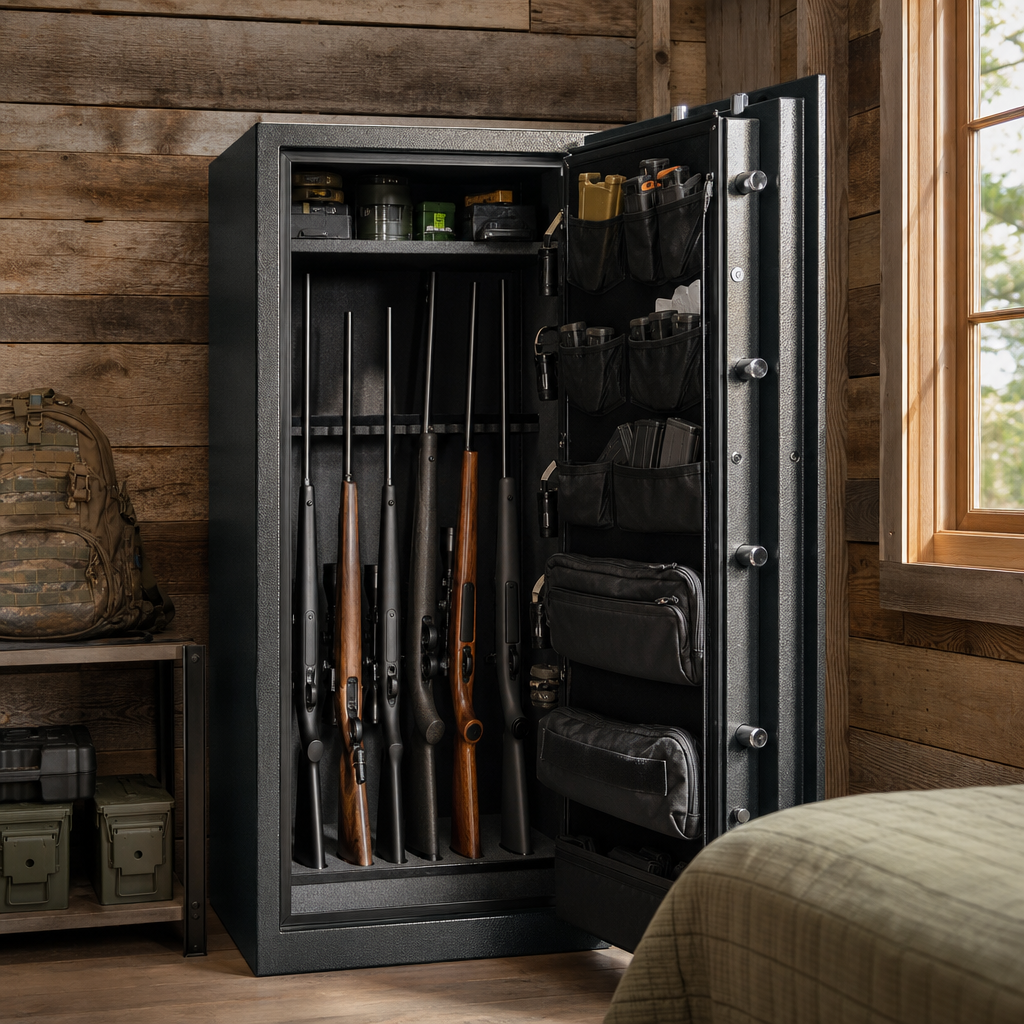
Gun safes for survivalists are not just storage boxes; they are security systems designed to protect firearms, ammunition, documents, and critical gear while still allowing fast access during emergencies. In the survivalist context, protection means more than burglary resistance. It includes fire resistance, moisture control, backup access methods, organized storage, concealment, and placement that supports a household defense plan. Accessibility also has a different meaning for preparedness-minded owners. A safe that is impossible for a thief to open but too slow for the owner under stress can fail its purpose when seconds matter.
When I evaluate safes for families focused on resilience, I start with the buyer persona. A buyer persona is a practical profile that groups people by needs, risks, budget, storage volume, living situation, and likely use during an emergency. The right gun safe for a rural homesteader is rarely the same as the right safe for an urban apartment dweller, a collector, a parent with children, or a retired couple planning for extended disruptions. Understanding these personas helps narrow the field quickly and prevents common buying mistakes, such as overpaying for capacity that will never be used or underestimating anchoring, fire ratings, and lock redundancy.
This matters because safe selection has permanent consequences. A 700-pound safe affects floor loading, room layout, and delivery logistics. A poor lock choice can create access failures during power outages. An undersized interior leads owners to stack rifles unsafely, damage optics, or move valuables outside the safe. In my experience, the best survivalist gun safe balances four demands at once: delay unauthorized entry, survive common hazards, support efficient retrieval, and fit the owner’s actual preparedness plan. This hub article explains the major gun safe buyer personas, the features each should prioritize, and the tradeoffs that determine whether a safe is truly ready for survival use.
The Preparedness-Focused Family: Child Safety, Layered Security, and Daily Access
The most common persona in this category is the preparedness-focused family. These buyers typically own several long guns, a few handguns, spare magazines, medical kits, passports, cash, and backup communications gear. Their primary concern is preventing unauthorized access by children or visitors while keeping defensive firearms available to responsible adults. For this group, a full-size residential security container or true gun safe in the 24- to 36-gun class is usually the practical starting point, even if the collection is smaller today. Manufacturers often overstate rifle capacity by assuming no optics, no slings, and no accessories, so real storage is usually 50 to 70 percent of the advertised number.
For families, quick-access handgun storage should complement, not replace, the main safe. A staged pistol safe in the bedroom can handle immediate defensive needs, while the main safe secures long guns, ammunition, important records, and less frequently used sidearms. Good family setups usually include an electronic or mechanical lock on the main safe, interior lighting, door-mounted organizers, and anchored installation into concrete or substantial wood framing. If children are present, biometric locks can be useful on bedside units, but the main safe should still favor proven reliability over novelty. Fingerprint readers have improved, yet dirt, sweat, battery issues, and inconsistent scans remain real limitations under stress.
Fire protection is especially important for this persona because the safe often stores irreplaceable documents alongside firearms. Buyers should look beyond marketing labels and examine how fire ratings are tested. A stated 60-minute rating at 1,200 degrees Fahrenheit is not equivalent across brands unless testing methods are clearly disclosed. Independent standards such as UL listings matter more than vague promises. In plain terms, the family buyer needs a safe that slows theft, protects against house fire long enough for suppression response, and keeps critical gear organized. That combination supports both everyday safety and long-term preparedness.
The Rural Homesteader: Theft Delay, Harsh Conditions, and High Capacity
Rural homesteaders have different risks. Their homes may sit farther from law enforcement response, and they often own more long guns for hunting, pest control, and property defense. They may also face environmental challenges such as detached outbuildings, high humidity, dust, and seasonal temperature swings. For this persona, capacity and theft delay matter more than sleek appearance. A heavier safe with thicker steel, robust locking bolts, reinforced door edges, and credible pry resistance is often the right investment, especially when response times can stretch well beyond urban averages.
I have seen rural buyers regret choosing decorative entry-level cabinets because they looked substantial on a showroom floor but used thin sheet steel that could be peeled open with basic tools. For a homesteader, steel thickness should be examined closely. Many consumer safes use 14- to 12-gauge bodies; stronger units may use 10-gauge or thicker steel and better door construction. Weight is not everything, but it often correlates with stronger material and more fire insulation. Anchoring is still essential. Even a heavy safe can be tipped or moved with mechanical advantage if it is not bolted down.
Environmental control is another priority. In humid regions, use of a GoldenRod-style dehumidifier, silica packs, and regular hygrometer checks can prevent rust on blued steel and corrosion on optics. Placement also matters. A climate-controlled interior room is preferable to a barn or garage, where moisture cycles and temperature swings are harder on both firearms and lock mechanisms. Rural buyers often benefit from larger interiors with configurable shelving so the safe can hold radios, night vision, batteries, and legal papers in addition to guns. Their safe is part of a broader resilience system, not a single-purpose container.
The Urban Apartment or Condo Owner: Space Efficiency and Discreet Installation
The urban survivalist faces a different problem: limited square footage, nearby neighbors, shared walls, and stricter attention to concealment. This buyer persona typically needs a compact safe or modular system that can fit a closet, utility room, or reinforced corner without advertising its presence during delivery. Weight limits may also matter in upper-floor apartments or older buildings, making it necessary to verify floor capacity and lease terms before purchase. In these cases, “best” does not mean biggest. It means secure enough for the threat profile, small enough to install discreetly, and organized well enough to maximize every cubic inch.
For apartment owners, a smaller safe with strong anchoring and low visual signature often outperforms a larger but poorly placed unit. Closet installation behind hanging clothes, furniture-assisted concealment, and noise-conscious delivery planning all matter. A compact safe should still have anti-pry door design, hard plate protection for the lock, relockers where available, and enough internal depth for scoped rifles if long guns are part of the plan. If the buyer owns only a few firearms, a purpose-built rifle safe or modular cabinet may be smarter than a large traditional safe with unusable dead space.
Fire tradeoffs are particularly important here. Apartment dwellers may assume multi-unit buildings provide better protection, but shared structures can produce unpredictable fire spread and water damage. A realistic approach is to choose the best fire rating available within space and weight constraints while storing passports, deeds, and digital backups in secondary protected containers. Urban owners should also think through access under evacuation pressure. If the plan is to shelter in place unless ordered out, safe location should support quick retrieval of key gear without crossing exposed windows or hallways.
The Collector and Enthusiast: Preservation, Inventory Control, and Segmented Access
Collectors and serious enthusiasts often buy with emotion first and logistics second, which is why they benefit from persona-based planning. This group may own heirloom rifles, historical pieces, custom builds, suppressors where legal, expensive optics, and serialized accessories that require careful recordkeeping. Their central need is preservation. Theft resistance still matters, but interior protection, inventory management, and controlled handling are just as important because scratches, rust, and poor organization can destroy value even without a break-in.
Collectors should prioritize soft interior finishes, adjustable racks, separate shelving for handguns and optics, humidity control, and enough width to prevent crowding. One of the most common mistakes I see is a beautiful safe filled beyond capacity, with rifles pressing against each other and scopes catching every time the owner reaches inside. For this persona, buying one size larger than current needs is not a luxury; it is sound asset protection. Insurance documentation also becomes part of the safe strategy. Photos, serial numbers, appraisals, and digital copies of receipts should be stored securely and updated regularly.
| Buyer Persona | Top Priority | Best Safe Type | Main Tradeoff |
|---|---|---|---|
| Preparedness-focused family | Child safety plus quick adult access | Mid-size full safe with separate bedside pistol safe | Higher total cost for layered storage |
| Rural homesteader | Theft delay and large capacity | Heavy safe with thicker steel and flexible interior | Difficult delivery and placement |
| Urban apartment owner | Space efficiency and discretion | Compact anchored safe or modular rifle safe | Less room for future expansion |
| Collector or enthusiast | Preservation and organization | Oversized safe with humidity control | Paying for space and accessories now |
| Budget-conscious beginner | Basic security without unsafe compromises | Entry-level safe from a reputable maker | Lower pry resistance and shorter fire protection |
Segmented access is another advanced consideration for collectors. Not every firearm needs the same availability. A defensive handgun may belong in a fast-access unit, while a vintage rifle belongs in the main safe with stricter control. Some owners also benefit from separating ammunition, regulated items, and particularly high-value pieces across multiple locked compartments. That approach reduces congestion and limits losses if one storage layer is defeated. In practical terms, the collector persona should think like a curator and a risk manager at the same time.
The Budget-Conscious Beginner: Avoiding False Economy
Budget-conscious beginners are often tempted by the lowest sticker price, especially after buying firearms, optics, training, and ammunition. The danger is false economy. Extremely cheap cabinets may keep honest people honest, but many provide minimal resistance to pry attacks, weak lockwork, and disappointing fit and finish. That does not mean a first-time buyer must spend premium money. It means they should buy the strongest unit available within budget from a manufacturer with a track record, clear specifications, replacement parts support, and realistic fire claims.
For beginners, the first filter should be use case. If the goal is simply to secure one defensive long gun and one handgun from unauthorized access, a compact safe may be enough for now. If the owner is already training regularly and expects to add firearms, stepping up to a mid-size safe prevents an expensive second purchase within a year or two. New buyers should compare body steel gauge, door construction, lock type, anchor holes, warranty terms, and interior dimensions, not just advertised gun count. A good entry-level safe can serve well when anchored properly and paired with home security basics such as reinforced doors, alarms, cameras, and discreet placement.
Beginners should also learn the difference between marketing language and tested performance. Terms like “drill resistant,” “military style,” or “fireproof” are often used loosely. No consumer gun safe is truly fireproof, and most are not rated against professional attack tools the way high-security commercial safes are. The honest goal is delay. A safe buys time, raises effort, and protects contents from common household hazards. When new owners understand that, they make better decisions and build stronger overall security.
Locks, Placement, and Accessibility Planning for Real Emergencies
Across all buyer personas, three decisions determine whether a gun safe actually works under survival conditions: lock type, placement, and retrieval workflow. Mechanical dial locks remain durable and independent of batteries, but they are slower and require practice in low light. Electronic keypad locks offer faster entry and easy code changes, but quality varies widely, and battery maintenance is mandatory. Biometric locks are fastest when they work perfectly, yet they should be tested extensively with the actual users, in realistic conditions, before anyone depends on them. Redundant entry options are valuable, especially during outages or high-stress events.
Placement should support both security and response. A safe visible from a front window invites attention. A safe in a damp garage invites corrosion. A safe at the far end of the house may be secure but tactically awkward during a nighttime break-in. In most homes, a concealed interior location with structural support, manageable access lines, and strong anchoring offers the best compromise. Concrete slab installation is ideal. On wood floors, buyers should consult load limits and distribute weight appropriately. Delivery paths, stairwells, and door widths need to be measured before ordering, not on arrival day.
Accessibility planning means rehearsing. Owners should know who has access, under what circumstances, and how long retrieval actually takes from a sleeping state. The answer is often slower than people assume. I advise clients to test safe access in darkness, with hearing protection nearby, and with the firearm setup they truly use, including optics, slings, and mounted lights. The result often changes shelf layouts, rifle positioning, and safe location. A survivalist gun safe succeeds when it protects against foreseeable threats without creating new failure points in the moment it is needed most.
Choosing gun safes for survivalists starts with a simple truth: the best safe is not universal. It is the one that matches the owner’s buyer persona, risk profile, space, collection size, and emergency plan. Families need layered child safety and organized daily access. Rural homesteaders need heavier construction, bigger interiors, and moisture control. Urban owners need compact discretion and smart placement. Collectors need preservation, documentation, and room to grow. Beginners need honest value, not misleading bargain claims.
Across every persona, the same principles hold. Buy more capacity than you think you need. Favor credible steel thickness, tested fire protection, and reliable locks over cosmetic features. Anchor the safe correctly. Control humidity. Separate immediate-access defensive storage from long-term secure storage when appropriate. Most important, evaluate accessibility in realistic conditions, because protection without timely access is only half a solution. A well-chosen safe should support your security plan, not complicate it.
If you are building out your gun safes and safety strategy, use this hub as the starting point for comparing buyer needs, then map your own requirements before you shop. Measure your space, list what must be stored, define your likely threats, and choose a safe that serves your real life as well as your preparedness goals.
Frequently Asked Questions
What should survivalists look for in a gun safe beyond basic theft protection?
For a preparedness-minded buyer, a gun safe should be evaluated as a complete protection system rather than a simple locked box. Burglary resistance still matters, but it is only one part of the equation. A good survivalist gun safe should also provide meaningful fire protection for firearms, ammunition, hard drives, maps, cash, legal paperwork, medical supplies, and other sensitive essentials that may be impossible to replace during a crisis. Look closely at fire ratings, how long the safe is tested to withstand high heat, and whether door seals expand under heat to block smoke and steam. Moisture control is equally important, especially if the safe is located in a basement, garage, cabin, or any area prone to humidity swings. Interior dehumidifiers, desiccants, and rust prevention features can make a major difference in long-term reliability.
Accessibility is another critical factor. In a survival situation, delayed access can be just as damaging as poor security. A well-designed safe should offer fast entry through a dependable lock system while still maintaining backup access options if batteries fail or electronics become unreliable. Internal organization also deserves more attention than many buyers give it. Adjustable shelving, door organizers, pistol racks, document compartments, and modular layouts help keep weapons, magazines, optics, radios, lights, and emergency paperwork easy to locate under pressure. Finally, placement and concealment matter. A safe should support your home defense plan, not work against it. That means choosing a size, style, and location that give you practical access while reducing visibility to intruders and limiting environmental risks.
Which locking system is best for a survivalist gun safe: biometric, electronic keypad, or mechanical dial?
Each lock type has strengths and weaknesses, so the best choice depends on how you balance speed, reliability, and redundancy. Biometric locks are attractive because they can provide very fast access, which is useful in a home defense emergency when fine motor skills may be compromised. However, not all biometric systems perform equally well. Lower-quality fingerprint scanners can struggle with dirty hands, moisture, cuts, gloves, or inconsistent reads under stress. For that reason, survivalists should only consider biometric safes from reputable manufacturers with proven reliability and a secondary entry method.
Electronic keypad locks are often the practical middle ground. They are generally faster than mechanical dials, easier to use in low light, and simple to operate for multiple authorized family members. Many high-quality keypad systems are dependable if they are maintained properly and the battery is replaced on schedule. Mechanical dial locks remain highly respected for long-term durability because they do not rely on batteries or circuit boards. The tradeoff is slower access, especially in darkness or under stress. For many survivalists, the smartest setup is not choosing one lock type in isolation, but selecting a safe that combines quick primary access with reliable backup access. A well-built electronic or biometric safe with a manual override, solid lock construction, and proven track record often offers the best balance for preparedness use.
How important are fire resistance and moisture control in a survivalist gun safe?
They are extremely important, and in many cases they matter just as much as anti-theft features. Survivalists typically store more than firearms alone. Important documents, passports, deeds, backup cash, medical records, radios, batteries, survival plans, and optical equipment may all end up in the same safe. Fire can destroy these assets long before a burglar ever reaches them. That is why it is wise to pay close attention to the safe’s fire rating, insulation design, door seal quality, and manufacturer testing standards. A stronger fire rating provides valuable time during a house fire and can protect critical items that support recovery after the event.
Moisture is the quieter threat, but it is just as real. Rust, mildew, corrosion, and damaged paper records can develop slowly and go unnoticed until something important is already compromised. This is especially relevant for safes installed in damp basements, outbuildings, garages, or seasonal retreat properties. A survivalist setup should include active or passive moisture management such as a dehumidifier rod, rechargeable desiccant packs, rust inhibitors, and regular inspection routines. It is also smart to store highly sensitive paperwork and digital media in protective sleeves or secondary containers inside the safe. In practical terms, a gun safe that ignores heat and humidity is incomplete. Long-term readiness depends on preserving equipment in working condition, not just keeping it locked away.
Where should a gun safe be placed to maximize both concealment and emergency access?
The best location is one that balances discretion, structural security, environmental stability, and realistic response time. A survivalist gun safe should be placed where authorized users can reach it quickly if needed, but where casual visitors, contractors, or intruders are unlikely to notice it. Master bedroom closets, secured utility rooms, reinforced interior rooms, and concealed spaces integrated into the home’s layout are common options. Placement should support your household defense plan. If the safe is so remote or awkwardly positioned that it cannot be reached during a nighttime emergency, it may be secure but not truly useful. At the same time, placing it in an obvious location can make it the first target during a break-in.
Structural considerations are also important. A heavy safe should ideally be anchored to concrete or other solid framing to prevent removal. If you are using an upper floor, you need to confirm the floor can support the weight safely. Avoid locations with excessive humidity, flooding risk, or major temperature fluctuations unless you have appropriate environmental controls in place. Concealment can be improved with built-ins, false cabinetry, controlled-room access, or placement behind ordinary storage features, but concealment should never interfere with opening the door fully or accessing contents efficiently. In preparedness terms, ideal placement is not just about hiding the safe. It is about integrating the safe into the household’s security and emergency response plan so that it remains both protected and usable when conditions are stressful.
How can survivalists organize a gun safe for fast access during emergencies without sacrificing security?
Organization is one of the most overlooked parts of gun safe performance. In an emergency, wasted motion and confusion can be dangerous. A survivalist should arrange the safe so the most important defensive tools are immediately identifiable and reachable, while secondary or long-term storage items remain secure but separate. This often means keeping a primary home-defense firearm in a consistent, unobstructed location, with loaded magazines, flashlights, medical gear, hearing protection, and other critical accessories stored in clearly assigned positions nearby. Door panels, handgun holsters, magazine racks, labeled pouches, and adjustable shelving can dramatically improve access speed. If multiple family members may need entry, the layout should be intuitive enough that they can find key items without guesswork.
Security does not have to suffer when organization improves. In fact, the opposite is usually true. A cluttered safe increases handling errors, accidental drops, damaged optics, and delayed response. Good organization also helps with inventory control, maintenance schedules, and accountability. Separate firearms from bulk ammunition where appropriate, store documents in protected sleeves or locked interior compartments, and keep high-priority gear positioned according to actual use rather than convenience alone. It is also wise to review the setup periodically as your equipment and household plans change. The goal is to create a system where every item has a purpose and a place. For survivalists, that kind of disciplined arrangement turns the safe into a reliable readiness hub rather than a crowded storage space.