
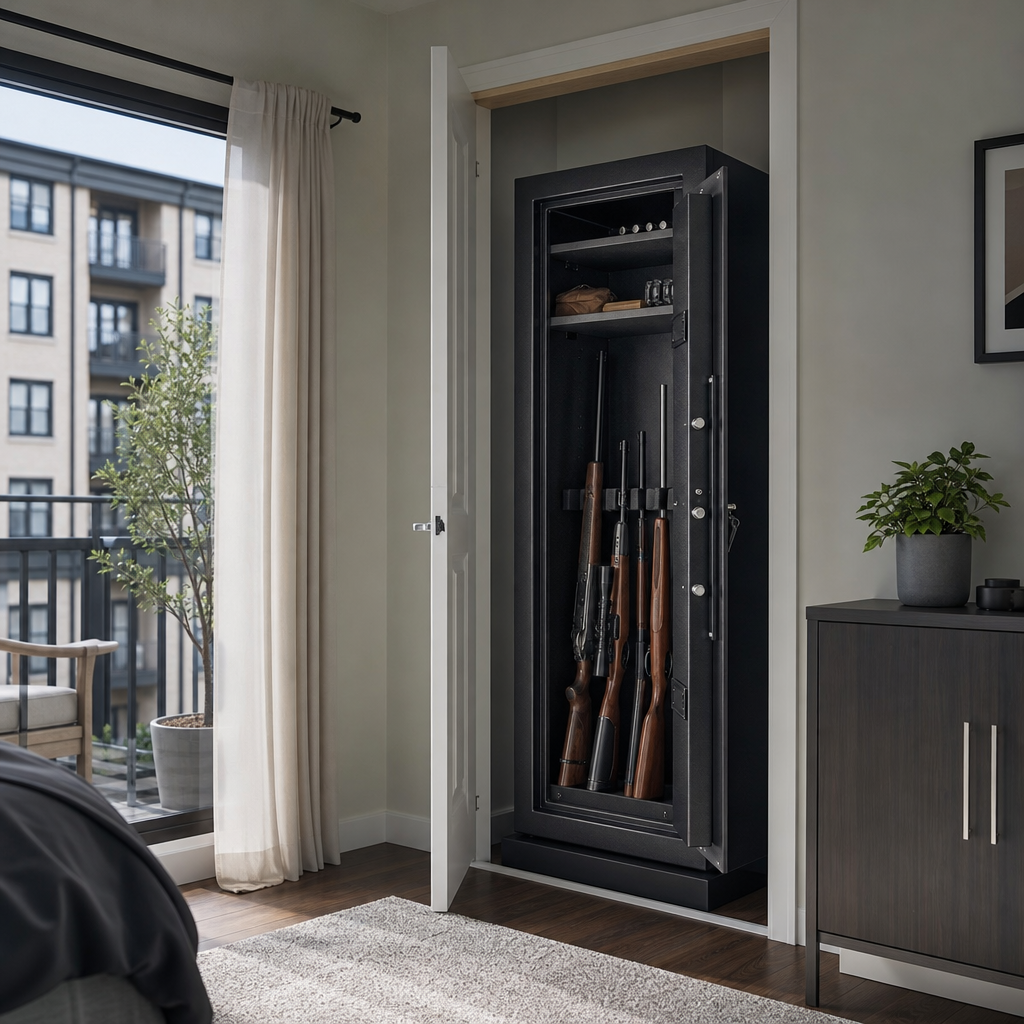
Choosing a gun safe in an apartment with strict regulations requires balancing security, legal compliance, building rules, available space, and daily practicality. Apartment residents face constraints that homeowners often do not: lease clauses that ban bolting into concrete, weight limits for upper floors, limited closet depth, noise concerns, shared maintenance access, and tighter expectations around fire safety. A good purchase is not simply the heaviest steel box you can afford. It is the safe that fits your apartment, your firearms, your budget, and your risk profile without creating new problems with management or violating local rules.
When I help apartment dwellers evaluate gun safes, I start with a few definitions. A gun safe is a locking storage container designed to prevent unauthorized access and, in some models, provide fire resistance and burglary protection. “Strict regulations” can mean state or local safe-storage laws, lease terms, HOA policies, fire-code restrictions, transport rules for elevators and hallways, or insurance requirements. Buyer personas are practical categories of shoppers with different needs. A first-time handgun owner, a competitive shooter with optics, a parent with children, and a collector storing heirloom rifles are all buying “a gun safe,” but they should not buy the same product.
This matters because the wrong safe can fail in several ways at once. It may be too heavy to move into the unit, too shallow for a closet, too loud for late-night access, or too small once magazines, documents, suppressor paperwork, and accessories are added. It may technically lock, yet offer little real resistance to pry attacks. It may satisfy a lease but frustrate the owner so much that the firearm gets left unsecured during everyday life. The best apartment gun safe is the one that matches realistic threats, supports consistent safe storage habits, and complies with both law and building policy. That is why a persona-based buying process works so well for apartment residents.
Start With Apartment Constraints Before You Shop
Before comparing brands, document the apartment-specific limits that will narrow your options. Measure the exact footprint where the safe will sit, including swing clearance for the door and any trim or baseboards behind it. Many apartment closets look large enough on paper but lose several usable inches once bifold doors, shelving standards, or HVAC returns are accounted for. Check floor-loading concerns if you are on an upper story. A compact 150-pound safe is rarely an issue, but larger residential security containers can exceed 500 pounds before firearms, ammo, and shelves are added. Property managers may not quote a formal floor-load number, yet they may still prohibit very heavy appliances or safes.
Next, review what your lease actually says. I have seen leases prohibit drilling into floors or walls, require management approval for “security installations,” and restrict storage of flammables, which matters if you keep ammunition in bulk. Some buildings ban changes that interfere with sprinkler coverage or egress. If the lease is vague, ask management direct, written questions: Can you anchor to wall studs? Can you place a safe on an interior closet floor? Are there weight restrictions? Can deliveries use freight elevators? Getting answers in writing protects you later.
Local law also matters. Some jurisdictions impose safe-storage requirements when minors could access firearms. Others tie storage obligations to whether the firearm is loaded, whether unauthorized access is foreseeable, or whether the owner reports a gun stolen. For apartment living, the key point is simple: legal compliance is not optional, and your safe choice should make compliance easy every day, not only in ideal conditions.
Match the Safe to the Right Buyer Persona
Buyer personas are useful because they turn a confusing product category into a practical decision. In apartment settings, I typically see six recurring personas. The first-time owner usually needs compact, intuitive storage and reliable quick access for one or two handguns. The family-focused buyer prioritizes child resistance, consistent locking discipline, and a location that keeps the safe hidden during visits from guests, babysitters, or maintenance staff. The concealed-carry professional values fast daily access and discreet form factors that work in a bedroom closet or nightstand.
The enthusiast or range regular needs room for multiple handguns, magazines, lights, optics, hearing protection, and paperwork, while still fitting within apartment dimensions. The long-gun owner, especially someone with AR-platform rifles, must think about interior height, scoped-rifle clearance, and whether the safe can be moved through stairwells and elevators. Finally, the collector or high-value owner needs stronger burglary resistance, better inventory organization, and usually a larger conversation with insurance, because apartment constraints may make a true commercial-rated safe unrealistic.
These personas are not marketing labels; they shape the specifications that matter most. A bedside biometric safe can be ideal for a shift worker living alone, but it is the wrong hub recommendation for a parent with three children and frequent houseguests. A 24-gun cabinet may fit the budget of a new rifle owner, yet if it uses thin steel and basic cam locks, it may offer compliance theater rather than meaningful protection. Persona matching prevents overspending on the wrong features and underspending on the features that actually reduce risk.
| Buyer persona | Best safe type | Main apartment concern | Key buying priority |
|---|---|---|---|
| First-time handgun owner | Compact quick-access safe | Limited space | Simple, reliable lock |
| Parent with children | Heavy-duty handgun or compact long-gun safe | Daily compliance | Consistent child-resistant storage |
| Concealed-carry renter | Nightstand or closet biometric safe | Quiet late-night access | Fast entry plus backup keypad |
| Range enthusiast | Modular cabinet or midsize safe | Accessory overflow | Interior flexibility |
| Rifle owner | Slim long-gun safe | Transport into unit | Depth, height, and anchor plan |
| Collector/high-value owner | Higher-security residential safe | Weight and concealment | Steel thickness and insurance fit |
Choose the Right Safe Type for Apartment Living
Most apartment buyers should look first at three categories: quick-access handgun safes, slim vertical long-gun safes, and modular security cabinets. Quick-access handgun safes from brands such as Fort Knox, Vaultek, Hornady, and V-Line are popular because they fit closets, dressers, or reinforced nightstands. The best models use pry-resistant lids, internal hinges or protected hinge designs, and a mechanical or electronic lock with a clear backup method. For apartments, this category is often the smartest starting point because it keeps weight manageable while supporting secure everyday use.
Slim long-gun safes are the next step for renters storing rifles or shotguns. Models from SecureIt and similar manufacturers often appeal to apartment residents because they emphasize efficient organization and lighter construction than traditional fire-lined safes. That lower weight is an advantage during delivery and move-out, but it also means you must be realistic about burglary resistance. A lighter safe that can be carried away is not truly secure unless it is anchored within allowed building rules or positioned to limit removal.
Modular safes deserve special attention in apartments. Because they ship in panels and assemble inside the unit, they solve one of the biggest real-world problems: getting a large safe through stairwells, narrow doors, and elevators without damaging common areas. In my experience, modular options are often the best answer for renters who need more than a bedside box but cannot accommodate a traditional welded safe. They also make future moves easier, which matters if your lease changes or you relocate for work.
Evaluate Security, Fire Protection, and Lock Reliability
Security claims in this category are inconsistent, so compare specifics, not marketing language. Steel thickness matters. Door construction matters. Boltwork matters. Continuous welds, anti-pry features, relockers, and protected hard plates are all better indicators of burglary resistance than generic phrases like “premium protection.” Many residential gun safes are technically residential security containers rather than high-security commercial safes, and apartment buyers should understand that distinction. For many renters, the goal is delaying smash-and-grab theft and preventing unauthorized access, not defeating a professional crew with power tools for an hour.
Fire ratings also need a careful reading. One brand’s “45 minutes at 1,200 degrees” may be tested very differently from another’s claim. In apartment settings, burglary resistance and smoke exposure are often more immediate concerns than extreme standalone fire endurance, especially in sprinklered buildings. That does not mean fire protection is unimportant. It means you should not sacrifice all other priorities for an inflated fire number. If important documents or NFA paperwork are involved, add a document pouch or a separate UL-rated document container inside the safe.
Lock choice is critical in apartments because reliability affects compliance. Biometric locks are convenient, but quality varies dramatically. Good units store multiple fingerprints, open quickly, and include keypad or key backup. Cheap biometric safes can fail with dry skin, dirt, weak batteries, or poor sensor placement. Mechanical simplex-style locks are extremely dependable and excellent for renters who want silent, battery-free access. Electronic keypads can work very well if the brand has a strong track record and you test the lock routinely. Whatever you choose, practice access under low light and replace batteries on a schedule.
Plan Installation Without Violating Lease Terms
The best installation method is the one that improves security while remaining fully allowed by the building. If floor anchoring is prohibited, wall-stud anchoring inside a closet may still be allowed. If drilling is entirely banned, a heavier safe concealed in a tight closet niche may be better than a lighter one sitting exposed in a bedroom corner. Some renters use security cables on smaller safes, but cables are only a partial deterrent; they are better than no attachment, not equivalent to true anchoring.
Placement matters as much as hardware. Closets are usually the best apartment location because they reduce visibility during guest visits, package deliveries, and maintenance entry. Avoid spots near windows that reveal the safe silhouette. Avoid damp exterior walls if humidity is a concern, and use desiccants or a GoldenRod-style dehumidifier when practical. If the unit has frequent service visits, choose a location that does not require exposing the safe every time maintenance enters the apartment.
Think through moving day before purchase. Confirm delivery dimensions, elevator reservations, stair turns, and whether the vendor offers threshold or room-of-choice delivery. I have seen renters buy a safe that fit the apartment perfectly but could not clear the building’s hallway turn. For apartment living, mobility is not a minor detail; it is part of the buying decision.
Budget for the Full Storage System, Not Just the Box
A realistic apartment gun safe budget includes more than the sticker price. Add delivery, installation, anchoring accessories, dehumidification, interior lighting, and organization. Also account for accessories that prevent the safe from becoming cluttered: handgun hangers, barrel rests, magazine bins, document sleeves, and labeled shelves. A cramped interior leads people to leave items outside the safe, which defeats the purpose.
Insurance is another overlooked factor. If you own multiple firearms, high-value optics, or collectibles, check whether your renters insurance has sublimits for theft of firearms or related accessories. Many policies do. In some cases, scheduling specific items or adding a rider is the only way to align your financial protection with the value stored. Keep serial numbers, photos, purchase records, and appraisals in a separate secure location or encrypted cloud folder.
For most apartment buyers, the sweet spot is a safe that is one size larger than current needs, from a brand with a solid lock reputation, installed discreetly, and supported by written approval where needed. Spending modestly more on better lock quality, thicker steel, or modular delivery usually pays off more than chasing oversized capacity claims. Capacity numbers are famously optimistic; a “12-gun” safe may hold far fewer long guns once optics, slings, and modern rifle shapes are involved.
Best Buying Process for Apartment Gun Safe Shoppers
The strongest buying process is straightforward. First, define your persona: who is using the safe, what firearms are being stored, and what daily access pattern must be supported? Second, confirm legal and lease constraints in writing. Third, measure the destination space, entry route, and door swing. Fourth, shortlist safe types that fit the apartment before comparing finishes or brand prestige. Fifth, evaluate lock reliability, steel construction, and installation options. Sixth, plan for insurance, humidity control, and future growth.
If you are building out a broader storage plan under the Gun Safes & Safety topic, this hub should lead naturally into deeper guides on biometric versus mechanical locks, modular safes for renters, safe placement in small apartments, child-access prevention, and insurance checklists for firearm owners. That structure mirrors how real buyers think. They start with “What safe should I buy?” and quickly move to narrower decisions once the persona and apartment constraints are clear.
The right gun safe for an apartment is not the biggest, cheapest, or most heavily advertised option. It is the model that fits your buyer persona, your unit, and your compliance obligations while making secure storage easy enough to maintain every day. Start by identifying your persona, confirming building rules, and measuring your space. Then buy for reliable access, realistic security, and a clean installation plan. If you take those steps first, you will choose a gun safe that protects your firearms, supports safe habits, and works with apartment life rather than against it.
Frequently Asked Questions
What should I check first before buying a gun safe for an apartment with strict rules?
The first step is to review every rule that may affect what you can bring into the unit and how you can install it. Start with your lease, house rules, and any written policies from the property manager or homeowners association if one applies. Look specifically for language about firearms storage, heavy items, floor load concerns, drilling into walls or concrete, damage deposits, fire code compliance, and access requirements for maintenance or inspections. In many apartments, the biggest mistake is not choosing a weak safe, but choosing a safe that violates building policy because it requires bolting into the floor, blocks utility access, overloads a small upper-floor area, or creates a problem during emergency entry.
After that, confirm your local and state storage laws. Some jurisdictions require firearms to be stored locked when not in use, especially in homes with minors or prohibited persons present. Others may impose standards related to unauthorized access prevention rather than specifying a certain type of safe. If your apartment complex has strict regulations, legal compliance and lease compliance need to work together. A safe that satisfies one but violates the other can still create serious problems.
Then measure the space with precision. Apartment storage is often tighter than people expect. Measure closet depth, doorway width, hallway turns, elevator dimensions, and the final placement area. Also account for door swing and whether the safe door opens fully enough to access shelves or long guns. A safe that technically fits into a closet but cannot open past 45 degrees is not practical. Finally, think about everyday realities such as delivery restrictions, noise when opening and closing the door, and whether shared maintenance staff may need access to nearby water heaters, electrical panels, or HVAC components. The best apartment-safe choice is the one that is legally compliant, allowed by the building, physically practical, and secure enough for your actual risk level.
Can I use a heavy, full-size gun safe in an apartment, or is a smaller safe usually the better option?
A heavy, full-size gun safe is not automatically the best choice for apartment living. In a house, a very large and extremely heavy safe may be ideal because there is more flexibility for placement, structural support, and anchoring. In an apartment, those same features can become drawbacks. Upper-floor weight limits, smaller rooms, limited closet depth, narrow stairwells, and prohibitions on drilling into concrete or subflooring often make oversized safes impractical or noncompliant. The goal is not maximum mass for its own sake. The goal is the strongest and most secure unit you can realistically place, use, and keep within the rules.
For many apartment residents, a medium-size residential security container or compact gun cabinet with meaningful anti-access features may be the smarter choice than a massive traditional safe. A smaller unit can be easier to move in discreetly, easier to position in a closet or interior corner, and less likely to create floor loading concerns. It can also reduce noise during installation and lower the chance of property damage. If you cannot bolt it down because of lease restrictions, a right-sized safe that can be concealed well and paired with layered security measures may be more effective in practice than a huge unit that draws attention or creates management issues.
That said, “smaller” should not mean flimsy. Look for solid steel construction, a reliable locking mechanism, protected hinges, and a design that resists quick pry attacks. Interior layout matters too. Many advertised gun capacities are optimistic, especially once optics, slings, and documents are added. For apartment use, it is often wise to buy a safe rated for more firearms than you currently own so you are not forced into overcrowding. In short, a full-size safe can work in some apartments, particularly on ground floors with clear approval and adequate structure, but in many regulated apartment settings, a well-chosen compact or mid-size model is the more responsible and realistic purchase.
How do I choose a safe if my lease does not allow bolting into the floor or walls?
If bolting is prohibited, you need to shift from a single-point security mindset to a layered one. Anchoring is valuable because it prevents quick removal of the safe, but many apartment residents simply do not have that option. In that situation, prioritize a safe that is still difficult to pry open, can be placed discreetly, and is heavy enough to discourage casual theft without becoming a building compliance problem. A safe tucked into a closet, a built-in nook, or a tight corner where the door can still operate but pry leverage is reduced is often more secure than the same safe sitting exposed in an open room.
Also consider placement strategy. Positioning the safe where it is not immediately visible from windows, entryways, or during routine maintenance visits helps reduce the chance that anyone even knows it is there. Apartment security depends heavily on secrecy and delay. If a thief has limited time and does not know where to look, a concealed, reasonably robust safe can perform far better than many people assume. Some residents add non-destructive stabilization methods that do not violate leases, but you should be careful here. Any method that compresses against walls, alters shelving, or puts unusual pressure on building materials should be cleared with management first.
Electronic security becomes more important when physical anchoring is limited. Good apartment-safe planning may include a monitored alarm system, door and window sensors, a discreet camera, reinforced apartment door hardware if permitted, and habits that reduce visibility of firearm ownership. Choose a safe with a dependable lock from a reputable brand rather than focusing only on cosmetic features. A quality mechanical or electronic lock, solid body construction, and smart concealment can compensate meaningfully when bolting is not allowed. In practical terms, if the lease says no drilling, your best move is to create delay, reduce discovery risk, and avoid any setup that could jeopardize your tenancy.
Do fire ratings and apartment building safety rules matter as much as burglary protection?
Yes, and in many apartment settings they matter just as much, sometimes more. Apartment residents often share walls, ceilings, utility systems, and access corridors, which means building management is usually more sensitive to anything that affects fire safety, emergency response, and code compliance. A gun safe should not interfere with sprinklers, exits, electrical panels, or required service access. It also should not be so oversized that movers damage common areas or create a hazard during delivery. Burglary resistance is important, but apartment living requires a wider view of risk.
Fire protection deserves careful attention because apartments present a unique exposure profile. Even if your own unit is well managed, a neighboring kitchen fire, electrical issue, or hallway incident can spread smoke, heat, and water damage quickly. A fire-rated safe can help protect firearms, documents, and valuables during a short-duration fire event, but ratings should be read carefully. Manufacturers do not always test to the same standards, and a higher advertised number is not automatically comparable across brands. Treat fire ratings as one useful data point rather than the only deciding factor.
It is also worth remembering that “fireproof” is not the right expectation. No safe is invincible under all fire conditions. Instead, look for realistic fire resistance from a reputable manufacturer and pair that with sensible placement. Interior closets on shared walls may seem hidden, but depending on the building, they may also be close to utility routes or hot spots. Choose a location that balances concealment, access, and building safety. If apartment regulations are strict, a safe that supports both theft deterrence and responsible fire planning is usually the better long-term decision than one built around burglary specs alone.
What features make a gun safe practical for daily apartment living without creating noise, access, or space problems?
Practicality matters more in an apartment than many buyers realize. A safe that is technically secure but frustrating to use will eventually create bad habits, such as leaving firearms out temporarily or storing them elsewhere. Start with dimensions and interior organization. In apartments, every inch matters. Look for a model with efficient shelving, adjustable interiors, and enough depth for firearms with optics or accessories. Exterior size should fit the space cleanly, but interior layout should still allow fast, orderly access. A cramped safe in a cramped apartment quickly becomes a daily annoyance.
Noise is another overlooked issue. In close-quarters living, loud metal clanging, beeping keypads, and slamming doors can carry through walls, especially late at night or early in the morning. If discretion matters, pay attention to door operation, keypad sound controls, handle movement, and interior padding. A quieter safe is not just a comfort feature; it also helps maintain privacy. Likewise, think about maintenance access and visibility. If building staff need to service appliances, inspect smoke detectors, or access utility areas, placing a safe where it forces awkward explanations or repeated movement is not ideal.
Lock type is also part of daily practicality. Mechanical locks are proven and do not rely on batteries, but they can be slower to open. Electronic locks offer speed and convenience, though they should come from reliable brands and include clear battery management. Some apartment residents prefer quick-access options for a smaller defensive firearm safe and a separate larger storage unit for long guns and documents. That split approach often works well in limited spaces. Finally, choose a finish and footprint that do not damage flooring, and consider whether the safe can be installed and later removed without violating lease terms. The right apartment safe is one you