
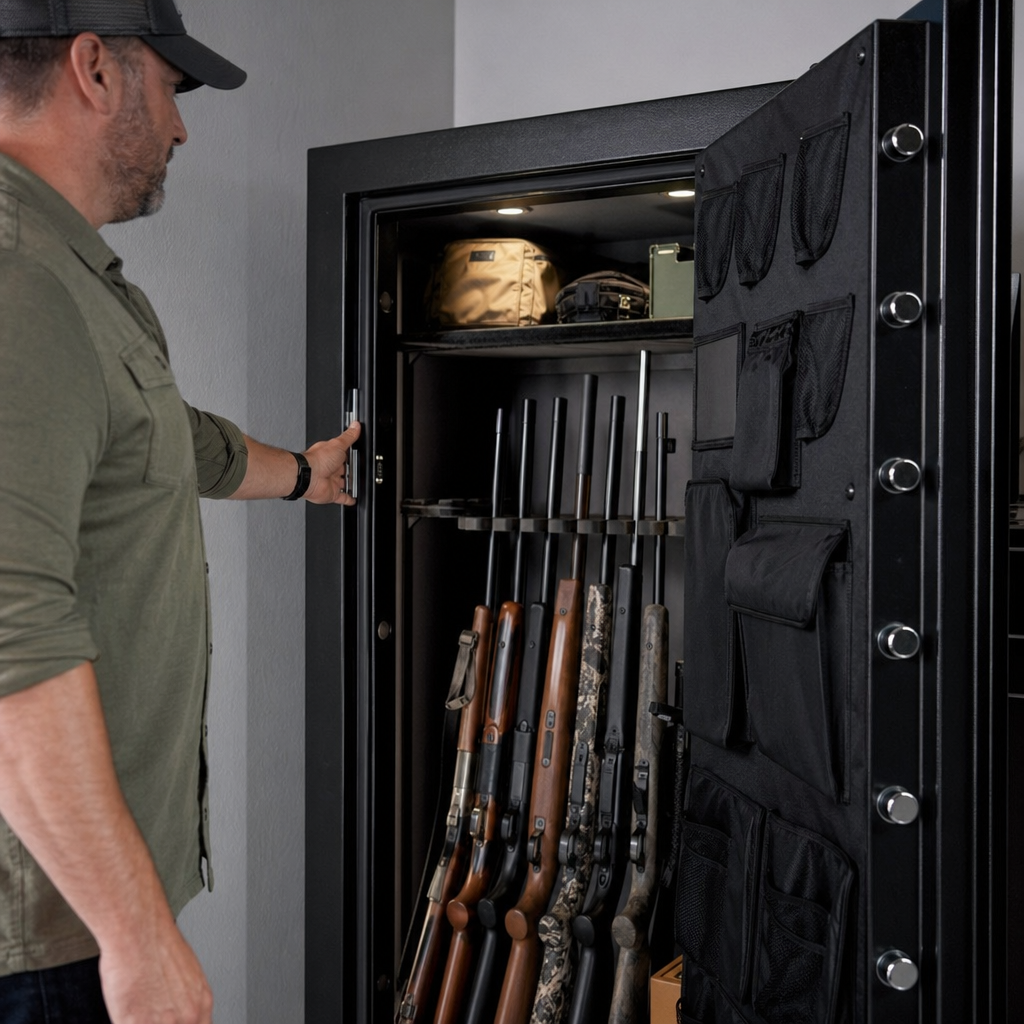
Choosing a gun safe that is designed for left-handed users means looking beyond fire ratings and steel thickness to a detail many buyers miss: how the safe actually opens, loads, and works when your dominant hand is the left. In practical terms, a left-handed gun safe is any safe whose lock placement, door swing, interior access, shelf layout, and daily controls allow a left-handed owner to retrieve firearms naturally, without awkward crossover movements or blocked sightlines. That matters because safe access is not just a convenience issue. It affects speed under stress, muzzle discipline during retrieval, and whether a safe becomes an easy daily habit or a constant frustration. After helping customers compare home-defense safes, long-gun cabinets, and modular vaults, I have seen the same mistake repeatedly: buyers choose by size and price alone, then discover the keypad is on the wrong side, the door pins their left arm against a wall, or the rifle rack forces an inefficient draw. This buying guide explains what left-handed users should evaluate, which features matter most, and how to choose a safe that fits both your room and your natural movement. As a hub page for gun safe buying guides, it also establishes the key criteria you can use when comparing biometric, keypad, mechanical, pistol, and full-size rifle safes.
What makes a gun safe truly left-handed
A gun safe is not automatically left-handed just because a left-handed shooter can use it. A truly left-handed-friendly design supports the full access sequence from approach to opening to retrieval. Start with door handing. Most gun safes use right-side hinges, which means the door swings left to right from the user’s perspective. For a left-handed person standing squarely in front of the safe, that can either help or hinder depending on room placement. If the safe sits in a left-side corner, a standard swing may trap your dominant arm or force you to lean around the open door. In contrast, a left-hinged configuration, where available, often gives a left-handed user cleaner access with the dominant hand leading directly into the opening.
Lock position is the second major factor. On many safes, the keypad, dial, or biometric scanner is centered, but not always. Handgun safes, bedside vaults, and vertical quick-access units commonly offset controls to one side. If the lock sits to the right, the left hand may need to cross the body or the right hand must do the unlocking while the left waits. That sounds minor until you test it from bed at night or while kneeling near a closet floor. The best left-handed designs place the primary control in the center or left side, with enough clearance for the left wrist and forearm.
Interior layout also matters more than advertising suggests. Rifle safes often place long-gun barrels, shelves, door organizers, and lighting in ways that assume a right-handed grab. A left-handed user should check whether the long gun can be lifted and rotated out without striking door pockets, optics, or shelf edges. Handgun safes should allow a left-hand grip without pinching fingers against the lid or frame. A left-handed gun safe, in short, is one that works with your dominant-side mechanics, not against them.
Key features to evaluate before you buy
When I compare safes for left-handed customers, I use a practical checklist built around access, installation, and safety. The first item is hinge orientation and opening arc. Ask whether the hinge side is fixed or reversible. Most heavy gun safes are fixed, while some cabinets and smaller quick-access boxes offer mounting flexibility that effectively changes approach angle. The second item is lock ergonomics. Test whether the keypad buttons, biometric reader, or dial can be reached cleanly with the left hand while your body stands in a natural position.
The third item is placement clearance. Measure wall distance, nightstand spacing, closet trim, and any nearby furniture. A safe that is technically usable in a showroom can become left-hand hostile once installed in a tight alcove. Fourth, examine interior reach depth. Deep safes with thick door panels can force a left-handed user to overextend if shelves or racks are not adjustable. Fifth, assess anchor points and mounting options, especially for under-bed and bedside safes. Sometimes the best left-handed solution is not a specialized model but a standard model mounted at an angle that favors the left hand.
Finally, review security and protection basics without letting handedness distract from essentials. For residential security containers, look for solid steel body construction, robust boltwork, pry resistance, and credible fire testing. Brands may advertise 12-gauge or 10-gauge steel, multiple live bolts, and expanding door seals, but the right choice depends on threat model and budget. Left-handed ergonomics should narrow your options, not replace core safe-buying standards.
| Feature | Why it matters for left-handed users | What to look for |
|---|---|---|
| Door swing | Determines whether the door blocks the dominant arm during access | Left-hinged option, reversible mounting, or room placement that opens away from the left arm |
| Lock location | Affects one-handed opening speed and comfort | Centered keypad, left-side scanner, or controls usable equally with either hand |
| Interior layout | Changes how easily firearms can be gripped and removed safely | Adjustable shelves, offset racks, low-profile door organizers, good lighting |
| Mounting flexibility | Can compensate for fixed hinge designs | Multiple anchor points, bedside or wall-mount options, angled installation |
| Clearance | Prevents wrist crowding and blocked movement | Enough space beside and in front of the safe for full door opening and left-hand access |
Choosing the right safe type for your use case
Not every left-handed buyer needs the same type of safe. For home-defense handguns, quick-access bedside safes deserve the closest attention because retrieval speed is the whole point. In this category, biometric readers and spring-assisted doors can work well for left-handed owners if the lid opens away from the dominant hand and the grip is presented naturally. Models from Vaultek, Fort Knox, and GunVault often differ sharply in button placement, lid geometry, and interior presentation, so photos alone are not enough; watch opening demonstrations from the user’s perspective.
For rifle owners, full-size gun safes and modular safes bring a different set of considerations. These units usually store multiple long guns, ammunition, documents, and accessories, so interior flexibility matters as much as lock speed. Adjustable shelving systems used by brands such as SecureIt and Liberty can be especially valuable because they let a left-handed owner create a dominant-side access lane. If you retrieve a scoped rifle from the left side, you want enough lateral clearance to lift and cant the firearm without dragging the optic along neighboring barrels.
For apartments, closets, or secondary storage, lighter gun cabinets and vertical lockers can be effective if they are anchored correctly. Here, left-handed usability often comes from installation strategy. A fast-access vertical locker mounted on the right side of a closet opening may be much easier for a left-handed person than the same locker mounted on the left. This is why a buying guide should never treat product selection and placement as separate decisions. They are one decision.
Lock types, speed, and real-world ergonomics
The best lock for a left-handed user depends on the specific motion required to open the safe. Mechanical dial locks are durable and proven, but they are usually the least ergonomic under time pressure. Spinning a dial with the left hand is possible, yet many users still brace with the right and manipulate with the left in a less stable posture. Electronic keypads are generally easier because they permit direct, repeatable input. For left-handed users, raised buttons, tactile numbering, and a centered keypad matter more than brand slogans about speed.
Biometric locks can be excellent or frustrating. A fingerprint reader positioned for a right-thumb presentation may fail to accommodate the left thumb or left index finger comfortably, especially if the scanner is recessed or angled. During product testing, I have found that scanner location is often a bigger usability variable than matching accuracy. If the angle forces the wrist to bend sharply, scan quality drops. Better biometric safes let you enroll multiple fingers from both hands, which is a practical requirement, not a bonus feature.
RFID and simplex-style mechanical pushbutton locks are often overlooked, yet they can be very left-hand friendly. A simplex lock, common on premium handgun boxes from Fort Knox and V-Line, offers tactile operation without batteries and can be worked confidently in darkness. For many left-handed owners, the ideal setup is one that can be opened with either hand but feels natural with the left. Ambidextrous beats nominally left-specific if reliability is higher.
Installation, room layout, and access planning
A gun safe that is perfect on paper can fail in the home because of poor placement. Before buying, map the access path. Stand where you will actually approach the safe: beside the bed, at the closet, in the office, or in the garage. Then simulate opening a door or lid with your left hand while your right hand stabilizes or manages a flashlight. This simple rehearsal exposes interference from walls, baseboards, bed frames, drawers, and door casings.
For heavy safes, installers usually focus on floor load, anchor pattern, and concealment. Those are essential, but left-handed users should add dominant-side clearance to the install brief. If the safe opens into a narrow passage, a few inches of repositioning can transform usability. In one installation I advised on, rotating a safe fifteen degrees within a walk-in closet allowed the owner to use the left hand on the keypad and retrieve a carbine without twisting around the door edge. No product change was needed, only smarter placement.
Also consider lighting. Interior LED kits, motion lights, and external ambient light affect retrieval safety. Left-handed users often cast shadows differently depending on where the door swings. If your body blocks the interior while reaching with the left hand, add lighting so you can identify the firearm and avoid snagging slings, optics, or trigger guards.
Security, fire protection, and tradeoffs you should not ignore
Handedness should improve access, but it should not cause you to compromise on core protection. Real gun safe buying requires balancing burglary resistance, fire resistance, capacity, and convenience. Steel thickness remains one of the clearest indicators of body strength, though door construction, relockers, hard plates, and bolt design matter too. Fire ratings vary widely by manufacturer because testing protocols are not standardized across the market, so compare the details behind the number: duration, peak temperature, and whether the rating reflects independent testing or internal claims.
There are also tradeoffs between speed and security. A bedside safe with a fast biometric latch may be ideal for defensive access, but it will not match the burglary resistance of a heavier steel box with a mechanical lock and anchor bolts. Conversely, a large fire-lined safe in the basement may protect a collection well while being too slow for immediate use. Many households need two safes: a quick-access unit for one defensive firearm and a larger primary safe for everything else. For left-handed buyers, that two-safe strategy often works best because each safe can be optimized for a specific movement pattern.
If children are present, test whether the safe encourages consistent locking. The best safe is the one used every time. A left-handed owner who struggles with awkward access may leave a firearm unsecured “just for a minute.” Good ergonomics are therefore part of safe storage discipline, not a luxury feature.
How to compare brands and make a confident final decision
When narrowing options, ignore generic marketing claims and build a short list using measurable criteria: dimensions, empty weight, steel gauge, lock type, hinge side, interior adjustability, anchor pattern, and warranty support. Then review owner manuals and installation diagrams, not just product pages. Reputable brands publish detailed specifications, replacement key policies, battery access instructions, and mounting templates. Those documents reveal how the safe will function in daily life.
Whenever possible, test a floor model or at least watch a demonstration from a true first-person angle. Ask a simple question: can I unlock, open, and grip the firearm with my left hand in one smooth sequence while maintaining control? If the answer is no, move on. Also assess serviceability. Electronic locks eventually need batteries, biometric readers need maintenance, and some components fail. Companies with accessible support, stocked replacement parts, and clear warranty terms deserve preference.
As the hub article for gun safe buying guides, the central lesson is straightforward. Left-handed users should choose a safe by combining standard protection criteria with dominant-hand ergonomics, lock placement, door swing, interior presentation, and installation planning. Measure your space, define your use case, test the access sequence, and buy the model that fits your actual movement rather than an imagined one. Do that, and your gun safe will be faster to use, safer in practice, and far more likely to serve you well for years. Start by auditing your room layout and current access habits, then compare safes with your left hand leading every test.
Frequently Asked Questions
What makes a gun safe truly left-handed, and how is it different from a standard model?
A gun safe designed for left-handed users is not necessarily a separate product category as much as it is a safe whose layout and operation work naturally for someone who leads with the left hand. The biggest difference usually comes down to door swing direction, lock placement, handle position, interior access, and how easily the owner can load or retrieve firearms without crossing over their body. On many standard safes, especially those designed around right-handed assumptions, the lock and handle may be easier to operate with the right hand while the door opens in a way that blocks a left-handed user’s natural reach into the interior.
For a left-handed owner, that awkwardness matters more than it may seem on paper. In day-to-day use, a safe should allow a smooth sequence: approach the safe, unlock it with the dominant hand, swing the door clear of the opening, and reach in without obstruction. If the hinge side, shelving arrangement, or lock location forces the user to twist, reach across the body, or reposition their grip, access becomes slower and less intuitive. That can be frustrating during routine storage and potentially more serious if quick access is important.
In practical terms, a “left-handed” gun safe often means choosing a model with a door swing and control layout that favor the left hand rather than simply accepting a generic design. It may also mean looking for adjustable interiors so long guns, handguns, magazines, and accessories can be arranged where the left hand reaches them most naturally. The safest and most functional choice is the one that lets a left-handed user open, see, and access the contents comfortably and consistently under real-world conditions.
Which features should left-handed buyers prioritize when comparing gun safes?
Left-handed buyers should start with the door swing because it has the biggest effect on usability. If the door opens in a way that blocks the safe’s opening from the user’s natural stance, retrieval can feel clumsy immediately. A left-handed user will usually want a configuration that allows the left hand to operate the lock or handle while the open door stays out of the way of the safe’s interior. This is one of those details that is easy to overlook online but becomes obvious the first time you use the safe in person.
Next, pay close attention to lock type and placement. Keypads, biometric scanners, key locks, and mechanical dials all create different access patterns. A lock positioned where the left hand can approach it directly is generally more comfortable than one that encourages right-hand use. Handle design matters too. Some handles are more symmetrical and forgiving, while others are easier to grip and turn from one side. If the safe includes interior lighting, override keys, power ports, or secondary controls, those should also be checked for left-hand convenience.
Interior layout is another major factor. Adjustable shelving, door organizers, handgun racks, and modular barrel supports can make a big difference for left-handed access. A left-handed owner may prefer frequently used firearms, ammunition, or documents placed on the left side or at a height that supports a cleaner draw and safer handling. Also consider how the safe will be positioned in the room. Even a well-designed safe can become inconvenient if wall placement prevents the door from opening fully in the preferred direction. In short, left-handed buyers should evaluate not only security specifications but also the entire movement of opening, viewing, reaching, and re-securing the safe.
Is door swing direction really that important for a left-handed gun safe?
Yes, door swing direction is often one of the most important and most underestimated features for left-handed users. The hinge side determines where the door goes when opened, and that directly affects whether the door blocks or clears the natural reach path of the left hand. If the door swings into the user’s working space, it can obstruct sightlines, force a crossover reach, and make it harder to safely remove or replace firearms. That is especially noticeable on larger safes with thick doors, built-in organizers, and deeper interiors.
For left-handed owners, the ideal setup is usually one where the opening motion feels fluid: unlock with the left hand, pull or swing the door clear, and access the contents without stepping around the door or shifting body position awkwardly. If the safe requires the user to reach across the door edge, lean around the panel, or turn sideways just to get a clear view inside, the design is not optimized for left-hand use. What sounds like a minor inconvenience during shopping can turn into a daily annoyance after installation.
Door swing also matters because the room itself affects usability. A safe placed in a corner, closet, or tight alcove may have limited opening space, so the wrong hinge configuration can become a permanent problem. Before buying, it helps to picture exactly where the safe will sit and how a left-handed user will stand in front of it. If possible, test the movement in person or verify swing orientation with the manufacturer. Choosing the right door swing can significantly improve comfort, speed, and safe firearm handling over the life of the safe.
Are quick-access biometric or keypad safes a good choice for left-handed users?
They can be an excellent choice, but only if the interface is truly accessible for left-handed operation. Quick-access safes are designed to reduce the time and effort required to open the unit, which makes them especially appealing for bedside use, defensive storage, or any situation where speed matters. For left-handed users, the benefit depends on whether the fingerprint reader, keypad, lid opening angle, and handle placement can all be used naturally with the left hand. A biometric safe that technically opens fast but positions the scanner awkwardly for the left thumb or left index finger may not deliver the convenience it promises.
With biometric models, left-handed buyers should verify that the scanner recognizes multiple fingers and can store more than one fingerprint from the dominant hand. This adds flexibility and improves reliability if the user approaches the safe from different angles. With keypad models, button placement and visibility are key. A keypad should be easy to reach and read from a normal left-handed stance, without forcing the user to angle their wrist or obscure the display while entering the code. Spring-assisted lids, gas struts, and interior lighting can also improve one-handed left-hand access.
That said, quick-access safes should still be evaluated for the same fundamentals as full-size gun safes: opening path, interior clearance, ease of retrieval, and consistency under stress. If possible, practice the exact motion a left-handed user would make when opening the safe and removing the firearm. The best model is not simply the one with the fastest advertised opening time, but the one that allows safe, repeatable, left-hand-friendly access every time. Reliability, ergonomic fit, and intuitive use matter just as much as speed.
How can I tell if a gun safe will work well for a left-handed user before I buy it?
The best way is to evaluate the safe as a sequence of real actions rather than a list of specifications. Start by imagining how a left-handed user will approach the safe, enter a code or use a key, grasp the handle, open the door, view the contents, and remove a firearm. If any step feels unnatural in the showroom or seems questionable in product photos, that is a sign to investigate further. A safe may have strong steel, solid fire protection, and a reputable lock, but if its physical operation fights the user’s dominant hand, it may never feel convenient to use.
When shopping in person, stand in front of the safe as you would at home and perform the opening motion with your left hand. Pay attention to whether the lock is comfortably positioned, whether the handle rotation feels natural, and whether the door clears the opening without blocking access. Look inside and assess whether shelves, barrel rests, door pockets, and accessory racks can be rearranged to support left-hand retrieval. If the interior is fixed and forces important items to the wrong side, the safe may be less adaptable than it appears.
When buying online, study product images carefully, confirm hinge side and door swing direction, and read the manual if it is available. Manufacturer support can also be useful; ask direct questions about left-hand ergonomics, interior adjustability, and installation clearance. Reviews may reveal whether other owners found the safe easy or awkward to use from the left side. Ultimately, the right purchase is the one that balances security, storage capacity, and true left-handed usability. If a safe supports smooth, natural access for the left hand from the moment it is opened to the moment it is locked again, it is likely a strong fit.