
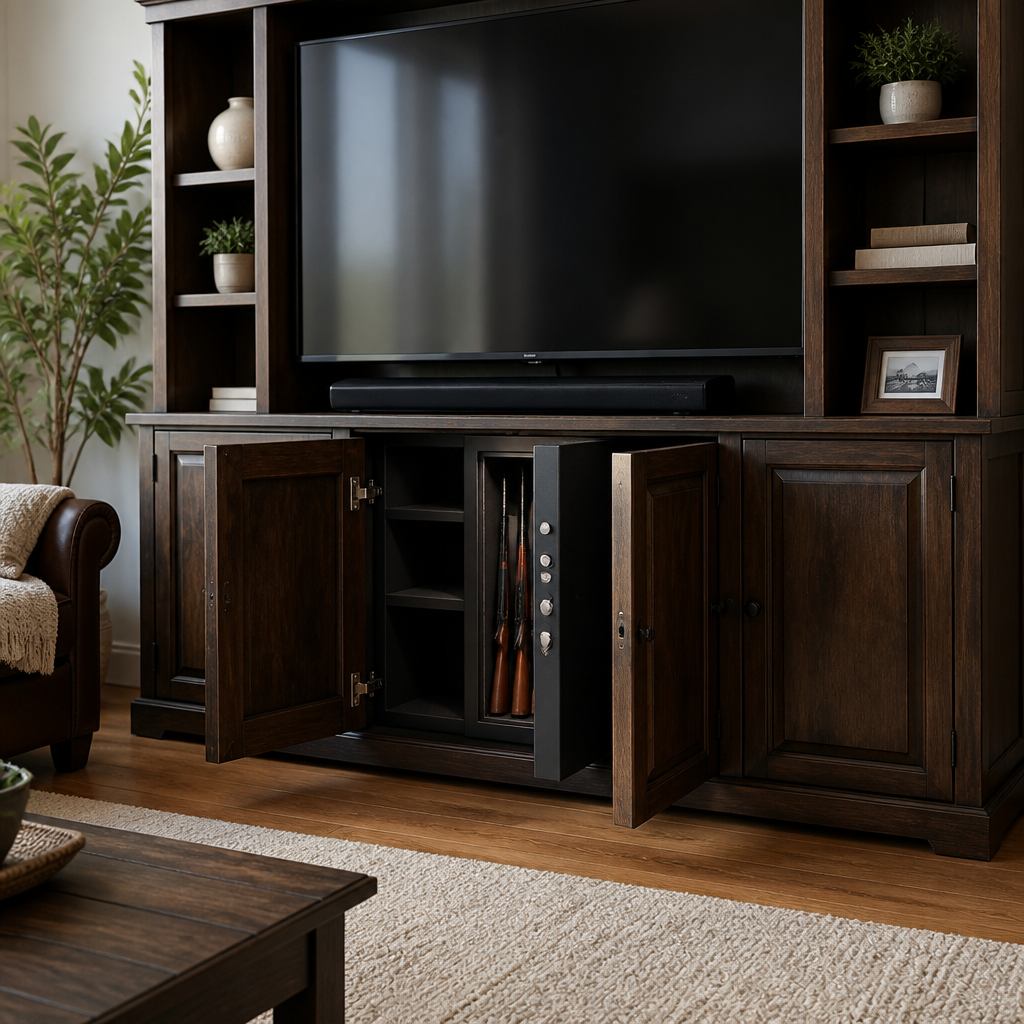
An entertainment center can conceal a gun safe in plain sight, giving firearm owners a practical way to combine secure storage, rapid access, and low visibility inside a lived-in room. In this context, a gun safe is a locking container designed to resist unauthorized access, theft, and in some cases fire, while an entertainment center is a furniture unit built to hold televisions, speakers, media devices, shelves, and cabinets. Hidden and discreet gun storage solutions use ordinary household structures or furnishings to reduce obvious visual cues that a firearm or valuables are present. I have helped homeowners plan these installations, and the best results always come from treating concealment as a secondary layer, not a substitute for real security. A hidden safe that is easy to pry out, poorly anchored, or accessible to children is not a responsible setup.
This topic matters because most residential gun theft is opportunistic. Thieves search primary bedrooms, closets, and obvious home office spaces first, and a visible safe can become a target even if it cannot be opened on site. A concealed installation inside an entertainment center changes the search pattern, increases the time required to find the safe, and may deter the theft attempt altogether. It also helps owners who prefer not to advertise firearm ownership to visitors, contractors, cleaners, or social guests. At the same time, concealment must be balanced with legal obligations, child access prevention, humidity control, and the need for authorized access under stress. The central question is not simply how to hide a gun safe inside an entertainment center, but how to do it without compromising retention, usability, ventilation, or structural stability.
As a hub for hidden and discreet gun storage solutions, this guide covers the main design choices, common mistakes, installation methods, and decision criteria that connect to related topics such as under-bed safes, in-wall concealment, hidden furniture compartments, biometric lock selection, and child-resistant firearm storage. The entertainment center approach is especially useful in family rooms, dens, home theaters, and multipurpose living areas because the furniture already contains doors, panels, wire chases, shelves, and dead space. When planned correctly, the safe disappears into the cabinetry, the furniture still functions normally, and the owner gains an added layer of discretion without sacrificing the fundamental purpose of a safe: controlling access to firearms and keeping them secured against theft.
Why an entertainment center works for hidden gun safe storage
An entertainment center is one of the most adaptable concealment platforms because it naturally includes enclosed bays, false backs, adjustable shelves, and visual clutter that masks small changes. Media furniture also sits in rooms people expect to see cabinets and doors, so a modified compartment rarely draws attention. In practice, the best placements are lower side cabinets, center console cavities beneath a television, and deep tower sections that can house a compact safe behind a removable panel or hinged shelf front. These locations offer depth, stable framing, and room for anchoring hardware. They also preserve a believable external appearance, which is essential for discreet gun storage solutions to work.
Another advantage is everyday accessibility. Compared with attic spaces, garage cabinets, or basement lockboxes, an entertainment center sits in a primary living area where an owner spends time daily. That can shorten retrieval time while keeping firearms out of obvious places. I generally recommend this approach for handgun safes, compact quick-access units, and shorter long-gun safes designed for takedown rifles or AR-style pistols, rather than full-height rifle cabinets. Standard furniture dimensions usually limit interior height and door swing, so trying to force a large safe into a decorative cabinet often creates weak modifications that undermine concealment. Matching the safe to the furniture is more effective than overbuilding the furniture around an oversized safe.
Choosing the right safe for concealed furniture installation
The right safe must fit the use case before it fits the compartment. For most entertainment centers, that means selecting a model with a compact footprint, pre-drilled anchor holes, a pry-resistant door design, and a lock type that can be opened reliably in low light. Thick steel matters more than external branding. Many small residential safes use 14-gauge to 12-gauge steel bodies, while sturdier units move into 10-gauge construction or composite designs. For furniture concealment, I look for a recessed door, internal hinges or protected hinge-side geometry, and mounting flexibility through the base or rear wall. A soft interior liner is useful, but structure comes first.
Lock choice deserves careful attention. Biometric locks are fast, but some budget fingerprint readers fail when fingers are wet, dirty, or misaligned. Electronic keypad locks are usually a better middle ground if they come from a reputable maker and include tactile keys, a backup key, and a low-battery warning. Simplex-style mechanical pushbutton locks remain one of the best options for reliability because they need no power and can be opened by feel. For owners prioritizing silent operation, soft-touch gas struts and damped doors reduce noise when opening a hidden compartment. No matter which lock is chosen, test it repeatedly from a normal standing or kneeling position in the exact place where the entertainment center will sit.
| Safe feature | Why it matters in an entertainment center | Best use case |
|---|---|---|
| Pre-drilled anchor holes | Allows direct bolting to framing, floor, or reinforcement plates | All concealed installations |
| Mechanical pushbutton lock | Reliable without batteries and usable by touch | Fast access in dark rooms |
| Electronic keypad | Good speed and easy code changes | Shared authorized access |
| Biometric lock | Very quick when sensors are high quality, less reliable on cheap units | Single-user handgun storage |
| Fire lining | Adds insulation but increases weight and bulk | When room layout raises fire exposure concerns |
Planning the compartment: measurements, structure, and concealment
Before cutting, drilling, or removing shelves, measure three things precisely: the safe exterior dimensions, the door clearance needed to open it fully, and the internal structure of the entertainment center. Furniture often looks symmetrical from the outside but contains offset partitions, thin hardboard backs, cam locks, and unsupported spans that cannot carry concentrated weight. A loaded safe can weigh far more than expected once firearms, magazines, documents, and desiccants are inside. I have seen particleboard cabinet bottoms sag under a compact steel safe because the installer relied on shelf pins instead of transferring load to side walls or a reinforced base. If the entertainment center is not solid wood or plywood, plan to add internal blocking or a sub-base.
Concealment design should follow the room’s normal visual logic. False cabinet fronts, magnetic touch latches, sliding media panels, and removable rear access panels all work, but they must appear ordinary. The goal is not theatrical secrecy; it is the absence of attention. A hidden compartment behind a component shelf can be effective if cable openings and ventilation slots remain believable. Likewise, a side cabinet can conceal a safe behind a secondary inner door while the outer door still stores board games, remotes, or media accessories. That kind of layered use is often better than leaving a suspiciously empty cabinet. Discreet gun storage works best when the space still feels functional to anyone casually opening nearby furniture.
Installation methods that improve security without ruining the furniture
Anchoring is the most important part of the project. A hidden safe that can be carried away is not secure. Whenever possible, bolt the safe through the entertainment center and into wall studs, floor joists, a concrete slab, or a steel reinforcement plate that spans structural members. If the furniture is freestanding, fasten the entertainment center itself to studs using anti-tip hardware, then create an internal anchor platform from three-quarter-inch plywood backed by solid blocking. Large fender washers or steel backing plates help spread force and reduce pull-through on wood surfaces. In upper cabinets, avoid mounting a heavy safe high off the floor unless the wall structure is unquestionably adequate and the furniture is professionally secured against tipping.
The installation should also preserve serviceability. Electronics generate heat, cords need access, and locks require battery changes or periodic testing. Leave enough room to replace batteries, inspect bolts, and remove the safe if future maintenance is needed. Pay attention to door swing: some safes require more than ninety degrees of opening to access the interior fully. If a cabinet face frame blocks that motion, the safe may become frustrating or unusable. Soft-close hinges, hidden European hinges, and magnetic catches can make the outer concealment panel feel like standard furniture. Avoid decorative modifications that scream secret compartment, such as oversized trim reveals, mismatched stain, or an obviously fake back panel secured by visible screws.
Safety, legal, and household considerations
Hidden storage is not automatically child-resistant. Children notice patterns, imitate adults, and explore cabinets routinely, especially in media rooms where they already reach for games and remotes. If minors are present, the safe itself must meet the security standard, regardless of how well it is concealed. State child access prevention laws vary, and some jurisdictions impose criminal or civil liability if a minor gains access to an unsecured firearm. For that reason, I never advise relying on a disguised compartment alone. Use a real lock, store the firearm according to your legal environment and risk profile, and keep access codes private. If you use loaded defensive firearms, train for secure handling and emergency access under realistic conditions.
Environmental control matters too. Entertainment centers can trap heat from receivers, game consoles, and streaming devices, while exterior walls may expose furniture to temperature swings and humidity. Rust prevention is part of responsible firearm storage. Add a small desiccant pack, rechargeable silica unit, or low-watt safe dehumidifier if the compartment allows it. Keep oils and documents separated from electronics when possible. Also think about noise, especially in homes with guests or children. A safe that beeps loudly on every keypress defeats discretion. Many better keypad safes allow sound muting. Finally, document the installation for insurance and inventory records, but store those records separately, ideally in another secure location or encrypted digital vault.
Common hidden gun storage mistakes and better alternatives
The biggest mistake is choosing concealment over actual resistance. Thin metal lockboxes tucked into furniture may hide a handgun from casual view, but they often fail basic pry and smash attacks. Another common error is using only furniture screws or shelf supports to hold the safe in place. Under force, particleboard splits and hardware tears out. I also see owners place the safe behind electronics without considering heat buildup, cable entanglement, or the awkward movement required to open the lock quickly. In an emergency, a clever hiding place that requires moving a speaker, opening two doors, and kneeling at an angle is slower than expected. If access matters, rehearse the exact sequence honestly, not hypothetically.
Better alternatives depend on the room and the threat model. For some homes, a hidden drawer safe in a sideboard offers faster handgun access. For others, an in-wall safe behind framed art provides stronger concealment but less storage flexibility. Under-bed safes can handle longer firearms and heavier steel but may be harder to access around children or dust. A concealed compartment inside a purpose-built gun concealment cabinet can outperform a retrofitted entertainment center if the furniture is designed around structural reinforcement from the start. The key lesson across all hidden and discreet gun storage solutions is that the best choice is the one that fits your space, household, legal obligations, and daily routine without creating false confidence.
Hiding a gun safe inside an entertainment center is effective when it combines discretion with real physical security, sensible access, and responsible household planning. The best installations start with a solid safe, not a decorative compartment, then add concealment through normal-looking cabinetry, reinforced mounting, and careful attention to dimensions, door swing, and room use. Entertainment centers work well because they already contain enclosed spaces and visual complexity, but they only succeed when the furniture can support the weight and when the safe is anchored to structure. If children, guests, or service workers enter the home regularly, the value of low-visibility storage increases, yet the locking mechanism still remains the primary safety control.
As the hub for hidden and discreet gun storage solutions, this topic connects naturally to deeper decisions about biometric versus mechanical locks, in-wall safes, hidden furniture safes, humidity control, and child-resistant firearm storage. Use this article as your starting framework: define your threat model, choose the right safe size and lock, reinforce the entertainment center, anchor everything properly, and test access in real conditions. Done correctly, a concealed safe inside an entertainment center reduces visibility without sacrificing readiness or accountability. Review your current setup, identify the weak points, and upgrade the storage system before concealment gives you a false sense of security.
Frequently Asked Questions
1. What is the safest way to hide a gun safe inside an entertainment center?
The safest approach is to treat concealment as a secondary benefit and security as the first priority. A gun safe hidden inside an entertainment center should still be a true safe or locking security container, not just a decorative cabinet with a latch. Start by choosing a safe sized appropriately for the firearms, valuables, and accessories you plan to store, then make sure the entertainment center can physically support the weight without sagging, tipping, or drawing attention. The best location is usually behind cabinet doors, inside a lower center bay, or in a side compartment that naturally blends in with speakers, media components, books, or storage bins.
For real security, bolt the safe to the floor, wall studs, or a reinforced platform inside the entertainment center whenever possible. This helps prevent smash-and-grab theft and keeps the unit from shifting when the door is opened. Many owners also add a false panel, sliding shelf, or cabinet face that makes the safe less obvious from a casual glance. The key is to preserve the normal appearance of the furniture. If the entertainment center looks unusually empty, has odd gaps, or appears difficult to open, it may attract more attention rather than less.
It is also important to think about daily function. A hidden safe should remain accessible to the authorized user without requiring a complicated sequence of moving heavy electronics or removing multiple decorative objects. In a defensive storage setup, quick access matters. At the same time, the safe must remain completely inaccessible to children, guests, and unauthorized users. A quality locking mechanism, a well-planned concealment method, and a stable installation together create the safest overall result.
2. Can any entertainment center be used to conceal a gun safe?
Not every entertainment center is a good candidate. The furniture must be evaluated for strength, dimensions, layout, and how naturally it can accommodate a hidden safe. Many modern entertainment centers are made from particleboard, thin MDF, or lightweight flat-pack materials that may look substantial but are not designed to hold a heavy steel safe. Even a compact gun safe can weigh enough to stress shelves, crack panels, or create instability over time. Before installation, check the manufacturer’s weight limits if available, examine how the unit is assembled, and look for solid framing, reinforced bases, or sections that can be modified without weakening the structure.
Layout matters just as much as strength. The best entertainment centers have enclosed compartments, deep cabinets, adjustable shelving, or lower storage bays that can conceal a safe without making the furniture look altered. If the safe requires obvious modifications such as cutting visible openings or removing doors permanently, the finished result may no longer appear discreet. An effective hidden storage solution should blend into the room and look like normal furniture use, not a makeshift hiding place.
You should also consider practical factors such as ventilation for nearby electronics, cord management, door swing clearance, and whether the safe can be accessed quickly when seated or standing in the room. If the entertainment center already houses amplifiers, gaming consoles, routers, or media boxes, avoid overcrowding the same compartment. Heat-producing devices and firearms storage should be separated whenever possible. In short, the ideal entertainment center is sturdy, enclosed, ordinary-looking, and easy to integrate with a safe without compromising the furniture’s normal purpose.
3. How do you keep a hidden gun safe both discreet and quickly accessible?
Balancing discretion and rapid access is one of the most important parts of this type of setup. A hidden gun safe should not be obvious to a visitor, but it also should not require several slow or awkward steps to reach. The most effective solution is to place the safe behind something that appears completely ordinary, such as a cabinet door, pull-out media section, false back panel, or decorative storage area. The concealment feature should open smoothly and predictably under stress, especially if the safe is intended for home-defense access.
The lock type makes a major difference. Electronic keypads, mechanical push-button locks, and biometric locks can all work well depending on the user’s preference, training, and reliability requirements. Whatever system you choose, it should be tested regularly and operated confidently in low light and under pressure. Quick access does not just mean opening the safe fast; it also means being able to reach it without shifting furniture, unplugging equipment, or moving fragile décor. If access depends on too many steps, the setup may fail when speed matters most.
At the same time, concealment should remain natural. Avoid dramatic hidden mechanisms that are clever in theory but obvious in practice. A compartment disguised as part of normal entertainment center storage usually works better than a novelty-style secret panel. Keep the surrounding shelves and cabinets arranged as they normally would be in a lived-in room. Consistent visual clutter such as books, remotes, framed photos, game cases, or speaker components can help preserve the ordinary look of the space. The goal is simple: authorized users know exactly where and how to access the safe, while everyone else sees nothing unusual.
4. What legal and safety issues should be considered when hiding a gun safe in furniture?
Any hidden gun storage plan should begin with a review of applicable firearm laws, storage requirements, and local regulations. Depending on where you live, there may be rules regarding safe storage, child access prevention, transportation within the home, or liability if an unauthorized person gains access. Concealing a gun safe inside an entertainment center does not reduce your legal responsibilities. In many cases, it increases the importance of installing a reliable locking safe and ensuring that access is limited only to authorized adults.
From a household safety perspective, the biggest concerns are unauthorized access, structural stability, and safe firearm condition. If children live in or visit the home, the concealment itself should never be considered adequate protection. The actual safe must remain locked, and firearms should be stored according to your safety protocol, which may include unloaded storage, separate ammunition storage, or other measures based on your use case and local law. The entertainment center should also be anchored if necessary to reduce tipping hazards, especially if a heavy safe is installed low in the unit and the door opening changes the center of gravity.
Another overlooked issue is emergency planning. Authorized users should know how to access the safe quickly, but that information should not be casually shared with guests, contractors, or social visitors. You should also inspect the installation periodically for loose bolts, shelf fatigue, humidity concerns, or interference from nearby electronics and cords. In short, hidden furniture-based gun storage can be very effective, but it must still meet the same standards of lawful ownership, secure storage, and responsible safety practices as any other firearms storage method.
5. How can you make a hidden safe installation look natural inside an entertainment center?
The most natural-looking installations are the ones that work with the entertainment center’s original design instead of fighting against it. A safe should fit within the furniture’s proportions and be concealed in a compartment that would reasonably exist in a normal living room setup. Lower cabinets, side storage sections, and enclosed media bays are usually better choices than open shelves. If you need to add a false front, trim panel, or hinged face, use matching materials, hardware, paint, and spacing so the modification blends seamlessly with the rest of the unit.
Visual consistency matters. If every other cabinet in the entertainment center opens one way, a hidden compartment should not suddenly use noticeably different hinges, handles, or gaps. Likewise, avoid empty spaces that seem odd for everyday furniture use. Surround the concealed area with believable living room items such as board games, manuals, blankets, DVDs, books, baskets, or decorative objects. The idea is not to over-stage the area, but to make it feel like a normal part of the room. A hidden safe is most effective when there is no obvious reason for anyone to inspect that section closely.
Functionality should also guide the design. The entertainment center still needs to perform like furniture, with room for televisions, sound systems, streaming devices, or décor without looking overcrowded. Good cord management, clean shelf organization, and proper spacing around electronics help the entire setup feel authentic and intentional. When concealment, furniture design, and everyday usability all line up, the result is a discreet storage solution that stays out of sight, preserves the room’s appearance, and gives the owner a practical way to combine low visibility with secure firearm storage.