
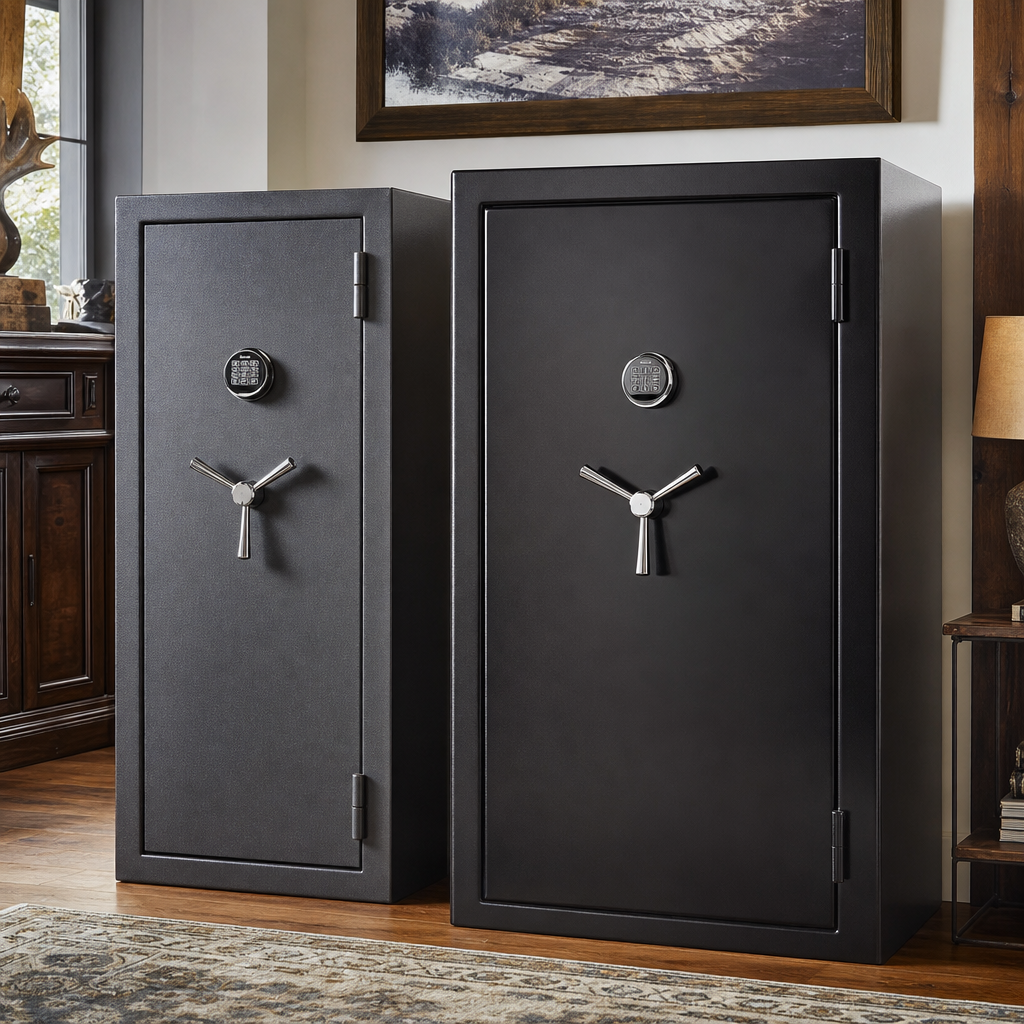
Choosing between Steelwater and AMSEC for fire protection is not just a brand preference; it is a practical decision about how long your firearms, documents, and valuables can survive extreme heat when a real house fire moves from smoke to flashover. In the gun safe market, “fire protection” refers to a tested or claimed ability to keep interior temperatures below the point where paper chars, electronics fail, wood stocks warp, adhesives soften, and ammunition components degrade. “Fire rating” usually means a stated duration at a stated external temperature, while “fire lining” describes the insulating layers, commonly gypsum-based drywall, proprietary concrete blends, ceramic wool, or poured barrier materials placed inside the safe body and door. “Best” fire protection does not mean the highest advertised number alone. It means the most credible combination of insulation design, door seal performance, body construction, test standards, and fit for the actual fire conditions likely in a home.
I have helped buyers compare both brands model by model, and the same confusion comes up every time: one safe advertises a longer fire rating, another comes from a manufacturer with stronger commercial pedigree, and neither comparison is useful until you ask how the rating was achieved. Steelwater is known for aggressive value positioning and feature-rich residential gun safes. AMSEC, short for American Security, spans residential gun safes, burglary safes, and commercial security products, and that broader engineering background matters when evaluating build quality. For shoppers building a shortlist in Gun Safe Comparisons & Brand Spotlights, this hub article explains where each brand stands on fire protection, what specifications actually matter, and how to decide which line deserves deeper reading in related comparisons.
Fire protection matters because most gun owners store more than firearms in a safe. Passports, tax records, suppressor paperwork, backup drives, family photos, jewelry, and cash are often inside the same cabinet. Standard paper begins to char around 451 degrees Fahrenheit, but many plastics and digital media fail at much lower sustained temperatures. Meanwhile, modern residential fires burn hotter and spread faster than many people expect due to synthetic furnishings. According to guidance commonly cited by fire safety organizations, room temperatures can exceed 1,100 degrees Fahrenheit after flashover. That is why any serious comparison between Steelwater and AMSEC has to move beyond catalog language and focus on insulation mass, seal integrity, steel thickness, and whether the safe’s stated rating aligns with independent testing or manufacturer protocol.
How fire protection in a gun safe actually works
A gun safe does not stop fire by staying cool on the outside. It slows heat transfer long enough to preserve the contents inside. The body and door create a thermal barrier, and the barrier’s effectiveness depends on thickness, density, gaps, and seams. In entry-level and mid-range gun safes, multiple layers of drywall are common because gypsum contains chemically bound water that releases as steam during heating, absorbing energy in the process. Better safes improve on that baseline with more layers, denser fireboard placement, reinforced door edges, and expanding heat-activated seals that block smoke and hot gases around the door opening.
When I inspect spec sheets, I look first for four elements: number of fireboard layers in the body and door, total body thickness, use of an intumescent seal, and the exact fire rating statement. A rating such as 60 minutes at 1,200 degrees Fahrenheit tells you far more than “fire resistant.” If the brand also identifies whether the test was independent, that improves confidence. UL 72 is the recognized benchmark for many fire-resistant security containers, though many residential gun safes do not carry a full UL fire endurance label because certification is expensive. That does not automatically make a safe poor, but it does mean shoppers should weigh claims carefully.
Body construction also affects fire performance. Thicker steel does not insulate well by itself, but it creates rigidity, preserves door fit under stress, and supports heavier insulation packages. A warped body or door gap can compromise the seal during a long burn. Interior layout matters too. A packed safe with documents stored high near the top can be exposed to more heat accumulation than firearms lower in the compartment. In practice, the safest approach is using the gun safe for the primary thermal barrier and adding a smaller UL-rated document or media box inside if irreplaceable paper or electronics are involved.
Steelwater fire protection: where it stands and who it fits
Steelwater has built much of its reputation on offering substantial feature lists for the money. In many residential models, you will see heavier steel than budget big-box competitors, multiple hardplates, robust bolt counts, and notable fire claims. The company commonly emphasizes layered fireboard construction in the door and body and promotes ratings that appeal to buyers who want a long-duration number without moving into premium custom pricing. For value-conscious shoppers, that combination is attractive because it feels closer to high-end protection than most imported commodity safes.
In real comparisons, Steelwater often wins attention on paper. A buyer may find a 60-minute, 90-minute, or even higher claimed fire rating at a price point where competing brands offer less. Some Steelwater safes also include upgraded door organizers and dehumidifying accessories that improve practical storage. For a homeowner in a suburban setting with standard fire department response times, a well-built Steelwater safe can represent a strong balance between budget and protective features, especially when the alternative is a thinner, less insulated cabinet from a sporting goods chain.
The limitation is that you need to verify exactly how a specific model’s fire claim is presented. Steelwater ratings can vary by series, and as with many residential gun safes, the details may rely on manufacturer testing rather than a full independent certification. That does not invalidate the claim, but it means the buyer should ask harder questions: What external temperature was used? Was the safe heated from all sides? How long did the interior stay below the threshold? Was there a cool-down phase? Fire testing methodology matters because a safe can survive the oven stage but fail as retained heat continues to soak inward after flames are controlled.
My practical view is that Steelwater is best for the buyer who wants above-average residential fire features at a competitive price and is willing to compare individual series closely. If your goal is maximizing stated fire protection per dollar and you are shopping the upper-middle residential segment, Steelwater frequently deserves a place on the shortlist.
AMSEC fire protection: deeper pedigree and stronger model range
AMSEC approaches fire protection from a broader security background. The company manufactures not only gun safes but also high-security burglary safes, fire safes, and commercial containers used in retail, pharmacy, and institutional settings. That history shows up in its engineering language, lock options, and product segmentation. AMSEC gun safes range from straightforward residential lines to premium models with more advanced fire barriers, thicker steel, and construction methods borrowed from commercial safes.
Where AMSEC stands out is consistency across tiers and credibility in the premium end. The BF series is the best-known example. It combines a substantial steel body with a poured proprietary fire insulation material rather than relying only on layered drywall. In the safe industry, poured fill matters because it can create a more continuous thermal and structural barrier. It also tends to support stronger burglary resistance. In side-by-side consultations, I often explain that the BF is not simply a gun safe with extra sheetrock; it is a hybrid security container influenced by commercial safe construction, and that distinction is meaningful.
AMSEC also offers broader lock and certification ecosystems. Depending on the model, buyers may see UL-listed lock options, ETL-verified ratings, or stronger burglary classifications than common residential competitors. Not every AMSEC gun safe carries every certification, and shoppers should not assume premium features across the entire line, but the upper ranges provide stronger evidence-backed protection than many value brands. If your concern is not only surviving heat but also preserving door fit, resisting pry attacks after a fire, and owning a safe built by a company with deep commercial security experience, AMSEC gains ground quickly.
The tradeoff is price. Comparable interior capacity in a stronger AMSEC series usually costs more than a Steelwater residential model. Weight is higher as well, which affects delivery, floor loading, and installation. Yet for buyers prioritizing fire protection quality over headline affordability, AMSEC often justifies the premium.
Steelwater vs. AMSEC: side-by-side fire protection factors
The best fire-protection brand depends on which level of the market you are comparing. In entry and mid-tier residential safes, Steelwater frequently offers more aggressive value and competitive stated fire ratings. In upper-tier comparisons, especially against AMSEC BF and similar lines, AMSEC usually delivers the stronger overall fire-protection package because the insulation system, body construction, and commercial design heritage are more convincing. Here is the clearest way to compare them.
| Factor | Steelwater | AMSEC | What it means in practice |
|---|---|---|---|
| Typical value proposition | High feature count for the price | Broader security pedigree, stronger premium tiers | Steelwater often wins on affordability; AMSEC wins on depth of construction options |
| Fire insulation approach | Often layered fireboard/drywall systems | Varies by line; premium models use poured proprietary barrier materials | Poured barriers generally inspire more confidence than drywall alone |
| Credibility of premium models | Good residential positioning | Excellent, especially BF series | AMSEC premium safes are easier to recommend for demanding fire scenarios |
| Price | Usually lower | Usually higher | Budget strongly influences the outcome |
| Best buyer fit | Homeowners seeking strong specs per dollar | Buyers prioritizing long-term build quality and advanced protection | The “best” choice depends on risk tolerance and budget |
If you want the short answer, Steelwater often offers the better advertised fire value, while AMSEC often offers the better fire protection once construction method and premium engineering are fully considered. That distinction matters. A 90-minute claim on a mid-tier safe may not outperform a better-built 60-minute safe under real-world conditions if the stronger safe maintains door integrity and thermal resistance more effectively through the cool-down period.
Another key difference is product-line spread. AMSEC has more separation between basic and advanced offerings, so you must compare the exact series rather than the brand name alone. Steelwater’s catalog is more straightforward for residential buyers, which simplifies shopping, but it also means fewer truly commercial-grade crossover options.
How to choose the right safe for your house, contents, and fire risk
Start with the fire risk of the structure, not the marketing sheet. A ground-floor installation on a concrete slab in a home with monitored smoke alarms and fast municipal response is different from a rural property with volunteer response and long travel times. In high-response urban or suburban areas, a well-built mid-tier safe may be fully adequate. In remote locations, detached shops, or rooms with heavy fuel loads, I advise stepping up in both fire rating credibility and burglary resistance.
Next, match the safe to the contents. If the priority is protecting rifles and handguns from a short-duration residential fire, both brands can work in the right series. If the safe will also hold paper records, title documents, optics, hard drives, and family heirlooms, lean toward the stronger fire system and consider internal secondary protection. Electronics are especially vulnerable; many survive theft but not heat and humidity trapped inside a hot safe after a fire event.
Placement can add or subtract real fire performance. Interior walls are usually better than garage perimeter walls. Lower floors are often better than upper stories because collapse risk is reduced and temperatures can be less extreme than attic-adjacent spaces. Bolting the safe down remains essential, but avoid placing it where direct flame exposure is likely to be concentrated, such as beside a fuel source, furnace, or overloaded electrical panel.
For most shoppers asking, “Steelwater vs. AMSEC: which gun safe offers the best fire protection?” my answer is simple. Buy Steelwater if you need strong residential fire features at a sharper price and have verified the exact model’s construction and rating details. Buy AMSEC if you can afford the premium, especially in a BF-class model, and want the more convincing long-term fire protection design. Then read the deeper comparisons for individual series, because brand alone never tells the full story.
Steelwater and AMSEC both make legitimate contenders, but they win for different reasons. Steelwater is compelling because it brings substantial residential fire features, heavy hardware, and attractive ratings into a price range many homeowners can justify. AMSEC is compelling because its best models reflect a deeper security-engineering background, stronger construction methods, and premium fire barriers that inspire more confidence when conditions move beyond an ordinary short-duration burn. If you compare only marketing numbers, Steelwater may look like the automatic winner. If you compare insulation method, body design, door integrity, and premium model credibility, AMSEC often takes the lead.
The main takeaway is that the best fire protection is model-specific, not logo-specific. For entry to mid-tier buyers, Steelwater often offers better value. For shoppers willing to invest more for stronger overall protection, especially in the AMSEC BF range, AMSEC is usually the better fire-protection choice. Either way, verify the exact fire rating statement, inspect the insulation design, confirm seal details, and think realistically about your home’s fire risk, installation location, and the non-firearm valuables you plan to store.
Use this hub as your starting point for Gun Safe Comparisons & Brand Spotlights, then move into brand-by-brand and series-by-series reviews before you buy. A safe is easiest to upgrade on paper and hardest to replace after a fire. Choose the one whose fire protection is credible for your actual risk, not just impressive in a brochure.
Frequently Asked Questions
1. Which brand typically offers better fire protection: Steelwater or AMSEC?
There is no one-size-fits-all winner, because fire protection depends on the specific safe model, the construction method, the insulation system, and whether the rating is independently verified or simply manufacturer-stated. That said, AMSEC has long been recognized for offering a broader range of fire-protection technologies across multiple product tiers, including higher-end models with more robust composite construction and specialized fire barriers. Steelwater, by contrast, has built a strong reputation around delivering attractive fire ratings and security features at competitive price points, which makes it very appealing to buyers who want strong published fire claims without stepping into premium pricing as quickly.
In practical terms, if you are comparing entry-level or mid-range safes, Steelwater may look more impressive on paper because it often advertises longer fire durations at specific temperatures for the money. However, AMSEC frequently distinguishes itself when you move into upper-tier models that use heavier bodies, more advanced insulation materials, and construction approaches designed to improve both burglary resistance and thermal performance. So if your question is purely, “Which brand name means better fire protection?” the honest answer is that the model matters more than the logo.
The best way to evaluate the two is to compare the exact fire rating, the temperature used in the test, the duration of exposure, whether the test was conducted by an independent lab such as UL or Intertek/ETL, whether there was a cool-down phase, and how the door seal and body are built. A safe claiming 90 minutes at one temperature is not automatically better than another claiming 60 minutes if the testing standard, insulation quality, and body construction are different. For real fire protection, details matter far more than marketing summaries.
2. What does a gun safe fire rating actually mean when comparing Steelwater and AMSEC?
A fire rating is supposed to indicate how long the safe can protect its contents while keeping the interior below a critical temperature threshold during exposure to heat. For paper documents, the commonly referenced limit is around 350 degrees Fahrenheit, because paper begins to char and deteriorate above that range. But many items stored in gun safes are even more heat-sensitive than paper. Electronics can fail at lower temperatures, wood stocks can crack or warp, adhesives can weaken, optics can be damaged, and moisture generated during heating can create additional problems inside the safe.
When comparing Steelwater and AMSEC, you should look beyond the simple headline number, such as “60 minutes” or “90 minutes.” Ask what external temperature was used during the test. Ask whether the safe was tested in a controlled furnace environment, whether the interior temperature was actually monitored, and whether the test included the cool-down period after active heating. That cool-down period matters because many safes continue absorbing heat even after the fire’s peak has passed, and contents can still be damaged during that phase.
You should also understand that not all fire ratings are equal. Some are manufacturer claims based on internal testing, while others are independently verified under established standards. AMSEC models are often easier to find with more clearly documented third-party testing in certain product lines, especially as you move upmarket. Steelwater models may present strong published ratings, but buyers should still verify how those ratings were established. A meaningful fire rating is not just a number; it is a description of test conditions, internal temperature limits, structural design, and credibility of the testing source.
3. Is an independently tested fire rating more important than a higher advertised fire rating?
Yes, in most cases an independently tested fire rating is more valuable than a higher advertised rating that lacks clear documentation. The reason is simple: standardized third-party testing gives you a more trustworthy basis for comparison. When a safe is tested by a recognized lab, the rating usually reflects a defined procedure, controlled conditions, and measurable performance criteria. That does not mean every independently tested safe is perfect, but it does mean the claim is generally more credible than a broad marketing statement with limited supporting detail.
This is especially important when comparing Steelwater and AMSEC because buyers are often tempted to compare only the headline fire durations. A safe advertised for 120 minutes sounds better than one rated for 60 minutes, but if the 120-minute claim is based on less transparent methods, while the 60-minute claim comes from a rigorous independent test, the lower number may actually give you more confidence in the real world. The quality of the test often matters as much as the quantity of time claimed.
Another reason third-party testing matters is that real fires are chaotic. Temperatures rise unevenly, flashover can radically intensify heat, and safes may be exposed to structural collapse, water, and long cool-down periods. A strong test standard helps reveal how a safe performs under stress beyond a simple heat exposure claim. For shoppers focused on protecting firearms, legal documents, passports, cash, heirlooms, and digital media, transparent testing should be treated as a major buying factor. If you are stuck between a Steelwater safe with a longer advertised duration and an AMSEC safe with a clearly documented independent rating, it is often smarter to give serious weight to the independently verified option.
4. How do safe construction and insulation affect real-world fire protection in Steelwater and AMSEC gun safes?
Construction and insulation are at the heart of real fire protection. A gun safe does not resist heat simply because a brochure says it does; it resists heat because of what is inside the walls, how thick the body and door are, how heat paths are interrupted, and how well the door opening seals against smoke and hot gases. This is where comparisons between Steelwater and AMSEC become more meaningful than a simple rating chart.
Many fire-resistant gun safes rely on layers of fireboard or drywall-type material in the walls and door. That approach can be effective when properly installed in sufficient thickness, but it is generally considered a more common and cost-conscious method. Higher-end safes may use poured or composite insulation systems that offer more mass, fewer gaps, and better overall thermal performance. AMSEC is especially known for some premium composite designs in its stronger product lines, where burglary resistance and fire resistance are engineered together. Steelwater often emphasizes multiple layers of fire insulation, heat-activated door seals, and solid feature packages in a way that appeals to value-focused buyers.
Door design matters too. The door is often the most vulnerable area in a fire because it includes seams, locking components, and potential heat pathways. A well-designed expanding door seal can help keep smoke, heat, and steam from entering the interior early in a fire event. Body thickness, internal reinforcement, and tight manufacturing tolerances all play a role in how steadily the safe resists thermal intrusion. So when comparing the two brands, you should ask how many insulation layers are used, whether the insulation is board-based or composite, whether the door has a true heat-expanding seal, and whether the safe’s structure is intended to maintain integrity during prolonged exposure. Those design details will often tell you more about real-world performance than the marketing headline alone.
5. If fire protection is my top priority, how should I choose between a Steelwater and an AMSEC safe?
If fire protection is your top priority, start by defining what you are actually trying to protect and for how long. A homeowner storing primarily firearms and some paper documents may have different needs than someone also storing passports, family records, hard drives, photos, jewelry, and optics. If your contents are highly heat-sensitive, you should be more conservative in your safe selection and not rely on minimum acceptable ratings. In many cases, it makes sense to buy more fire protection than you think you need, especially if your home is in a rural area with longer fire department response times.
Next, compare specific Steelwater and AMSEC models side by side. Look at the fire duration, test temperature, type of insulation, door seal design, body and door construction, and whether the rating was independently verified. Consider where the safe will be installed as well. A safe placed in a garage, on an exterior wall, or in a climate-challenging environment may face different risks than one installed on a lower level of the home. Location can influence both fire exposure and moisture conditions before and after a fire.
As a practical rule, choose Steelwater if your goal is to maximize features and strong advertised fire protection at a more aggressive price point, but verify the testing details carefully. Choose AMSEC if you want access to a wider range of premium fire-resistant constructions, stronger documentation on certain models, and potentially more confidence as you move into higher-end safe categories. Ultimately, the best safe is the one that combines credible fire performance, appropriate burglary protection, proper size, and smart installation. A well-placed, properly anchored, well-documented safe with a trustworthy fire design is a better investment than simply buying the model with the biggest number printed in the ad.