
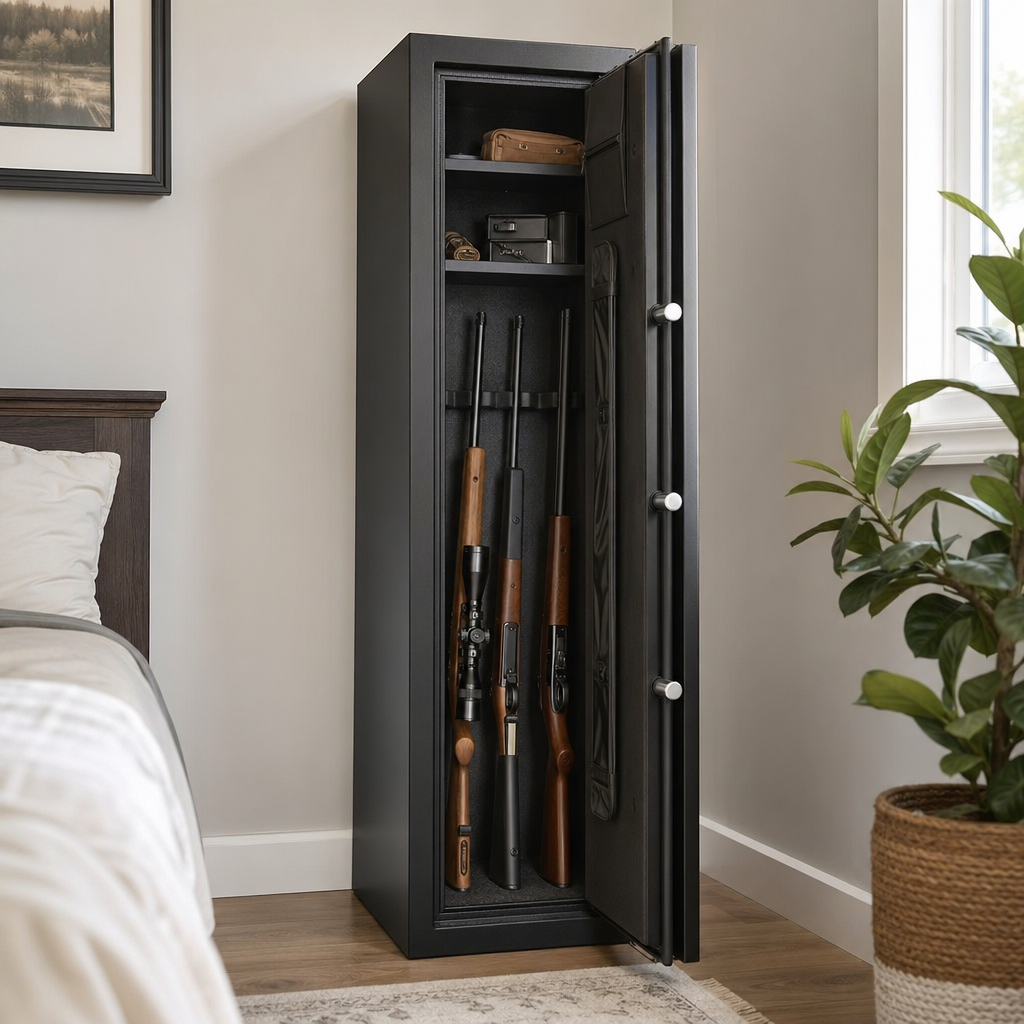
Finding the best firearm safes for homeowners with limited space starts with understanding a simple truth: small homes still need serious security. Apartment dwellers, condo owners, and families in older houses often lack a dedicated gun room, large closet, or reinforced basement corner, yet they face the same risks of theft, unauthorized access, moisture damage, and liability. A compact safe is not a compromise if it matches the firearm collection, the floor plan, and the owner’s daily routine.
In this buying guide, “limited space” means any setting where every square foot matters. That includes studio apartments, narrow bedroom closets, townhome utility rooms, under-bed storage areas, and garages where a full-size traditional safe would block walkways or violate lease rules. “Best firearm safes” does not mean one universal product. It means the right category, lock type, steel construction, anchoring method, and interior layout for a specific home. After installing and evaluating safes in tight bedrooms, upstairs offices, and small mudrooms, I have learned that dimensions on a product page never tell the full story; door swing, shelf depth, and anchoring access often decide whether a safe works in real life.
This hub article covers the full buying process for compact gun storage. It explains the main safe types, how to measure available space, what construction details matter, which locking systems suit different households, and how fire ratings and installation choices affect performance. It also acts as a central guide for deeper topics within gun safes and safety, helping readers compare under-bed safes, closet gun safes, biometric pistol safes, modular cabinets, and wall-mounted options with a consistent framework. If you want a safe that fits a small home without sacrificing responsible storage, this guide will help you choose with confidence.
Start with fit, capacity, and the realities of a small home
The first question is not “Which brand is best?” It is “Where will the safe live, and how will it be used every day?” In small homes, placement determines nearly everything else. A safe beside a bed needs fast access and quiet operation. A safe in a hall closet needs shallow depth and a door that opens without hitting trim or shelving. A safe in a garage may need better corrosion protection and a dehumidifier. Before comparing models, measure width, depth, height, doorway clearance, and the full arc of the door opening. Also check the floor structure, especially in upstairs rooms where concentrated weight matters more than overall safe size.
Capacity claims are one of the most misunderstood parts of any firearm safe buying guide. A “12-gun” safe rarely holds twelve scoped long guns in a practical layout. Manufacturers often count slim rifles with no optics, no slings, and no spacing for easy removal. In compact safes, realistic capacity is usually 50 to 70 percent of the listed number. Homeowners with limited space should buy for actual use, not catalog math. If you own four rifles with optics, one shotgun, and two handguns, a safe marketed for eight to ten guns may be the real minimum.
Small homes also require a sharper distinction between a true safe and a residential security container. Many products in this segment are lighter-gauge steel cabinets with basic locking systems. They can still be useful for child access prevention and organized storage, but they are not equivalent to heavier, better-reinforced safes. When I help buyers compare compact models, I tell them to evaluate the threat profile honestly. If the priority is preventing unauthorized handling in a low-crime apartment, a compact quick-access unit may be appropriate. If the home has repeated service traffic, isolated garage access, or higher burglary risk, thicker steel and better anchoring become mandatory.
Which compact firearm safe type is best for limited space?
There is no single winner because different floor plans favor different formats. The best compact firearm safes usually fall into five categories: under-bed safes, vertical slim safes, closet-friendly rectangular safes, wall safes, and dedicated handgun safes. Under-bed safes work well when bedroom floor area is limited but bed clearance is available. They are excellent for one or two defensive long guns plus handguns, though they usually offer lower fire protection and can be awkward to access if bedding or bed frames obstruct the drawer.
Vertical slim safes are ideal for corners, closet ends, and narrow alcoves. They use height efficiently and can store several long guns in a small footprint. Their weakness is often interior width; scoped rifles and AR-style platforms can crowd quickly. Closet-friendly rectangular safes offer better shelf flexibility and often better fire insulation, but they need enough depth and door clearance. Wall safes save floor space, yet they are usually too shallow for many long guns and provide less steel mass than freestanding units. Dedicated handgun safes fit nightstands, shelves, or dresser tops and are useful for quick access, but they should supplement, not replace, full collection storage if long guns are present.
| Safe Type | Best Use | Main Advantage | Main Limitation |
|---|---|---|---|
| Under-bed safe | Bedrooms with open bed clearance | Excellent use of dead space | Limited fire protection on many models |
| Slim vertical safe | Closets, corners, utility rooms | Stores long guns in a narrow footprint | Gets crowded with optics and accessories |
| Compact rectangular safe | Closets or small offices | Better shelves and mixed firearm storage | Needs more door swing clearance |
| Wall safe | Hidden installation between studs | Saves floor space | Very limited depth and capacity |
| Handgun safe | Nightstand or quick-access use | Fast retrieval | Not suitable for long-gun storage |
For most homeowners with limited space, the strongest overall choice is a slim vertical safe or a compact rectangular safe that can be anchored in a closet or bedroom corner. They balance security, capacity, and realistic installation options better than most wall safes or ultra-light cabinets. Under-bed designs are excellent specialty solutions, especially for defensive access, but they should be chosen carefully because the category ranges from well-built steel drawers to thin boxes with weak rails and minimal pry resistance.
Construction details that separate a good small safe from a weak one
Steel thickness matters more than marketing language. Many compact gun safes advertise “solid steel construction,” but that phrase alone says almost nothing. Look for body steel specifications and door plate details. Lower-cost compact products often use 14-gauge or thinner steel, while stronger residential options may use 12-gauge, 10-gauge, or composite door structures. In practical terms, heavier steel slows forced entry with pry bars, hand tools, and smash-and-grab attacks. Door reinforcement, continuous welds, and recessed designs also matter because compact safes are often targeted at the door edge rather than the body panels.
Locking bolts deserve similar scrutiny. More bolts do not automatically mean better security if they are small, poorly supported, or active on only one side. In tight-space safes, a well-designed door frame and anti-pry tabs can outperform flashy bolt counts. Internal hinges protect the hinge side but reduce door opening angle; external hinges can allow wider access, which is helpful in closets, provided the door frame is reinforced. I usually advise buyers to value overall door construction above simple brochure metrics.
Another overlooked detail is the base and back panel anchoring pattern. Compact safes are more vulnerable to removal because they weigh less than large traditional safes. A thief who cannot open a small safe quickly may try to carry it out and attack it elsewhere. Good compact models provide multiple anchor points, solid hardware, and enough interior access to install bolts correctly. If a safe cannot be anchored because of rental restrictions or weak flooring, weight and concealment become even more important, but security always drops when anchoring is impossible.
Interior design matters too. Adjustable shelves, barrel rests, door organizers, and convertible sections help a small safe do more work. In limited-space homes, one safe often has to store handguns, passports, documents, optics, magazines, and valuables in addition to long guns. A poor interior wastes cubic inches; a thoughtful one can eliminate the need for a second lockbox. Brands such as SecureIt, Vaultek, Hornady, Fort Knox, and SnapSafe are often discussed because they emphasize different strengths, from modularity and access speed to heavier construction and organization.
Lock types, fire ratings, and smart buying decisions
The best lock type depends on who needs access and how quickly. Electronic keypad locks are common because they are fast and easy to use in low light. Quality matters, though. Cheap keypads can suffer from inconsistent buttons, battery neglect, or poor lock bodies. Mechanical dial locks are slower but proven and independent of batteries. Biometric locks are attractive for bedside handgun safes and some compact long-gun units, yet fingerprint readers vary widely. In my experience, premium biometric safes can work well if users enroll multiple fingers and keep the scanner clean, but no buyer should rely on biometrics alone without testing access repeatedly under realistic conditions.
Fire ratings require even more caution. A label such as “30 minutes at 1200°F” is not standardized across all brands, and testing methods differ. Some companies use independent labs such as Intertek or ETL, while others rely on internal testing. For a compact safe in a small home, fire resistance is valuable, especially when documents are stored inside, but it should be viewed in context. A lighter safe with basic insulation may protect contents in a short-duration event, yet it will not match the thermal mass of a heavier unit. Fireboard, door seals, and body gaps all influence performance. If fire protection is a top priority, verify the rating source and understand that paper documents, electronics, and firearms have different heat tolerances.
Budget decisions should follow threat level, not impulse. A homeowner storing one defensive pistol in a low-risk apartment may be well served by a high-quality quick-access handgun safe from Vaultek or Fort Knox. A family storing several rifles and handguns in a suburban house should usually step up to a compact anchored safe with better steel and at least modest fire protection. The worst buying mistake is purchasing solely by external dimensions and sale price. The second worst is buying too small. Future purchases, optics, suppressor-ready lengths, and accessory growth should be considered from the start. Choose the smallest safe that still leaves breathing room, then install it correctly and practice using it. That combination delivers the real benefit: secure, responsible firearm storage that fits the home you actually have.
Installation, concealment, and using this hub to compare related guides
Installation is where many compact safe purchases succeed or fail. In a small home, the safe should disappear into normal movement patterns rather than disrupt them. Bedroom closets are popular because they offer concealment, stable temperatures, and walls that may support anchoring into wood framing or concrete slabs. Corners near load-bearing walls often make the best use of weight and allow the safe body to resist pry attacks from more than one side. Under-bed safes should be checked for drawer extension clearance, bed skirt interference, and the ability to reach the lock quickly from a standing or kneeling position. If the safe sits in a garage, raise it slightly off bare concrete, control humidity, and inspect it seasonally for corrosion.
Concealment should support security, not replace it. A hidden safe behind clothes, inside cabinetry, or below a workbench is helpful because it reduces opportunistic discovery, but concealment alone is weak protection. Small safes need layered defense: discreet placement, proper anchoring, quality locks, and household access rules. Homes with children should combine the safe with routine lock checks and clear handling protocols. Homes with frequent guests, cleaners, or contractors should avoid obvious placements such as visible bedroom corners or open office nooks. The best firearm safe for limited space is the one that remains both secure and convenient enough that the owner actually uses it every time.
As the central buying guide in this subtopic, this article should also help you navigate specialized comparisons. If you are deciding between bedside access and full-home storage, look next at dedicated handgun safe guides and under-bed safe reviews. If closet fit is the main challenge, focus on slim vertical safes and modular gun storage systems. If you rent, prioritize articles on no-drill strategies, portable safes, and landlord-friendly installation options. If fire and theft resistance matter most, move to deeper comparisons of steel gauge, lock certifications, and third-party fire testing. Using a hub-and-spoke approach makes the research process faster because each follow-up guide answers one narrow question in detail while this page gives you the decision framework.
The key takeaway is straightforward: limited space does not excuse weak firearm storage. It simply changes the buying criteria. Measure the space carefully, choose the safe type that fits your floor plan, verify steel thickness and anchoring options, select a lock you can trust under stress, and treat fire ratings with informed skepticism. When those pieces line up, a compact safe can protect firearms, reduce unauthorized access, and preserve usable room in the home. Start by identifying your intended location today, write down the real dimensions and firearm count, and use that information to compare the compact gun safes that truly match your needs.
Frequently Asked Questions
What should homeowners prioritize when choosing a firearm safe for a small apartment, condo, or older house?
Homeowners with limited space should focus on fit, security, access, and installation before anything else. The best firearm safe for a smaller home is not necessarily the biggest or heaviest model on the market. It is the one that fits the available footprint, stores the firearms you actually own, and can be secured in a way that prevents theft or unauthorized use. In practical terms, that means measuring the intended location carefully, including door swing, wall clearance, closet depth, and any stairs or narrow hallways the safe must pass through during delivery.
Security features matter just as much in a compact safe as they do in a full-size gun vault. Look for solid steel construction, a dependable locking system, internal hinges or protected hinge-side locking, and pre-drilled mounting holes for bolting the safe to the floor or wall structure when appropriate. In small homes, thieves may be more likely to target lightweight safes that can be carried away, so anchoring is especially important. A well-mounted compact safe can be much more secure than a larger unit that is simply placed in a corner without reinforcement.
Access is another major priority. Homeowners should think about how quickly they need to reach the firearm and who lives in the home. A bedside biometric safe may be ideal for a defensive handgun, while a slim vertical cabinet or under-bed safe may be better for long guns in a tighter floor plan. The right choice depends on whether the safe is meant for rapid access, long-term secured storage, or a mix of both. For many households, using one small quick-access safe for a defensive firearm and another compact lockable safe for additional storage is the most realistic solution.
Finally, do not ignore environmental protection. Smaller homes often have less climate control in closets, garages, and exterior-adjacent rooms. Moisture protection, a tight door seal, interior lining, and room for a dehumidifier or desiccant pack can make a major difference in preventing rust and preserving firearms over time.
Are compact firearm safes secure enough, or do small safes make it easier for thieves to steal guns?
Compact firearm safes can be very secure, but only when buyers choose the right type and install it correctly. The size of a safe alone does not determine its security. What matters is the thickness and quality of the steel, the locking mechanism, the design of the door and bolts, and whether the safe is anchored properly. A small safe with strong construction that is bolted into wood framing, concrete, or another solid structural point can provide excellent protection against unauthorized access and many common theft attempts.
The main weakness of a poorly chosen small safe is portability. If a thief can pick it up and remove it from the home, they gain time and privacy to attack it elsewhere. That is why homeowners with limited space should treat anchoring as a non-negotiable part of the purchase. Even a good compact safe loses much of its value if it is left loose in a closet or under a bed. The safest small-home setup often involves placing the safe in a discreet location, minimizing visibility, and securing it to a surface that cannot be easily removed.
It is also important to distinguish between true firearm safes and simple lock boxes. A lock box may be suitable for temporary storage or travel, but it generally does not provide the same level of resistance as a purpose-built safe. Homeowners should read product specifications carefully and avoid assuming that all metal containers offer equal protection. In the small-space category, there is a wide range between basic access-control boxes and more robust safes designed to resist prying, tampering, and smash-and-grab theft.
For many homeowners, the realistic goal is layered security rather than invulnerability. A compact safe that denies children and unauthorized adults access, slows a thief significantly, and protects firearms from casual discovery is a strong solution for a limited-space home. Adding an alarm system, discreet placement, reinforced mounting, and careful inventory management makes that protection even stronger.
Where is the best place to install a firearm safe in a home with very limited square footage?
The best place to install a firearm safe in a small home is usually the location that balances concealment, structural support, accessibility, and environmental stability. In apartments, condos, and older houses, popular options include bedroom closets, under-bed spaces, inside cabinetry, and tucked-away corners that do not interrupt daily movement through the home. The right location depends on the safe’s purpose. A quick-access handgun safe may belong near the bed or in a secured nightstand area, while a slim long-gun safe may fit better in a closet where it remains out of casual view.
Closets are often one of the most practical choices because they help conceal the safe and make better use of vertical space. However, homeowners still need to confirm that the floor can support the unit, the door opens fully, and the safe can be bolted properly. Under-bed safes are another excellent option for homeowners who truly do not have spare closet or corner space. They make use of otherwise wasted square footage and can provide fast access, especially for handguns or breakdown long guns, but they should still be secured against removal and checked regularly for dust and moisture buildup.
Older homes present unique challenges because floors may be uneven, walls may not align with modern framing expectations, and humidity control may be less consistent. In those cases, homeowners should inspect the area carefully and avoid placing a safe directly against damp exterior walls or in unconditioned spaces unless the safe and firearms are protected with moisture-control accessories. Garages and basements may seem convenient, but they are often poor choices in small homes if they expose firearms to temperature swings, corrosion risk, or easier access during a break-in.
Whatever location you choose, think beyond simple placement. The safe should not be obvious to guests, service workers, or anyone looking through windows or open doors. Discretion is part of security. In a small home, where everything is closer together, a smart installation plan often matters just as much as the safe itself.
How much firearm safe capacity do small-space homeowners really need?
Most homeowners underestimate the amount of space they need inside a firearm safe. Manufacturers often list capacity in ideal conditions, using tightly packed firearms with minimal accessories. In the real world, optics, lights, spare magazines, documents, and protective sleeves reduce usable space quickly. For that reason, small-space homeowners should buy for actual storage needs plus some room for growth rather than relying strictly on the advertised firearm count.
A good rule is to start by identifying exactly what must be stored inside the safe. If the collection consists of one defensive handgun and one additional pistol, a compact biometric or keypad handgun safe may be enough. If the owner has a shotgun, a rifle, and a few handguns, a small upright safe or an under-bed model may be more appropriate. If the household expects to add firearms later, choosing a slightly larger slim-profile safe can prevent an expensive upgrade too soon.
Capacity planning should also account for layout efficiency. Some compact safes are better designed than others, with adjustable shelves, door organizers, handgun racks, and modular interiors that make limited cubic space more practical. These features are especially valuable in condos and apartments because they let owners store more securely without increasing the exterior footprint. A well-organized interior can be the difference between a safe that works for years and one that feels overcrowded after only a few months.
At the same time, do not oversize a safe just because bigger seems safer. In a small home, a safe that overwhelms the room, cannot be installed correctly, or draws attention can create new problems. The goal is efficient capacity: enough room for current firearms, key accessories, and safe operation, all within a model that fits the home and can be secured properly.
What features are most important in a small firearm safe for preventing unauthorized access, moisture damage, and liability?
The most important features are a reliable lock, strong construction, proper mounting capability, and interior protection against humidity. For unauthorized access, the safe should have a locking system that fits the homeowner’s needs and habits. Biometric locks can be excellent for fast access if they come from a reputable manufacturer and are tested regularly. Electronic keypad locks are also popular because they offer speed and easy code changes. Mechanical locks are slower but often valued for long-term durability and independence from batteries. The best choice is the one the owner can operate consistently and confidently under normal and stressful conditions.
Construction matters because a lock is only one part of the security picture. Look for pry-resistant doors, reinforced locking bolts, heavy-gauge steel, and tamper-resistant designs. Compact safes should also include pre-drilled mounting points so they can be anchored securely. In terms of liability, this is critical. Responsible firearm storage means preventing children, visitors, and prohibited persons from gaining access. A safe that is easy to move, easy to pry open, or routinely left unsecured undermines that responsibility.
Moisture protection is often overlooked in smaller homes, where storage locations may be close to exterior walls, HVAC fluctuations, or cramped areas with limited airflow. Useful features include carpeted or lined interiors, door seals, and enough interior room for desiccant packs or an electric dehumidifier if the model supports one. Regular maintenance also plays a