
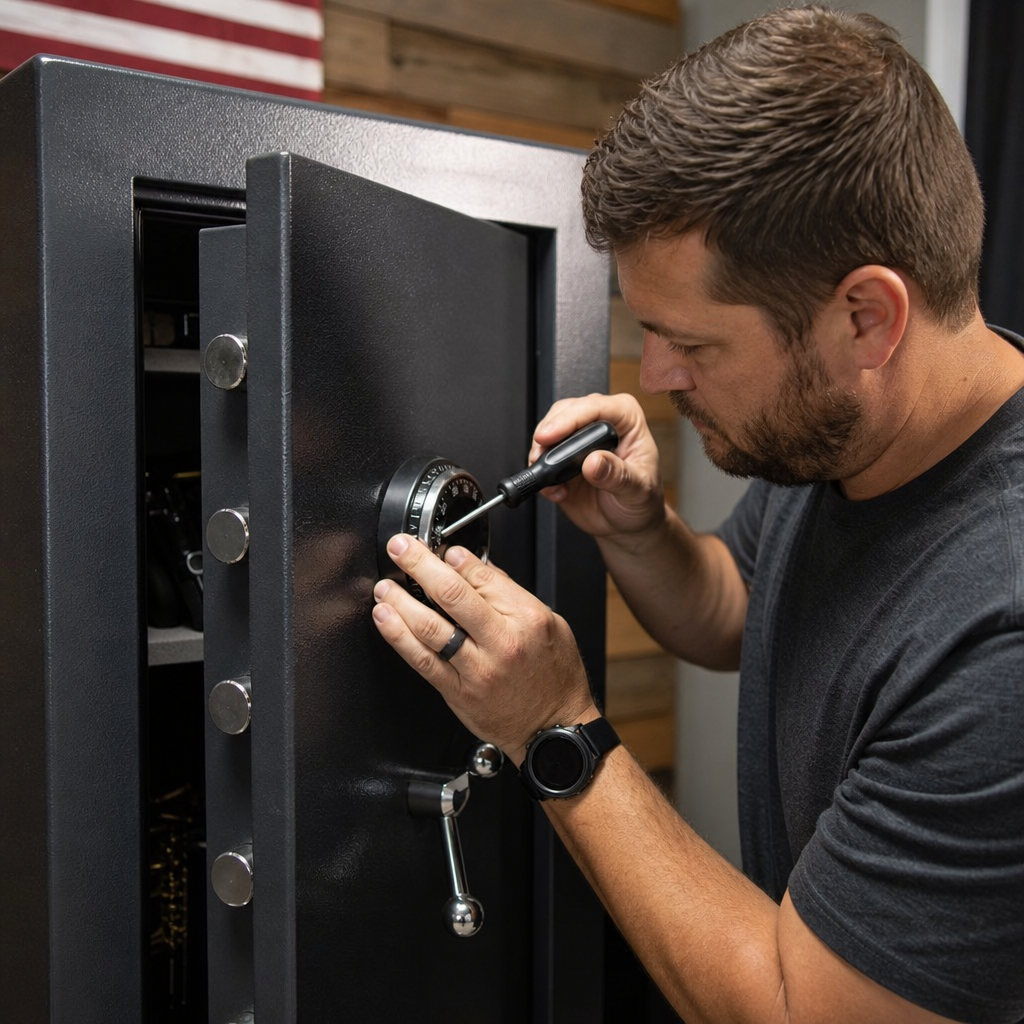
Gun safe owners often ask a practical question: is it legal to modify your gun safe’s locking mechanism? The short answer is usually yes, but legality depends on what you change, why you change it, where you live, and whether the safe is used to satisfy a legal storage requirement, an insurance condition, or a court order. In plain terms, changing a keypad, dial, boltwork component, relocker, or lock body on a privately owned safe is not generally prohibited by federal law. Problems arise when a modification weakens required security, defeats child-access prevention rules, violates building or fire code, voids a warranty tied to security ratings, or creates evidence that storage was negligent after a theft or unauthorized access incident.
To understand the issue, define a few terms. A locking mechanism includes the lock itself, such as a mechanical dial lock, electronic keypad lock, biometric lock, or redundant lock, plus connected parts like the spindle, cam, relocker, hardplate, handle clutch, and boltwork. A modification can range from replacing a failed electronic keypad with a listed equivalent to drilling extra holes, bypassing a relocker, or retrofitting a consumer cabinet with aftermarket smart access hardware. Gun safe myths and misconceptions complicate the decision. Many owners assume any upgrade is automatically legal, that all digital locks are inferior, or that a warranty disclaimer has no real-world impact. In practice, legal exposure usually comes from consequences: unauthorized child access, insurance disputes, denied warranty claims, and arguments that the safe no longer met advertised or required standards.
This topic matters because safe storage laws are expanding, insurers increasingly ask how firearms are secured, and modern owners want faster access without sacrificing security. I have worked with safe owners who changed locks for accessibility, battery failures, and fire-damage repair, and the pattern is consistent: the mechanical work is often straightforward, but the compliance picture is not. If your safe supports compliance with a state child access prevention law, a household risk-reduction plan, or a policy rider covering firearm theft, your modification should preserve the safe’s protective function and documented rating. The safest approach is to treat lock changes as both a hardware project and a risk-management decision.
What the law usually allows, and where the real legal risk appears
For most private owners in the United States, no broad federal statute bans modifying a gun safe lock on personal property. You can typically replace a Sargent and Greenleaf mechanical lock with a compatible electronic lock, install a SecuRam keypad after a failure, or have a locksmith convert a Group 2 dial arrangement to another listed lock. The legal question is rarely “may I touch this safe?” and more often “does the modified safe still satisfy another rule or obligation?” Those obligations may come from state safe-storage laws, retailer return agreements, homeowners insurance, warranty terms, landlord restrictions, or criminal and civil standards of reasonable care after an incident.
State law is the first place to check. Some states impose criminal penalties when a child gains access to an improperly stored firearm. In those states, a modification that makes the safe easier to bypass, easier to leave partially latched, or dependent on unreliable power can become relevant evidence. California, for example, regulates firearm safety devices and has detailed rules in adjacent areas of storage, transfers, and dealer compliance. While a privately modified residential safe is not automatically illegal there, an owner who weakens security could still face serious consequences if a prohibited person or minor accesses a firearm. Massachusetts and other jurisdictions also expect locked storage under specific circumstances. The lock change itself is not the offense; the resulting failure to secure firearms can be.
Another legal layer involves representations. If you advertise to an insurer that firearms are stored in a “TL-rated safe” or “California DOJ-compliant container,” and then remove or defeat components tied to that security performance, you may create a coverage dispute. Insurance contracts focus on material facts. If a claim adjuster sees drilled holes, disconnected relockers, or an unlisted aftermarket keypad installed contrary to manufacturer guidance, the argument may become whether the safe still matched the represented level of protection. That is not hypothetical. In property-loss investigations, adjusters document the condition of locks, boltwork, and anchoring because those details affect forced-entry analysis and coverage decisions.
Common modifications and whether they are usually acceptable
Not all modifications carry the same risk. A like-for-like replacement by a qualified safe technician is generally the least controversial. Replacing a failed keypad with the same model, swapping a worn mechanical lock for another listed lock approved by the manufacturer, or updating to a redundant lock package offered by the brand usually preserves both function and documentation. These jobs can often be recorded on an invoice showing part numbers, technician credentials, and testing results. That paper trail matters if you later need to show that your storage remained secure and professionally maintained.
Risk rises when owners change security architecture rather than replace a failed part. Examples include disabling a relocker because it nuisance-trips, enlarging the door cutout to fit a consumer biometric module, altering bolt throw geometry, removing hardplate to ease drilling, or converting a safe designed for internal lock mounting to an external smart-lock arrangement. These changes may weaken resistance to attack in ways a casual owner cannot evaluate. I have seen safes that seemed to function after a DIY lock retrofit but no longer fully engaged the boltwork or relocker. The door shut, the keypad beeped, and the owner assumed all was well. Under force, though, the system was materially weaker than before.
| Modification | Typical legal posture | Main risk | Best practice |
|---|---|---|---|
| Like-for-like lock replacement | Usually acceptable | Warranty or documentation gaps | Use manufacturer-approved parts and keep service records |
| Upgrade to approved electronic or redundant lock | Usually acceptable | Improper installation or power management issues | Confirm model compatibility and test relocker function |
| DIY retrofit of aftermarket biometric lock | Potentially problematic | Reduced security, insurance disputes | Use a safe technician and verify listing status |
| Disabling relocker or hardplate | High risk | Negligence arguments after theft | Avoid unless directed by manufacturer during repair |
| Drilling or welding structural door components | High risk | Void ratings, weaken fire or burglary resistance | Obtain written manufacturer guidance first |
Biometric upgrades deserve special caution because they are heavily marketed and heavily misunderstood. Modern biometric locks can be useful, especially better capacitive or multispectral fingerprint systems with fallback PIN access, but consumer-grade modules vary widely. False reject rates, battery dependency, and sensor contamination all matter. More importantly, many aftermarket biometric products were designed for cabinets or light lockers, not heavy gun safes with specific door thicknesses, spindle geometry, and relocker layouts. If the lock is not listed, not tested with your safe model, or installed by improvisation, the convenience benefit may come with legal and practical downside.
How standards, ratings, and warranties affect legality in practice
Owners often treat ratings and labels as marketing, but they become legally significant once a dispute begins. Underwriters Laboratories burglary ratings such as TL-15 and TL-30 are tied to tested configurations, including door and lock arrangements. A Residential Security Container rating, while less demanding than TL classifications, still depends on a tested design. Changing the locking mechanism may not be illegal by itself, yet the safe may no longer correspond to the tested configuration on which the rating was based. If your insurer, dealer, or employer relied on that rating, the modification can have legal consequences through contract or policy enforcement.
Fire protection claims raise similar issues. Many gun safes marketed for fire resistance use intumescent seals, layered drywall-type insulation, and engineered door gaps. Owners sometimes drill access points for wiring, dehumidifier routing, or smart modules near the lock area. Those penetrations can alter heat pathways or compromise seals. Again, the modification is not normally a criminal offense, but it can undermine a claim that the safe still performed as sold. In litigation, technical deviations matter. A manufacturer can credibly say the product no longer reflected the tested or warranted assembly once unapproved openings or substitutions were made.
Warranty language is also more important than many people think. Major brands routinely state that unauthorized modifications, welding, drilling, or lock substitutions can void coverage. A voided warranty is not merely a customer-service annoyance. If the modified lock fails shut, traps firearms during an emergency, or contributes to theft, the lack of manufacturer support increases your cost and weakens your position. A professional invoice from an authorized technician is often the difference between a clean service history and a difficult argument over whether the owner caused the problem.
When modifying a lock can create liability after theft, injury, or child access
The strongest legal argument against careless modification appears after something goes wrong. If a thief defeats your safe unusually quickly, investigators and insurers will examine whether the lock, relocker, anchoring, and boltwork were intact. If a child opens the safe because the keypad was left in a programming state, the biometric reader misread prints, or the owner bypassed the internal relocker to stop lockouts, those facts can support negligence allegations. Courts do not need a statute saying “you may not replace this lock” to evaluate whether your actions were reasonable under the circumstances.
This is especially important in homes with minors, prohibited persons, roommates, caregivers, or frequent visitors. Safe-storage law and civil liability both turn on foreseeability. If you know a household member has attempted access before, or you store loaded defensive firearms for rapid retrieval, any modification that reduces secure retention requires extra scrutiny. I generally advise clients to assume that every change may be judged later by a skeptical adjuster, prosecutor, or plaintiff’s attorney asking a simple question: did this owner make access easier for the wrong person? If the answer looks like yes, the legal position worsens quickly.
There is also a documentation problem after DIY work. Professional safe technicians test lock operation through repeated cycles, inspect bolt travel, verify relocker status, and confirm that the door cannot be left apparently closed while unlocked. Many consumer modifications skip those checks. I have inspected safes where the owner believed the handle resistance meant the bolts were fully extended, when in fact misalignment prevented complete engagement. That kind of partial failure may remain invisible until a burglary attempt or accidental opening by a child. From a liability perspective, invisible defects are often the most damaging because they show overconfidence without verification.
Best practices before you change a gun safe locking mechanism
If you are considering a modification, start by identifying the safe’s exact make, model, serial number, current lock type, and any published rating or compliance label. Then read the manufacturer’s service guidance and warranty terms. Contact the company directly and ask a precise question: does replacing this lock with this specific model preserve the safe’s rating and warranty? Get the answer in writing. Next, review your insurance policy or scheduled-property rider to see whether storage representations were made. If the safe supports legal compliance in your state, review the text of the applicable safe-storage or child-access law, not just retailer summaries.
Choose a safe technician or locksmith with demonstrated safe experience, not merely general lock experience. Ask whether they routinely service gun safes, whether they install listed lock bodies from recognized manufacturers, and whether they test relockers and boltwork after installation. Good technicians document door thickness constraints, spindle length, mounting footprint, keypad placement, and any required drilling templates. They also explain battery maintenance, lockout procedures, and override limitations. That level of detail is what separates a compliant upgrade from a risky improvisation.
Finally, keep records. Save invoices, part numbers, warranty correspondence, photos before and after service, and any written confirmation that the modified safe remains compatible with stated ratings or storage requirements. Then test the safe under normal use: multiple open-close cycles, battery change procedures, low-light operation, and access by only authorized adults. Gun safe myths and misconceptions thrive on assumptions. The reality is simpler: modifying your gun safe’s locking mechanism is often legal, but legality is only the starting point. The smart standard is whether the change preserves security, compliance, insurability, and reliable operation. Before you approve any lock work, verify those four points and treat the safe like the life-safety device it is.
Frequently Asked Questions
Is it generally legal to modify your gun safe’s locking mechanism?
In most cases, yes. For a privately owned gun safe, there is usually no federal law that broadly prohibits changing the locking mechanism itself. Owners commonly replace electronic keypads, mechanical dial locks, lock bodies, relockers, and even certain internal boltwork components for convenience, reliability, or security upgrades. From a basic ownership standpoint, modifying property you legally own is typically allowed. That said, the legal answer depends on context rather than the hardware alone.
The biggest issues arise when the safe is being used to meet a specific legal, contractual, or court-imposed requirement. For example, if your safe helps satisfy a state safe-storage law, a child access prevention rule, a probate or trust obligation, a domestic violence protective order, a firearm dealer regulation, or an insurance policy condition, then the modification could create problems if it weakens the safe or causes it to no longer meet the required standard. In other words, changing the lock is not usually illegal by itself, but changing it in a way that defeats a required level of security can become a legal issue.
There is also a practical distinction between upgrading and downgrading. Replacing a failing lock with a better UL-rated lock is generally less risky than installing a cheap aftermarket device that reduces security or makes the safe easier to open without authorization. If the modification leads to unauthorized access, accidental child access, theft, or a denial of insurance coverage, legal consequences can follow even if the original act of modification was not expressly banned. That is why owners should review state and local law, manufacturer guidance, insurance terms, and any legal orders that apply to their specific situation before making changes.
When can changing a safe lock create legal or liability problems?
Legal trouble usually begins when the modification affects a duty you already have. If your safe is part of your compliance with a storage law requiring firearms to be secured from minors, prohibited persons, or unauthorized users, then weakening the lock or installing an unreliable mechanism could expose you to civil liability or even criminal allegations after an incident. The same is true if the safe is relied upon under a court order, employment policy, firearms business regulation, or landlord or military housing rule. The modification itself may not be the violation; the problem is that the modified safe may no longer satisfy the rule you were depending on it to meet.
Insurance is another major concern. Many gun owners assume that if the safe still locks, coverage is unaffected. That is not always true. Some policies require a certain class of safe, a particular lock type, or proof that the storage container remained in compliant condition. If you replace a listed lock with a non-listed one, disable a relocker, alter the boltwork, or make an undocumented repair after a malfunction, an insurer may argue that the safe no longer met the policy’s protective-device requirement. That can matter after theft, fire, or a liability claim involving firearm access.
Product warranty and negligence issues can also overlap. If a manufacturer warns that only qualified technicians should replace the lock or relocker and an owner performs a poor installation that leads to lock failure, unauthorized access, or inability to open the safe in an emergency, that can become important evidence in a lawsuit. In short, the legal risk increases when the modification reduces security, bypasses required standards, voids a relevant contract, or contributes to foreseeable harm.
Does it matter whether the modification is an upgrade or a downgrade?
Yes, that distinction matters a great deal. A legitimate upgrade is typically the lowest-risk scenario. Examples include replacing a worn lock with a reputable equivalent, moving from an older lock to a higher-quality electronic or mechanical model, or having a certified locksmith install a lock that maintains or improves the safe’s security rating. These kinds of changes are generally easier to defend because they show an effort to preserve or enhance secure storage rather than avoid it.
A downgrade is more likely to create legal and practical exposure. That could include installing a low-quality consumer lock not designed for gun safes, removing a relocker, altering bolt engagement so the door appears locked when it is not fully secured, adding a remote-access feature that compromises access control, or converting a dual-control lock system to a simpler setup that allows easier unauthorized entry. Even if no statute specifically says, “You may not downgrade your safe lock,” the downgrade can become legally significant if it contributes to theft, child access, misuse, or a violation of storage obligations.
Documentation also matters. If you make an upgrade, keep records showing what was installed, who did the work, and whether the replacement lock is compatible with the safe. That paperwork can be valuable if you later need to show compliance to an insurer, law enforcement, a court, or a buyer. In practice, the safer path is to treat the modification like a security-sensitive repair: use quality components, preserve the safe’s intended protective function, and avoid any change that makes the container less secure than before.
Do state laws, local rules, or special circumstances affect whether a lock modification is legal?
Absolutely. Firearm storage laws vary widely by state, and some local jurisdictions impose additional rules, especially where child access prevention or secure storage is emphasized. A modification that seems harmless in one state may create a problem in another if your jurisdiction defines secure storage in a specific way or expects firearms to be stored in a locked container that functions reliably. Even if the law does not name a particular lock brand or model, the safe may still need to remain effective at preventing unauthorized access. That makes local legal context extremely important.
Special circumstances can matter even more than geography. If you are a federally licensed firearms dealer, a security professional, a government employee, a member of the military living in regulated housing, or someone subject to a restraining order, custody arrangement, or other legal directive involving firearm access, your safe may be part of a broader compliance framework. In those situations, modifying the lock without checking the applicable rules can create serious consequences. The same caution applies if the safe stores NFA-regulated items, estate firearms, or weapons subject to business inventory controls, where documentation and restricted access may carry additional importance.
Because these rules are highly situation-specific, a smart approach is to verify four things before making changes: the law in your state and locality, any court order or legal obligation affecting storage, any insurance policy requirement, and any manufacturer or installer guidance that could affect the safe’s security rating. If the safe serves more than a private convenience function, you should assume the modification deserves extra review before you proceed.
What should you do before modifying your gun safe’s locking mechanism?
Start by identifying why the safe matters legally, not just mechanically. If it is simply a privately owned safe used for personal storage, your options are usually broader. But if the safe is part of how you comply with a state storage law, a household safety plan involving minors, an insurance requirement, a business obligation, or a court-related restriction, you should confirm that the modification will not undermine that role. Review your insurance policy, purchase paperwork, and manufacturer specifications to see whether a certain lock type, certification, or installation method is expected.
Next, choose the replacement carefully. Use a lock designed for gun safes or security containers, preferably from a reputable maker, and make sure it is compatible with your safe’s door thickness, mounting pattern, boltwork, and relocker system. If the change involves internal components beyond a straightforward keypad swap, consider hiring a qualified safe technician or locksmith. Professional installation helps reduce the risk of accidental lockout, malfunction, or degraded security, and it gives you a record that the work was done properly. Keep invoices, model numbers, and any certification details in case you later need to prove what was installed.
Finally, test the safe thoroughly after the modification and document the result. Confirm that the lock fully engages the boltwork, that any relocker remains functional, and that the safe can be opened and secured reliably under normal use. If you have any doubt about whether the change affects legal compliance, insurance eligibility, or a court-related duty, consult a lawyer or your insurer before relying on the modified safe. The key takeaway is simple: modifying a gun safe’s locking mechanism is often legal, but the wisest course is to make changes that preserve or improve security and to verify that the safe still meets every rule or requirement that applies to you.