
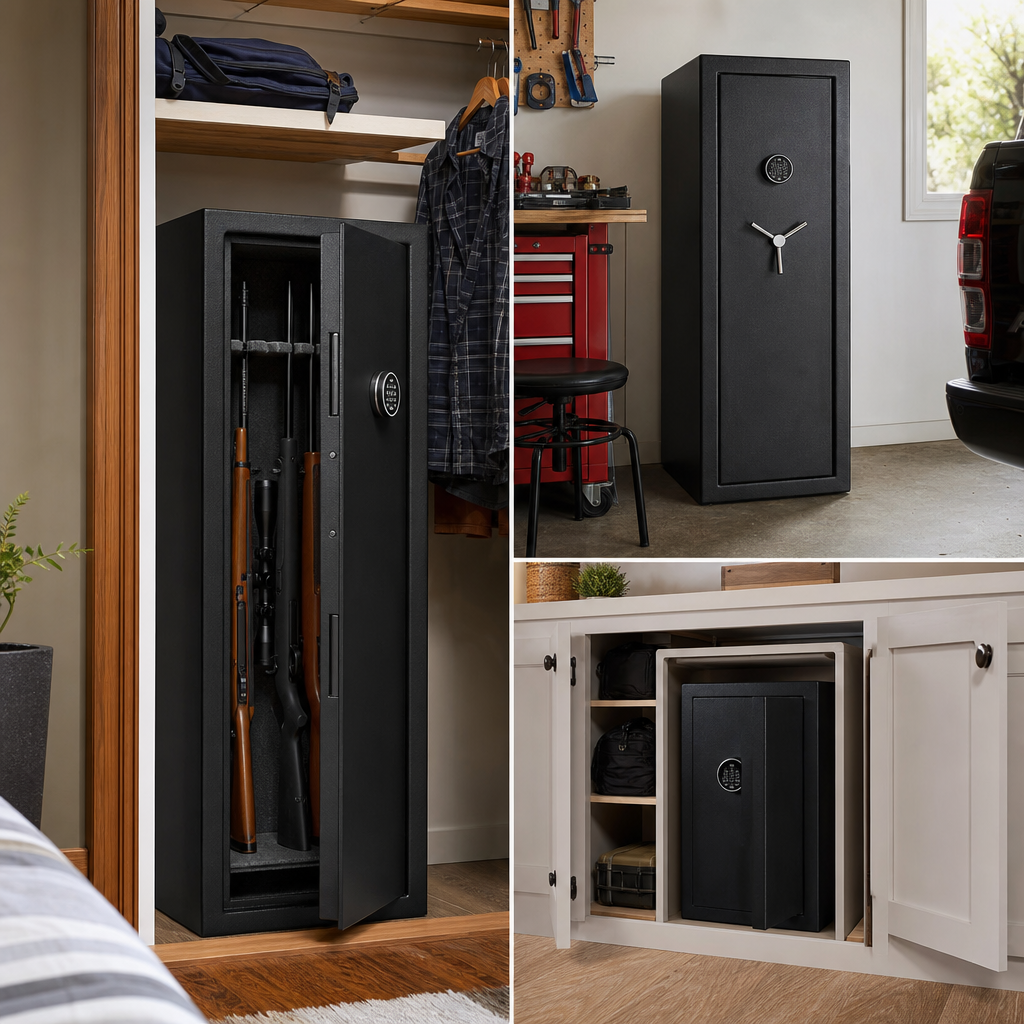
Choosing the best gun safes for people who store firearms in multiple locations starts with a simple reality: one safe rarely solves every storage problem. A hunter may need a full-size safe at home, a compact handgun safe in a truck, and a travel case that meets airline rules. A landlord with a rural property may keep a defensive shotgun at a primary residence, a rifle at a cabin, and a pistol in a small office. In practice, multi-location firearm storage means matching the safe to the environment, the risk level, and the user’s daily routine.
This buyer persona hub explains how to do that. In the firearms industry, a buyer persona is a practical profile of a real storage need: the frequent traveler, the family homeowner, the competitive shooter, the part-time rancher, the apartment renter, or the collector splitting time between two properties. The best gun safe for one persona can be a poor choice for another because burglary patterns, moisture exposure, child-access concerns, and insurance requirements vary sharply by location. I have helped owners set up layered storage plans, and the biggest mistake is usually overbuying one premium safe while leaving other locations protected by flimsy lockboxes or unsecured cases.
Why this matters is straightforward. The Department of Justice and public health research have consistently linked secure firearm storage to reduced unauthorized access, lower theft risk, and safer homes with children. At the same time, the right setup must preserve legitimate access when needed. For multi-location owners, that means thinking in systems rather than products. Steel thickness, lock type, fire rating, anchoring method, humidity control, and portability all matter, but they matter differently in a suburban house, a vehicle, a detached shop, or a seasonal cabin. The goal of this guide is to help you identify the right gun safe buyer persona, understand the tradeoffs, and choose a coordinated storage plan that works everywhere you keep firearms.
What multi-location firearm storage really requires
The best gun safes for multiple locations share one principle: fit the threat model of each site. A gun safe is not just a metal box. It is a combination of burglary resistance, access control, environmental protection, and installation quality. At a primary residence, burglary resistance and fire protection often rank highest. In a vehicle, discretion, tethering, and fast access matter more than a long fire rating. In a vacation home, corrosion control and low-maintenance locking systems can matter as much as steel construction because long periods of vacancy create both humidity and delayed discovery after a break-in.
Most shoppers compare only dimensions and price, but professionals look at several technical factors. Steel gauge affects pry resistance; lower gauge numbers indicate thicker steel. Locking bolts sound impressive in marketing, yet door construction and frame design matter just as much. Lock choice creates tradeoffs: mechanical dial locks have long service lives and no batteries, while electronic locks are faster and easier for shared authorized users. Fire ratings are also inconsistent across brands because testing methods differ; shoppers should read whether the manufacturer cites an independent protocol such as UL classifications for locks or uses proprietary furnace testing for the safe body.
Installation determines whether a safe performs as intended. Even a strong safe can be defeated if thieves can tip it over, attack weak sides, or remove it entirely. For concrete floors, anchor bolts significantly improve real security. On upper floors or rental units, weight limits and lease terms may require lighter safes with reinforced placement, hidden locations, and supplemental alarm coverage. In short, multi-location storage is less about finding one perfect model and more about building an appropriate set of solutions that work together.
Gun safe buyer personas and the right safe strategy for each
Buyer personas help narrow the field quickly. The family homeowner persona usually needs a full-size long-gun safe with interior flexibility, tamper-resistant anchoring, and a lock simple enough for regular use. This owner often stores firearms alongside documents, optics, and ammunition. A model from Liberty Safe, Fort Knox, Browning, or Rhino Metals may fit, but selection should be driven by door strength, interior configuration, and verified support rather than branding alone. Families with children should prioritize disciplined access control, not just concealment.
The apartment renter persona typically benefits from a compact or mid-size safe that balances security with manageable weight. Here, the ideal unit may be a modular safe such as a SnapSafe assembly model, a compact vertical rifle safe, or a handgun safe secured inside a closet footprint. The renter’s constraint is often installation. If permanent anchoring is restricted, mass, concealment, and monitored security become more important. I usually advise renters to avoid ultra-light cabinets marketed as safes; they may organize firearms, but many offer limited burglary resistance.
The frequent traveler persona needs two layers: a compliant transport container and a fixed safe at the destination. For airline travel in the United States, Transportation Security Administration rules require an unloaded firearm in a hard-sided locked container, and only the passenger retains the key or combination. That is not the same thing as a residential security safe. Brands like Pelican, Eylar, or Nanuk make strong travel cases, but those should feed into a more secure destination safe once the traveler arrives. For road trips, a cabled vehicle handgun safe from Hornady, Vaultek, or Console Vault may add temporary control, but vehicles should never become long-term storage sites.
The second-home or cabin owner is one of the most common multi-location personas. This buyer needs burglary resistance, corrosion prevention, and low-maintenance reliability because the property may sit unattended for weeks. In these settings, dehumidifier rods, desiccants, and elevated placement off damp flooring are essential. If the cabin is remote, visible delivery and installation matter too; a premium safe advertised from the road can signal value to thieves. The best plan often combines a moderate-size anchored safe, window and door sensors, and discretion about placement.
The competitive shooter or collector persona usually stores more than firearms. Optics, suppressors where legal, magazines, records, and cleaning gear all need organization. This buyer should emphasize interior adaptability, capacity above current needs, and documented inventory practices for insurance. Many collectors underestimate weight growth. A “36-gun” safe may realistically store far fewer scoped rifles without crowding. For this persona, quality shelving, power access for lighting or dehumidification, and an inventory log are not extras; they are central requirements.
| Buyer persona | Primary risk | Best safe type | Key features |
|---|---|---|---|
| Family homeowner | Unauthorized household access, burglary, fire | Full-size residential gun safe | Anchoring, fire lining, flexible interior, reliable lock |
| Apartment renter | Theft with limited installation options | Compact or modular safe | Manageable weight, concealment, shelf fit, secondary alarms |
| Frequent traveler | Transport compliance, temporary vehicle exposure | Hard-sided travel case plus destination safe | TSA-compliant case, cable attachment, fast transfer to fixed storage |
| Cabin owner | Long vacancy, humidity, delayed loss discovery | Anchored mid-size safe | Corrosion control, discreet placement, simple dependable lock |
| Collector or competitor | High value concentration, space inefficiency | Large configurable safe | Shelving, inventory support, power outlet, expansion room |
How to choose the best gun safes by location, not just by brand
At home, start with the room. A garage exposes steel to temperature swings and often offers thieves more attack time, while a master closet may provide concealment but limited floor support. Basements can work well if humidity is controlled and flood risk is addressed. Concrete slab locations are ideal for anchoring. If quick access is needed for a defensive handgun, pair the main safe with a smaller bedside safe using a biometric or keypad lock from a reputable maker. That dual-safe approach usually outperforms trying to make one large safe serve every use case.
For vehicles, define the purpose honestly. A vehicle safe is for brief, unavoidable storage during restricted stops, not routine overnight retention. The better products use reinforced cable systems, steel housings, and discreet placement under a seat, inside a console, or in a trunk compartment. Console Vault and Hornady RAPiD models are common examples. They deter smash-and-grab theft but are not equivalent to an anchored home safe. If a firearm must remain in a vehicle more often because of work rules, that reality should push the owner toward stronger parking security, shorter storage intervals, and possibly different carry logistics.
At remote properties, maintenance planning matters as much as purchase price. Electronic locks are convenient, but dead batteries or keypad failure at a seasonal property can create a serious access problem. Mechanical locks are slower, yet many owners appreciate their durability for low-use sites. Humidity is the other silent threat. GoldenRod dehumidifiers, rechargeable desiccants, and silicone-treated gun socks can reduce corrosion, but only if the safe is reasonably sealed and the room itself is not chronically damp. For barns or workshops, I prefer a climate-stable interior room over an outbuilding whenever possible.
Travel storage has its own standards. A travel case should protect the firearm from impact and unauthorized opening during transit, then hand off to a secure fixed location when the trip ends. This is especially important for instructors, hunters crossing state lines, and competitors flying with pistols. Keep the transport role and the residential storage role separate in your buying decisions. One case can satisfy transportation rules, while another product protects the firearm from theft where you sleep.
Features that separate a serious gun safe from a basic lockbox
Not every locked container is a true safe. Serious gun safes use heavier steel, stronger door interfaces, better boltwork, and more robust installation options than thin-walled cabinets. Marketing can obscure this difference, so buyers should look for specifics. Ask about body steel gauge, door plate thickness, relocker design, hard plate protection around the lock, hinge style, and anchor-hole placement. A safe with modest external dimensions but better steel and anchoring can outperform a larger, thinner model that advertises huge capacity.
Lock selection deserves careful thought. Mechanical dial locks remain a strong choice for long-term reliability and locations where battery replacement is inconvenient. Electronic keypad locks win on speed and ease of use, especially for owners accessing firearms regularly. Biometric systems have improved, particularly in handgun safes from Vaultek and Hornady, but fingerprint readers are still best treated as convenience features rather than the sole basis for trust. If speed matters, choose a unit with backup entry methods and test it under realistic conditions, including dry hands, cold fingers, and low light.
Fire ratings require skepticism. Residential gun safe fire claims vary because there is no universal testing standard governing every advertised number on the market. Some brands state minutes at a certain temperature based on internal testing; others rely on third-party protocols for related components. A practical approach is to compare ratings within reputable brands, examine seal design, and remember that fire resistance complements, but does not replace, insurance and document backup. If fire is a top concern, placement within the home and local fire response times matter almost as much as the safe itself.
Interior design affects real ownership more than most buyers expect. Adjustable shelving, barrel rests, door organizers, electrical pass-throughs, and modular racks can dramatically improve usable capacity. I have seen owners replace a safe not because it failed, but because they bought too little interior flexibility. For multi-location setups, standardizing lock operation and interior organization across safes also reduces confusion, especially in households where more than one authorized adult may need access.
Building a layered storage plan across several properties
The best result for multi-location owners is a layered system. Start by ranking each location by four factors: theft exposure, child access risk, humidity, and required speed of access. Then assign the right safe class to each site. A common setup is a heavy anchored long-gun safe at the primary residence, a compact quick-access handgun safe in a bedroom, a mid-size anchored safe at a cabin, and a hard-sided travel case for transit. That approach spreads protection where it is needed instead of concentrating all the budget in one impressive but incomplete purchase.
Documentation is part of the system. Record make, model, serial number, photos, optic serials, and accessory values, then store copies securely off-site or in encrypted cloud storage. Insurance riders may be appropriate for high-value collections because standard homeowners policies often limit firearms coverage or impose sublimits on theft. If you store National Firearms Act items where lawful, maintain records carefully and review all federal, state, and local rules for transport and possession at each property. Multi-state owners in particular should verify that lawful storage at one location does not create legal problems at another.
Finally, review your setup once a year. Test locks, replace batteries, inspect anchor points, refresh desiccants, and reassess whether your current firearm count still fits the original safe plan. Life changes create new buyer personas: a new child in the home, a move to a rental, more business travel, or the purchase of a second property. The best gun safes for people who store firearms in multiple locations are the ones chosen as part of a system, not in isolation. Define your persona, match each location to its real risks, and build a storage plan that is secure, practical, and consistent.
Multi-location firearm owners need a strategy, not a single product. The right answer depends on who you are, where you store firearms, how often you travel, and what risks each location presents. Family homeowners usually need anchored full-size safes with child-access controls. Renters need compact or modular options that respect floor limits and lease constraints. Travelers need compliant transport cases plus fixed destination storage. Cabin owners need corrosion control and dependable low-maintenance locks. Collectors and competitive shooters need interior flexibility, inventory discipline, and room to grow.
Across every persona, the same principles apply. Choose storage by location-specific threat, not marketing claims. Favor stronger construction, credible lock systems, and proper anchoring over inflated capacity numbers. Treat vehicle storage as temporary, verify transport rules before travel, and account for humidity at remote properties. Support the hardware with alarms, insurance, documentation, and annual maintenance. When these pieces work together, firearm storage becomes safer, more consistent, and easier to manage.
Use this hub as your starting point for the broader Gun Safes & Safety topic, then map your own buyer persona and each property you use. List your locations, rank the risks, and buy the right safe for each job. That simple process leads to better protection, better access control, and fewer costly compromises.
Frequently Asked Questions
How do I choose the right gun safe setup when I store firearms in more than one location?
The best approach is to think in terms of a storage system rather than a single product. People who keep firearms at a primary home, vacation property, office, vehicle, or while traveling usually need different safe types for different risks and use patterns. A full-size safe at home may be the right choice for long guns, optics, documents, and larger firearm collections, while a compact handgun safe may make more sense for a truck, bedside use, or a secondary property with limited space. If you travel with firearms, a separate portable case designed for transit and airline compliance may also be necessary. In other words, the right setup starts with where the gun is stored, how often it is accessed, who else may be nearby, and what level of theft resistance is realistic for that location.
It also helps to evaluate each location based on a few practical questions. Is the firearm there for quick defensive access, seasonal hunting use, or long-term storage? Is the building occupied full time or left unattended for days or weeks? Can the safe be bolted into concrete or framing, or does it need to be portable? Are temperature swings, humidity, dust, or vehicle vibration factors? Once you answer those questions, safe selection becomes clearer. A remote cabin may benefit from a heavier safe with solid anchoring and moisture control, while a small office may call for a discreet under-desk pistol safe with controlled access. Matching the safe to the environment is what makes a multi-location storage plan effective.
Finally, do not overlook consistency. Even if each safe is different, your overall strategy should follow the same standards: secure unauthorized users out, prevent easy smash-and-grab theft, protect the firearm from environmental damage, and allow the level of access appropriate to that specific location. That kind of layered thinking is usually much more effective than trying to force one “best gun safe” to perform equally well everywhere.
What features matter most when comparing gun safes for a home, vehicle, cabin, or office?
The most important features change depending on where the safe will be used, but there are several core areas that always matter: construction quality, lock type, mounting options, internal fit, and environmental protection. Construction quality includes the steel thickness, pry resistance, door design, and hinge protection. For a primary residence or rural property, heavier steel, better locking bolt coverage, and stronger anti-pry construction usually deserve priority because those locations may be targeted for theft. For a vehicle or office, size and mounting compatibility may be just as important as raw weight, since a smaller unit that can be properly secured is often safer than a larger one that simply sits loose.
Lock type should also be chosen according to actual use. Mechanical locks are simple and proven, but slower to open. Electronic keypads offer convenience and quick access, which many owners prefer for defensive firearms. Biometric locks can be useful for fast access, but they should be evaluated carefully for reliability, especially in cold conditions, dusty environments, or locations where battery maintenance may be overlooked. In a secondary property that is not visited often, a lock with dependable backup access is especially important. You do not want to arrive at a cabin or office and find that dead batteries or humidity have created a preventable problem.
Other practical features often make a bigger difference than buyers expect. Interior dimensions must match the firearm and accessories you actually store, including optics, lights, spare magazines, and important paperwork. Fire protection may matter at a main residence but be less critical in a vehicle safe. In humid environments, look for room for desiccants or a dehumidifier system. If a safe will be installed out of sight in a closet, under a desk, or inside a vehicle console area, the shape and mounting footprint may matter more than cosmetic appearance. The best safe for each location is the one that fits the environment, supports how the firearm is used, and can realistically be secured against theft or unauthorized access.
Is it better to buy one premium gun safe and duplicate it everywhere, or mix different safe types by location?
For most people, mixing safe types by location is the smarter decision. It is tempting to assume that buying the same premium model for every property creates a cleaner, simpler solution, but firearm storage needs are rarely identical from one place to another. A large residential gun safe may be excellent for a primary home and completely impractical for a truck, small office, apartment, or travel use. In multi-location storage, effectiveness comes from fit. A safe that matches the specific physical space, threat level, and access needs of each location will usually outperform a one-size-fits-all setup, even if the models are not identical.
That said, there is value in standardizing certain elements. Many owners prefer to keep lock style, operating method, or brand consistent so every safe feels familiar. For example, you might use one manufacturer for a full-size home safe, a compact handgun safe, and a travel case, while still choosing different products within that brand’s lineup. That can simplify training, maintenance, battery replacement schedules, and day-to-day use. It may also reduce mistakes under stress because the opening process is consistent across locations.
The key is to standardize where it helps and customize where it matters. Use a heavier safe where theft resistance is critical, a quick-access handgun safe where lawful defensive access is the priority, and a compliant locking case where transportation rules apply. In practical terms, a mixed setup is usually more secure, more affordable, and more convenient than trying to place the same oversized or overbuilt safe in every environment.
How can I keep firearms secure in secondary properties or places that are not occupied all the time?
Unoccupied locations such as cabins, rental properties, seasonal homes, workshops, or detached offices require extra care because they often present a different theft profile than a primary residence. If a property sits empty for long periods, a criminal may have more time and privacy to attack a safe. In those situations, the safe itself is only part of the answer. Weight, anchoring, concealment, and environmental control all become more important. A properly anchored safe installed in a low-visibility area is generally a stronger choice than a lighter unit left obvious and unsecured. If the location allows it, mounting the safe into concrete or structural framing can significantly improve security.
You should also think beyond the safe and consider the full security environment. Alarm systems, motion lighting, cameras, reinforced doors, and discreet placement all reduce risk. In many cases, it is wise not to store more firearms at a remote property than are truly necessary. Keeping inventory lean at unattended sites limits potential loss if a break-in occurs. Documentation is also important. Maintain a current record of serial numbers, model information, and photos stored securely off-site. That can help with insurance claims and law enforcement reporting if theft ever happens.
Environmental protection is another major concern in remote properties. Cabins and outbuildings often experience humidity swings, dust, and temperature extremes that can damage firearms over time. Choose a safe with enough interior space for moisture-control products, and inspect the contents on a regular schedule rather than assuming a locked gun will remain in perfect condition. In secondary locations, the best strategy combines a suitable safe, smart installation, low visibility, and periodic maintenance.
What should I know about storing firearms in vehicles or using travel gun safes?
Vehicle and travel storage are different from residential storage because portability, legal compliance, and temporary use become central issues. A vehicle gun safe should never be treated like a substitute for secure long-term home storage, but it can be an important part of a multi-location plan when you need short-term storage during daily routines or transit. The most useful vehicle safes are compact, lock securely, and can be tethered or mounted to a fixed point in the vehicle. Quick-access designs can be helpful, but they still need solid construction and a realistic anti-theft strategy. A lockbox that opens quickly but can be carried off in seconds is not much protection.
For travel, especially air travel, the focus shifts toward meeting transport requirements while protecting the firearm in transit. In general, a travel-safe or locking case should be sturdy, rigid, and designed to prevent easy forced entry. It also needs to fit your firearm properly and allow secure locking in accordance with applicable airline and legal requirements. Because laws and policies vary by jurisdiction and carrier, it is important to verify current rules before every trip rather than relying on memory or old advice. Responsible owners should also understand how state and local laws affect transportation, temporary storage in hotels, and vehicle carry across different locations.
One final point is that travel and vehicle safes should be selected with realistic expectations. Their purpose is usually controlled access, temporary security, and lawful transport, not the same level of protection you would expect from a large anchored home safe. When used that way, they are extremely valuable. For people who store firearms in multiple locations, a quality vehicle safe or travel case fills a specific role in the broader storage system and helps ensure firearms remain both accessible when appropriate and secure when they are not in direct possession.