
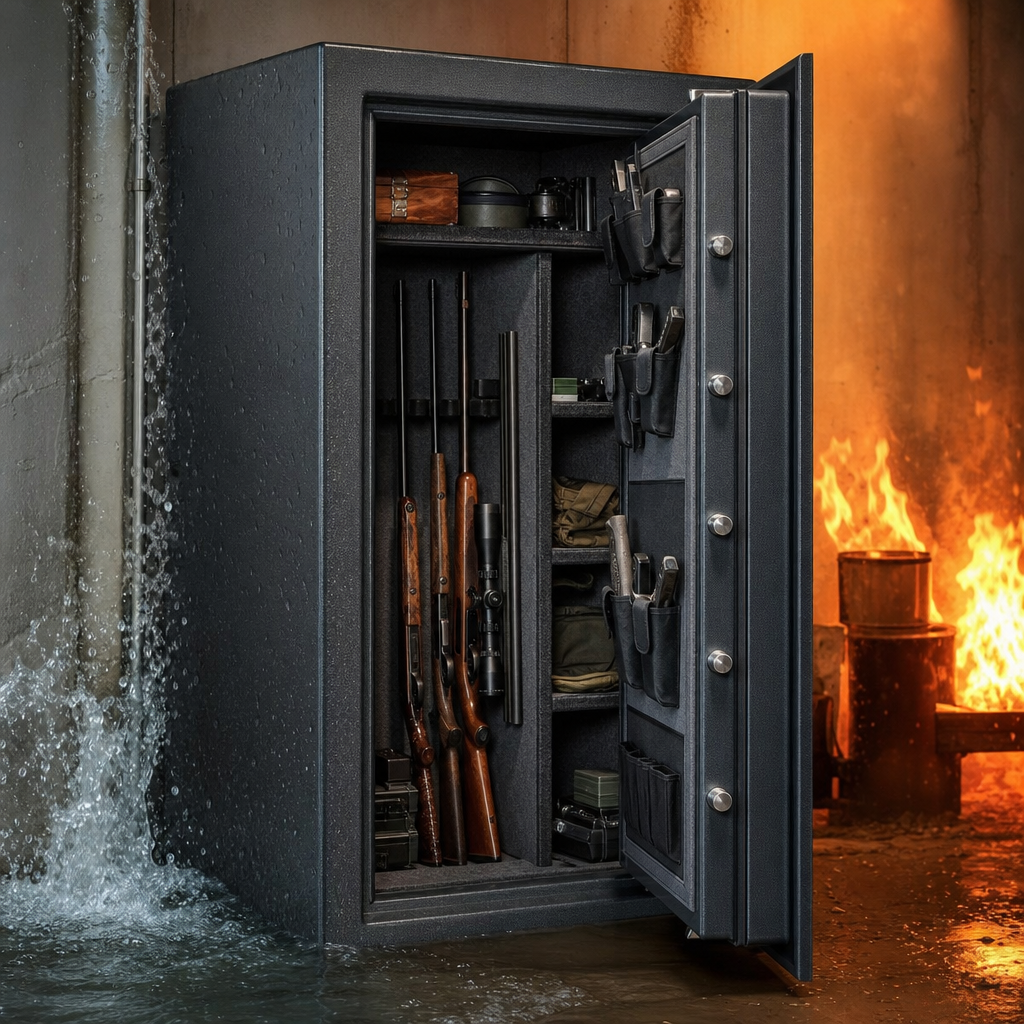
Choosing the best waterproof and fireproof gun safes on the market starts with understanding what those labels really mean, how manufacturers test them, and which models protect firearms when a house fire, burst pipe, hurricane, or basement flood turns a storage mistake into a total loss. In the gun safes and safety category, disaster-resistant storage is the part many buyers underestimate because burglary usually gets the attention, yet fire, smoke, steam, and water from sprinklers or fire hoses destroy guns, optics, documents, and ammunition far more often than most first-time safe shoppers expect. A waterproof gun safe is designed to limit water intrusion for a stated depth and duration, while a fireproof gun safe is built to keep the interior below a target temperature for a specified time during a controlled burn test. Those details matter because paper chars around 451 degrees Fahrenheit, wood stocks warp under heat and moisture, optics fail when seals are compromised, and corrosion can begin quickly after even brief exposure to humidity or dirty water. I have evaluated safes after residential fires and storm losses, and the pattern is consistent: buyers who focused only on steel gauge or capacity often lost everything inside, while those who paid attention to fire ratings, door seals, insulation type, anchor methods, and placement usually had recoverable firearms and documents. This hub article covers the full landscape of fireproof and disaster-resistant storage, from test standards and construction details to leading models worth considering, common buying mistakes, and practical setup advice. If you want one page that explains which safes are best for fire, water, and all-around disaster protection, this is the starting point.
What makes a gun safe truly fireproof and waterproof
No gun safe is invincible, and that is the first point serious buyers need to understand. The strongest products are more accurately described as fire-resistant and water-resistant to a tested level, not magically immune to every disaster. Fire ratings usually specify the number of minutes the safe can maintain an internal temperature below a threshold, often 350 degrees Fahrenheit for paper protection, under an external temperature such as 1200 or 1400 degrees. Better manufacturers disclose both figures. Water ratings usually describe submersion depth and duration, such as 2 feet for 7 days or 8 inches for 24 hours. That is useful, but only if the seal remains intact and the safe is properly bolted and level.
Construction explains why some safes perform much better than others. A true fire-lined gun safe typically uses multiple layers of gypsum board or a proprietary composite insulation inside a formed steel body. Palusol-style heat-expanding door seals are especially valuable because they swell during high heat and help block smoke and hot gases, which are often more damaging than open flame. Waterproof designs rely on compression gaskets around the door opening, raised thresholds, and tighter manufacturing tolerances. If a safe has gaps, exposed bolt paths, or poor weld consistency, marketing claims mean little in a real event.
Interior design also matters. Soft-lined shelves protect firearm finishes, but dehumidification matters more over time. After a flood or fire suppression event, even a safe that kept out most water can trap humidity inside. That is why many experienced owners pair a disaster-rated safe with a GoldenRod dehumidifier, rechargeable desiccants, and silicone-treated gun socks. The safe protects during the event; moisture control prevents the slow damage that follows.
How to judge ratings, testing, and build quality
The safest buying approach is to separate verified data from broad advertising language. Independent testing by UL, ETL, or Intertek carries more weight than a brand saying a safe is “factory tested.” UL 72 is a recognized benchmark for record protection, though many gun safes are not fully certified to it because certification is expensive. That does not automatically disqualify a product, but it means the buyer should ask what protocol was used, whether sensors measured internal temperature, and whether the safe was tested in a heated chamber, direct burn, or both. A safe that survives a 30-minute oven exposure is not equivalent to one that survives a one-hour external fire followed by impact and cooldown.
Steel thickness should be viewed alongside fire design. Heavy steel slows forced entry, but insulation and door geometry determine thermal performance. Many quality residential gun safes use 12-gauge or 11-gauge bodies, with 10-gauge or thicker appearing in premium models. Doors are usually more robust than bodies. Continuous welds, reinforced hinges, drill-resistant hard plates, and robust boltwork improve both security and survivability because fire can warp weaker frames and compromise alignment. Weight is often a helpful signal. In my experience, disaster-resistant safes that feel unusually light for their size usually achieve that weight savings by reducing steel, insulation, or both.
| Feature | What to look for | Why it matters in a disaster |
|---|---|---|
| Fire rating | 60 to 120 minutes at a stated external temperature | Longer, clearer ratings improve survival in whole-room fires |
| Water rating | Depth and duration, such as 2 feet for 7 days | Indicates protection from flooding, sprinkler discharge, and storm water |
| Door seal | Heat-expanding seal plus compression gasket | Blocks smoke, steam, and water intrusion |
| Steel body | 11-gauge or thicker for many full-size models | Improves rigidity, pry resistance, and door alignment under heat |
| Lock type | UL-listed electronic or mechanical lock | Reliable access before and after a stress event |
| Anchoring | Bolted to concrete with sealed anchor points | Reduces tipping, shifting, and water-path exposure |
Best waterproof and fireproof gun safes on the market
For buyers who want strong all-around disaster protection, several models consistently stand out. The Liberty Colonial and Liberty Fatboy lines remain popular because they combine credible fire ratings, expanding door seals, organized interiors, and a large dealer network for service. Higher in the Liberty lineup, the Franklin and Presidential models add longer fire endurance, thicker steel, and upgraded boltwork, making them stronger choices for larger collections and expensive optics. Browning’s ProSteel safes are also worth serious consideration, especially models with DPX door storage and broad interior adjustability. Browning typically does a good job balancing storage efficiency with respectable fire resistance, which matters if you need room for scoped rifles without turning the interior into a tight puzzle.
Sports Afield’s Preserve series deserves attention for shoppers who prioritize a stated waterproof rating. Several Preserve models are marketed with 40 minutes of fire protection at 1200 degrees and waterproofing for 7 days in up to 2 feet of water. That combination is particularly relevant for homes with finished basements, coastal weather risk, or slab-level installation near garage entries where storm runoff can accumulate. Cannon’s Safari and Commander series have also remained competitive, with broad availability at major retailers and useful feature sets for mid-range budgets, though buyers should compare exact specifications because ratings vary widely by model.
At the premium end, Fort Knox, Rhino Metals, and American Security offer some of the strongest construction in the category. Fort Knox is well known for customization, heavier steel upgrades, and tight build quality. Rhino’s Ironworks and Kodiak lines appeal to different buyers, but the stronger Rhino models combine good insulation strategy with robust bodies and attractive fit and finish. American Security, often shortened to AMSEC, is especially respected because its BF series uses a composite construction approach that has long earned praise in the safe industry. While not every AMSEC model is fully waterproof, the BF line is among the most credible choices if fire protection and burglary resistance are both top priorities.
Choosing the right safe for your home, climate, and gun collection
The best safe for one household can be the wrong purchase for another because disaster risk is local. In wildfire regions, long fire duration and robust smoke sealing matter more than deep-water submersion. In hurricane zones, waterproof performance, corrosion prevention, and elevated placement become equally important. In northern climates with finished basements, sump failures and pipe bursts are common, so a waterproof safe on a raised concrete pad is often smarter than a heavier but non-sealed model placed directly on the floor. I usually recommend buyers start with three variables: total firearm count including optics, local disaster profile, and where the safe will physically sit.
Capacity numbers deserve skepticism. A “24-gun” safe rarely stores 24 modern long guns with scopes, slings, bipods, and chassis stocks in a practical way. Realistic capacity is often 50 to 70 percent of the stated number if you want organized access. If you own AR-platform rifles, precision rifles, or shotguns with large optics, prioritize interior depth and flexible shelving over nominal count. Door organizers can free up shelf space for handguns, magazines, suppressor accessories where legal, and documents. For mixed-use households, a safe that can protect passports, hard drives, tax records, jewelry, and emergency cash adds more value than a firearms-only layout.
Lock choice is another practical decision. Electronic locks offer quick access and multiple user codes, but quality matters. Sargent and Greenleaf and SecuRam are widely trusted names. Mechanical dials are slower but remain reliable over decades with minimal maintenance. For a primary household safe, I often prefer a UL-listed electronic lock backed by a redundant key policy for auxiliary lockboxes, not for the main gun safe itself. Fast access is useful, but a large disaster-rated safe is usually intended for secure storage rather than defensive bedside use.
Installation, placement, and maintenance after purchase
Even the best waterproof and fireproof gun safe on the market can underperform if it is installed badly. Placement should balance concealment, structural support, humidity control, and disaster exposure. Ground-floor concrete is ideal for weight and anchoring, but direct basement placement increases flood risk unless the safe sits on a raised platform. Interior closets often perform better in fires than garages because garages can contain fuel loads, solvents, and vehicles that push temperatures higher. Exterior walls can expose the safe to hose streams, weather changes, and greater heat transfer depending on the fire path, so central interior locations often make more sense if structural support allows.
Anchoring is essential. A heavy safe can still tip during forced entry or shift during severe events. Use manufacturer-approved anchor points and quality concrete anchors, and seal around floor penetrations if waterproof performance is a priority. If the safe includes an electrical pass-through, inspect that area carefully because it can become a moisture pathway if poorly designed or modified. Once installed, add a hygrometer inside the safe. Humidity above about 50 percent for extended periods is a warning sign for rust, especially on blued steel firearms.
Maintenance is simple but not optional. Test the lock, inspect door seals, replace batteries on schedule for electronic locks, and refresh desiccants as needed. After any fire in the home, even if the safe was not directly exposed, inspect the exterior for heat damage and avoid forcing the door if warping is visible. After a flood, open the safe as soon as conditions are safe, document contents for insurance, and dry firearms immediately. Disaster-resistant storage works best when paired with an inventory list, serial number records, photos, and insurance coverage that specifically includes firearms and accessories.
The best waterproof and fireproof gun safes on the market are the ones that match real risks, not just showroom impressions. Buyers should focus on verified fire ratings, meaningful water resistance, strong door seals, reliable locks, solid anchoring, and realistic interior capacity. Brands such as Liberty, Browning, Sports Afield, AMSEC, Fort Knox, Rhino, and selected Cannon models all offer worthy options, but the right choice depends on whether your bigger threat is wildfire, basement flooding, hurricanes, or everyday humidity. Good disaster-resistant storage protects more than guns; it preserves documents, optics, heirlooms, and the records you need after a loss. Use this hub as your starting point, then compare model-specific specifications carefully, measure your space, and invest in the safe that protects your collection when conditions are at their worst.
Frequently Asked Questions
What does “waterproof” and “fireproof” really mean when shopping for a gun safe?
In the gun safe world, “waterproof” and “fireproof” are often shorthand terms, but neither means a safe is invincible under every possible disaster condition. Fire protection usually refers to a safe’s ability to keep the interior below a temperature threshold for a stated amount of time, such as 30, 60, 90, or 120 minutes, while exposed to high exterior heat. The key detail is not just the furnace temperature in the test, but how hot the inside of the safe gets and how long it stays there. Firearms, documents, optics, ammunition, and electronic accessories can all be damaged at different temperatures, so a safe with a stronger fire rating generally offers broader protection during a house fire.
“Waterproof” can be even more nuanced. Some safes are designed to resist water intrusion from standing floodwater for a specific depth and duration, while others are better described as water-resistant against spray, splashing, sprinkler systems, or brief exposure during firefighting efforts. A waterproof rating may indicate that the safe can remain in several inches or even feet of water for a number of hours or days, but that does not necessarily mean it is intended for full submersion in fast-moving flood conditions. Door seals, body seams, lock openings, and cable pass-throughs all affect real-world water performance.
The bottom line is that buyers should look beyond the marketing words on the box. The most useful labels are the ones backed by clear test standards, specific temperature and time ratings, and transparent claims about flood depth or duration. If a manufacturer only says “fireproof” or “waterproof” without giving details, that is a sign to dig deeper before trusting the safe with valuable firearms and gear.
How are fire and water ratings tested, and which certifications matter most?
Not all testing is created equal, and this is where smart buyers separate meaningful protection from pure advertising. For fire protection, one of the most trusted benchmarks is third-party testing by organizations such as UL. A UL fire rating typically involves controlled testing that measures how long a safe can protect its contents while exposed to a specified external temperature. Some tests also evaluate impact resistance, which matters because a safe may fall through a weakened floor during a fire. A safe that survives heat in a lab but fails after a drop may not perform as well in an actual home fire.
Manufacturers may also use independent labs or internal testing. That does not automatically mean the rating is useless, but it does mean buyers should read carefully. Ask what temperature was used, how long the safe was exposed, what maximum interior temperature was allowed, and whether the rating applies to paper, firearms, or other contents. The more specific the answers, the more confidence you can have in the safe’s real performance.
For water protection, there is less standardization across the industry, so the details matter even more. A reputable manufacturer may state that the safe was tested for water resistance at a certain depth for a defined period, such as 2 feet of water for 72 hours. That is far more informative than a vague “waterproof seal” claim. Also pay attention to whether the safe is tested against standing water, spray, or total submersion, because those are very different scenarios. If you live in a flood-prone area, basement environment, or hurricane zone, these distinctions are especially important.
In practice, the best approach is to prioritize safes with transparent, well-documented ratings and established brand credibility. A trusted name with clear specifications and third-party validation is usually a safer bet than a cheaper model making broad promises with no supporting data.
What fire and water protection levels should most gun owners look for in a home safe?
The right protection level depends on where you live, where the safe will be installed, and what you are storing inside. For many homeowners, a fire rating of at least 60 minutes is a strong starting point, especially if the safe is going in an attached garage, main floor, or interior room. In larger homes, rural areas with longer emergency response times, or locations where wildfire risk is a concern, stepping up to 90 or 120 minutes can be a wise investment. More fire protection generally means more insulation, heavier construction, and a higher price, but it can also make the difference between recoverable firearms and a complete loss.
On the water side, think in terms of your actual risks. If your main concern is sprinkler discharge, fire hose runoff, or a burst pipe, a safe with strong door seals and water-resistant construction may be sufficient. If the safe will be stored in a basement, near ground level, or in a region affected by hurricanes or seasonal flooding, look for a model with a clearly stated flood rating, including depth and duration. A safe rated to withstand several inches or feet of standing water for 24 to 72 hours offers much more meaningful protection than one that simply claims to resist moisture.
It is also smart to consider what else will live inside the safe. Scopes, red dots, suppressor paperwork, passports, cash, and digital media can all be more vulnerable than the firearms themselves. Adding moisture control products, protective sleeves, and document pouches can complement the safe’s disaster resistance. In other words, choose the safe based not just on the guns, but on the full value and sensitivity of everything you plan to protect.
Which features should I compare when choosing among the best waterproof and fireproof gun safes on the market?
Start with the core protection specs: verified fire rating, stated water resistance or waterproof depth and duration, steel thickness, door construction, and locking system. These are the foundation of the safe’s ability to protect your firearms during both disasters and theft attempts. A safe with impressive fire insulation but weak steel and a flimsy door may keep contents cooler during a fire yet still fall short as a security product. The best models balance disaster resistance with real anti-theft strength.
Next, look closely at the door seal design. Expanding heat seals are common for fire protection, while compression-style gaskets and recessed door frames can help resist water intrusion. The way the door closes and the consistency of the seal around the perimeter are more important than marketing language alone. Boltwork design, hinge protection, relockers, and drill-resistant hard plates are also worth comparing if burglary resistance matters, which it usually does.
Interior design deserves more attention than many buyers give it. Adjustable shelving, rifle barrel supports, door organizers, and soft-lined interiors can improve storage efficiency and help protect optics and finishes. If you store long guns with scopes or accessories, the safe’s usable interior space matters more than the advertised gun count, which is almost always optimistic. Also check for power outlets, lighting, and dehumidifier compatibility, but remember that any electrical pass-through should be designed in a way that does not compromise water resistance.
Finally, consider weight, footprint, and installation. A heavy safe with better insulation and thicker steel generally offers better performance, but it must be practical for your floor structure and entry path. Bolt-down capability is important for theft prevention, though buyers in flood zones should also think carefully about placement and anchoring strategy. A well-chosen safe is not just one with strong ratings on paper, but one that fits your home, your risk level, and the way you actually store and access your firearms.
Can a waterproof and fireproof gun safe completely protect firearms after a house fire or flood, and what should owners do afterward?
No safe can guarantee perfect outcomes in every disaster, but a high-quality waterproof and fireproof gun safe can dramatically improve the odds that your firearms and valuables survive with limited or manageable damage. In a fire, the safe may protect against direct heat long enough for firefighters to control the blaze, but extended burn times, structural collapse, or extreme temperatures can still overwhelm lower-rated models. In a flood, a safe may keep out standing water for the rated period, yet prolonged submersion, debris impact, contaminated water, or improper door sealing can still create problems.
After any fire or water event, owners should open the safe carefully and inspect contents as soon as it is safe to do so. Even if liquid water did not enter, humidity, condensation, smoke residue, or chemical contaminants from firefighting efforts can affect blued steel, wood stocks, optics, and ammunition. Wipe down firearms, inspect for rust or soot, and arrange professional cleaning if needed. If the safe was exposed to floodwater, remember that the water may contain corrosive or hazardous contaminants, so use gloves and proceed cautiously.
It is also important to document everything for insurance purposes. Take photos of the safe, the room, and the contents before extensive cleanup. Save model information, serial numbers, receipts, and any manufacturer literature that describes the safe’s fire or water rating. If the safe appears to have failed under conditions within its stated rating, contact the manufacturer as well as your insurer. Some brands offer warranties tied to fire events, though terms vary widely.
The most realistic way to think about these safes is as a critical layer of risk reduction, not absolute immunity. A well-made safe, properly installed in a smart location and supported with humidity control and good maintenance habits, can make a huge difference when disaster strikes. That is exactly why waterproof and