
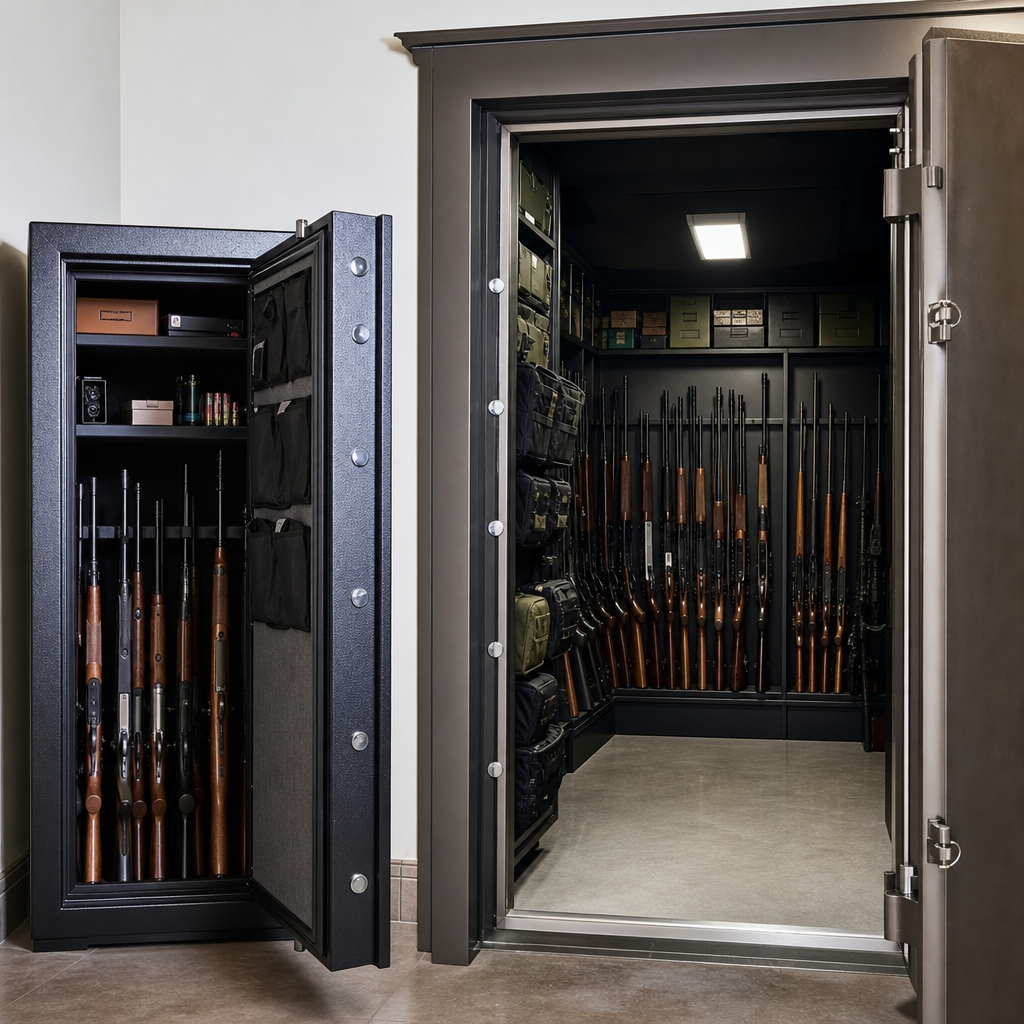
Choosing between fireproof gun safes and vault rooms is not just a budget decision; it is a risk-management decision that affects firearm security, fire survival, insurance outcomes, and daily access. In practical terms, a fireproof gun safe is a reinforced container engineered to resist burglary and slow heat transfer during a fire, while a vault room is a hardened, walk-in space built into or added to a home for large-scale secure storage. Both can protect firearms, ammunition, documents, optics, and other valuables, but they solve different problems in different ways.
Fireproof and disaster-resistant storage matters because most firearm losses do not happen in dramatic movie-style break-ins. They happen through ordinary residential theft, house fires, water damage from sprinklers or firefighting, and preventable corrosion after exposure to heat and humidity. I have seen buyers focus almost entirely on steel thickness or lock type while ignoring fire ratings, anchoring, room placement, and post-fire recovery. That is backward. A safe that survives a pry attack but fails after forty minutes of heat, or a vault room that resists intrusion but floods during a storm, is not a complete protection strategy.
This hub article explains the core tradeoffs so you can choose the right storage approach and plan the rest of your disaster-resistant setup. We will cover how fire ratings work, where manufacturer claims can mislead, how construction differences affect burglary resistance, what water and smoke do after the flames are out, and when a vault room genuinely outperforms a premium safe. If you are comparing options for a few rifles in a suburban home, a serious collection with optics and suppressors, or a mixed-use secure room for guns and records, the goal is simple: match the storage system to your threat profile, property layout, and long-term ownership needs.
What Fireproof Really Means for Gun Storage
“Fireproof” is convenient marketing language, but no residential gun container is literally proof against all fire conditions. The real question is how long the interior stays below damaging temperatures during a defined heat exposure. Gun safes typically use gypsum-based fireboard, ceramic wool, expanding door seals, and layered steel shells to slow heat transfer. Vault rooms use insulated wall assemblies, concrete, steel liners, and vault doors, but performance depends heavily on how the room was built, not just on the door brand.
For firearms, heat can damage stocks, optics, lubricants, polymer components, and finishes well before steel parts structurally fail. Paper documents begin charring around 350 degrees Fahrenheit, which is why many document safes aim to stay below that threshold. Firearms may tolerate higher temperatures than paper, but that does not mean they emerge unharmed. In actual fire losses, smoke residues, moisture, and corrosive byproducts often create the most expensive restoration work. That is why the best disaster-resistant gun storage should be evaluated as a system, not as a single sticker on the door.
Independent fire testing matters. Standards such as UL 72 are stronger signals than vague claims like “tested at manufacturer facility” or “120 minutes at 1800°F” without test details. Many gun safe brands publish internal testing protocols that are useful but not equivalent to a third-party certification. A serious buyer should ask three direct questions: Who performed the fire test, what interior temperature threshold was used, and was the unit tested as a complete product with the same door seals, insulation package, and hardware sold to consumers? Clear answers separate engineering from marketing.
Security Against Theft and Forced Entry
Burglary resistance is where the gap between entry-level fireproof gun safes and properly built vault rooms can widen quickly. A common residential gun safe uses formed steel bodies in the 12-gauge to 10-gauge range, heavier plate on the door, active locking bolts, relockers, and a mechanical or electronic lock. That can defeat smash-and-grab theft, especially when the safe is anchored into concrete. It is much less impressive if thieves have time, privacy, and cordless cutting tools. In my experience, many residential burglaries end before a quality anchored safe is breached, but unanchored safes are routinely tipped, dragged, or removed.
A vault room changes the attack surface. Instead of defeating a box, a thief must defeat the door or penetrate walls, ceiling, or floor. If the room is built with reinforced concrete or concrete masonry units filled and grouted with rebar, the labor and noise required rise substantially. However, many so-called vault rooms are simply closets with a vault door installed. Those are not true hardened rooms. Drywall over wood studs with a premium vault door is still a stud wall. The door can be excellent while the surrounding structure remains vulnerable.
Lock choice also matters. Group 2 mechanical locks have a long track record for reliability. Modern electronic locks are faster and often support multiple users, audit features, and time delay, but they depend on battery maintenance and quality electronics. On both safes and vault rooms, redundant relocking devices, hard plates, and protected lock bodies improve resistance to drilling and punching. The best setup is not just harder to attack; it is slower, louder, and more visible to attack.
| Feature | Fireproof Gun Safe | Vault Room |
|---|---|---|
| Typical use case | Small to mid-size firearm collections | Large collections or mixed valuables storage |
| Theft resistance | Good when anchored and well built | Excellent if walls, ceiling, and door are hardened |
| Fire protection | Depends on insulation and test standard | Can be superior, but only with correct build materials |
| Water resistance | Limited unless seals are designed for it | Depends on room location, drainage, and door threshold |
| Installation | Delivered and anchored | Construction project requiring design coordination |
| Cost range | Lower upfront cost | Higher initial cost, broader long-term utility |
How Fire Ratings, Smoke, and Water Affect Real-World Protection
A posted fire rating is useful only when you understand the scenario behind it. House fires are not uniform. Fuel load, ventilation, room flashover, response time, and where the safe sits in the structure all influence survival. A safe in a garage can face different heat dynamics than one on a slab in a central interior room. A vault room in a basement may avoid direct flame longer, yet become vulnerable to water intrusion from hoses, broken pipes, or storm runoff. The best-performing fire storage can still lose contents after the fire if moisture remains trapped inside.
Smoke is a major issue for firearms. Combustion byproducts can settle inside actions, under grips, into optics housings, and onto ammunition packaging. After fire exposure, I advise opening the storage only when conditions are safe, documenting contents for insurance, and starting controlled drying and decontamination quickly. Desiccants, rechargeable dehumidifiers, and powered goldenrod-style heaters help in normal conditions, but after a fire they are recovery tools, not prevention tools. Prevention comes from layered seals, room placement, and keeping contents organized in breathable, non-moisture-trapping arrangements.
Water resistance deserves more attention than it gets. Firefighting operations can dump large volumes of water into a structure in minutes. Some premium gun safes include expanding heat seals that help during fire, but they are not the same as flood seals. Vault rooms can be built with raised thresholds, floor drains, waterproof membranes, and sump strategies, yet those features are often left out to save money. If you live in a hurricane, wildfire, tornado, or flood-prone area, disaster-resistant storage must be matched to the hazards that actually exist where you live.
Capacity, Access, and Daily Use
One reason owners graduate from safes to vault rooms is simple: published gun counts on safe brochures are optimistic. A “24-gun safe” may hold far fewer once you account for scoped rifles, slings, bipods, soft cases, pistols on door organizers, and separate storage for suppressors, magazines, and documents. Safe interiors also become crowded in ways that increase the risk of stock dings, optic contact, and awkward access. For households with frequent range use, hunting seasons, or multiple authorized users, access friction matters more than buyers expect.
A vault room offers easier organization. Long guns can be spaced properly, ammunition can be shelved by caliber, and accessories can be stored without stacking everything vertically. That matters for safety as much as convenience. Clear inventory visibility reduces the chance of overlooked rust, duplicate purchases, or unsecured items left outside because the safe is full. A room also supports lighting, climate control, camera coverage, and workspace surfaces. Those features sound secondary until you have tried to inspect optics batteries or serial numbers while crouched in front of an overstuffed safe.
That said, safes are usually faster and cheaper to deploy. A quality safe can be installed in a day, bolted down, and placed where family access control is easiest. For many owners, especially in standard suburban homes, that practicality outweighs the benefits of a dedicated room. Quick-access handgun safes can then handle defensive firearms separately, leaving the main safe for long guns and valuables. In other words, choosing a fireproof gun safe does not mean accepting a weak system; it means building a layered system scaled to your home and routine.
Installation, Cost, and Property Considerations
Cost comparisons can be misleading because buyers often compare a midrange gun safe with a fully finished vault room. A better comparison is premium safe versus properly engineered room. A good fire-rated safe may cost a few thousand dollars, plus delivery, stair carry if needed, anchoring, and possible floor reinforcement. Brands such as Liberty, Fort Knox, AMSEC, Browning, and Rhino span a wide range of construction levels, and the differences inside those catalogs are substantial. Steel gauge, door construction, lock protection, and actual fire certification all move the needle more than glossy interiors.
Vault rooms bring design and construction costs that depend on whether they are planned during new construction or retrofitted later. New builds have the advantage because concrete, rebar, ventilation, electrical runs, and door rough openings can be specified from the start. Retrofitting often means structural review, demolition, moisture control, and permit coordination. The hidden cost many people miss is opportunity cost: a vault room consumes square footage that could otherwise serve as living space. In high-cost real estate markets, that matters.
There can also be resale implications. A safe usually moves with the owner or can be negotiated in a sale. A vault room is part of the house. Some buyers see that as a premium feature; others see a strange bunker they must repurpose. Insurance carriers may also treat the two options differently. Before committing, ask your insurer whether documented fire ratings, central station alarms, monitored smoke detection, or inventory records reduce premiums or improve claim handling. Good records often matter more than owners realize when proving post-loss value.
Which Option Offers Better Protection?
The honest answer is that vault rooms offer better total protection only when they are truly engineered as hardened, climate-managed, disaster-aware spaces. A real vault room with reinforced walls, a rated vault door, humidity control, smoke detection, backup power for monitoring, and sensible placement inside the structure can outperform even a high-end fireproof gun safe in theft resistance, organization, and long-duration resilience. But a “vault room” that is just a standard closet with a heavy door may offer worse real protection than a premium anchored safe with verified fire performance.
For most firearm owners, the best value comes from a high-quality fireproof gun safe installed correctly in a low-risk location, paired with environmental controls and good documentation. Anchor it to concrete, keep it off damp surfaces with a barrier or riser, use dehumidification, avoid overloading, and maintain an updated inventory with photographs and serial numbers stored securely offsite. Add whole-home smoke alarms, monitored security, and if possible, residential sprinklers. Those measures improve outcomes regardless of whether the storage is a safe or a room.
If your collection is large, highly valuable, or includes transferable items, heirlooms, or business inventory, a purpose-built vault room deserves serious consideration. The tipping point is not ego or aesthetics. It is when storage volume, access frequency, and risk exposure justify construction. Start with your threats: burglary time, wildfire risk, flood history, response times, occupancy patterns, and household access needs. Then buy the strongest system you can support properly. Better protection comes from matching the solution to the hazards, not from choosing the bigger object.
Fireproof gun safes and vault rooms both play important roles in firearm protection, but they are not interchangeable by default. Safes excel at practical, lower-cost deployment and can provide strong fire and theft resistance when independently tested, properly anchored, and managed for humidity. Vault rooms excel when they are genuinely hardened spaces designed around security, fire performance, water control, and usable organization. The key takeaway is simple: labels do not protect firearms; construction quality, installation, and planning do.
As the hub for fireproof and disaster-resistant storage, this topic should guide every related buying decision you make, from comparing fire ratings to planning flood mitigation, dehumidification, safe placement, and insurance documentation. If you are building a complete protection strategy, use this article as your starting point, then map your specific risks and budget before purchasing. A well-chosen system protects more than guns. It protects access, value, history, and peace of mind. Review your current setup today and decide whether a better safe, a real vault room, or a layered combination is the right next step for your home.
Frequently Asked Questions
What is the main difference between a fireproof gun safe and a vault room?
The biggest difference is scale, construction, and how each system manages risk. A fireproof gun safe is a self-contained, reinforced security container designed to protect firearms and other valuables from theft and high temperatures for a limited period of time. Most quality safes combine thick steel, internal locking bolts, relockers, and fire-insulating materials to slow heat transfer during a house fire. They are typically rated by burglary resistance, fire endurance, lock type, and storage capacity. For many homeowners, a safe is the most practical way to secure a moderate number of firearms without altering the structure of the home.
A vault room, by contrast, is a hardened walk-in space built into a basement, closet, garage, or interior room. Instead of protecting contents inside a steel box, it turns part of the home into a secure enclosure with reinforced walls, a specialized vault door, and often upgraded concrete, steel, or ballistic materials. Vault rooms are usually chosen by owners with larger collections, multi-purpose storage needs, or a desire for easier walk-in access to firearms, ammunition, important documents, optics, jewelry, and emergency supplies. In simple terms, a gun safe is a product you install, while a vault room is a security structure you build.
That difference matters because each option solves different problems. A safe is faster to buy, easier to place, and generally less expensive upfront. A vault room offers more interior space, potentially stronger perimeter protection if well built, and better organization for large collections. The better choice depends on the level of theft risk, expected fire exposure, available square footage, insurance requirements, and how often you need access to stored items.
Which offers better fire protection for firearms and valuables: a fireproof gun safe or a vault room?
Neither option is automatically better in every fire scenario, because fire protection depends heavily on design quality, installation, and the severity and duration of the fire. A good fireproof gun safe is engineered specifically to slow internal temperature rise. Manufacturers often test safes for a certain number of minutes at a specified external temperature, such as 30, 60, 90, or 120 minutes. That rating can be very useful when comparing models, especially if the safe uses expanding door seals, layered insulation, and a tight body-to-door fit. For many homeowners facing a typical residential fire response window, a well-rated safe can provide meaningful protection for firearms, documents, and some accessories.
A vault room can outperform a safe in a prolonged fire, but only if it is built with true fire-resistant materials and not just security materials. Reinforced concrete, masonry, and properly detailed fire-resistant wall assemblies can create a very durable envelope, and a high-quality vault door can add another layer of protection. However, not every vault room is designed with tested fire performance in mind. Some are built primarily for burglary resistance, with fire protection treated as secondary. That means a poorly designed vault room may offer less predictable fire performance than a tested safe from a reputable manufacturer.
There is also an important content issue: firearms may survive conditions that can still damage optics, stocks, paperwork, electronics, and certain ammunition components. Documents and digital media are even more vulnerable to heat and humidity than metal firearms. So the best fire solution is often not just “safe versus vault room,” but how the interior is configured. In practice, many owners use a vault room for overall security and add rated document chests, dehumidification, and specialty storage inside it. If your primary concern is validated fire resistance in a compact package, a quality fire-rated safe is often easier to evaluate. If you want broad, whole-room protection for a large collection and are willing to invest in proper fire-resistive construction, a vault room can be the superior long-term solution.
Which option provides better burglary protection and security against unauthorized access?
Burglary protection depends less on the label and more on the quality of the build, lock system, anchoring, and surrounding environment. A fireproof gun safe can offer excellent protection when it is made from heavy-gauge steel, equipped with a reliable lock, reinforced against pry attacks, and securely anchored to concrete. One of the most overlooked issues with safes is removal risk. A thief may not defeat the safe onsite if they can tip it, move it, and attack it later. That is why anchoring, concealed placement, and limiting visibility are just as important as door thickness and bolt count.
A vault room can provide stronger perimeter defense because the entire room becomes the secure boundary, especially if the walls, ceiling, and door assembly are reinforced to resist forced entry. It is much harder to carry away a room than a safe, and a properly constructed vault room can offer more resistance to pry tools, cutting attempts, and smash-and-grab theft. However, the key phrase is “properly constructed.” A vault room with standard framing hidden behind decorative finishes may give a false sense of security if the walls can be breached more easily than the door. In many weak vault-room designs, the door is excellent but the adjacent wall assembly is the real point of failure.
For unauthorized access by children, guests, or service workers, both options can be highly effective if they use dependable locks and disciplined access control. Electronic locks offer speed and convenience, while mechanical locks are often valued for long-term simplicity. Some owners also prefer biometric access for rapid entry, though lock quality varies widely. If your top concern is preventing quick theft and casual access in a typical household, a premium anchored safe may be more than sufficient. If you face elevated burglary risk, own a large and valuable collection, or want layered home security integrated with alarms and surveillance, a hardened vault room may provide a better overall defensive posture.
Is a vault room worth the extra cost compared with buying a high-quality fireproof gun safe?
A vault room is worth the cost when your storage needs, risk profile, and long-term plans justify the investment. For many gun owners, a high-quality fireproof safe delivers the best balance of security, fire resistance, convenience, and price. It is usually far less expensive than designing and building a secure room, and it can still protect a meaningful collection if chosen carefully. Installation is faster, the buying process is simpler, and you can often compare products using published ratings and features. If you have a small to mid-sized collection and want strong protection without a major renovation, a safe is usually the more efficient use of money.
A vault room starts to make more financial sense when you need significantly more capacity, want to protect a broader mix of valuables, or plan to stay in the home long enough to benefit from the build-out. It can also be valuable if you want a multi-purpose secure space for firearms, documents, precious metals, family heirlooms, emergency gear, and related equipment. In that case, the cost is not just about storage volume but about creating a dedicated security environment that can be easier to organize and use every day. For collectors who would otherwise need multiple premium safes, a vault room may compare more favorably than it first appears.
There are also indirect cost factors. Insurance carriers may view professionally installed security solutions more favorably, though requirements and discounts vary. A better security setup can reduce loss exposure, simplify documentation, and improve compliance with policy terms. On the other hand, a custom vault room can involve engineering, permits, HVAC considerations, humidity control, electrical work, and finish carpentry. So the right question is not simply which one costs less, but which one gives you the best risk-adjusted value. If your collection is growing and your security goals extend beyond basic storage, the extra cost of a vault room may be justified. If not, a premium safe often delivers excellent protection at a much lower entry point.
How should homeowners decide between a fireproof gun safe and a vault room for daily use, insurance, and long-term protection?
The smartest way to decide is to treat the purchase as a risk-management decision rather than a simple product comparison. Start with the size and value of your collection, including firearms, ammunition, optics, suppressors where lawful, documents, and other valuables you may store together. Then consider your actual threat profile: burglary rates in your area, whether the home is occupied during the day, how visible your collection may be to outsiders, and how quickly firefighters typically respond in your location. A person with a modest collection in a suburban home may arrive at a very different answer than a serious collector in a rural area with longer emergency response times.
Next, think about daily access and usability. A safe works well when you need compact, controlled storage and can tolerate tighter interior space. A vault room is often more comfortable for people who access items frequently, maintain a large inventory, or want better shelving, work surfaces, and organization. Ease of access matters because security systems are only effective if people actually use them consistently. If a storage setup is frustrating, overcrowded, or too slow for your routine, it may encourage poor habits over time.
Insurance and documentation should also be part of the decision. Review your homeowners policy, any firearms riders, and any collection-specific coverage to see what storage standards are expected or rewarded. Ask whether the insurer cares about lock type, burglary rating, fire rating, alarm integration, inventory records, or photographic documentation. In some cases, the best protection strategy is layered: a monitored alarm system, discreet