
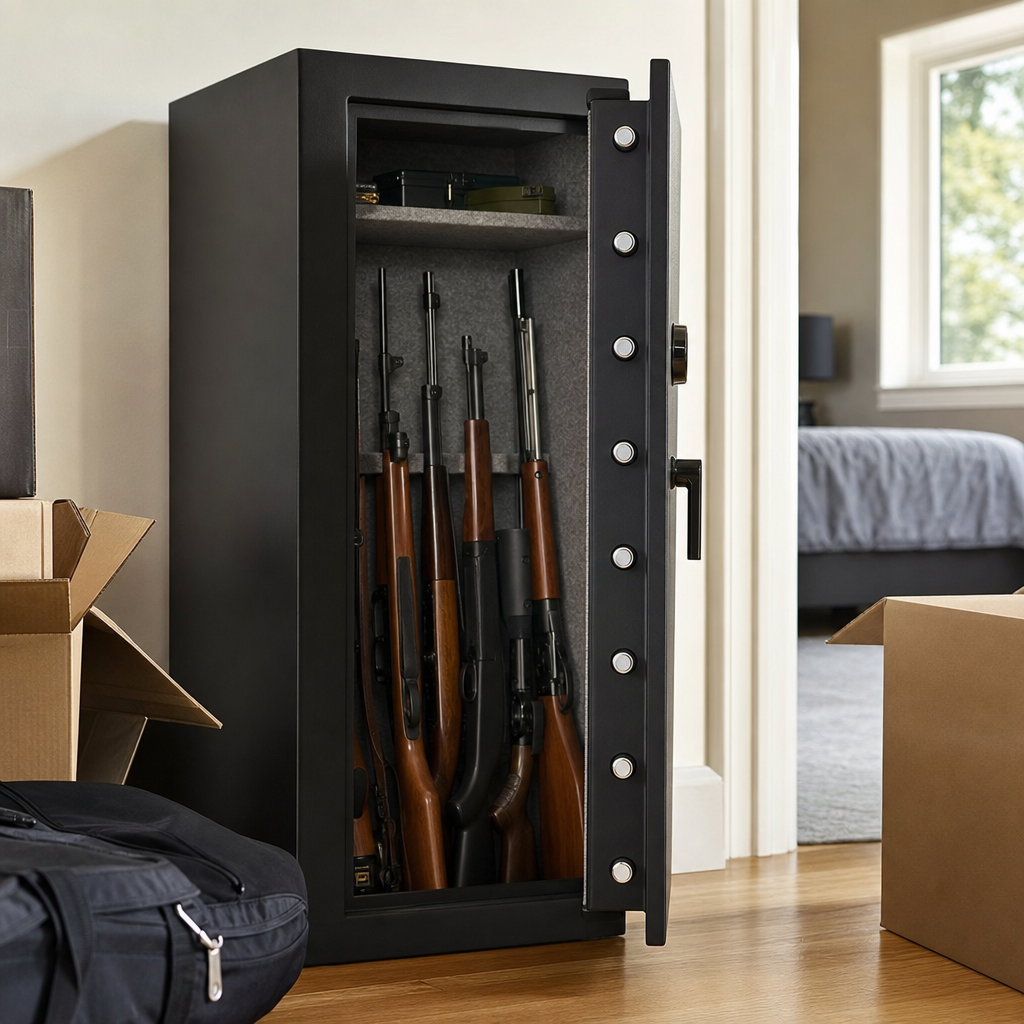
Choosing a gun safe when you move frequently requires a different mindset than buying one for a forever home. Portability, reinstallation, legal compliance, and realistic theft resistance matter as much as storage capacity. In practical terms, a safe for frequent movers must protect firearms from unauthorized access, fire, moisture, and casual theft without becoming a nightmare to transport through stairwells, rental units, and changing floor plans. The wrong purchase can leave you paying movers extra, damaging floors, violating a lease, or settling for a box too weak to secure your collection properly.
This topic sits at the center of gun safe buyer personas because mobility changes every buying decision. A military family on three-year relocations, a traveling competitive shooter, a renter in urban apartments, and a homeowner who upgrades houses every few years all need different safe features, even if they own similar firearms. Buyer persona simply means the real-world profile that shapes what you need: how often you move, how many guns you own, whether you rent or own, your budget, your risk tolerance, and how quickly you need access. I have helped buyers compare safes before interstate moves, and the biggest mistake is assuming a heavier safe is always better. Weight improves security, but frequent relocation adds costs, hazards, and compromises that should be planned upfront.
If you move often, your best option is usually not the largest residential gun safe on the showroom floor. It is a right-sized, purpose-built solution: sometimes a modular gun safe, sometimes a compact RSC-rated safe, sometimes a heavy-duty lockable cabinet paired with separate insurance and discreet placement. Understanding the tradeoffs lets you buy once, move smarter, and keep your firearms secured wherever you live next.
Start With the Right Buyer Persona
The best gun safe for frequent movers depends first on who you are as a gun owner. In my experience, four common personas drive most purchase decisions. The first is the renter who owns a few handguns and one or two long guns, lives in apartments, and cannot bolt a thousand-pound safe into concrete. The second is the military or corporate relocation household that changes states every few years and needs repeatable installation in garages, closets, or spare rooms. The third is the enthusiast or competitive shooter with a growing collection who needs stronger organization and humidity control but still wants manageable moving costs. The fourth is the road-heavy user who splits time between home and travel, often needing separate storage for documents, ammunition, and pistols.
These personas matter because they change the acceptable balance between security and portability. A renter may prioritize a compact 200 to 400 pound safe that can be anchored where permitted. A repeat mover with six to ten rifles may benefit more from a modular safe that ships in panels and assembles on site. A collector with dozens of firearms may need one anchored main safe at a long-term property and a secondary travel-ready safe for temporary residences. Before comparing brands, define your persona in plain language: number of firearms, frequency of moves, current and future housing type, whether children are present, and whether your move will be DIY or handled by insured safe movers.
Answering that question narrows the field fast. If you move every one to three years, avoid oversized “buy for life” models unless you are ready to pay specialty movers repeatedly. If you rent upstairs units, focus on compact dimensions, panel construction, and floor load. If your collection is expanding, buy for your three-year inventory, not your current count. Gun safe buyer personas are useful because they turn an emotional purchase into an operational decision.
What Safe Types Work Best for Frequent Movers
For most frequent movers, three safe categories deserve serious attention: compact traditional safes, modular gun safes, and security cabinets. Compact traditional safes are welded units, often between 200 and 600 pounds, with locking bolts, pry-resistant doors, and some fire lining. Good examples come from brands such as Fort Knox, Liberty, and American Security, though exact fit depends on model tier rather than logo alone. These units provide a better theft-delay profile than cabinets, but once they get too large, each move becomes expensive and risky.
Modular gun safes are often the best answer for people who relocate regularly. Models from Zanotti Armor and Snapsafe assemble from panels, letting you carry pieces through narrow hallways, basements, and second floors, then bolt the structure together inside the room. This solves one of the biggest relocation problems: a traditional safe might fit your current house but not your next staircase. Properly assembled modular units can offer meaningful pry resistance and practical security while drastically reducing moving complexity.
Security cabinets, such as products in the Stack-On category, occupy the lowest security tier but still have a place for certain buyer personas. They can satisfy basic locked-storage needs and keep children or guests away from firearms, yet they are not equivalent to a safe. Thin steel cabinets are lighter, easier to move, and less expensive, but they are vulnerable to tools and forced entry. If you choose one, do it with open eyes, then compensate through concealment, anchoring, an alarm system, and insurance.
| Safe Type | Best For | Typical Weight | Main Advantage | Main Limitation |
|---|---|---|---|---|
| Compact traditional safe | Homeowners and renters with moderate collections | 200–600 lbs | Better theft resistance in one unit | Harder and costlier to move |
| Modular gun safe | Frequent movers, upstairs units, tight access homes | Panels vary; assembled often 300–700 lbs | Easy transport and room-to-room assembly | Fewer model choices and longer setup time |
| Security cabinet | Budget buyers with low-risk storage needs | 80–200 lbs | Low cost and easy relocation | Lower resistance to attack |
If you want a direct answer, buy a modular gun safe if you move often and need real firearm storage, buy a compact traditional safe if your moves are less frequent and you want stronger steel in one body, and buy a cabinet only if budget and portability clearly outweigh higher security needs.
How to Balance Security, Weight, and Installation
Security starts with understanding what ratings and construction details actually mean. Many gun safes sold to consumers fall into the Residential Security Container category under UL 1037 rather than true TL-rated burglary safes. That does not make them useless, but it does mean you should evaluate them honestly. Steel thickness matters. A 12-gauge body is meaningfully better than 14-gauge, and 10-gauge is better still. Door design, hard plate over the lock, relockers, and internal hinges or robust external hinge design all influence resistance to prying or drilling. Frequent movers should also ask a practical question: can this unit be anchored securely in each new location?
Anchoring is often more important than buyers realize. Even a decent compact safe can be tipped onto a dolly and removed if it is not anchored. In rental settings, anchoring may be limited by lease terms or floor type, so talk to the property manager before purchase. In houses, slab anchoring is usually ideal, while wood subfloors may require backing plates or lag placement into joists. I have seen buyers obsess over lock brand and ignore the fact that their safe sat loose in a first-floor closet.
Weight also affects safety during the move itself. A 700-pound safe can crack tile, overload weak floors, or injure movers if handled poorly. Check floor load assumptions, especially in older apartments and upper stories. Ask your moving company whether they transport safes, what their liability limits are, and whether they subcontract specialty work. For many households, the sweet spot is a safe large enough for current firearms plus 25 to 40 percent growth, yet still small enough for professional relocation without cranes, stair climbers, or structural drama.
Lock Types, Fire Protection, and Interior Planning
The lock should fit your routine, not just your preference. Mechanical dial locks remain durable and proven, with no batteries to fail during a move or storage period. Their downside is slower access and user error under stress. Electronic keypad locks are faster and convenient, which is why many mobile households prefer them, but quality varies. Stick with reputable lock platforms and change factory codes immediately after each move. Redundant locks with key backup can be useful, though key control then becomes another security problem to manage. Biometric locks are fastest for some handgun safes, but fingerprint sensors vary widely in consistency, especially with dirty or dry hands.
Fire ratings require skepticism. There is no single universal standard across consumer gun safes, and marketing claims can be inconsistent. Compare test duration, peak temperature, and whether the rating comes from an independent lab or the manufacturer. If you move often, remember that many apartment fires spread differently than single-family house fires, and placement matters. A safe in a garage may face different heat exposure and humidity than one in an interior closet. Fire protection is valuable, but it should not distract from burglary resistance or unauthorized access prevention.
Interior layout is another overlooked factor for frequent movers. Adjustable shelving, door organizers, scoped rifle clearance, and separate document storage improve usability in small spaces. A modular or compact safe can work better than a larger fixed interior if it lets you adapt to each new home. Add a dehumidifier rod or rechargeable desiccant, especially if you relocate across climates. Rust prevention becomes more important when firearms move from dry regions to humid ones, or from climate-controlled houses to garages and basements.
Buying Strategy, Budget, and Moving-Day Best Practices
A smart buying strategy begins with total cost, not sticker price. Include delivery, installation, anchoring hardware, humidity control, and repeat moving costs. A $2,500 safe that costs $700 every relocation can become more expensive than a $3,200 modular unit within a few years. Insurance also matters. Standard homeowners or renters policies may cap firearm coverage unless you schedule items separately. If your safe choice involves a lighter unit or cabinet, insurance becomes part of the overall risk plan, not an afterthought.
Brand comparison should focus on construction details and support. Ask about steel gauge, locking bolt count, fire board layers, replacement parts, lock service, and whether the company supports relocation disassembly if modular. Measure every doorway, hallway, stair turn, elevator, and closet before ordering. Then measure again. I have seen buyers purchase solid safes they could not get into the intended room without removing doors, trim, or railings. The practical dimensions of your next move are as important as the spec sheet.
On moving day, unload firearms completely, follow transport laws for every state involved, and move ammunition separately where required. Photograph serial numbers and the safe condition before transport. Remove shelves and accessories to reduce internal damage. Wrap the safe to protect finish and walls. If the safe has an electronic lock, install fresh batteries after arrival rather than trusting old ones through transit and temperature swings. Once placed, re-anchor promptly, reset codes, inspect for door misalignment, and restore humidity control before loading firearms back in.
Frequent movers should buy a gun safe that matches their mobility pattern, not an idealized version of permanent homeownership. For most people in this buyer persona, the best answer is a modular gun safe or a compact traditional safe with solid steel, reliable locking hardware, manageable weight, and repeatable anchoring options. Security cabinets have a role for low-risk, budget-driven situations, but they should never be confused with higher-security storage. The right choice depends on your collection size, housing type, budget, lease constraints, and tolerance for recurring moving costs.
The core lesson is simple: define your buyer persona first, then choose the safest option you can realistically transport, install, and secure every time you move. Prioritize honest construction details over marketing language, verify dimensions before ordering, and build a complete storage plan that includes anchoring, moisture control, and insurance. If you do that, you will end up with a safe that protects your firearms consistently instead of becoming a burden at every relocation.
Before you buy, list your firearms, map your likely next housing setup, and compare one modular safe, one compact safe, and one cabinet side by side. That short exercise will clarify your best fit and make every future move safer, simpler, and cheaper.
Frequently Asked Questions
What type of gun safe is best for someone who moves frequently?
For most people who relocate often, the best choice is not the biggest or heaviest safe they can afford, but a well-built, mid-weight gun safe or security cabinet that balances protection with practical portability. A frequent mover usually needs something substantial enough to deter unauthorized access and casual theft, but not so massive that every move requires specialized equipment, extra labor charges, or damage to floors and staircases. In many cases, a modular gun safe, a lighter residential security container, or a compact long-gun safe with decent steel construction makes more sense than an oversized vault-style model designed for permanent installation.
The key is to match the safe to how you actually live. If you rent, move between apartments, or expect to deal with narrow hallways and second-story units, a lower-profile model with manageable weight and external dimensions is often the smartest option. Look for features such as pry-resistant door construction, solid locking bolts, a reliable mechanical or electronic lock, pre-drilled anchor holes, and interior flexibility. You also want a safe that can be reinstalled repeatedly without becoming a moving liability. A safe that offers moderate fire protection, humidity control options, and enough room for your current firearms plus a little growth is usually more useful than a giant safe that becomes too expensive and difficult to transport every time your address changes.
Is a heavy gun safe always better, or can it become a problem if you move a lot?
Heavier is not always better when you move frequently. In a permanent home, a very heavy safe can be a strong advantage because mass helps resist theft and makes removal difficult. But in a frequent-move situation, too much weight can create serious problems. Extra-heavy safes may require professional safe movers, reinforced dollies, lift gates, stair-climbing equipment, and additional insurance every single time you relocate. That adds cost fast, and it can also increase the risk of property damage to walls, stairs, hardwood floors, and rental units.
There is also a practical limit to what your living space can handle. Some apartments, older homes, and upper-story rooms are not ideal places for extremely heavy safes. Even if the floor technically supports the load, maneuvering a massive safe into position may be difficult or impossible. That is why frequent movers should think in terms of realistic total protection, not just raw weight. A somewhat lighter safe that can be properly anchored in each new residence often delivers better real-world security than a huge safe that is left unanchored because moving and reinstalling it is too burdensome. The best safe for a mover is one you can transport responsibly, place intelligently, and secure properly every time you settle into a new location.
Should you buy a modular gun safe if you expect to relocate often?
A modular gun safe can be an excellent option for frequent movers because it addresses one of the biggest headaches of ownership: transportation through tight spaces. Unlike traditional one-piece safes, modular models are designed to be disassembled into panels or sections and reassembled on site. That makes them far easier to carry through stairwells, elevators, narrow doorways, and awkward floor plans. For people who rent, live in condos, or expect multiple moves over the years, this can be a major advantage.
That said, modular does not automatically mean better in every case. You still need to evaluate the steel thickness, locking mechanism, fire protection claims, door design, and overall fit and finish. Some modular safes are very well engineered and offer strong security for residential use, while others lean more toward convenience than protection. The best approach is to treat a modular safe the same way you would treat a traditional one: verify construction quality, understand how the panels lock together, and make sure it can be anchored securely after assembly. If you need a safe that can move with you without turning each relocation into a logistical event, a quality modular model is often one of the most practical long-term purchases you can make.
What features matter most in a gun safe for rentals, apartments, and changing floor plans?
When you move frequently, the most important features are portability, manageable dimensions, anchor capability, moisture control, and enough fire and theft resistance for your actual risk level. Start with exterior size. A safe may look perfect online but become a problem if it will not clear door frames, fit in a closet, ride in an elevator, or sit properly in the only low-visibility corner available in your next place. Compact depth and a reasonable footprint matter more than many buyers realize, especially in rentals where layout options are limited.
Anchor points are also crucial. A safe that can be bolted to the floor or another approved structural surface is far more secure than one that simply relies on weight. Frequent movers should also pay attention to interior adjustability, because your storage needs may change from one home to another. Shelves that convert between long guns, documents, and valuables can help you make the most of limited space. Fire protection and sealed door designs matter too, particularly if the safe may be placed in garages, utility rooms, or other less climate-stable areas. Finally, think about corrosion prevention. If you move between humid and dry climates, choose a safe that allows for desiccants, dehumidifier rods, or other moisture-control tools so your firearms stay protected no matter where you live next.
How do legal requirements and installation concerns affect gun safe choices for frequent movers?
Legal compliance should be part of the buying decision from the start, especially if you move across cities or state lines where storage expectations can differ. Some jurisdictions have specific rules about firearm access, locking requirements, child safety, transportation, or how firearms must be stored in homes with prohibited persons or minors present. A safe that works well in one location may still be legal in another, but your overall storage setup, installation method, and day-to-day access practices may need to change. That is why frequent movers benefit from choosing a safe with clearly documented locking features, secure construction, and flexible installation options.
Installation matters just as much as the safe itself. Every move creates a new security environment, and the safe should be positioned where it is discreet, structurally appropriate, and practical to use. In one home, that might mean anchoring it in a closet on a ground-floor slab. In another, it may need to sit in a low-traffic interior room with moisture control and added concealment. Before each move, it is smart to confirm floor support, review lease terms if you rent, and understand whether drilling or anchoring is permitted. The right safe for a frequent mover is one that can adapt to these changing conditions without sacrificing lawful storage, responsible access control, or basic theft deterrence. In other words, buying the safe is only part of the decision; being able to install and use it correctly in every new home is what makes it a successful purchase.