
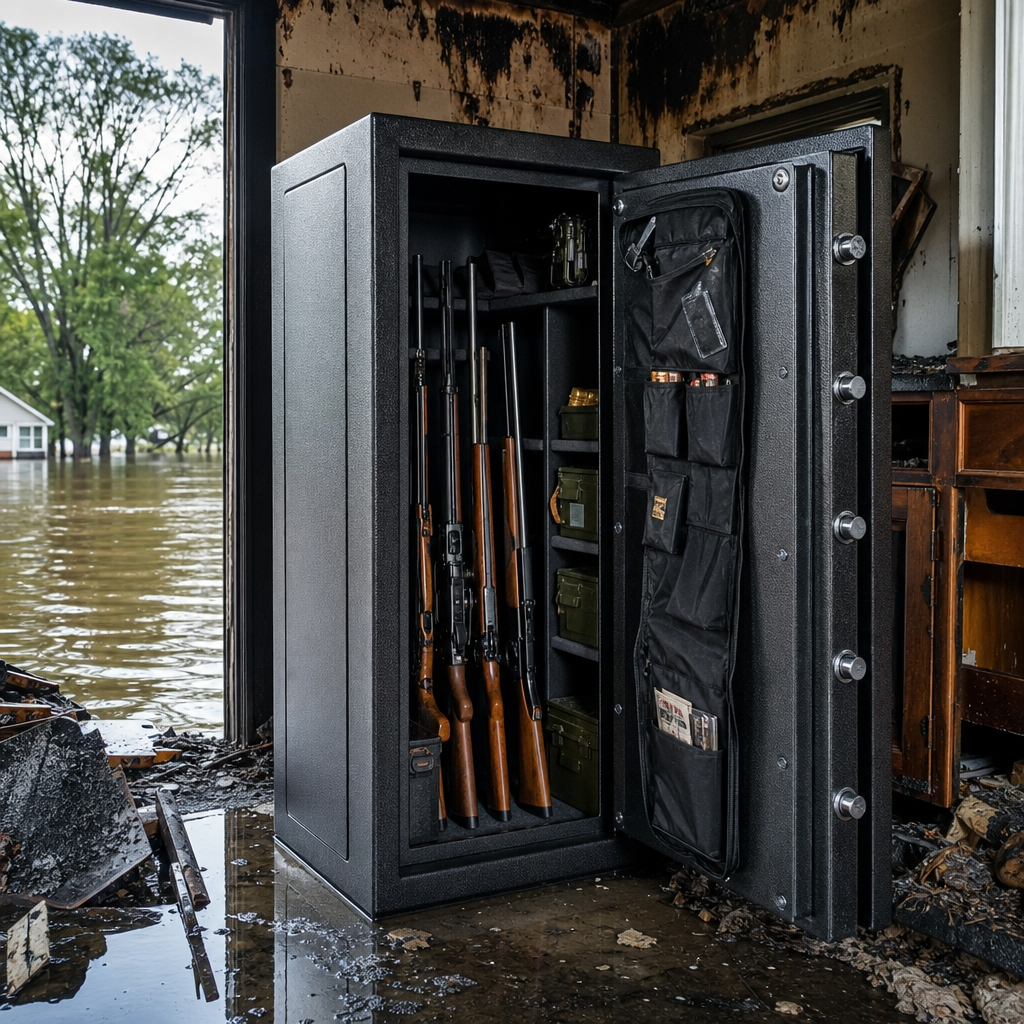
Choosing a gun safe in a flood or fire-prone area requires more than comparing price tags and exterior dimensions. The right safe has to protect firearms from two very different threats: sudden water intrusion and extreme heat exposure. It also has to fit the owner’s daily use, collection size, home layout, and tolerance for maintenance. When I help buyers evaluate safes for hazard-heavy regions, the biggest mistake I see is assuming “fireproof” or “waterproof” on a label tells the full story. It does not. Those claims depend on test conditions, duration, sealing method, installation quality, and even where the safe sits inside the home. This matters because floodwater can corrode metal parts within hours, while heat and steam from a house fire can damage wood stocks, optics, documents, and ammunition long before a safe body fails. A smart purchase starts with buyer persona thinking: matching the safe to the owner’s risks, budget, habits, and storage needs, then choosing features that address those realities directly.
In this context, a gun safe is a secure storage container designed to resist unauthorized access and, in better models, delay damage from fire, water, humidity, and impact. Flood resistance usually refers to a gasketed door and body design that limits water entry for a stated depth and duration. Fire resistance refers to a tested time-and-temperature rating, often based on external temperatures reaching 1200 to 1700 degrees Fahrenheit while the interior stays below a threshold intended to protect paper or, in some cases, electronics. Buyer personas are practical profiles of common shoppers: the first-time handgun owner, the rural long-gun collector, the family prioritizing child safety, the preparedness-minded buyer, the budget upgrader, and the premium investor protecting heirloom firearms. Understanding those personas matters because each one weighs access speed, capacity, insurance requirements, installation constraints, and environmental protection differently. The best safe for a basement in coastal Louisiana is not automatically the best safe for a hillside home in California wildfire country.
Start With Hazard Mapping and Realistic Risk
The first step is to identify whether flood, fire, or both hazards are primary. Use FEMA flood maps, local emergency management guidance, and your home insurer’s risk assessments. For fire exposure, look beyond regional wildfire headlines and examine structure-to-structure fire risk, local response times, roofing materials, vegetation clearance, and whether your safe will sit near a garage, utility room, or ammunition storage. In flood zones, placement can be as important as product rating. A safe with a 24-hour water seal can still fail if anchored through an unsealed floor in a basement that fills rapidly. In fire zones, a 60-minute rating may be inadequate if the home is remote and fire crews may not arrive quickly.
I advise buyers to think in scenarios rather than slogans. Ask: if six inches of water enters the first floor, is the safe elevated? If the garage burns hot from fuel and tools, is the safe isolated from direct flame impingement? If power is out after a storm, can you still open the lock and inspect contents quickly? These questions reveal product needs better than marketing language. They also clarify whether you need a true gun safe, a lighter residential security container, or a higher-security composite safe with stronger insulation and better door seals.
Gun Safe Buyer Personas in Flood or Fire-Prone Areas
Buyer personas help narrow the field because not every owner faces the same threat profile or usage pattern. A first-time owner with one handgun often needs a compact, elevated safe with fast access, dehumidification support, and enough fire protection for documents. A family-focused buyer usually needs stronger child-resistant storage, more interior organization, and a lock that balances security with reliable access under stress. A collector with ten to twenty long guns needs capacity beyond the sticker number, adjustable shelving for optics, and a fire rating that protects wood, bluing, and paper records. A preparedness-minded rural owner may prioritize mechanical redundancy, EMP-independent access, and a safe location above likely flood levels. A premium buyer protecting engraved rifles, suppressors, and appraised heirlooms will care about independent fire verification, thicker steel, better door construction, and insurer-friendly documentation.
| Buyer persona | Main risk | Best safe priorities | Common mistake |
|---|---|---|---|
| First-time handgun owner | Quick home fire, minor water intrusion | Fast lock, elevated placement, 30-60 minute fire rating | Buying a tiny box with no seal or anchor plan |
| Family safety buyer | Unauthorized access, house fire | UL-rated lock, interior organization, child-resistant design | Choosing speed over dependable lock quality |
| Collector | Heat, humidity, corrosion | Thicker steel, dehumidifier, configurable interior, higher fire rating | Trusting inflated long-gun capacity claims |
| Flood-zone homeowner | Standing water, rust, mold | Door gasket, elevated base, sealed anchor points, desiccants | Installing in basement directly on concrete |
| Wildfire-region owner | Extended heat, smoke, structural collapse | Verified fire protection, interior temp control, strategic placement | Focusing only on burglary rating |
| Premium investor | Total loss, insurance disputes | Independent tests, appraisals, serial documentation, premium build | Underinsuring rare firearms |
These personas are not rigid categories. Many households overlap. Someone may be both a family-safety buyer and a flood-zone homeowner, or a collector living in wildfire territory. The useful lesson is this: match the safe to the dominant use case and the worst plausible event.
How Fire Ratings Actually Work
Fire ratings are often misunderstood. Many manufacturers advertise numbers like 45, 60, 90, or 120 minutes, but the important detail is how the test was conducted and what interior temperature was maintained. Paper chars around 350 degrees Fahrenheit, while plastics, adhesives, optics components, and electronic media can fail at much lower temperatures. Fireboard-lined gun safes can provide meaningful delay in residential fires, but they are not equivalent to data safes or commercial record safes. Standards from UL and other recognized labs matter because they create a repeatable test environment, although not every gun safe marketed to consumers undergoes full third-party verification.
In real homes, heat exposure is uneven. A safe on an upper floor may fall through during structural collapse, increasing damage even if the body initially resists heat. A safe in a garage can be exposed to accelerants, vehicles, and hotter burn conditions than one on an interior slab. That is why placement matters so much. For wildfire-prone homes, I generally favor at least a 60-minute fire rating from a reputable maker, and 90 minutes is better if budget allows. Brands often compared in this category include Liberty, Fort Knox, American Security, Browning, and Hollon, though specific models vary widely in insulation, steel thickness, seal design, and lock quality.
What Water Resistance Means and What It Does Not
Water resistance in a gun safe usually means a heat-expanding or compression-style door seal designed to keep out water for a limited time and depth. Some manufacturers state ratings such as 24 to 72 hours in several inches of water. That can be valuable after firefighting spray, pipe bursts, or shallow flooding, but buyers should read the details carefully. A safe may resist water at the door while still allowing moisture through bolt-down holes, cable pass-throughs, or damage caused during transport and installation. No door seal substitutes for smart placement above expected flood levels.
Floodwater is especially destructive because it carries silt, salts, sewage, and chemicals that accelerate corrosion. Even if the safe interior stays mostly dry, high humidity after a flood can rust barrels, springs, magazines, and optics mounts quickly. For coastal and river-adjacent buyers, interior moisture control is not optional. Use a GoldenRod-style electric dehumidifier where power is stable, plus rechargeable desiccants or silica canisters as backup. Keep firearms in silicone-treated socks only if air circulation remains adequate. Store serial records, photos, tax stamps, and appraisals in waterproof document sleeves inside a secondary container.
Construction Details That Separate Better Safes From Better Marketing
Steel thickness, door design, boltwork, lock reliability, and insulation type tell you more than glossy paint and tactical branding. Many entry-level residential security containers use 14- to 12-gauge steel bodies. That may be acceptable for basic deterrence when anchored well, but buyers in high-risk areas should look for heavier bodies and stronger door edges because warped doors and thin bodies lose protective value faster in heat and impact. Composite door construction usually performs better than decorative plate over thin steel. Continuous welds are preferable to sparse stitch welds. External hinges are not automatically bad if the door has full dead-bar support, but poorly fitted doors can compromise both security and seal performance.
For locks, a UL-listed mechanical dial remains a dependable option in harsh conditions, though it is slower. Electronic keypad locks are convenient and common, but quality varies sharply by manufacturer. In storm-prone regions with outages, make sure battery replacement is simple and the keypad is weather-resilient. Biometric locks can be useful for rapid-access handgun safes, yet they should not be your only criterion. Fingerprint readers can struggle with wet fingers, dirt, or inconsistent enrollment. Reliability under stress beats novelty every time.
Installation Strategy: Placement, Elevation, Anchoring, and Room Choice
Installation is where many otherwise solid purchases fail. In flood-prone homes, avoid basements whenever possible. A first-floor interior closet on a concrete slab is usually better, especially if the safe is elevated on a steel or composite platform above the highest likely minor flood level. Raise it enough to protect against shallow water and routine wet mopping, but not so high that stability suffers. Seal anchor penetrations according to manufacturer guidance. If the area has major surge or deep flooding potential, consider whether the safer answer is off-site storage for the most valuable pieces rather than relying on one residential safe.
In fire-prone homes, place the safe against an interior wall, away from garages, kitchens, and large windows. Concrete surroundings moderate heat better than exposed perimeter walls. Do not cram the safe into a humid utility room just because it is out of sight. Also think about access after an event. If debris blocks a closet door, a good safe becomes hard to reach when documentation and firearms need inspection. Professional delivery and anchoring are worth the cost for large models because tipping damage, bad shimming, and poor bolt placement can undermine both security and water resistance.
Capacity Planning, Accessories, and Long-Term Ownership
Safe capacity claims are optimistic. A “24-gun” model may hold that number only with slim, unscoped rifles placed tightly together. In reality, optics, bipods, slings, and modern sporting rifles consume more room. Buy at least 30 to 50 percent more capacity than your current collection suggests. Adjustable shelving, barrel rests, door organizers, and jewelry or document modules add useful flexibility, especially for mixed collections that include handguns, suppressors, ammunition records, passports, and cash.
Long-term ownership also means budgeting for maintenance. Inspect door seals, lock function, boltwork smoothness, and interior humidity monthly during fire season or flood season. After any nearby fire, check for smoke infiltration and elevated moisture. After any flood warning, move portable valuables to higher levels if time allows. Photograph contents annually, keep serial-number spreadsheets, and update insurance riders. Most standard homeowners policies impose sublimits on firearms, sometimes far below collection value. Scheduled personal property coverage or a specialty firearms policy can prevent ugly surprises after a claim. A gun safe reduces risk, but it does not replace documentation, insurance, and routine care.
The best gun safe for a flood or fire-prone area is the one that matches your specific hazards, collection, and daily use instead of relying on generic labels. Start with hazard mapping, then identify your buyer persona and the worst realistic loss scenario. From there, evaluate verified fire protection, meaningful water resistance, sturdy construction, dependable locking, and careful installation. Elevation, placement, humidity control, and insurance records matter just as much as steel and insulation. If you treat this purchase as part of a larger protection plan rather than a one-time box purchase, you will make better decisions and avoid the most common failures. Use this hub as your starting point, compare models against your persona, and choose a safe that protects both your firearms and your peace of mind for years.
Frequently Asked Questions
1. What should I look for first in a gun safe if I live in a flood or fire-prone area?
The first thing to look at is not the marketing label, but the safe’s verified protection profile. In hazard-heavy areas, you are balancing two separate risks: heat and water. A safe that performs well in a house fire may not do much during standing water, and a safe advertised as water-resistant may offer only limited protection during smoke, radiant heat, or prolonged flame exposure. Start by reviewing the fire rating in practical terms. Look for how long the safe is rated to protect contents, at what external temperature it was tested, and whether the rating comes from a recognized independent lab or only from the manufacturer. Those details matter because “30-minute fire safe” can mean very different things depending on how it was tested.
Next, evaluate water protection just as carefully. Ask whether the safe is designed to resist splashing, hose spray, temporary submersion, or actual flood conditions. Many products are only intended to keep out minor moisture or firefighting runoff, not several inches or feet of rising water. The door seal, body seams, lock area, and bolt openings all influence how much water can get inside. Also think about placement. Even an excellent safe can fail your needs if it is installed in the lowest part of the home, directly on unfinished concrete, or in a garage where water tends to collect. In flood-prone homes, elevation is often just as important as the safe itself.
After that, match protection to your collection and your use habits. If you open the safe frequently, pay attention to lock reliability, dehumidification options, interior organization, and ease of access under stress. If you store optics, documents, or valuables alongside firearms, internal humidity control becomes even more important. In other words, the best safe is the one that gives you realistic fire performance, meaningful water resistance, proper capacity, secure anchoring options, and a location strategy that reduces exposure before disaster ever hits.
2. Are “fireproof” and “waterproof” labels on gun safes reliable?
They are not always reliable on their own, and this is one of the most important things buyers need to understand. Terms like “fireproof” and “waterproof” are often used loosely in advertising. In the real world, no gun safe is magically immune to every fire or every flood. Fire protection depends on time, temperature, construction method, seal quality, and what internal temperature the manufacturer considers acceptable for the contents. Water protection depends on seal design, depth of water, duration of exposure, pressure, and whether the safe remains upright and intact during the event.
That is why you should read beyond the headline claim. For fire protection, look for specifics such as “60 minutes at 1200 degrees” or “90 minutes at 1400 degrees,” and find out whether that rating was independently tested. Also pay attention to what the safe is meant to protect. Paper can tolerate higher internal temperatures than firearms with lubricants, wood stocks, optics, electronics, or important documents. For water protection, look for statements that define depth and duration, such as resistance to a certain number of inches of water for a specific number of hours. A vague statement like “water-sealed” tells you much less than a tested submersion or water ingress rating.
The most trustworthy approach is to treat labels as a starting point, not a final answer. Ask for testing documentation, warranty details, and construction information. Look into the door seal type, the thickness of the body and door, the insulation material, and whether the lock and relocker mechanisms are protected from heat and moisture. Reputable sellers should be able to explain how the safe performs, not just repeat the label. If they cannot, that is a sign to keep shopping.
3. How much fire protection do I really need in a gun safe?
The right fire rating depends on your home, your region, and what you are storing, but in fire-prone areas, it is usually wise to buy more fire protection than you think you need. Many buyers focus on entry-level ratings because they are less expensive, but fire behavior is unpredictable. A fast-moving wildfire, a garage fire with fuel sources, or a structure fire that burns before firefighters gain access can expose a safe to higher heat for longer than expected. A minimal fire rating may help in a brief incident, but a more robust rating gives you a larger safety margin.
As a practical guideline, many homeowners in higher-risk areas look for at least 60 minutes of rated fire protection, and often 90 minutes or more if budget and size allow. Just as important as the duration is the testing temperature and the test method. A safe rated for 60 minutes at a lower temperature may not perform like one rated for 60 minutes at a higher temperature with stricter testing conditions. Construction also matters. Better fire-protective safes often use more substantial insulation, stronger door seals that expand under heat, and heavier bodies and doors that help slow temperature rise inside the safe.
You should also think about the contents beyond the firearms themselves. Wood stocks, optics, slings, ammunition documentation, suppressor paperwork, heirloom items, and digital media can all be more vulnerable than a steel receiver. If your safe will hold legal documents, passports, or electronics, you may need supplemental storage solutions inside the safe, such as specialized fire-rated document boxes or media containers. In short, choose a fire rating based on realistic worst-case exposure, not just the minimum number that sounds acceptable on a sales tag.
4. How can I protect a gun safe from flood damage if my area gets heavy rain, storm surge, or rising water?
The most effective flood strategy starts before you buy the safe: choose a location and installation method that reduce water exposure. If possible, avoid basements, ground-level garages with poor drainage, and other low spots where water naturally pools. Place the safe on a raised platform, pedestal, or reinforced stand so the bottom sits above the level of minor flooding or firefighting runoff. Even a small amount of elevation can make a meaningful difference. If you are in a serious flood zone, consider placing the safe on an upper floor that can safely support its loaded weight, or in a part of the home with a known history of staying dry.
The next layer is the safe’s own water resistance. Look for models with expanding door seals, tighter seam construction, and explicit water-resistance specifications. Keep in mind that “water resistant” is not the same as “submersible.” If your area is vulnerable to prolonged flooding or storm surge, the goal should be to minimize the chance that the safe ever sits in water for long. Anchoring is still important for theft deterrence, but in flood regions, it also helps prevent the safe from shifting, tipping, or being moved by forceful water. That said, anchoring should be planned carefully so that the mounting method does not create unnecessary moisture pathways or place the safe in direct contact with damp concrete without protection.
Finally, protect the contents from residual moisture even if the safe itself stays mostly dry. Use a dehumidifier rod, desiccant packs, and regular inspection intervals, especially after storms or seasonal humidity swings. Store documents, optics, and other moisture-sensitive items in secondary sealed containers inside the safe. Wipe down firearms, maintain protective finishes, and check for rust in hidden contact points such as under stocks, around scope rings, and inside foam-lined accessories. In flood-prone areas, long-term moisture management is just as important as surviving the actual water event.
5. Where should I install a gun safe in a hazard-prone home, and what setup mistakes should I avoid?
In a flood or fire-prone home, location can be just as important as the safe’s specifications. For flood risk, the main rule is simple: stay out of low areas whenever possible. Basements are usually a poor choice, and many garages are not much better because they often sit at slab level and are exposed to vehicle fluids, temperature swings, and water intrusion. For fire risk, avoid placing the safe in areas with unusually high fuel loads, such as rooms stacked with cardboard, solvents, lawn equipment, or workshop chemicals. An interior location can sometimes offer better protection from direct flame exposure and extreme temperature spikes than an exterior wall or detached outbuilding, though every home layout is different.
Weight, structure, and access all matter too. A large safe loaded with firearms and ammunition-related accessories can be extremely heavy, so the floor system must be able to support it safely. This is especially important on upper levels. Professional delivery and installation are often worth the cost because they reduce the chance of structural problems, damage to the home, or improper anchoring. Also think through your daily routine. A safe hidden in a hard-to-reach place may sound ideal until you realize it discourages proper storage or becomes difficult to open, inspect, and maintain regularly.
The most common setup mistakes include buying a safe that is too small, placing it directly on damp concrete, ignoring humidity control, trusting labels without understanding test data, and choosing convenience over hazard reduction. Another frequent error is forgetting future growth. Firearms collections tend to expand, and once shelves, document boxes, handguns, and accessories are added, a “12-gun safe” can feel full surprisingly quickly. The best installation plan balances protection, structural