
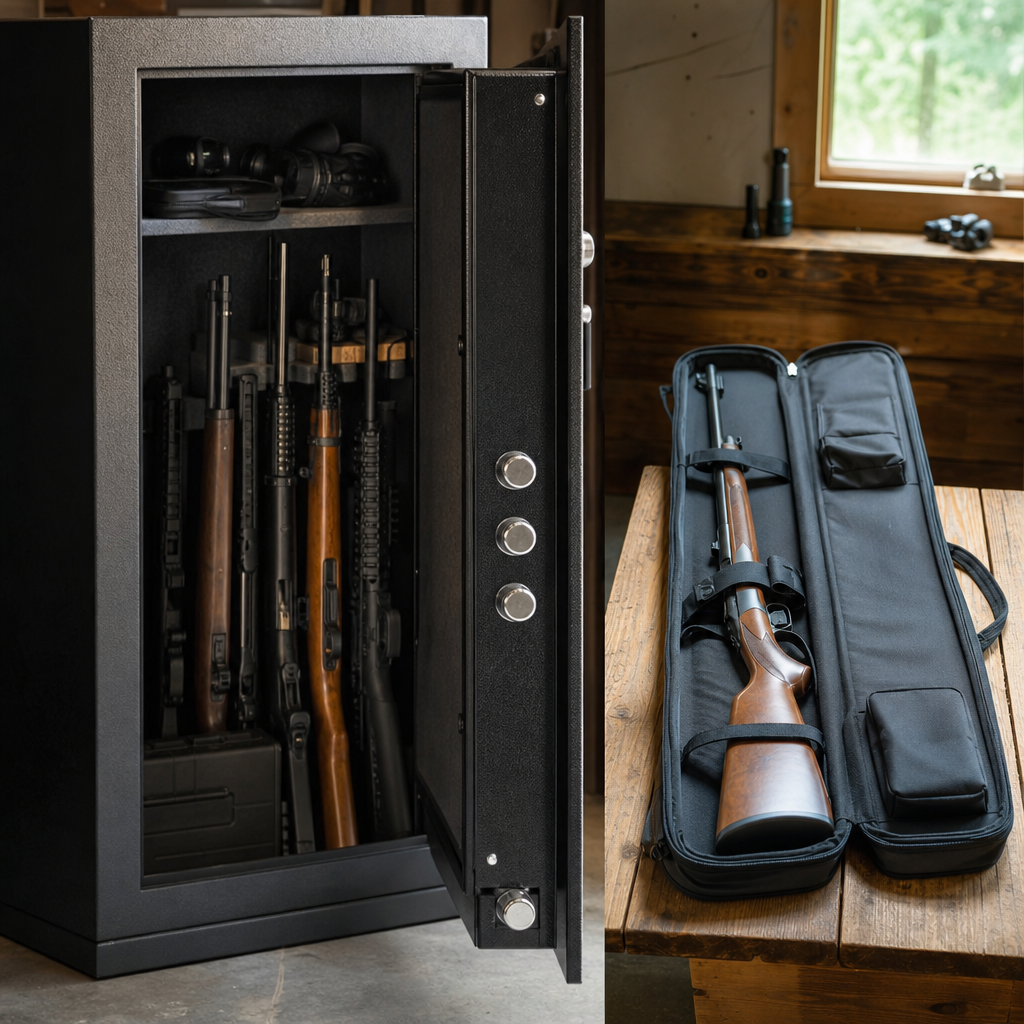
Portable gun safes are less secure than heavy-duty safes in absolute terms, but that does not mean they are insecure, unsuitable, or a poor choice for responsible firearm storage. The real question is not whether a small lockbox can match a 700-pound steel safe, because it cannot. The practical question is how much security you need for your risks, your firearms, your home, your travel habits, and the legal standard you are trying to meet. In years of reviewing gun storage products, testing lock mechanisms, and comparing burglary ratings, I have seen the same misconception repeated: buyers assume “portable” means flimsy and “heavy-duty” means invincible. Both assumptions are wrong.
To answer the title directly, portable gun safes usually provide lower resistance to prying, cutting, lock attacks, and outright theft than full-size heavy-duty safes. Heavy-duty safes use thicker steel, stronger boltwork, more rigid bodies, and sometimes certified fire or burglary construction. Portable gun safes prioritize mobility, fast access, vehicle use, bedside use, and discreet storage. Yet many gun owners do not need the maximum protection of a large residential security container for every firearm, in every room, or during every trip. A compact handgun safe anchored with a security cable may be the safest realistic option in a car, hotel room, office drawer, or apartment nightstand.
This distinction matters because gun safe myths lead to bad storage decisions. Some owners overspend on size and features they never use, while others trust a cheap lockbox to solve risks it was never designed to address. Good firearm storage starts with clear definitions. A portable gun safe is typically a small handgun vault or lockbox designed to be moved and often secured temporarily by cable or anchor points. A heavy-duty safe is a larger, heavier unit intended for long-term installation, with greater steel thickness, reinforced doors, and higher resistance to tampering and removal. Security is not one thing; it includes delay time, access control, concealment, anchoring, child resistance, theft deterrence, and reliability under daily use.
As the central hub for gun safe myths and misconceptions, this guide explains where portable safes fall short, where they work well, and how to judge claims made by manufacturers and reviewers. It also addresses the broader misunderstandings that shape this category: the myth that all steel boxes are safes, the myth that weight alone equals protection, the myth that biometric access is always better, the myth that fire ratings are standardized, and the myth that a safe replaces safe gun handling. If you want a simple answer, buy the strongest safe you can use correctly every day. If you want the complete answer, the details below show exactly how portable and heavy-duty gun safes differ, and why that difference should guide your purchase.
What security difference actually separates portable gun safes from heavy-duty safes?
The biggest difference is attack resistance. Most portable handgun safes use 16-gauge to 14-gauge steel, simple latch systems, and compact locks. Better models may use 12-gauge steel, anti-pry lips, reinforced hinge designs, and quality electronic or mechanical locks. Heavy-duty gun safes and residential security containers commonly use thicker bodies, composite doors, multiple live bolts, hardplates to protect lock areas, relockers, and more robust frame geometry. In plain terms, a thief with hand tools can often defeat a weak portable safe faster than a properly installed heavy-duty safe.
That does not make the comparison unfair; it reflects intended use. A portable safe is designed to secure a handgun from unauthorized access, provide fast retrieval, and resist opportunistic theft long enough to matter in a car, hotel, or bedroom. A heavy-duty safe is designed for prolonged attack resistance inside a fixed location. When I evaluate products, I ask two practical questions: can a child or untrained person get in, and can a thief quickly remove or open it? Portable safes often do very well on the first question and less well on the second unless they are properly tethered or bolted down.
Another overlooked difference is volume. A full-size safe stores multiple firearms, ammunition, documents, optics, and valuables. That creates organizational benefits and allows owners to centralize access control. Portable safes usually protect one handgun or a small set of essentials. If your risk profile includes burglary loss of an entire collection, a bedside lockbox is not the right primary solution. If your risk profile includes keeping one defensive pistol inaccessible to children while remaining available at 2 a.m., a portable safe may be exactly right.
Common gun safe myths that confuse buyers
The first myth is that all locking steel boxes provide meaningful burglary protection. They do not. Many products sold online are really lockboxes, not true safes by any serious standard. Thin sheet metal, exposed hinges, weak welds, and poor lock quality can create a false sense of security. A product can satisfy a basic need for child resistance while still offering minimal theft resistance. Buyers need to separate unauthorized access prevention from burglary protection.
The second myth is that heavier always means safer. Weight matters because it often correlates with steel content and removal difficulty, but construction matters more than sheer mass. I have inspected heavy cabinets with weak doors and mediocre locking systems that looked impressive but offered disappointing pry resistance. I have also tested compact handgun safes with well-designed anti-pry seams and solid lock housings that outperformed cheaper, larger boxes. Weight without anchoring can still mean a thief takes the whole safe.
The third myth is that biometric safes are automatically superior. Fast fingerprint access can be excellent, especially with modern semiconductor readers and onboard enrollment that stores multiple finger positions. But not all biometric systems are equal. Some low-cost readers fail with dry skin, dirty sensors, or inconsistent finger placement. Any defensive-use safe should have a reliable override method and should be tested repeatedly under realistic conditions. Speed is valuable only if access is dependable.
The fourth myth is that a fire rating printed in marketing materials is directly comparable across brands. It often is not. Fire testing methods vary widely, and not every claim comes from an independent laboratory. Terms such as “30 minutes at 1,200 degrees” may be based on internal testing with undocumented protocols. A published standard, the test curve used, door seal design, and interior temperature thresholds all matter. For handgun lockboxes, fire protection is often minimal or absent, which is another reason they should not be judged by the same criteria as large safes.
Where portable gun safes make sense in real life
Portable gun safes solve problems that heavy-duty safes cannot solve conveniently. The most obvious example is vehicle storage. If you carry lawfully and must disarm before entering a prohibited location, a portable handgun safe attached to a seat frame with a steel cable is far better than leaving a pistol loose in a glove box. Is a cable-mounted safe unbeatable? No. But it forces time, noise, and tool use, which is often enough to deter a smash-and-grab theft.
They also work well for bedside storage in apartments, dorm-adjacent family housing, RVs, and offices where space is limited. A large safe may be impossible to move upstairs, violate lease restrictions, or create flooring concerns. In those settings, a small safe bolted inside furniture or anchored discreetly can dramatically reduce unauthorized access risk without making ownership impractical. I have seen many households improve safety simply by replacing a drawer-stored handgun with a quality quick-access safe.
Travel is another legitimate use case. Hunters, competitive shooters, and armed professionals often need temporary secure storage in hotel rooms or during transit. A portable safe is not a substitute for constant control, but it creates a layer of protection during predictable gaps, such as showering, sleeping, or stepping briefly away in a private room. The key is realistic expectations: portable safes are delay devices, not vaults.
| Use case | Portable safe advantage | Heavy-duty safe advantage |
|---|---|---|
| Vehicle storage | Fits under seat, can tether discreetly | Usually impractical for mobile use |
| Bedside access | Fast access and small footprint | Better theft resistance if installed nearby |
| Full firearm collection | Limited capacity | Centralized storage for many guns and gear |
| Burglary event | Can delay opportunistic theft | Stronger resistance to prying and removal |
| Rental housing | Easier to install and relocate | May exceed floor, space, or lease limits |
How to evaluate security instead of marketing claims
Start with steel thickness, but do not stop there. Gauge numbers run backward, so lower numbers mean thicker steel. A 12-gauge body is thicker than a 16-gauge body. Door construction matters as much as body steel because many attacks target the opening edge. Look for recessed doors, anti-pry lips, tight gaps, protected hinges, and a lock area shielded by hardened components. On larger safes, pay attention to boltwork design and whether active bolts are complemented by dead bars on the hinge side.
Next, evaluate anchoring. A portable safe that is not anchored may be stolen intact, then opened later with more time and better tools. Cable systems are useful, but fixed bolts into solid structure are stronger. For full-size safes, bolting to a concrete slab or a structurally sound floor makes a major difference. One of the most common buying mistakes is focusing entirely on lock type while ignoring the simple physics of removal.
Lock quality deserves a careful look. Mechanical simplex-style pushbutton locks have a long track record for quick access and no battery dependence. Electronic keypad locks vary by brand and board quality. Biometric locks range from excellent to frustrating. Whatever the system, test consistency, lockout behavior, battery access, and override procedures. Well-known names in the handgun-safe market include Fort Knox, V-Line, GunVault, Vaultek, Hornady, and SnapSafe, while larger safe buyers often compare Liberty, Fort Knox, Browning, American Security, Rhino Metals, and SecureIt, each with different design priorities.
Finally, check whether the product has any recognized certification. In the handgun category, California Department of Justice roster listings can indicate minimum standards for certain locking containers, though that is not the same as high burglary resistance. In larger safes, UL-listed lock components, residential security container classifications, and independent fire testing provide more meaningful signals than generic marketing language. The more specific the claim, the more credible it usually is.
Choosing the right safe for your risk profile
The best safe is the one that matches your threats and your habits. If your main concern is preventing child access to one defensive handgun, a quality portable safe near the bed may be ideal. If your concern is theft of ten rifles, serialized pistols, suppressors, and important documents, you need a larger anchored safe with stronger burglary resistance. If both concerns apply, the right answer is often both: a heavy-duty main safe plus one or more quick-access portable safes for daily-use handguns.
Think in layers. Safe storage works best when combined with discreet placement, alarm systems, cameras, reinforced doors, and disciplined access control. Concealment still matters. A thief who never finds the safe cannot attack it. Location also matters for fire and water exposure; garages can be convenient but may bring humidity and easier access for thieves. Dehumidifiers, desiccants, and regular maintenance are part of responsible storage, especially for blued steel firearms and optics.
Budget matters, but buying the cheapest option usually costs more later. A poor lock, weak lid, or unreliable biometric reader tends to reveal itself at the worst moment. Spend where it changes outcomes: stronger construction, better lock quality, proper anchoring, and a size you will actually use. For most households, the sensible takeaway is straightforward. Portable gun safes are less secure than heavy-duty safes, but they fill critical roles that large safes cannot. Choose by use case, not by myth. Audit your storage today, identify the gap between convenience and protection, and upgrade the weak point first.
Frequently Asked Questions
Are portable gun safes less secure than heavy-duty safes?
Yes, in absolute terms, portable gun safes are less secure than heavy-duty safes. A compact lockbox simply cannot deliver the same level of theft resistance, pry resistance, anchoring strength, fire protection, and long-term access control as a large, purpose-built gun safe made from thicker steel and designed to stay in one place. If someone has enough time, privacy, and basic tools, a portable safe is generally easier to remove or attack than a 500- to 700-pound safe that is bolted down.
That said, “less secure” does not mean “not secure.” Portable gun safes can still provide meaningful protection against unauthorized access, especially from children, guests, smash-and-grab thieves, and opportunistic handling. In many real-world situations, that is exactly the problem a gun owner is trying to solve. If your goal is to secure a handgun in a vehicle, keep a defensive firearm inaccessible to kids while still available to you, or meet storage requirements during travel, a quality portable safe can be a highly practical and responsible solution.
The better way to think about the comparison is in terms of use case. A heavy-duty safe is ideal when you need maximum home storage security for multiple firearms and longer-term protection against theft. A portable safe is ideal when you need mobility, flexibility, quick installation, or temporary secure storage. The right question is not whether a small portable safe can equal a heavy-duty safe, because it cannot. The right question is whether the portable safe offers enough protection for your specific risks, environment, and legal obligations.
When is a portable gun safe a smart and responsible choice?
A portable gun safe is a smart choice when convenience, mobility, and controlled access matter more than maximum burglary resistance. This includes situations like storing a handgun in a bedroom, office, apartment, dorm-compatible living situation, rental property, hotel room, or vehicle. It is also useful for commuters, travelers, people who split time between homes, and gun owners who need secure storage without installing a large permanent safe.
For many owners, portable safes fill a very practical gap. A full-size safe may be excellent for the main firearm collection, but it is not realistic for every location where a firearm might need to be secured. For example, if you carry a handgun and must disarm before entering a prohibited location, a vehicle lockbox may be the most responsible way to prevent theft or unauthorized access. Likewise, if you need a quick-access bedside solution, a small portable safe can keep a firearm out of reach of children while remaining accessible to the owner.
Portable safes are also a good fit for people with fewer firearms, tighter budgets, or limited floor space. Not every responsible gun owner needs a giant safe. If the firearm is used primarily for personal defense and the owner values discreet storage, a well-made portable safe may offer the right balance of security, access speed, and affordability. The key is matching the product to the job rather than assuming bigger is always necessary.
What security features should you look for in a portable gun safe?
The most important features are steel construction, a well-designed locking mechanism, tamper-resistant hinges, secure cable or anchor options, and a shape that does not invite easy prying. Look for a body made from solid steel rather than thin sheet metal that can flex easily. The door or lid should close tightly with minimal gaps, and the lock should engage securely at one or more reinforced points.
You should also pay close attention to how the safe can be secured to an object or structure. Many portable gun safes use a steel security cable, which can be effective against quick theft when looped around a seat frame or another solid anchor point. Some models also allow bolting to furniture or vehicle interiors. Even if the safe itself is compact, anchoring it properly greatly improves its real-world security because it forces an intruder to attack the box on site rather than simply carrying it away.
As for lock types, electronic keypad, mechanical combination, and biometric models all have strengths and tradeoffs. Electronic keypads are often fast and user-friendly. Biometric safes can be convenient, but reliability varies by brand and conditions such as dirty fingers, moisture, or poor sensor quality. Mechanical locks avoid batteries but may be slower to access. In general, build quality matters more than marketing. A sturdy safe with a reliable, simple lock is usually a better investment than a flashy model with weak construction.
Finally, consider interior fit and intended use. A portable safe should securely hold your firearm without putting pressure on the trigger or controls. Foam lining helps protect the finish and reduce movement. If the safe is for travel or vehicle storage, choose one designed specifically for that environment. A well-chosen portable safe should not only lock—it should also fit your firearm, your access needs, and the places you will actually use it.
Can a portable gun safe meet legal storage requirements?
In many cases, yes, but it depends entirely on your state, local laws, travel rules, and the specific circumstances of storage. Some laws require firearms to be secured in a locked container when left unattended in a vehicle. Others focus on preventing access by minors or prohibited persons. In those situations, a portable gun safe may satisfy the practical and legal standard if it is a genuine locked container used correctly.
However, gun storage laws are not uniform. Some jurisdictions define acceptable storage more narrowly than others, and certain settings—such as schools, employer parking lots, government property, or interstate travel—can involve additional rules. If you are relying on a portable safe to meet a legal obligation, you should verify exactly what the law requires where you live and where you travel. Pay attention to details like whether the container must be hard-sided, fully enclosed, locked with a key or combination, out of plain view, or fixed to the vehicle.
It is also important to understand that legal compliance and best security practice are not always the same thing. A setup might meet the minimum letter of the law while still being less than ideal from a theft-prevention standpoint. Responsible storage means going beyond the bare minimum when possible. If a portable safe is your solution, use it consistently, anchor it whenever possible, keep it discreet, and avoid leaving firearms unattended longer than necessary.
How can you make a portable gun safe more secure in everyday use?
The biggest improvement is anchoring. A portable safe that is loose in a drawer, backpack, or vehicle can be stolen much more easily than one attached to a solid object. Use the included security cable properly, or bolt the safe down if the design allows it. In a vehicle, secure it to a fixed structural point rather than a weak or removable component. At home, place it where it is not visible, not easy to reach, and not likely to be discovered casually.
Location and discretion matter almost as much as the safe itself. A portable safe hidden from plain view is less likely to attract attention. Avoid advertising gun ownership with bumper stickers, social media posts, or predictable storage habits. In a car, a safe under a seat or in a secured compartment is generally better than one left exposed. In a home, a portable safe tucked inside furniture or a closet can add another layer of concealment, which helps reduce opportunistic access.
Routine maintenance also matters. Replace batteries in electronic locks before they fail, test your keypad or biometric reader regularly, and make sure backup keys are stored securely but accessibly. Practice opening the safe so you can do it reliably under stress. If the safe is used for defensive access, reliability and consistency are just as important as basic strength.
Finally, use layered security. A portable gun safe works best as one part of a broader plan that may include alarm systems, cameras, reinforced doors, responsible concealment, and a larger safe for long-term storage of additional firearms. Portable safes are not meant to do everything. They are most effective when used for the situations they were designed for: controlled access, temporary storage, travel, vehicle security, and practical daily firearm management.