
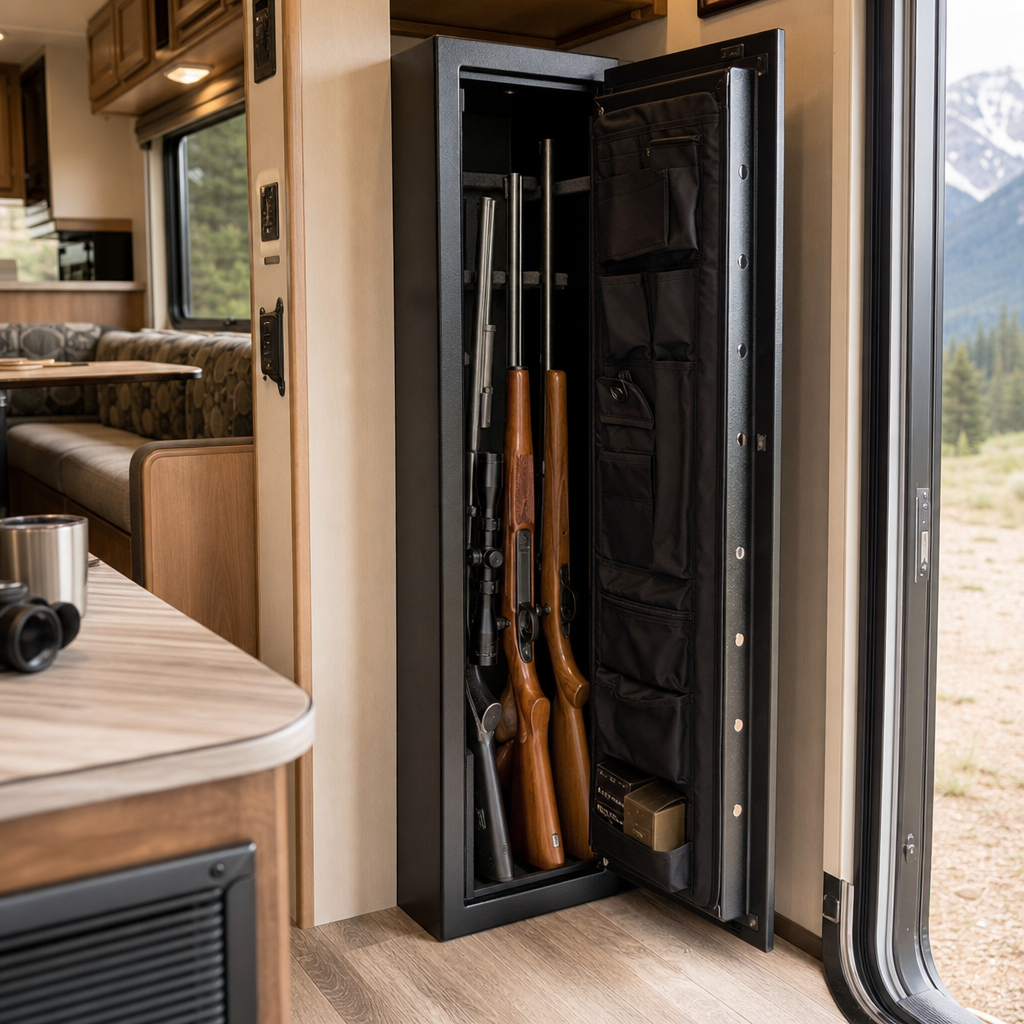
Choosing the best gun safe for RV owners and frequent campers starts with understanding a hard truth: a safe that works perfectly in a suburban bedroom can fail badly on the road. Mobile living changes the risk profile. Weight limits matter, vibration matters, humidity matters, and quick access may matter more than total storage capacity. For travelers who move between campgrounds, trailheads, and overnight parking spots, the right gun safe is not just a steel box. It is a security system adapted to motion, limited space, variable temperatures, and legal complexity.
In this guide, I cover the best gun safe for RV owners and frequent campers through the lens of buyer personas. That matters because “RV owner” is too broad to be useful. A retired couple in a Class A motorhome, a solo overlander in a truck camper, a full-time family in a fifth wheel, and a weekend tent camper towing a small trailer all need different storage solutions. A buyer persona is a practical profile that groups people by use case, constraints, and priorities. When I help people compare safes, this is the fastest way to cut through marketing claims and identify what will actually work in the field.
The stakes are high. Firearms stolen from vehicles and temporary lodging are often easier for criminals to move into illegal markets than guns taken from occupied homes. At the same time, many owners need lawful access for personal protection in remote areas. The challenge is balancing theft resistance, portability, concealment, access speed, corrosion protection, and compliance with state and local transport rules. Good selection starts with honest questions: Where will the safe be mounted, who needs access, how often will it be opened, what firearm types must fit, and what happens if power, fingerprints, or cellular service fail?
Throughout this hub article, I explain how common camper and RV buyer personas map to safe categories, locking methods, mounting strategies, and maintenance routines. I also point to the broader “Gun Safes & Safety” topic by connecting this page to child themes such as biometric handgun safes, truck gun vaults, under-bed safes, fire ratings, and humidity control. If you want one article that frames the buying process before you dive into model-specific reviews, start here.
What Makes a Gun Safe Suitable for RV Life and Camping
The best gun safe for RV owners and frequent campers shares six core traits. First, it fits the mobile environment. That usually means compact external dimensions, manageable weight, and flexible mounting points for beds, dinettes, closets, pass-through storage bays, or tow vehicles. Second, it resists opportunistic theft. In an RV, you are often defending against smash-and-grab time windows measured in minutes, not hours. Thick steel, pry-resistant doors, internal hinges, anti-tamper tabs, and solid anchoring matter more than glossy paint or oversized branding.
Third, it opens reliably without ideal conditions. I have seen biometric readers work well in dry bedrooms and struggle after a rainy setup day when hands were cold, dusty, or damp. That does not make biometrics useless; it means campers should treat lock type as a system, not a feature. The best mobile safes pair a primary method with a backup key or keypad. Fourth, it controls moisture. RVs experience condensation, temperature swings, and storage compartments exposed to road spray. A safe with a tight door gap, quality finish, and room for desiccants or a dehumidifier rod is easier to live with long term.
Fifth, it matches the firearm. A subcompact pistol can live in a lockbox that would be useless for a duty-size handgun with a weapon light. A takedown rifle, folding PCC, or short-barreled defensive shotgun creates another set of dimensional needs. Sixth, it matches your legal travel pattern. Some owners need a lockbox that can move between vehicle and campsite cabin. Others need a permanently mounted safe that supports unloaded transport across restrictive jurisdictions. The best safe is the one that secures your firearm in the exact moments when risk is highest.
Gun Safe Buyer Personas for RV Owners and Frequent Campers
Buyer personas help you avoid buying the wrong product for the right reason. The weekend camper usually prioritizes portability, low cost, and fast installation. This person may travel in a pickup, SUV, teardrop trailer, or rented camper van. A compact handgun lockbox with a steel cable or bolt-down option often fits. The weakness is limited theft resistance if it is not anchored properly.
The full-time RVer needs a more durable setup because the safe becomes part of daily life. Space is still limited, but repeated opening cycles, changing climates, and long absences from the rig raise the standard. This buyer often does best with a bolted handgun safe near the sleeping area plus a secondary locked compartment for spare magazines or documents. The family camper persona adds another requirement: child access prevention. For them, predictable lock behavior and disciplined storage routines outweigh gimmicks.
The off-grid boondocker or overlander usually values defensive access, concealment, and ruggedness. They may park far from populated areas and deal with dust, vibration, and steep terrain. Mechanical Simplex-style locks or robust electronic keypads with physical override keys are often preferable to fingerprint-only designs. The hunter and sport shooter persona may need capacity for a scoped rifle, broken-down shotgun, or ammunition segregation. That often pushes them toward under-bed drawers, truck vaults, or pass-through compartment safes instead of small bedside boxes. Finally, the cross-country traveler is defined by legal complexity. This buyer needs a safe that supports compliant transport through multiple states, with clear procedures for unloading, separating magazines, and restricting access during travel days.
| Buyer Persona | Primary Need | Best Safe Type | Main Tradeoff |
|---|---|---|---|
| Weekend camper | Portable basic security | Cable lockbox or small bolt-down handgun safe | Lower theft resistance if not anchored |
| Full-time RVer | Daily-use reliability | Mounted bedside or cabinet handgun safe | Installation planning required |
| Family camper | Child access prevention | Quick-access safe with consistent backup entry | Needs strict routines and training |
| Overlander | Rugged field performance | Mechanical or reinforced electronic safe | Usually smaller interior capacity |
| Hunter or sport shooter | Long-gun accommodation | Under-bed drawer or vehicle vault | Heavier and harder to conceal |
| Cross-country traveler | Multi-state compliance | Lockable transport-safe with fixed mounting | Slower access during transit |
Best Safe Types by Firearm, Mounting Location, and Access Method
For most RV owners, the first decision is safe type. Handgun safes dominate because pistols are easier to secure in compact spaces and are the most realistic option for quick-access defense in a motorhome or trailer. Good examples include clamshell bedside safes, front-opening boxes sized for a pistol with optic and light, and slim under-seat vaults for tow vehicles. Models from Vaultek, Fort Knox, V-Line, Hornady, and SnapSafe are commonly considered because they cover biometric, keypad, and mechanical designs with usable mounting hardware.
Long-gun storage is harder. Traditional tall safes rarely make sense in RVs due to weight, height, and floor loading. Better options include under-bed drawers, horizontal vaults in basement storage compartments, and vehicle-specific truck vault systems from brands like TruckVault or Tuffy for travelers who keep firearms in the tow vehicle. A takedown rifle or folding carbine dramatically expands your options because it fits safes designed for shorter footprints. I regularly advise measuring not only firearm length, but optic height, bolt handle clearance, and magazine insertion if you intend to store ready-to-use.
Mounting location determines whether a safe helps or hurts your routine. Bedside mounting is ideal for nighttime access, but you need enough clearance for the door to open fully without binding on cabinetry. Under-dinette and under-sofa compartments offer concealment but can become awkward in emergencies. Exterior pass-through compartments provide room, yet they are usually poor choices for primary defensive firearms because access is slower and moisture exposure is higher. In tow vehicles, center-console vaults and under-rear-seat boxes work well when state law permits vehicle carry.
Lock choice deserves blunt analysis. Biometric safes are fast when tuned properly and used with enrolled fingers that are clean and consistently placed. Electronic keypad safes are often the best compromise because they combine speed, low training burden, and reliable backup keys. Mechanical pushbutton locks excel in durability and are unaffected by dead batteries, though they are bulkier and usually more expensive. Key-only boxes are acceptable for transport and legal compliance, but they are not ideal for rapid defensive access.
Security, Installation, and Environmental Protection on the Road
Even the best gun safe for RV owners and frequent campers will underperform if installed poorly. Factory RV furniture often uses thin plywood, laminated panels, and light framing, so you cannot assume any flat surface is strong enough. The safest installations tie into steel seat bases, reinforced flooring, bed platforms with backing plates, or vehicle frame-adjacent points approved by the manufacturer. Use quality fasteners, wide washers or steel backing plates, and threadlocker where appropriate. If you are drilling into floors, verify tank, wiring, brake, and propane line locations first. I have seen expensive mistakes caused by treating an RV like a house.
Concealment is part of security. A modest safe hidden inside a bed pedestal may outperform a larger visible unit mounted in an obvious closet. Window placement matters too. If a thief can see the safe from outside, you have advertised both value and location. Keep any branded packaging, manuals, and range gear out of sight. Layered security helps: door alarms, motion lights, steering wheel locks for tow vehicles, GPS trackers, and campground habits that avoid broadcasting your routine all reduce risk.
Environmental protection is not optional. Firearms stored in RVs face humidity spikes from cooking, showers, wet gear, and nighttime condensation. Use rechargeable desiccant packs, rust inhibitors such as VCI products, and regular wipe-downs with a corrosion-resistant protectant. Stainless and nitrided finishes help, but optics screws, magazines, and springs still need attention. If your safe sits in an exterior compartment, inspect seals and fasteners frequently because road vibration can loosen hardware over time. Also verify battery replacement intervals for electronic locks before long trips. A dead battery discovered at 2 a.m. in a remote site is a preventable failure.
How This Hub Connects to the Broader Gun Safe Buyer Journey
This hub exists to guide readers into the right next article, because no single page can answer every specialized question. If you are choosing between fingerprint and keypad access, the next stop should be a dedicated comparison of biometric handgun safes for campers, including false rejection rates, enrollment practices, and backup entry planning. If your priority is storing a firearm in a pickup, Jeep, or SUV used with your RV, look for vehicle vault and truck gun safe guides focused on console safes, under-seat lockboxes, and cargo-area drawers.
Readers with families should continue to articles on child-access prevention, safe placement in small living spaces, and training routines for shared travel. Hunters and sport shooters should move into content about long-gun storage, takedown rifle options, soft-case versus locked-case transport, and ammunition separation rules. Full-time RVers benefit from deeper guides on dehumidification, corrosion prevention, and maintenance schedules for safes exposed to constant vibration and seasonal climate shifts. Shoppers comparing standards should read articles explaining steel gauge, pry attack design, California DOJ listings, TSA case rules for air connections, and the difference between residential security containers and true burglary-rated safes.
The central lesson is simple: buy for your persona, not for the catalog photo. Start with how you travel, where you sleep, what you carry, who may access it, and how the safe will be anchored. Then choose the smallest safe that fully fits the firearm and the strongest lock you can operate reliably under stress. Done correctly, a good RV gun safe reduces theft risk, supports lawful transport, protects children, and keeps your defensive plan realistic. Use this hub as your starting point, then move into the model-specific and scenario-specific guides under the Gun Safes & Safety category to build a setup that fits your travel life.
Frequently Asked Questions
What should RV owners and frequent campers look for in a gun safe that they would not necessarily prioritize in a house?
The biggest difference is that an RV is a moving environment, not a fixed structure. That changes nearly every buying priority. In a house, buyers often focus on maximum storage, fire ratings, and long-term placement in a closet, basement, or garage. In an RV, the better question is whether the safe can stay secure, accessible, and functional while the vehicle is in motion, parked at campgrounds, or left unattended for short periods. Weight becomes a real concern because every pound affects payload capacity and fuel efficiency. Size matters too, since floor plans are tight and storage compartments are limited. A bulky residential safe may be technically secure, but it can be impractical or even unsafe in a mobile setup.
Mounting options also matter much more on the road. A good gun safe for RV use should be designed to anchor to a solid surface, such as reinforced flooring, framing, or a structural compartment, rather than simply sitting loose in a cabinet. Vibration resistance is another factor many first-time buyers overlook. Frequent travel can loosen mounting hardware, affect electronics, and accelerate wear on hinges or locking components. That means RV owners should look for a safe with durable construction, reliable hardware, and a locking system that performs consistently after repeated movement.
Environmental protection is equally important. RVs and camping rigs are exposed to wider temperature swings, more humidity, and more condensation than most homes. A safe intended for travel should help protect firearms from moisture, dust, and corrosion, especially if the owner moves through changing climates or stores the safe in a compartment that is not fully climate controlled. For many travelers, quick access is also a higher priority than total capacity. A compact safe that securely stores one or two defensive firearms and can be opened quickly may be more useful than a large cabinet that holds an entire collection but is difficult to fit, anchor, or reach. In short, the best RV gun safe is one that balances security, mobility, weather resistance, and practical daily use rather than simply offering the biggest steel box for the money.
Are biometric gun safes a good choice for RV travel and camping, or is a keypad or mechanical lock more reliable?
Biometric gun safes can be a very good option for RV owners and campers, but they are not automatically the best choice in every situation. Their main advantage is speed. A quality fingerprint safe can allow quick access in low light or stressful conditions without requiring the user to remember a code or manipulate a key. That is especially attractive in an RV, where space is tight and defensive access may need to happen from a bed, dinette, or driver area. However, mobile travel introduces conditions that can expose weaknesses in lower-quality biometric systems. Dust, moisture, cold temperatures, worn fingertips, and constant vibration can all affect sensor performance. That does not mean biometric locks are bad; it means buyers should be selective and realistic.
For frequent campers, the best approach is often to treat the locking system as a reliability question rather than a feature comparison. A high-quality biometric safe with a backup keypad or key override usually provides the best balance of speed and redundancy. If the scanner struggles because your hands are wet, dirty, or cold after setting up camp or hiking, you still have another way in. By contrast, a cheap biometric model with inconsistent recognition can become frustrating fast and may be less dependable than a simple electronic keypad. Keypad safes are often a strong middle-ground choice because they are usually quick, easier to maintain, and less sensitive to environmental conditions. Mechanical locks can be very reliable over the long term, but they are generally slower and less convenient for rapid access in the confined space of an RV.
The real answer comes down to quality, backup access, and your use case. If the safe is intended for defensive access while sleeping in the RV, speed and repeatable performance matter a great deal. If it is primarily for secure transport and storage during travel, a robust keypad or even a mechanical solution may be perfectly suitable. No matter which locking type you choose, test it under realistic conditions. Try it in the dark, with one hand, while seated or lying down, and after driving on rough roads. In an RV, reliability in real-world conditions matters more than impressive marketing claims.
Where is the safest and most practical place to install a gun safe in an RV or camper?
The safest and most practical location is usually the one that combines concealment, structural support, and accessibility without interfering with normal RV use. That means the ideal spot is rarely the most obvious cabinet or storage compartment. Many factory compartments are built with lightweight materials that are fine for clothes or cookware but not strong enough to anchor a safe properly. The best installation areas are typically near reinforced flooring, under a fixed bed platform, inside a bolted bench base, within a structurally sound pass-through compartment, or in a custom-built enclosure tied into the RV frame or other strong supports. The goal is to make the safe difficult to see, difficult to remove, and still usable when needed.
Accessibility should be matched to how the firearm will be used. If the safe stores a defensive handgun for nighttime security, placing it in a hard-to-reach exterior compartment may defeat the purpose. In that case, an interior mounting point close to the sleeping area makes more sense. If the safe is mainly for transport and compliance while moving between campgrounds or trailheads, a less accessible but more concealed and robustly mounted location may be the better choice. Owners should also think about theft patterns. Smash-and-grab thieves usually target visible valuables and easy-to-carry items. A small safe hidden behind a panel, under a bed, or within built-in furniture can be much less attractive than one mounted in plain view inside a wardrobe or open storage bay.
It is also important to avoid unsafe installation choices. Do not mount a safe to weak particleboard, thin cabinet walls, or locations that could damage plumbing, electrical wiring, propane lines, or holding tank components. Before drilling or bolting anything down, inspect the area carefully and verify what sits behind the surface. In many RVs, professional installation or at least a very careful structural review is worth the effort. A well-placed safe should feel like part of the rig, not an accessory that could break loose during travel or be unbolted in minutes. The right location is one that supports both security and the realities of living in a compact, moving space.
How do humidity, temperature swings, and road vibration affect a gun safe in an RV?
These factors have a much bigger impact than many travelers expect. Humidity and condensation are among the most common threats to firearms stored in RVs and campers. Unlike a typical home interior, an RV may go from cool overnight temperatures to warm daytime heat very quickly, creating moisture buildup inside compartments and enclosed spaces. If a gun safe is placed in an exterior bay, under a bed with limited airflow, or in an unconditioned area, that moisture can linger and lead to rust, corrosion, and damage to both firearms and the safe’s internal components. That is why moisture control should be part of the buying decision, not an afterthought. A safe with a tight seal, interior lining, and room for desiccant packs or a dehumidifying solution is a smarter choice for travel.
Temperature swings can also affect lock performance and electronics. Batteries in electronic and biometric safes may drain faster in extreme heat or cold, and lower-quality electronics may become less consistent over time. Mechanical parts such as hinges, gas struts, and latch systems can also be affected by repeated expansion and contraction. This does not mean electronic safes should be avoided, but it does mean owners should inspect them regularly, replace batteries proactively, and choose models from reputable manufacturers with a track record for reliability. For people who travel across multiple regions or camp year-round, these small maintenance habits can make a major difference.
Road vibration is the third issue that separates RV use from home use. Continuous movement can loosen anchor bolts, shift contents, wear out padding, and gradually stress the lock or door alignment. A safe that feels solid on day one may develop rattles or mounting play after months of rough highways, washboard roads, or repeated setup and teardown cycles. The solution is to choose a sturdy unit, mount it properly, use thread-locking hardware where appropriate, and inspect the installation regularly. Firearms inside the safe should also be secured so they do not bounce against hard surfaces during travel. In practical terms, the best gun safe for RV life is not just secure against theft; it is built and installed to survive moisture, temperature changes, and constant motion without compromising function.
Can a small portable gun safe really provide enough security for RV owners and campers?
Yes, a small portable gun safe can provide enough security for many RV owners and frequent campers, but only if it is chosen for the right purpose and used correctly. Portable does not have to mean flimsy, and compact does not automatically mean inadequate. For many travelers, a small handgun safe is the most realistic and effective solution because it fits the space limitations of an RV, adds less weight, and can be positioned close to where it is needed. It can also make sense for owners who carry one primary defensive firearm rather than transporting a large collection. In that context, a well-built compact safe can deliver practical security, quick access, and better concealment than a larger