
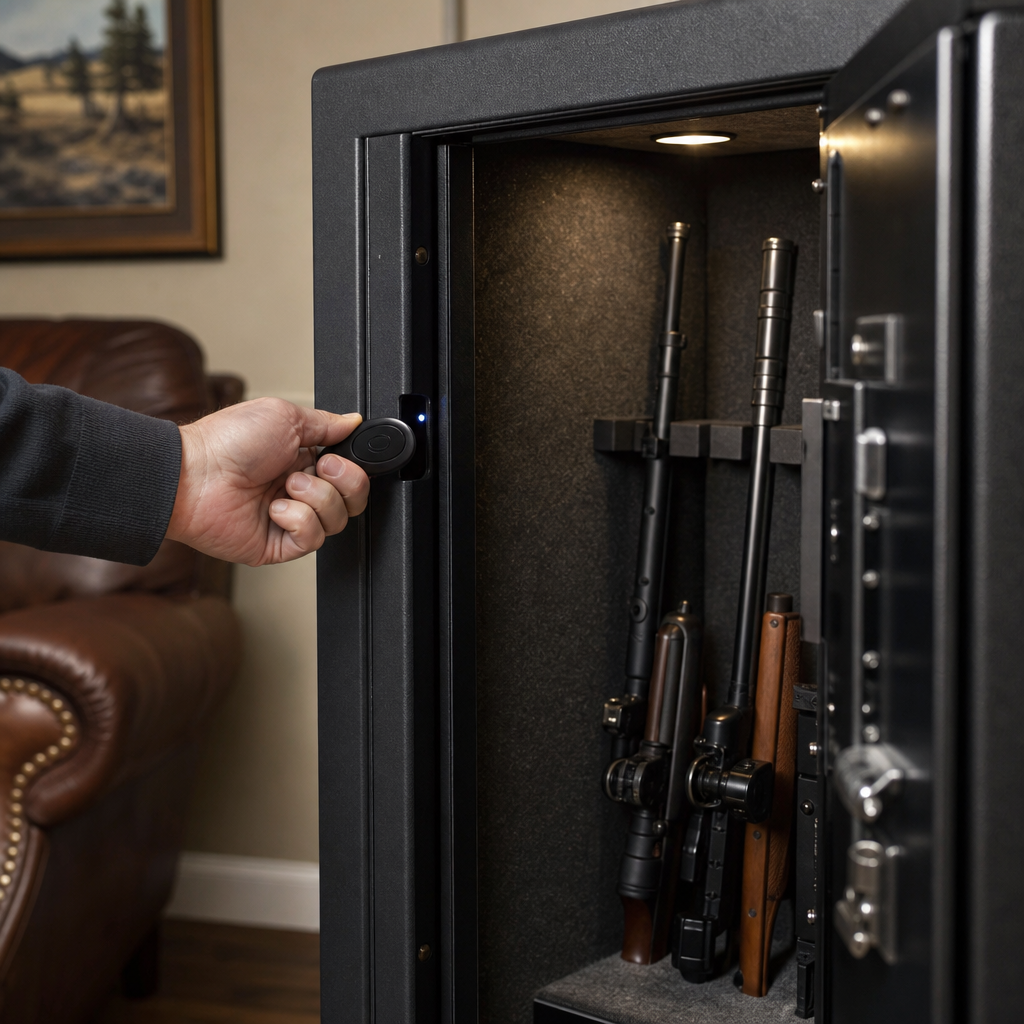
RFID gun safes promise fast access in a crisis, but speed alone does not determine whether they create a security risk. To answer the question clearly, it helps to define the technology, the threat model, and the way real safes fail in homes, trucks, and nightstands. RFID stands for radio-frequency identification, a method that lets a tagged object such as a card, fob, bracelet, or sticker communicate with a reader at short range. In the gun-safe market, RFID access systems are usually paired with backup entry methods such as keypad codes, mechanical override keys, or biometric scanners. The concern is straightforward: if a safe can be opened electronically, can someone else trigger it, defeat it, or exploit it more easily than a traditional lock?
In my experience evaluating handgun vaults and quick-access bedside safes, the biggest mistakes buyers make are not about the chip itself. They are about confusing convenience with security level, assuming every electronic lock works the same way, and overlooking basic factors such as steel thickness, latch design, pry resistance, mounting, battery management, and child-proof placement. A cheap bedside box with RFID is risky, but not because it uses RFID. It is risky because it may use thin sheet metal, weak welds, exposed hinges, poor tamper detection, or an override key that can be picked or duplicated. A well-designed RFID handgun safe from a reputable maker can be secure enough for rapid-access defensive storage, while still being the wrong choice for long-term theft protection against a determined burglar.
This matters because gun storage decisions are about layered risk reduction, not marketing claims. Safe storage must balance unauthorized access prevention, defensive readiness, legal responsibilities, and household realities such as children, guests, cleaners, or service workers. Underwriters Laboratories burglary ratings, California Department of Justice roster considerations, ASTM testing language, and insurance expectations all matter more than buzzwords. The practical question is not whether RFID is inherently dangerous. The real question is whether an RFID gun safe, in a specific use case, introduces more risk than it removes. Understanding common gun safe myths and misconceptions is the fastest way to make that judgment well and avoid buying a product that solves the wrong problem.
What RFID gun safes actually do, and what they do not do
Most RFID gun safes use high-frequency or near-field style credential reading at very short distance, often requiring the user to place a fob, card, or tag within inches of a marked point. That is not the same as a long-range gate badge system or a passively broadcasting tracker. In practical terms, the safe is waiting for a recognized credential, then energizing a lock release that allows a spring-assisted lid or door to open. On better units, the credential list is stored locally, the reader has anti-collision logic, and the latch remains mechanically engaged until the unlock event is complete. On weaker units, the electronics may be crude, the power management may be poor, and the backup access path may be the weakest point.
RFID also does not replace the rest of the safe. If the body flexes under a screwdriver attack, the lock technology is almost irrelevant. I have tested quick-access boxes where the latch held, but the lid peeled enough to expose contents. I have also seen the opposite: a decent steel shell paired with a finicky reader and low-quality battery contacts. Buyers often obsess over whether a hacker can clone a tag, when a burglar is more likely to carry the whole unbolted safe away in under thirty seconds. For this reason, any honest evaluation of RFID security has to include physical construction, mounting hardware, hinge protection, lock redundancy, and the practical environment in which the safe lives.
Common myths about RFID gun safes and the reality behind them
The first myth is that RFID safes are easy to open remotely. In mainstream consumer handgun safes, the read range is intentionally short. A credential generally must be presented very close to the reader, which sharply limits casual interception. Could a sophisticated attacker target a poorly designed system? Yes, especially if the implementation lacks encryption or uses predictable identifiers. But that is not the dominant residential threat. Most unauthorized access incidents come from unsecured keys, discoverable codes, poor placement, dead batteries, or a safe left unlocked after use.
The second myth is that electronic means unreliable and mechanical means reliable. Mechanical simplex-style locks are excellent on some quick-access safes, and traditional dial locks are proven, but every lock type has failure modes. Electronic systems fail from battery neglect, component defects, or bad user enrollment. Mechanical systems fail from wear, misdialing, broken springs, tolerance stack issues, or simple user error under stress. The right comparison is not electronic versus mechanical in the abstract. It is a specific model, tested over time, in the context of your routine, your dexterity, and your lighting conditions at two in the morning.
The third myth is that biometrics are always safer than RFID because fingerprints are unique. In practice, low-cost biometric modules vary wildly in sensor quality, false reject rates, and resistance to dirty fingers, moisture, or partial contact. I have seen decent RFID readers outperform budget fingerprint scanners in speed and consistency. The fourth myth is that a backup key always improves safety. It improves availability, but a weak tubular key or common wafer lock can become the easiest bypass path. The fifth myth is that any gun safe marketed for children automatically prevents child access. Child resistance depends on lock integrity, code secrecy, placement, anchoring, and disciplined household handling, not label language alone.
| Myth | Reality | What to verify |
|---|---|---|
| RFID opens from across the room | Most consumer readers work only at very short range | Published read distance and tag type |
| Electronic locks are less secure than mechanical locks | Both are secure or insecure depending on design and quality | Failure history, backup access, battery system |
| Biometric is always the best quick-access method | Budget fingerprint readers often fail under real conditions | Sensor quality, enrollment limit, dry or wet finger performance |
| Any safe prevents theft | Quick-access handgun vaults are usually access-control devices, not burglary safes | Steel gauge, pry resistance, anchoring, certifications |
| Backup keys only add convenience | They can become the primary weakness | Keyway quality, key control, hidden key location |
Where the real security risks come from
The most significant security risk with RFID gun safes is category confusion. Many buyers treat a compact bedside safe as if it were a true burglary safe. It is not. Most quick-access units are designed to deny casual access and provide immediate retrieval for lawful defensive use. They are rarely built to resist sustained prying, cutting, or carry-off theft the way a heavier safe with a recognized burglary rating can. If you store multiple firearms, jewelry, cash, documents, or suppressors in a small RFID box, you are using the wrong tool.
Another real risk is poor implementation. Weak solenoids, exposed lock bars, thin lids, underpowered springs, and inconsistent firmware create failure points. Battery management is especially important. A safe that depends on four AA cells with no low-battery warning, no external power option, and corroding terminals is not acceptable for a defensive firearm. Reputable brands typically provide low-battery alerts, nonvolatile memory, tested cycle life, and accessible but protected battery compartments. Good safes also allow multiple access methods without making the backup path trivial to defeat.
User behavior creates more risk than radio technology. Tags left in a drawer next to the safe, RFID stickers attached to a phone case that is regularly borrowed, keypad codes shared between spouses and then reused elsewhere, and safes left unbolted inside a vehicle all undermine security. For vehicle storage, an RFID safe can be useful, but cable-only tethering is a compromise, not a strong anti-theft solution. In homes with children, a rapid-access safe should be mounted in a location that supports immediate adult access while denying a child time, privacy, and leverage. Secure storage is a system, not a box.
How RFID compares with keypad, biometric, and mechanical options
RFID offers one major advantage: consistent speed with minimal fine motor demand. In low light, under stress, placing a wristband or fob near the reader can be easier than entering a code or getting a clean fingerprint scan. That matters for people with arthritis, reduced sensation, or a need to access a bedside firearm discreetly. Compared with keypads, RFID reduces the chance of shoulder-surfed codes and worn button pattern clues. Compared with biometrics, it avoids issues caused by sweat, lotion, cuts, calluses, and sensor contamination.
Its disadvantages are equally clear. You must control the credential. If an authorized tag is lost, stolen, or left too close to the safe, security collapses. Some users also dislike the dependence on proprietary fobs or adhesive tags. Mechanical push-button locks avoid batteries and token management, but they can be slower for some users and require memorized sequences. Keypad safes are flexible and common, though cheap membranes and weak electronics are frequent failure points. Biometric safes can be excellent when the sensor and algorithm are good, but buyers should be skeptical of bargain models with inflated user-count claims and vague testing language. No access method is universally best; the best method is the one that performs reliably in your environment without adding avoidable vulnerabilities.
What to look for before you buy an RFID gun safe
Start with construction. Look for steel thickness that is appropriate for the category, internal hinge protection or protected external hinges, solid lock engagement, and mounting holes that let you bolt the unit to framing, furniture structure, or concrete as intended by the manufacturer. Then examine the lock system. Ask whether the RFID credentials are unique, how many can be enrolled, whether deleted tags are actually removed from memory, and what the backup entry method is. If there is a key override, inspect the keyway quality and find out how replacement keys are controlled.
Next, evaluate power and durability. A defensive-access safe should provide low-battery warnings well before failure, preserve enrolled credentials during battery replacement, and ideally offer external jump power or another practical contingency. The lid or door should open reliably in repeated testing without sticking. Read warranty terms carefully. A lifetime body warranty means little if the electronics are covered for one year and known to fail. Look for third-party reviews that include pry attempts, drop observations, and lockout scenarios rather than simple unboxing videos. If the product claims compliance with a state roster or child-resistance standard, verify what that claim specifically covers.
Finally, match the safe to the job. For a nightstand handgun, prioritize rapid and repeatable access, quiet operation, and secure mounting. For a truck, prioritize concealment, tamper resistance, and realistic expectations about theft. For long guns, consider whether an RFID compartment makes sense only as a secondary access point within a larger safe. As you build out your broader Gun Safes & Safety plan, related topics worth reviewing include how to choose safe size, where to place a safe in the home, how humidity control protects firearms, and which lock types make sense for different households. Those connected decisions matter as much as the RFID feature itself.
Best practices for safe setup, daily use, and ongoing testing
Once installed, an RFID gun safe should be tested the way it will actually be used. Enroll at least two credentials, confirm that both work from realistic angles, and verify the backup method without relying on it as your primary plan. Replace factory batteries immediately with quality alkaline or lithium cells if permitted by the manufacturer, record the installation date, and set a replacement interval. I recommend a simple quarterly function test and an annual review of mounting bolts, battery contacts, tag condition, and hinge screws. If a safe lives in a humid room or vehicle, inspect for corrosion and condensation.
Keep credentials under the same level of control as a house key to a locked room, and in many homes under tighter control. Do not store spare tags in obvious locations. If a tag is lost, delete it from memory at once and re-test the remaining enrolled devices. Practice access with your support hand and in darkness. Time matters, but consistency matters more. If the safe ever hesitates, fails to open cleanly, or begins draining batteries unusually fast, treat that as a repair signal, not an annoyance to ignore. Security products deserve maintenance discipline.
RFID gun safes are not inherently a security risk; poorly designed, poorly mounted, or poorly managed safes are the real risk. The technology can be a strong fit for rapid-access handgun storage because it offers fast, simple entry under stress, especially when paired with good physical construction and a trustworthy backup method. The central misconception in this category is that lock technology alone determines security. In reality, security comes from matching the safe to the threat, controlling credentials, maintaining power and hardware, and understanding the difference between access control and burglary resistance.
For the broader Gun Safe Myths & Misconceptions topic, that distinction is the key organizing idea. RFID is not magic, biometrics are not automatically superior, mechanical locks are not automatically safer, and no compact handgun vault substitutes for a true burglary-rated safe when theft resistance is the goal. Buyers who focus on steel, latch design, anchoring, testing, and real-world use patterns make better decisions than buyers who chase marketing language. If you are building a complete Gun Safes & Safety plan, use this page as your hub: compare lock types, review child-access prevention practices, and evaluate where each safe fits in your home, vehicle, and daily routine.
The best next step is simple: audit your current storage setup against actual risks, then choose the safest access method that you will maintain and use correctly every day.
Frequently Asked Questions
Are RFID gun safes inherently a security risk?
No, RFID gun safes are not inherently a security risk, but they are not automatically secure either. The real answer depends on how the safe is designed, how it is used, and what threats matter most in the environment where it is kept. RFID technology is simply a way to identify an authorized token, such as a card, wristband, fob, or sticker, at short range. In most gun safes, that RFID reader is only one part of the access system. The safe also depends on the quality of its locking mechanism, its backup entry methods, its power system, and the strength of the enclosure itself.
In practice, the biggest risks with any quick-access gun safe are often more ordinary than people expect. Poor construction, weak latches, bad mounting, dead batteries, low-quality electronics, and predictable user habits tend to create more real-world failures than dramatic “hacking” scenarios. A safe that can be pried open with common tools or removed entirely from a nightstand or vehicle can be a bigger problem than the fact that it uses RFID. At the same time, a well-made RFID safe can improve security if it helps the owner keep a firearm locked up consistently while still allowing fast access under stress.
So the key issue is not whether RFID is risky by itself. The better question is whether a specific RFID safe balances speed, reliability, child resistance, theft resistance, and fail-safe operation in a way that fits the owner’s needs. When evaluated that way, some RFID gun safes are responsibly engineered, while others cut corners and create unnecessary risk.
Can RFID gun safes be hacked, cloned, or opened by someone with the right equipment?
Potentially, yes, but the risk varies widely depending on the type of RFID system used, the quality of the implementation, and how close an attacker can get to the safe or to the authorized tag. RFID is a broad category, not a single security standard. Some systems use very basic identifiers that may be easier to copy or emulate if someone has the time, tools, and opportunity. Others use better authentication methods or more limited operating ranges, which reduce the practical risk of unauthorized access.
That said, many households are unlikely to face a sophisticated attacker trying to clone a wristband or intercept a short-range signal from a bedside safe. The more realistic concern is targeted access by someone who has repeated physical proximity to the safe, to the owner’s key fob, or to backup credentials. For example, if an RFID sticker is hidden in an obvious place, if a bracelet is left near the safe, or if a backup key is poorly stored, the system can be compromised without any advanced technical attack at all. Convenience often introduces these human-factor vulnerabilities.
It is also important to remember that “hacking” is only one path to failure. Attackers often choose the easiest method available. If a safe has a flimsy body, exposed hinges, weak override keys, or easily guessed backup codes, those weaknesses may be exploited long before anyone attempts to defeat the RFID system itself. A strong overall design matters more than marketing claims about electronic access. Buyers should look for safes that combine a reputable RFID implementation with solid mechanical construction, tamper resistance, secure programming, and dependable backup entry options.
What are the most common ways RFID gun safes actually fail in homes, vehicles, and nightstands?
The most common failures are usually practical, not exotic. In homes and bedrooms, a frequent problem is power-related reliability. Batteries drain, contacts corrode, and electronics can become inconsistent over time. If the safe does not provide clear low-battery warnings or a dependable backup method, fast access may disappear when it is needed most. Another issue is poor placement. A safe that is loosely placed in a drawer, not anchored to furniture, or installed where children can reach it may technically be locked but still not meaningfully secure.
In vehicles, the threat model changes. Temperature swings, vibration, humidity, and opportunistic theft all become more serious. Electronics that work well indoors may become less dependable after repeated exposure to heat and cold inside a truck or car. Vehicle safes also face a major theft risk because a criminal may have time to remove the entire unit and attack it elsewhere. In that setting, a safe’s mounting method, steel thickness, latch strength, and resistance to prying can matter more than whether it opens by RFID, keypad, or biometrics.
For nightstand use, speed and consistency are critical, but so is user discipline. People sometimes defeat their own security by leaving an RFID tag attached in an obvious place, storing backup keys in the same room, or relying on a safe they rarely test. Another common issue is training failure: under stress, users may fumble the tag, approach the reader at the wrong angle, or forget the backup code. The safest setup is one that the owner can operate reliably in darkness, under adrenaline, and with one hand if necessary. Real-world performance comes from a combination of device quality, installation, maintenance, and practice.
Are RFID gun safes safer or less safe than biometric or keypad gun safes?
They are not universally safer or less safe; they simply involve a different set of tradeoffs. RFID safes are popular because they can provide fast, low-effort access with minimal fine motor input. In a high-stress situation, touching a tag or presenting a wristband may be easier than accurately entering a code or dealing with a fingerprint reader that struggles with sweat, dirt, skin condition, or hand position. For some users, that simplicity improves real-world access speed without encouraging unsafe storage habits.
Compared with biometric safes, RFID systems often avoid one of the biggest complaints about consumer fingerprint readers: inconsistency. Lower-end biometric readers can fail because of dry skin, wet hands, worn fingerprints, or sensor quality. RFID does not depend on fingerprint quality, but it does depend on keeping track of an authorized token. If someone finds or steals that token, the convenience becomes a liability. Compared with keypad safes, RFID can be faster and easier in darkness, but keypads have the advantage of not relying on a separate physical credential that can be misplaced.
The best choice depends on the user and the environment. A person concerned about very rapid bedside access may prefer RFID if the safe is well made and the tag is secured intelligently. Someone who wants fewer moving parts in the daily routine may prefer a keypad. Others may prefer a safe that combines RFID with keypad or key backup so there is no single point of failure. Rather than asking which technology wins in the abstract, it is more useful to ask which one will be consistently secure, dependable, and usable for the specific owner over months and years of actual use.
How can you reduce the security risks of an RFID gun safe?
The most effective way to reduce risk is to treat the safe as a complete security system rather than as a gadget with a fast opening feature. Start with build quality. Choose a model with a solid steel body, a strong locking mechanism, pry resistance, and secure mounting capability. If a safe can be easily carried away, bent, or forced open with basic tools, the access technology matters much less. Independent reviews, destructive testing videos, and long-term owner feedback can provide a clearer picture than product listings alone.
Next, manage the RFID credentials carefully. Do not store the tag in an obvious location near the safe, and do not assume that convenience should override basic access control. If the safe uses stickers, cards, or bracelets, think about who can physically reach them and whether they could be copied, borrowed, or discovered. Backup keys and override codes should be protected just as seriously, because they are often the weakest link. A strong safe can be undermined by a hidden key taped inside a drawer or by a default code that was never changed.
Finally, maintain and test the safe regularly. Replace batteries on a schedule instead of waiting for a warning. Practice opening the safe in low light and under mild stress so access becomes repeatable. If the safe lives in a truck or other harsh environment, inspect it more often for electronic or mechanical degradation. Anchor it properly, confirm that the latch fully engages, and periodically verify that every access method still works. When owners take those steps, RFID gun safes can be a practical balance of access speed and responsible storage rather than a security risk by default.