
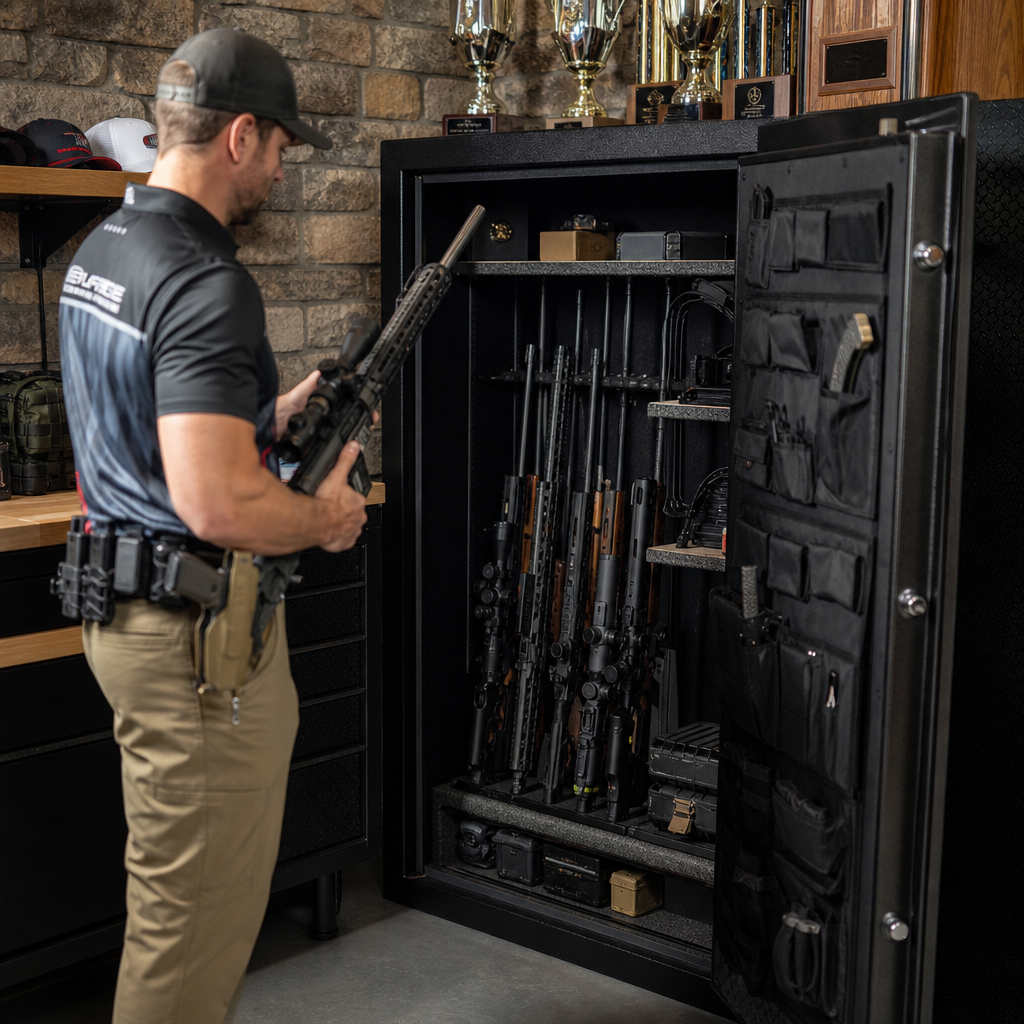
Competitive shooting changes what “good storage” means. A casual owner may only need basic theft deterrence, but a shooter who travels to matches, rotates optics, stores match ammo, and maintains several tuned firearms needs a gun safe built around access, organization, humidity control, and repeatable security. In this buyer persona, the ideal gun safe is not simply the biggest cabinet with the thickest door. It is a system that protects investment-grade equipment, supports training routines, and keeps firearms secured without slowing down preparation for the next stage.
When I help competitive shooters choose safes, I start with the realities of the sport. A USPSA shooter may own multiple pistols with red-dot sights, extended magazines, holsters, belts, and spare springs. A PRS competitor may need room for long rifles with large optics, suppressors where legal, bipods, tripods, data books, and weather meters. A 3-Gun shooter often keeps a rifle, shotgun, and pistol platform match-ready at the same time. These collections are expensive, highly configured, and frequently handled. That makes the ideal gun safe for a competitive shooter different from the ideal safe for a first-time buyer, a hunter, a concealed-carry homeowner, or a collector focused on heirlooms.
A gun safe buyer persona is a practical profile that matches storage features to ownership habits. It asks how many firearms you own, how often you access them, whether you travel, what accessories must stay protected, and how much risk you face from theft, fire, rust, or unauthorized access. In the broader Gun Safes & Safety category, buyer personas matter because they stop people from overbuying the wrong feature and underbuying the critical one. For competitive shooters, the right answer usually includes faster access than a collector safe, better interior flexibility than a hunting safe, and stronger environmental control than a basic residential security container. If you compete regularly, your safe should work like part of your equipment plan, not an afterthought in the garage.
What Competitive Shooters Need From a Gun Safe
The ideal gun safe for a competitive shooter starts with capacity that reflects both current use and inevitable expansion. Most competitors outgrow published firearm counts almost immediately because manufacturer counts assume unscoped rifles placed tightly together with no slings, oversized bolt handles, or pistol grips. A “24-gun” safe may hold far fewer match rifles once you add optics and accessories. In practice, I advise competitors to buy for at least 1.5 to 2 times their current firearm count. That extra volume prevents gear damage and makes staging for events faster.
Organization is the next differentiator. Competitive shooters do not store firearms in isolation. They store magazines, choke tubes, optics tools, chamber flags, range bags, belts, ear protection, chronographs, batteries, cleaning rods, and spare parts. An effective safe uses modular shelves, door-panel organizers, pistol racks, adjustable barrel rests, and bins for small components. Without that structure, expensive accessories get piled together, lenses get scratched, and pre-match setup becomes chaotic. The best safes for this persona treat the interior like a workshop inventory wall, not a dark box.
Security still matters, but it should be evaluated correctly. Many gun owners see thick steel advertising and stop there. Competitive shooters should look at door construction, hard plates protecting the lock, relockers, continuous weld quality, bolt coverage, and anchoring options. In the United States, many consumer gun safes are classified as Residential Security Containers under UL 1037 rather than true high-security burglary safes. That does not make them useless; it means buyers should understand what they are getting. For many households, an anchored RSC from a reputable maker is an appropriate theft deterrent. For competitors with higher-value collections, especially those with custom race guns and premium optics, stepping up in steel thickness and lock protection is often justified.
Environmental control is equally important. Match pistols with tuned triggers, high-end rifle barrels, optics electronics, and reloading components do not respond well to moisture swings. If your safe lives in a basement, garage, or room with unstable humidity, plan for a dehumidifier rod, rechargeable desiccants, and some airflow around gear. Rust prevention is not optional when your rifle may represent several thousand dollars in action work, barrel fitting, optics, and ammunition testing.
Core Features That Make a Safe Ideal for Match Use
The best gun safe for a competitive shooter balances four categories: size, access, protection, and layout. Size should support firearms with optics attached. Access should be quick enough for routine loading and unloading without encouraging bad storage habits. Protection should address burglary, unauthorized access, and at least moderate fire risk. Layout should make equipment visible and reachable. If one category is missing, the safe becomes frustrating and shooters stop using it efficiently.
Lock type deserves careful consideration. Mechanical dial locks are proven, durable, and not battery-dependent, but they are slower for daily use. Electronic keypad locks are faster and easier for frequent access, which is valuable when you are packing for weekly matches. Modern UL-rated electronic locks from recognized brands can be reliable, but they require battery management and proper installation. Biometric locks are less common on full-size gun safes and vary significantly in quality. For a competitive shooter opening the safe often, I generally favor a quality electronic lock with backup key or override procedures defined by the manufacturer, provided the lock body and hard plate protection are solid.
Interior depth matters more than shoppers expect. Long-range rifles and AR-pattern rifles with larger optics need space so turrets and eyepieces do not bang into shelving. Door organizers can add tremendous utility for pistols and documents, but on shallow safes they may reduce clearance for scoped long guns. The right configuration depends on discipline. Pistol-focused shooters benefit from dense door storage and shelf bins. Precision rifle shooters usually need fewer door pockets and more unobstructed long-gun space.
Fire protection claims also need context. Safe brands often advertise a certain number of minutes at a stated temperature, but test methods vary. Some use independent labs, others use internal protocols. Fireboard thickness, door seals that expand under heat, and body construction all contribute. For competitive shooters, fire protection matters not only for firearms but for optics, data books, electronics, and legal documents. Still, fire ratings should be weighed alongside placement. A moderate fire-rated safe installed on a lower floor, away from ignition sources and anchored correctly, can be a smarter real-world choice than a larger but less manageable model placed poorly.
| Competitive shooter profile | Ideal safe priorities | Typical configuration |
|---|---|---|
| USPSA or IDPA pistol competitor | Fast access, pistol organization, magazine storage, humidity control | Mid-size safe with electronic lock, door panel, pistol racks, accessory shelves |
| PRS or NRL rifle shooter | Deep interior, scoped rifle clearance, suppressor and bipod storage, dehumidification | Tall safe with adjustable shelving, fewer door obstructions, power outlet kit |
| 3-Gun competitor | Mixed-platform storage, flexible shelves, quick weekly access, strong anchoring | Large modular safe with long-gun slots, pistol section, gear bins |
| Travel-heavy regional match shooter | Frequent loading cycles, inventory visibility, secure document storage | Wide safe with electronic lock, lighting, labeled containers, organizer door |
Choosing by Discipline, Collection Value, and Training Frequency
Different shooting sports create different storage patterns. USPSA, Steel Challenge, and IDPA shooters may own several handguns configured for divisions such as Carry Optics, Limited Optics, or Production, plus many magazines and spare optics plates. Their ideal safe emphasizes handguns, support gear, and rapid visibility. A dedicated pistol competitor may gain more from a wide, modular safe with dense interior accessory storage than from a tall safe designed primarily for traditional hunting rifles.
Precision rifle competitors have another challenge: physical dimensions. A bolt rifle with a 26-inch barrel, muzzle device, large optic, and bipod can be awkward in cramped interiors. Add a trainer rifle, a backup gun, hard-to-find match ammunition, kestrel, tripod head, and tools, and generic shelves stop working. These shooters should prioritize interior width, shelf repositioning, and the ability to keep rifles upright without stress on optics. Some also benefit from storing bolts separately inside locked compartments or bins for organizational discipline rather than legal necessity.
3-Gun shooters are often the hardest to fit well because they need mixed storage. Shotguns are long, rifles can be optic-heavy, and pistols come with many magazines and belts. The safe has to handle all three without forcing stacking. In these cases, modularity beats headline capacity. I have seen competitors improve both security and efficiency simply by moving from a nominally larger fixed-interior safe to a slightly smaller but better-configured modular model.
Collection value should drive security upgrades. A pair of entry-level pistols and basic accessories do not require the same safe specification as a stable of custom 2011s, an Atlas or Staccato setup, a high-end PRS rifle with a ZCO or Nightforce optic, and thousands in support gear. Once the replacement value climbs into five figures, cutting corners on steel thickness, lock quality, and anchoring becomes false economy. Insurance can help after a loss, but it does not preserve tuned triggers, load data, or the time invested in setup.
Training frequency is the final filter. If you open the safe daily or several times each week, convenience matters more than most buyers admit. A safe that is too cramped, too dark, or too annoying to open encourages temporary unsafe staging outside the safe. In real homes, usability is a security feature because it increases compliance. That is especially true for competitors balancing range trips, dry fire, cleaning, and travel.
Installation, Placement, and Accessories That Matter
Even the best gun safe underperforms if installed badly. Competitive shooters should anchor the safe to concrete or substantial framing whenever possible. Anchoring dramatically reduces smash-and-grab risk because most residential theft attempts are fast and opportunistic. Weight alone is not enough. I have seen otherwise serious buyers spend thousands on a premium safe and then leave it freestanding on a slick garage floor, where a dolly and time become the burglar’s advantage.
Placement should account for climate, discretion, and logistics. Garages are convenient for loading vehicles before dawn, but they usually introduce humidity swings and greater visibility to contractors, neighbors, or passersby. Basements can be excellent for concealment and thermal stability if moisture is controlled. Interior rooms often offer the best environment but may require floor-load evaluation for larger safes. A full-size loaded safe can weigh well over 1,000 pounds. On upper floors, consult manufacturer specifications and, when needed, a structural professional.
Lighting and power are not cosmetic extras. LED interior lighting helps competitors identify the right firearm, optic, or magazine without unnecessary handling. A power outlet kit can support a dehumidifier rod and battery charging for certain electronics stored in the safe, though loose lithium battery storage should follow manufacturer safety guidance. Door organizers, labeled bins, silicone-treated socks for some firearms, and rifle rods or stock bases can all improve capacity and protect gear from contact damage.
Documentation belongs in the safe too. Keep serial number records, purchase receipts, warranty information, match registration documents, trust paperwork where applicable, and photos of your equipment. After theft, fire, or insurance claims, organized records matter. I recommend competitors photograph each firearm and major optic combination annually and update values as equipment changes.
How This Persona Fits the Wider Gun Safe Buyer Landscape
As a sub-pillar hub in Gun Safes & Safety, the competitive shooter persona helps define the larger map of gun safe buyer personas. Not every owner needs the same safe. New gun owners often need straightforward security and basic education. Families with children may prioritize layered access control and room placement. Collectors may focus on long-term preservation and display-compatible organization. Hunters often need mud-tolerant practicality and seasonal access. Concealed-carry owners may combine a full-size home safe with quick-access bedside storage. Competitive shooters sit at the intersection of frequent use, high accessory density, and elevated replacement value.
That is why this persona often serves as the most demanding practical benchmark. If a safe can support a serious competitor’s workflow, it can often support less intensive use cases as well. The reverse is not true. A budget cabinet that works for a single shotgun rarely scales to a match shooter’s reality. For readers exploring related pages in this subtopic, the key lesson is simple: buy for your actual habits, not for generic marketing categories.
The ideal gun safe for a competitive shooter protects tuned firearms, premium optics, ammunition, and support gear while making weekly access easy and orderly. It should be larger than your current collection suggests, organized around your discipline, equipped for humidity control, and anchored properly in a discreet location. Electronic locks, modular interiors, door organizers, interior lighting, and realistic fire and burglary protection usually provide the best balance for active match use.
More broadly, gun safe buyer personas are the smartest way to shop within Gun Safes & Safety. When you match the safe to the owner, you avoid wasted money and reduce real risk. If you are a competitive shooter, start by listing your disciplines, firearm count, accessory loadout, access frequency, and room conditions. Then choose a safe that supports how you actually train and travel. That approach will protect your gear better, simplify match preparation, and give you a storage setup that stays useful as your competition calendar and collection grow.
Frequently Asked Questions
What makes a gun safe ideal for a competitive shooter instead of a casual gun owner?
An ideal gun safe for a competitive shooter is designed around workflow, not just basic storage. Casual owners may only need a secure place to lock away one or two firearms, but competitive shooters typically manage multiple tuned firearms, backup guns, optics, magazines, match ammunition, maintenance gear, and supporting accessories. That changes the buying criteria significantly. The right safe needs to provide dependable security, of course, but it also has to support fast access, organized storage, repeatable gear checks, and protection for equipment that has been carefully selected and often heavily invested in.
Competitive shooters also tend to swap optics, adjust setups, rotate seasonal equipment, and prepare for travel more often than the average owner. That means the interior matters just as much as the steel. Adjustable shelving, dedicated rifle and pistol zones, door organizers, magazine storage, and room for hard cases or range bags can make a major difference in how efficiently you train and pack. A safe that looks large on paper but wastes space with poor interior layout may become frustrating very quickly.
Humidity and environmental control are also more important for this buyer. Match-grade firearms, precision optics, electronics, custom triggers, and premium ammunition all benefit from a stable storage environment. If you live in a humid region or travel frequently and return with gear exposed to temperature shifts, a safe with room for dehumidification solutions and airflow planning becomes a smart long-term choice.
In short, the ideal safe for a competitive shooter is less about buying the heaviest box available and more about choosing a secure storage system that protects performance equipment, streamlines preparation, and keeps every part of your setup ready for the next match.
How much gun safe capacity does a competitive shooter really need?
Most competitive shooters need more capacity than they initially expect. Manufacturer capacity ratings are often optimistic and typically based on tightly packing firearms without accounting for optics, oversized grips, bipods, magwells, compensators, slings, lights, or protective spacing. For a shooter with AR-platform rifles, precision rifles, competition pistols, and backup firearms, a “12-gun” or “24-gun” rating may not reflect real-world use at all. In practical terms, competitive shooters should usually consider buying one size larger than their current collection suggests.
Capacity should also be evaluated beyond firearm count. Ask whether the safe has room for pistols in racks, magazines organized by platform, match ammunition stored safely and sensibly, optics cases, hearing protection, tools, cleaning supplies, spare parts, holsters, belts, and training accessories. Many competitors discover that the challenge is not storing the guns themselves, but storing the complete ecosystem around them in a way that remains neat and accessible.
Another important factor is growth. Competitive shooters rarely have static gear needs. They add divisions, experiment with new platforms, keep backup guns for reliability, and accumulate accessories over time. Buying a safe that only fits your current loadout can create problems sooner than expected. A larger, better-organized safe helps avoid overcrowding, which can lead to bumped optics, scratched finishes, and slower packing routines before events.
A good rule of thumb is to shop for future capacity, not just current inventory. If you think you need a mid-size safe, a larger model with flexible shelving and modular interior options is often the better value. It gives you the space to organize efficiently, protect equipment properly, and maintain a storage system that still works as your competitive setup evolves.
Which features matter most if I travel to matches regularly?
If you travel to matches often, the most valuable gun safe features are the ones that make loading out, unloading, and resetting your gear as efficient and consistent as possible. Security remains essential, but convenience with structure is what separates a safe that simply stores gear from one that supports a serious competition routine. Quick, reliable access is one of the top priorities. That does not mean sacrificing security; it means choosing a lock and layout that let you open the safe smoothly, verify your equipment, and retrieve what you need without unnecessary delay.
Interior organization is especially important for traveling shooters. Look for configurable shelves, pistol racks, door panels, and compartments that let you assign fixed positions to magazines, ammo, tools, optics, and maintenance supplies. When every item has a dedicated location, it becomes much easier to pack for a match, notice what is missing, and return everything to the correct place after you get home. That kind of repeatability reduces mistakes and saves time, especially before early departures or multi-day events.
Access width and door design can matter more than buyers realize. A safe with a usable opening, practical shelf placement, and enough clearance for cased handguns or longer rifles can make a big difference when you are staging equipment. Lighting is another underrated feature. Interior lighting helps with visual inventory checks, identifying the right ammunition, and confirming that small but essential items like batteries, choke tubes, tools, or optic screws are where they belong.
For frequent travelers, durability of the interior is also worth attention. Soft surfaces, stable racks, and sensible spacing help protect zeroed optics and tuned firearms from accidental contact when gear is moved in and out regularly. If your schedule includes constant prep, maintenance, and repacking, the ideal safe is one that reduces friction in that cycle while keeping your investment secure every single time.
Do competitive shooters need special humidity control and environmental protection in a gun safe?
Yes, in most cases competitive shooters should take humidity control and environmental protection very seriously. Competition firearms often include precision-machined components, premium finishes, electronics, optics, and carefully maintained internals that can all suffer if stored in a damp or unstable environment. Even if corrosion is not immediately visible, humidity can affect metal parts, promote rust over time, degrade cases and accessories, and create unnecessary wear on equipment that is meant to perform consistently.
This becomes even more relevant for shooters who travel. Firearms and gear often move between climate-controlled homes, vehicles, outdoor ranges, hotels, and changing weather conditions. Bringing equipment back from a humid or rainy match day and placing it in a sealed space without a moisture management plan can trap that moisture inside. A well-chosen safe should allow room for dehumidifiers, desiccant systems, or other humidity-control solutions, and it should be arranged so air can circulate around stored items rather than crowding them together.
Optics deserve special mention. Competitive shooters frequently invest heavily in red dots, scopes, mounts, and related electronics. These components benefit from clean, dry, stable storage conditions. The same is true for match ammunition and spare parts. While a safe is not a substitute for proper ammo storage practices, keeping these items in a controlled environment can help preserve reliability and reduce unnecessary exposure to moisture.
The best approach is to think of environmental protection as part of performance protection. A gun safe should not only keep unauthorized people out; it should also help preserve the condition, readiness, and long-term value of your competition setup. For a serious shooter, humidity control is not an optional luxury feature. It is a practical part of protecting expensive equipment and maintaining confidence that your gear will be match-ready when you need it.
Is speed of access more important than maximum security for a competition gun safe?
For a competitive shooter, the answer is not one or the other. The ideal gun safe balances speed of access with repeatable security. If a safe is so slow or inconvenient that it disrupts training routines, packing, or maintenance habits, it may not fit the realities of competitive use. On the other hand, if it prioritizes speed in a way that compromises reliable protection, it fails its most basic job. The best choice is a safe that opens dependably, fits your routine, and still provides the level of security appropriate for your home, collection value, and risk profile.
Access speed matters because competitive shooters interact with their gear frequently. They may train several times a week, inspect firearms after matches, swap optics or accessories, prepare ammunition and magazines, and rotate among platforms depending on division or event. In that context, a cumbersome storage setup can create friction and discourage the disciplined routines that keep gear organized and ready. A practical lock type, intuitive interior arrangement, and consistent access process can make a meaningful difference.
At the same time, maximum security should not be reduced to marketing language about sheer weight or door thickness alone. True security includes how the safe is installed, whether it is anchored properly, where it is located, how well it conceals valuable contents, and whether it offers meaningful resistance to unauthorized access. For many competitive shooters, especially those with several customized firearms and expensive optics, the value inside the safe can be substantial. That makes a balanced, well-built solution more important than chasing any single specification.
The smartest approach is to define your real needs honestly. If you use your equipment often, choose a safe that supports efficient daily or weekly access. If your collection is high-value, travel-heavy, and central to your sport, invest in a model that combines solid construction with an organized interior and dependable locking system. For competitive shooters, the ideal gun safe is not the one that wins a single spec-sheet argument. It is the one that protects your equipment, fits your routine, and keeps your system secure and usable over the long term.