
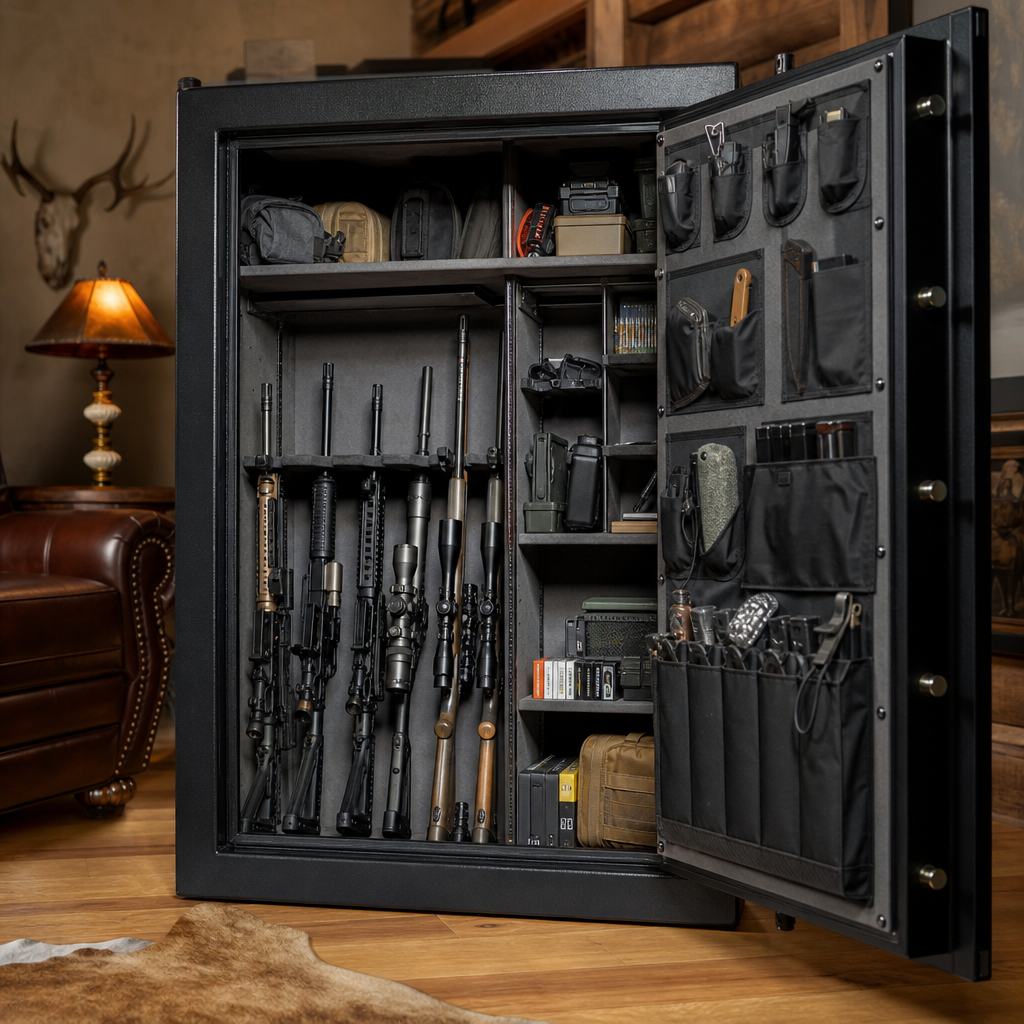
Modular interior customization is the feature that separates a merely large gun safe from a truly useful one, because storage needs change long before the steel box wears out. In practical terms, a modular gun safe uses adjustable shelves, movable barrel rests, configurable door panels, slide-out racks, and accessory bins that can be rearranged without tools or with minimal hardware. For owners balancing long guns, handguns, optics, documents, magazines, and valuables, that flexibility matters more than headline capacity numbers printed on a brochure. I have set up safes for households with six scoped rifles, competitive shooters with pistols and ammo arriving in waves, and collectors whose layouts changed every season. The best gun safes that feature modular interior customization let you adapt the space as your collection, family needs, and security priorities evolve.
This buying guide matters because many shoppers still choose by exterior dimensions, lock type, and fire rating alone, then discover the interior wastes space or forces unsafe stacking. A safe advertised for thirty guns may hold closer to fifteen once optics, bipods, slings, and modern sporting rifles enter the picture. Modular systems address that problem by converting dead zones into usable storage and reducing contact between firearms. They also help with organization, which directly affects safety: a layout that separates loaded defensive access, archived paperwork, cleaning supplies, and range gear lowers the chance of mishandling and speeds retrieval under stress. As the central buying guide in a broader gun safes and safety library, this article explains what modular customization means, which brands execute it well, what specifications actually matter, and how to match a safe to your real inventory rather than an optimistic catalog claim.
What Modular Interior Customization Actually Includes
When manufacturers say a gun safe has a modular interior, the term can mean very different things. At the entry level, it may be no more than adjustable shelves on side rails. Better systems include full-width shelf tracks, split shelving for mixed long-gun and storage sections, interchangeable pistol holsters on door organizers, and removable barrel supports that can be repositioned around optics. Premium interiors add pull-out gun racks, gear cradles, vertical divider kits, and LED-compatible panel systems that support future add-ons. The key idea is not simply adjustability, but repeatable reconfiguration without compromising storage density or protection.
The best designs use rigid, felt-lined or fabric-wrapped components that protect finishes while maintaining structure under weight. I strongly prefer interiors built around pegboard-style or slot-track panels over loose foam inserts, because panels age better, support more configurations, and are easier to clean. Door organizers deserve special attention. A well-designed panel can store handguns, passports, suppressor paperwork where legal, choke tubes, magazines, and cleaning tools, freeing the main cavity for long guns. In small and midsize safes, that one feature often increases practical capacity more than an extra inch of width.
Another important distinction is whether customization is factory integrated or dependent on aftermarket kits. Integrated systems from established manufacturers tend to fit tightly and preserve access to dehumidifiers, power ports, and anchor holes. Aftermarket systems can still be excellent, especially for legacy safes, but they require closer measurement and may interfere with hinge-side access or shelf clearance. If you know your collection will change, buy the safe with the strongest built-in framework you can afford.
How to Evaluate the Best Gun Safes for Flexible Storage
Start with steel thickness, because interior flexibility is worthless if the enclosure itself is underbuilt. Many residential security containers rely on 12-gauge to 14-gauge bodies, while stronger mid-tier safes move toward 10-gauge or composite constructions. Door construction, hard plate protection around the lock, relockers, and robust boltwork all matter more than plush upholstery. In the field, I have seen buyers get distracted by deluxe interiors and overlook a thin cabinet body that can be attacked much faster than they expected. Security first, then layout.
Next, examine the interior support architecture. Ask whether shelves are rated for ammunition weight, whether rifle racks accommodate scoped firearms without offset crowding, and whether the vertical spacing can be changed independently on both sides. Measure your longest firearm with its optic installed and compare that to the safe’s interior height minus shelf thickness and barrel rest depth. This step eliminates many regrettable purchases. The same goes for door depth. Some organizer panels reduce interior clearance enough to create conflicts with long optics or magazine-fed rifles.
Fire protection should be reviewed realistically. Manufacturers commonly list fire ratings from thirty to one hundred twenty minutes, but the testing standard varies widely. Independent verification such as UL classifications is more meaningful than unsupported marketing language. Fireboard layers, door seals, and body construction all influence performance. For documents, I generally recommend separate document protection inside the safe, such as a smaller UL-rated document box, because gun safe fire ratings are not always equivalent to true media or paper preservation ratings. Modular storage helps here by making room for nested protection.
Lock choice shapes day-to-day usability. Mechanical dial locks are proven and low maintenance, electronic keypad locks offer speed, and redundant systems combine access options. If the safe will be opened often, a quality electronic lock from a recognized maker such as SecuRam, Sargent and Greenleaf, or La Gard is usually the practical choice. If you favor minimal electronics, a mechanical lock remains a sound option, though it slows access. Either way, verify serviceability, warranty support, and battery access if applicable.
| Buying factor | What to look for | Why it matters |
|---|---|---|
| Interior system | Adjustable shelves, movable racks, door panel storage | Adapts to changing firearm and gear mix |
| Body and door steel | Heavier gauge steel, reinforced door, relockers | Improves resistance to pry and attack |
| Real capacity | Layout for scoped rifles and accessories, not brochure count | Avoids overcrowding and firearm contact |
| Fire protection | Documented testing, seals, layered insulation | Provides more credible heat resistance |
| Lock system | Quality electronic or mechanical lock from known brands | Balances speed, reliability, and service support |
Top Brands and Models Known for Modular Interiors
Browning is one of the first names I mention when buyers ask about modular interiors because its Axis Adjustable Shelving and DPX door systems have long set a practical benchmark. The Axis setup allows shelves and long-gun sections to be rearranged in meaningful ways rather than just shifted slightly. In real homes, that means one side can hold scoped hunting rifles while the other converts to shelves for handguns, binoculars, and paperwork. The DPX door panel increases handgun and accessory storage without consuming much usable width. Browning safes are not all built to the same steel standard across every line, so evaluate each series individually, but the interior engineering is consistently strong.
Liberty is another major contender, particularly in lines that offer flexible shelving and door organizer packages. Liberty’s interiors are usually straightforward to configure and supported by a large dealer network, which helps with parts and service. Models in the Colonial, Fatboy, and Franklin families often appeal to buyers who need mixed-use storage and broad availability. I have found Liberty’s strongest advantage is usability: owners tend to keep these safes organized because the systems are intuitive rather than fussy. That matters more than it sounds, since the best interior is the one you continue using correctly after the first month.
Vaultek enters the conversation from a different angle. Its RS series focuses on modular rifle storage with modern accessory management, smart features, and flexible rack systems for tactical firearms, optics, and gear. These are especially relevant for buyers whose collection leans toward modern rifles, suppressor-ready setups where lawful, and frequent-access defensive storage. Vaultek’s approach trades some traditional large-safe volume for a more contemporary organizational system. For apartments, offices, and compact rooms, that can be the right answer.
SecureIt deserves serious attention because modularity is central to its design philosophy. Instead of forcing owners into a carpeted traditional layout, SecureIt uses a CradleGrid-style organization system that supports highly customized placement of firearms and accessories. This is one of the best solutions for avoiding stock-to-stock contact and making room for optics, lights, and odd-form-factor firearms. It is particularly strong for users who rotate equipment often, including instructors and competitive shooters. The tradeoff is that some buyers expecting classic heavy safe proportions may need to compare specific models carefully for burglary resistance and fire protection relative to conventional options.
Higher-end brands such as Rhino Metals, Sports Afield in selected lines, and Fort Knox also offer customizable interiors worth considering. Fort Knox stands out for semi-custom ordering, allowing buyers to specify shelf and rack arrangements closer to the factory. That matters if you already know your collection profile and want to minimize compromise. Rhino’s modular shelving in some models is practical for households wanting a balance of traditional safe form and updated interior flexibility. The best choice ultimately depends on whether your priority is maximum security, fastest access, most adaptable organization, or the best blend of all three.
Matching the Interior Layout to Your Collection and Room
The right modular interior starts with an inventory, not a budget spreadsheet. Count long guns by actual configuration: scoped bolt actions, AR-pattern rifles with magazines inserted, shotguns with side saddles, youth rifles, and takedown models all occupy space differently. Then count handguns, optics not mounted, magazines, important documents, and high-value accessories such as rangefinders or night vision where legal. Once you map the real load, divide items into daily access, occasional use, and archive storage. This one exercise often reveals that a so-called gun safe is also being asked to function as a home security hub.
Room placement changes what interior layout works best. In a tight closet installation, deep door organizers can limit access. In a garage, you may need more shelving for ammo cans, dehumidification accessories, and maintenance gear, though heavy ammunition is often better stored separately to avoid overloaded shelves and difficult moves. In a bedroom, fast access may matter more than total capacity, favoring a layout with a clear defensive zone and reduced clutter. Modular safes shine here because they let you reserve one section for immediate-use firearms while keeping the rest structured for longer-term storage.
Plan for growth honestly. Most buyers underestimate how quickly optics, spare magazines, and family documents consume interior space. I generally advise choosing a safe with at least twenty-five to thirty percent more practical room than your current collection requires. Practical room means after accounting for scopes and organizers, not brochure capacity. Anchoring is non-negotiable for all but the heaviest installations. A lighter safe with a smart modular interior still needs to be bolted down according to manufacturer instructions and local flooring conditions.
Common Buying Mistakes and How to Avoid Them
The most common mistake is confusing customizable with spacious. A modular interior improves efficiency, but it cannot override narrow depth or poor door clearance. Before buying, request interior dimension drawings, not just exterior size. Another frequent error is ignoring accessory weight. Shelves loaded with ammunition, camera gear, or coin collections may sag if they were designed mainly for soft goods or a few pistols. Ask for shelf load guidance and distribute heavy items low in the safe.
Buyers also overvalue decorative interiors and undervalue installation logistics. Plush lining, LED kits, and chrome hardware are fine additions, but they do not compensate for a safe that cannot be moved through the doorway, anchored on the intended floor, or opened fully in the chosen corner. Measure hallways, turns, and door swing before purchase. If the safe includes a power outlet kit, verify cord routing and whether the interior modular components block access.
Finally, do not assume every dealer understands practical capacity. Bring your own measurements and photos of your firearms with optics attached. A good dealer will discuss shelf placement, door organizer interference, desiccant or electric dehumidifier placement, and likely future expansion. That conversation is usually more valuable than a discount on a model that fits poorly.
How to Make the Final Decision
The best gun safe that features modular interior customization is the one that protects your firearms adequately, fits your room, and can be reorganized as your collection changes without turning into a puzzle. Prioritize security construction, then judge interior flexibility by your actual inventory. Favor systems with adjustable shelves, meaningful door storage, and support for scoped rifles rather than inflated capacity claims. Compare lock quality, fire testing credibility, warranty support, and dealer service before deciding.
For many households, Browning and Liberty offer the easiest path to a balanced traditional safe with useful modular features. For modern rifle owners and compact-space users, Vaultek and SecureIt deserve close comparison. For buyers with exacting layout needs, semi-custom options from premium makers can save years of compromise. Whichever route you choose, measure carefully, anchor the safe properly, and leave room for growth. If you are building out your gun safes and safety plan, use this guide as the starting point, then compare detailed reviews, installation advice, and accessory guides before you buy.
Frequently Asked Questions
What does modular interior customization actually mean in a gun safe?
Modular interior customization refers to a safe layout that can be changed as your storage needs evolve, rather than forcing you to live with a fixed arrangement of shelves and gun slots. In a modular gun safe, components such as shelving, barrel supports, door organizers, pistol racks, storage bins, and sometimes even entire interior panels can be repositioned, removed, or swapped out with little effort. That makes it possible to create space for scoped rifles, short-barreled firearms, handguns, ammunition, documents, jewelry, suppressor accessories, and other valuables without wasting capacity.
This matters because most owners do not keep the exact same collection for years at a time. A safe that works well for six long guns and a few papers may become inefficient once optics get larger, accessories multiply, or family storage needs change. Modular interiors solve that problem by letting the owner adapt the safe to current use instead of replacing the entire unit. The best examples include adjustable shelf tracks, removable vertical partitions, flexible door panel systems, and slide-out or pull-out storage that improves access. In short, modular customization turns a gun safe from a static metal box into a practical, long-term storage system.
Why is a modular interior better than simply buying a larger gun safe?
A larger safe can certainly provide more cubic space, but space alone does not guarantee usable organization. Many oversized safes disappoint owners because the interior remains rigid, with fixed gun racks and shelf positions that do not accommodate real-world combinations of firearms and valuables. You may end up with wasted vertical gaps, blocked access to shorter firearms, or awkward storage around bulky optics and accessories. A modular interior addresses those inefficiencies by allowing the storage layout to match what you actually own.
That flexibility often gives you more practical capacity than a bigger but poorly designed safe. For example, being able to move shelves, remove rifle sections, or add door-mounted pistol holders can free up the main compartment for long guns while keeping smaller items visible and secure. It also helps with future-proofing. Collections grow, home security needs change, and many owners eventually want to store passports, cash, backup drives, estate documents, or heirlooms alongside firearms. A modular setup gives you the freedom to reconfigure the interior instead of buying a second safe sooner than expected. For most buyers, that means better organization, better access, and a much smarter long-term investment.
Which modular interior features are most useful when comparing the best gun safes?
The most useful modular features are the ones that improve both capacity and accessibility. Adjustable shelves are one of the most important, because they let you create custom heights for ammunition, documents, optics, or electronics instead of being stuck with factory spacing. Movable barrel rests and repositionable long-gun supports are also valuable, especially if you own rifles with large scopes, pistol grips, bipods, or other accessories that make standard rack spacing too tight. Door panel organizers deserve close attention as well, since they can hold handguns, magazines, knives, paperwork, and small valuables while freeing up the floor and shelves inside the safe.
Other standout features include slide-out racks, pull-out shelving, modular bins, and removable interior sections. Slide-out systems are particularly useful in deeper safes where items placed in the back would otherwise be hard to reach. Accessory bins help keep smaller gear sorted rather than piled together. Some premium safes also include interchangeable shelving and gun-storage modules, allowing the interior to shift between more rifle space and more general storage space as needed. When comparing models, look beyond the marketing phrase “customizable interior” and examine how easily components move, how securely they lock into place, and whether the design truly accommodates different firearm sizes and storage priorities. The best modular interiors are not just adjustable on paper; they are genuinely practical in everyday use.
Are modular interiors durable and secure, or do adjustable components make a safe less reliable?
A well-designed modular interior should not compromise the core security of the safe. The steel body, door construction, locking mechanism, boltwork, fire lining, and anchoring capability remain the primary factors that determine burglary resistance and overall protection. Interior customization components are there to improve organization, not replace structural elements. In quality gun safes, shelves, rack systems, and door panels are built to handle repeated adjustments and normal loading without sagging, shifting excessively, or interfering with the door and locking bolts.
That said, build quality varies widely. In lower-end safes, interior parts may feel flimsy, use weak clips or thin fabric-backed panels, or offer limited weight support for heavier gear. That does not necessarily make the safe insecure, but it can make the modular system frustrating over time. A better approach is to evaluate the interior the same way you would evaluate any functional storage system: check the sturdiness of shelf supports, the stability of pistol pockets and door organizers, the fit of movable racks, and the amount of weight each shelf can hold. A strong modular interior should feel intentional and well-engineered, not like an afterthought. So yes, adjustable interiors can absolutely be durable and reliable, provided the safe is built by a manufacturer that treats organization as part of the product’s long-term value rather than a cosmetic feature.
How should I choose the best modular gun safe for my current needs and future growth?
Start by thinking about what you need to store now, then add room for how your collection and household needs may change over the next several years. Count your long guns realistically, especially those with scopes, slings, lights, bipods, or wide stocks, because these take up more space than manufacturer capacity ratings often suggest. Then consider handguns, magazines, ammunition, important documents, cash, jewelry, hard drives, and other valuables that may also end up inside the safe. Once you understand your real storage profile, look for an interior that can shift between rifle-heavy and shelf-heavy configurations without requiring complicated tools or expensive replacement parts.
It is also smart to focus on layout efficiency, not just total size. A safe with adjustable shelves, a useful door organizer, configurable long-gun supports, and pull-out storage may serve you better than a larger model with a rigid interior. Review shelf placement options, check whether interior modules can be removed or repositioned, and pay attention to access. If retrieving a handgun, document, or accessory requires unloading half the safe, the design is not as practical as it should be. Finally, do not ignore the fundamentals: verify the lock type, steel thickness, fire protection claims, hinge design, bolt coverage, and anchor options. The best modular gun safe is one that pairs strong physical security with a flexible interior system that can evolve with your collection instead of limiting it.