
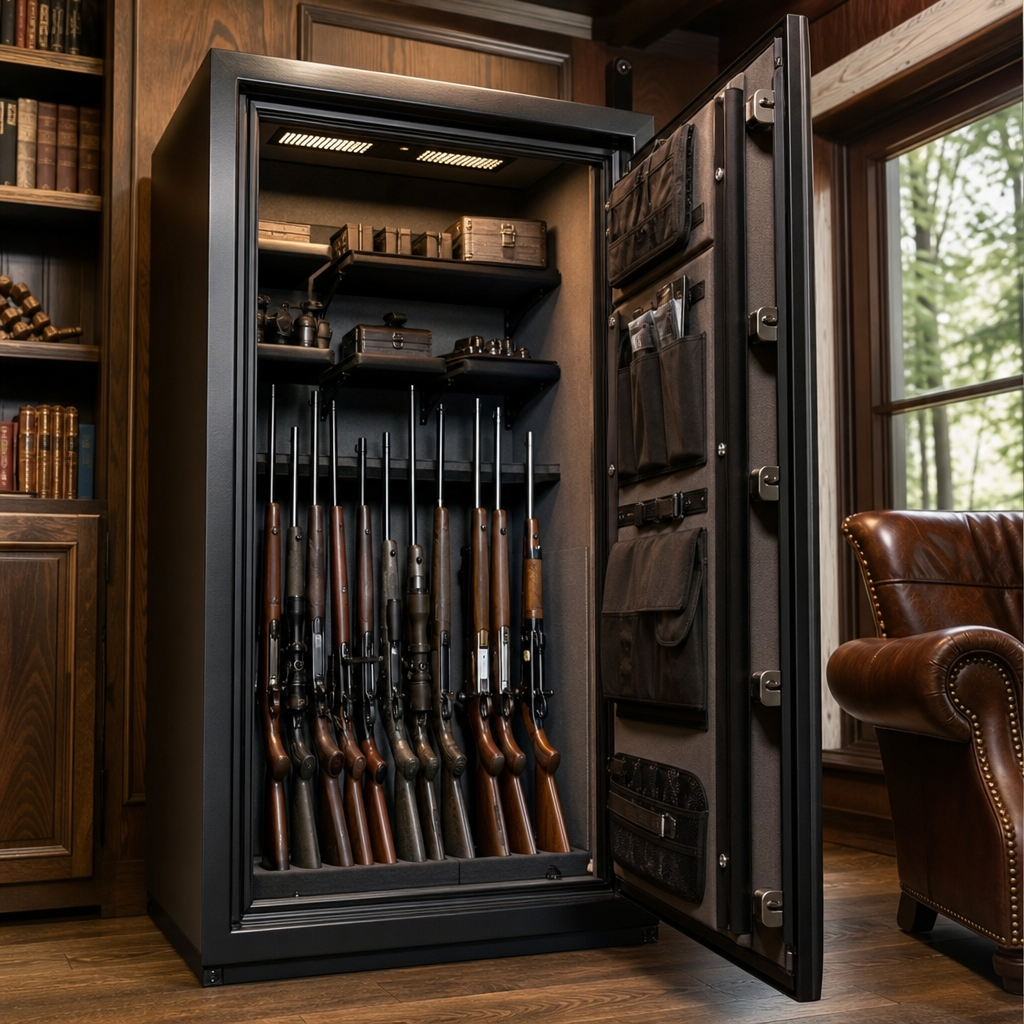
Best gun safes that offer climate control for delicate firearms solve a problem many owners underestimate until rust freckles a barrel, wood stocks swell, or optics fog after a humid season. Climate control in a gun safe means actively managing humidity and, in some cases, temperature stability inside the enclosure so firearms, ammunition, documents, and accessories remain protected from corrosion and material degradation. Delicate firearms include blued steel heirlooms, finely checkered walnut-stock rifles, engraved shotguns, precision rifles with expensive optics, and collectible handguns whose value depends on original finish. I have seen beautiful firearms lose value because they were stored in a strong safe with poor internal conditions; security alone did not stop oxidation.
This buying guide is the hub for evaluating climate-controlled gun safes because the right purchase depends on more than burglary ratings or glossy paint. You need to understand safe construction, sealing, dehumidification methods, interior volume, power access, fire protection, and placement inside the home. A climate-controlled gun safe is not always a factory feature. Often it is a well-built safe designed to support climate control through an electrical outlet kit, tight door seal, adjustable shelving, and enough internal space for air circulation. The best choice balances security, preservation, and realistic day-to-day use, especially if your collection includes wood-and-steel firearms stored for years rather than weeks.
Buying guides for gun safes can be confusing because marketing terms are inconsistent. One brand advertises a “sealed environment,” another promotes a “dehumidifier-ready interior,” and another bundles an electric rod and calls the package climate management. The practical question is simpler: can the safe maintain humidity low enough to inhibit rust without creating damaging dryness for wood furniture? In most homes, the target is usually around 45 to 55 percent relative humidity. Below that range, wood may dry excessively over long periods; above it, corrosion risk rises fast, especially where temperatures fluctuate. Understanding that middle zone helps you compare products with more confidence.
What climate control in a gun safe actually requires
A gun safe does not need refrigeration-grade temperature control to protect firearms. In normal residential use, effective climate control means limiting moisture, reducing temperature swings, and preventing stagnant air pockets. The two most common tools are desiccants and electric dehumidifiers. Desiccants, such as rechargeable silica canisters, absorb moisture and work well in smaller safes or as backup protection. Electric dehumidifiers, including low-wattage heating rods like GoldenRod units, warm the air slightly so moisture does not condense on metal surfaces. In larger safes, I prefer pairing a rod with a digital hygrometer because it gives continuous humidity feedback instead of guesswork.
Door seals matter more than many buyers think. A safe with a continuous door seal helps reduce external humidity exchange, especially in garages, basements, and coastal homes. However, a perfectly sealed safe without a dehumidification plan can trap moisture introduced by a damp firearm case, recently handled guns, or humid room air from the last opening. That is why outlet access is a major buying criterion. If a safe cannot route power cleanly to a dehumidifier, light kit, or sensor, climate control becomes inconvenient and owners often skip it. The best gun safes for delicate firearms make these add-ons easy to install and maintain.
Fireproofing also affects internal climate. Many fire liners use gypsum-based materials that contain chemically bound water. During a fire, that water helps absorb heat, but in ordinary use some safes can feel slightly humid when new, especially if they were stored in a damp warehouse. I routinely recommend letting a new safe settle indoors, monitoring humidity with a digital meter, and running a dehumidifier immediately. This is especially important for collectors storing case-colored receivers, vintage revolvers, and older doubles with oil-finished stocks. Security features can coexist with preservation, but only if the buyer treats interior conditions as part of the core specification, not an afterthought.
Key buying factors that separate average safes from the best options
The best gun safes that offer climate control for delicate firearms share several structural traits. Steel thickness is first. Many big-box cabinet-style products use thinner bodies that resist casual access but do little for serious forced entry and often flex enough to compromise door alignment. Better safes use thicker steel bodies, reinforced door edges, hard plates over locks, and relockers. For climate control, that rigidity matters because the door closes more consistently against the seal. Interior layout is next. If long guns are packed too tightly, air circulation drops and humid microclimates form around soft cases, slings, and foam-lined shelves. Adjustable shelving and modular racks are worth paying for.
Lock type influences usability. Mechanical dial locks are durable and time-tested, while electronic keypad locks offer faster access and simpler multi-user operation. From a climate-control perspective, the lock matters less than reliability, but I have found electronic models encourage owners to open safes more often for inspection, which is useful if you are actively monitoring a collection. Fire rating should be read carefully. Minutes alone are not enough; look at the tested temperature and whether the rating comes from independent verification or internal claims. A safe rated for 60 to 90 minutes at meaningful temperatures from a reputable manufacturer is usually a sensible baseline for a serious home collection.
Capacity claims are almost always inflated. A “24-gun” safe may realistically hold 12 to 16 scoped rifles with adequate spacing. For climate control, underfilling is better than maxing out every slot. You want room for air movement, rod placement at the bottom, and shelves for desiccants, humidity meters, and paperwork. Weight and anchoring are equally important. Even a heavy safe should be bolted down to concrete or robust framing because theft often involves tipping and prying rather than carrying. Finally, consider serviceability. The best buying guide advice I can give is to choose a safe from a manufacturer with accessible replacement parts, lock support, and documented interior dimensions.
| Buying factor | What to look for | Why it matters for delicate firearms |
|---|---|---|
| Humidity management | Outlet kit, door seal, hygrometer compatibility | Prevents rust, mold, and stock movement |
| Steel and door design | Thicker body, reinforced door, relockers | Improves security and consistent sealing |
| Interior layout | Adjustable shelves, wider spacing, carpeted supports | Reduces contact damage and stagnant air pockets |
| Fire protection | Credible rating, expanding seal, quality insulation | Adds disaster protection without ignoring moisture issues |
| Power access | Factory outlet or pass-through kit | Makes dehumidifiers and sensors practical long term |
Best safe categories for different collections and living environments
For heirloom sporting guns and collectible long guns, premium traditional safes from brands such as Liberty Safe, Fort Knox, Browning, American Security, and Rhino often make the most sense. These models commonly offer upgraded door seals, interior outlet kits, better shelving, and stronger steel than entry-level competitors. A Liberty Franklin or Presidential, for example, gives enough internal flexibility for dehumidifier rods, pistol racks, and humidity monitors while maintaining robust fire protection. Browning’s Axis shelving is useful when storing mixed firearm sizes because it opens air channels between long guns and accessories. American Security BF series safes remain standout choices where burglary resistance is prioritized alongside preservation.
For humid basements, garages, and coastal climates, composite safes with strong seals and reliable electrical access are usually safer bets than thin steel cabinets marketed with a small desiccant pack. In those environments, I advise buyers to think in systems: the safe, the room, and the monitoring setup work together. A quality compressor dehumidifier in the room may lower the burden on the safe’s interior devices. If you live in Florida, the Gulf Coast, or the Pacific Northwest, that room-level control can be the difference between stable 50 percent humidity and a constant fight against moisture every time the door opens.
For apartment owners or smaller collections, a compact gun safe with a factory outlet and enough room for a rechargeable desiccant can work well, provided the firearms are not packed tightly. Vertical home-defense safes can protect a few defensive rifles, but they are usually less suitable for collectible finishes and long-term storage because they prioritize access over internal climate stability. If your main concern is preserving a handful of high-value handguns, a burglary-rated safe with shelves, silicone-treated socks, and active humidity control may outperform a tall “gun safe” with less precise organization. The category should fit the collection, not the label on the showroom tag.
How to evaluate climate-control accessories and setup after purchase
The safe itself is only half the solution. Once installed, climate control depends on the accessories you add and how you use them. Start with a calibrated digital hygrometer; without measurement, you are guessing. Many affordable units from SensorPush, Govee, or Cigar Oasis-style monitor systems track humidity trends over time, which is far more useful than a single reading. Place the sensor at mid-height, not directly beside the heating rod. For larger safes, I often use two sensors because humidity can vary from bottom to top, especially when ammunition cans, fabric cases, or document boxes block airflow near the floor.
Choose dehumidifiers based on safe size and room conditions. Heating rods are simple, durable, and effective when the safe has moderate leakage and the room is not extremely damp. Eva-Dry and other rechargeable desiccants are useful backups or primary solutions in small enclosed spaces, but they require discipline because owners forget to recharge them. In a high-humidity setting, use both. Keep firearms lightly protected with quality rust-preventive products such as Break-Free CLP, Eezox, or collector-focused oils, but avoid over-oiling wood-contact areas. Moisture barriers like silicone gun socks add scratch protection and reduce sudden condensation risk, though they should never substitute for actual humidity control.
Placement changes outcomes dramatically. Avoid exterior walls with frequent temperature swings, direct sun, unconditioned garages, and damp basement corners unless the safe and room are both actively managed. Leave a little clearance behind and above the safe if manufacturer instructions permit, because trapped dead air can amplify temperature differences. When moving firearms into the safe after range use, let them reach room temperature first. I have seen condensation form when a cold rifle from a truck case goes straight into a warm safe. That moisture event may be brief, but over months it creates the kind of recurring exposure that damages bluing and encourages hidden rust under grips.
Common mistakes buyers make when shopping for a climate-controlled gun safe
The biggest mistake is assuming “fireproof and waterproof” automatically means ideal for delicate firearms. Fire resistance and water resistance are valuable, but both can introduce moisture management challenges if the safe is not ventilated and dehumidified properly in normal use. Another common error is buying for today’s collection instead of the likely five-year collection. Once optics, suppressor accessories, paperwork, handguns, and magazines are added, the interior gets crowded fast. Crowding raises the risk of finish wear and blocks airflow. Buyers also underestimate the value of professional delivery and anchoring, which protects the safe from both theft tactics and door misalignment.
A second mistake is trusting factory capacity numbers, generic online reviews, or a showroom demo without checking internal measurements, outlet location, shelf dimensions, and actual seal design. Look for continuous door seals, not just isolated contact points. Read warranty terms, especially for lock replacement, fire claims, and moving costs after a covered event. If the manufacturer does not clearly state steel gauge or thickness, that omission is informative. Finally, do not install foam-lined hard cases, wet slings, or cardboard boxes inside the safe for long-term storage without monitoring humidity. Those materials hold moisture and create localized corrosion zones even when the overall safe reading looks acceptable.
How this buying guide helps you choose the right next step
The best gun safe for climate control is the one that preserves your specific firearms under your specific household conditions while still delivering real security. Start by identifying the most sensitive items in your collection: blued steel, engraved surfaces, walnut stocks, old paper records, or premium optics. Then match those needs to a safe with credible steel construction, a practical fire rating, adjustable interior space, and built-in support for power and humidity monitoring. Add the climate accessories on day one, not after the first humid summer. If you treat humidity control as essential equipment rather than an optional accessory, your firearms will look, function, and hold value better over time.
As the hub for gun safe buying guides under Gun Safes & Safety, this page should point your next research steps. Compare full-size premium safes, compact handgun safes, fire-rated models, and installation planning with the same standard: can this setup maintain stable conditions for delicate firearms year-round? That question keeps you focused on preservation and not just marketing. A well-chosen safe protects against theft, fire, neglect, and environmental damage at the same time. Use this guide to narrow your shortlist, measure your space, and build a complete storage plan with monitoring, anchoring, and maintenance so your collection stays secure and genuinely preserved for the long term.
Frequently Asked Questions
What does climate control in a gun safe actually mean, and why is it important for delicate firearms?
Climate control in a gun safe refers to managing the internal environment so moisture and temperature swings do not damage the contents over time. For delicate firearms, this matters far more than many owners realize. Bluing, case hardening, polished steel, engraved surfaces, wood stocks, leather slings, optics, and even paper records can all suffer when humidity rises and falls unchecked. Rust can begin as faint surface speckling on a barrel or receiver, then progress into pitting. Walnut and other hardwood stocks can absorb excess moisture, swell slightly, and eventually warp or crack as conditions fluctuate. Scopes may develop internal fogging issues, and ammunition stored in damp conditions can degrade in reliability over the long term.
In practical terms, climate control usually means using dehumidification tools inside the safe, such as electric dehumidifier rods, desiccant packs, or more advanced humidity-monitoring systems. Some premium safes are built with tighter seals, better insulation, and interior systems designed to help maintain a stable environment more effectively than basic models. The goal is not to create a refrigerator-like chamber, but to keep relative humidity in a safer range and reduce sudden shifts that encourage condensation. For collectors, heirloom owners, and anyone storing high-value or sentimental firearms, climate control is one of the most important features because it helps preserve metal finishes, stock fitment, optical clarity, and overall value.
What humidity level is best inside a gun safe for protecting firearms, wood stocks, and optics?
A commonly recommended target for the interior of a gun safe is around 45% to 50% relative humidity, though anywhere in the general 40% to 50% range is often considered a strong balance for most firearm collections. This range is low enough to discourage rust and corrosion on steel components, while still being moderate enough to avoid drying out wood stocks excessively. If humidity climbs too high, corrosion risk increases quickly, especially in enclosed spaces where moisture can linger. If it drops too low for extended periods, certain wood components and natural materials may dry out more than desired.
The ideal setting can vary depending on what is in the safe and the climate where you live. A collector storing blued steel shotguns with finely finished walnut stocks may prioritize a stable middle-ground humidity level. Someone in a coastal or southern environment may need more active moisture control than an owner in a dry inland region. It is also smart to use a hygrometer inside the safe rather than guessing. Digital hygrometers with min-max tracking let you see patterns over time, which is far more useful than checking conditions only occasionally. If your readings are regularly above 55%, your dehumidification setup may need improvement. If your safe stays in the low 30s and contains older wood-stocked firearms, you may want to dial things back. Stability is just as important as the number itself, because constant swings can stress wood, finishes, and accessories even if the average humidity seems acceptable.
Are electric dehumidifiers better than desiccants for a climate-controlled gun safe?
Neither option is universally better in every situation, but electric dehumidifiers are often the more convenient long-term solution for a frequently accessed gun safe, while desiccants are useful for supplemental protection or for safes without power access. Electric dehumidifier rods work by gently warming the air inside the safe, which helps reduce condensation and improves air circulation. They are low-maintenance, designed for continuous use, and especially practical in larger safes or humid climates. Once installed, they generally require little attention beyond making sure they remain powered and unobstructed.
Desiccants, on the other hand, absorb moisture directly from the air. Rechargeable silica gel canisters are popular because they are simple, affordable, and do not require permanent wiring. They work well in smaller safes, cabinets, or secondary storage setups. However, they have limited capacity and need to be dried out or replaced regularly. In very humid environments, they can saturate faster than owners expect. That means protection can fade quietly if you are not monitoring conditions with a hygrometer.
For many gun owners, the best answer is to combine both methods. An electric rod can provide steady baseline moisture control, while a desiccant pack helps catch excess humidity spikes. This layered approach is particularly useful for delicate firearms, antique pieces, engraved guns, and collections with expensive optics. The safe itself also matters. A well-built safe with solid seals and quality construction will help any climate-control system work more effectively than a thin cabinet with poor environmental resistance. If you are investing in a safe specifically to protect fine firearms, think of dehumidification as part of a complete system rather than a single gadget.
What features should I look for in the best gun safe with climate control for heirloom or high-end firearms?
If you are shopping for one of the best gun safes that offers climate control for delicate firearms, start by looking beyond simple storage capacity. The first priority is a well-built safe with strong construction, because climate control works best when the enclosure itself is designed to limit outside air exchange. Look for a safe with a tight-fitting door, reliable seals, solid steel construction, and an interior layout that allows air to circulate rather than trapping moisture in crowded corners. A power outlet or pass-through for electrical accessories is especially helpful if you plan to use an internal dehumidifier rod, lighting, or digital humidity monitoring equipment.
Interior materials also matter. Soft-lined shelves, adjustable racks, and supportive barrel rests can help protect delicate finishes and wood furniture from scratches and pressure points. If you are storing heirloom guns, deep interiors and flexible shelving can keep firearms from leaning awkwardly against one another, which is important for preserving stock integrity and avoiding finish wear. Fire protection is another key consideration, not because it replaces climate control, but because documents, valuables, and collectible firearms often need both forms of protection. A good safe should also allow easy installation of hygrometers and desiccants so you can fine-tune the environment rather than assume it is under control.
For premium collections, useful climate-related features include factory-installed electrical ports, better insulation, upgraded door seals, and interiors designed to support low-humidity maintenance. Some higher-end models are simply better at maintaining stable internal conditions because they are more robustly built. Also consider where the safe will be placed. Even the best safe performs better in a climate-moderated room than in a damp garage or unfinished basement. In short, the right safe combines security, thoughtful interior protection, power access for humidity control, and enough structural quality to keep the internal environment more stable over time.
Can a climate-controlled gun safe completely prevent rust, stock damage, and moisture problems?
A climate-controlled gun safe can dramatically reduce the risk of rust, corrosion, stock swelling, and moisture-related damage, but it should not be viewed as a complete guarantee. Safe climate control is one layer of protection, not a substitute for proper firearm maintenance and smart storage habits. Firearms should still be cleaned after handling and use, especially if they have been exposed to humidity, rain, fingerprints, or temperature changes. Metal surfaces benefit from an appropriate protective oil or rust preventive, and wood stocks should be kept clean and maintained according to the manufacturer’s or collector’s recommendations.
Moisture issues can still occur if the safe is placed in a problematic location, opened frequently in humid conditions, overloaded so air cannot circulate, or left unmonitored. One common mistake is assuming that adding a dehumidifier means the job is done forever. In reality, climate control works best when paired with periodic checks of relative humidity, seasonal adjustments, and occasional inspection of the firearms themselves. Another issue is condensation from sudden temperature changes. If a firearm is brought in from a cold environment and placed directly into a warmer safe, moisture can form on the metal before the safe’s climate-control setup has a chance to stabilize things.
The safest approach is to think in terms of prevention and routine. Use a quality safe, monitor humidity, maintain the firearms, avoid damp installation locations, and inspect high-value pieces regularly. When done properly, a climate-controlled gun safe can make a major difference in preserving blued steel heirlooms, fine walnut-stocked rifles, collectible handguns, precision optics, and related accessories. It may not eliminate every risk in every circumstance, but it is one of the most effective steps you can take to protect delicate firearms for the long term.