
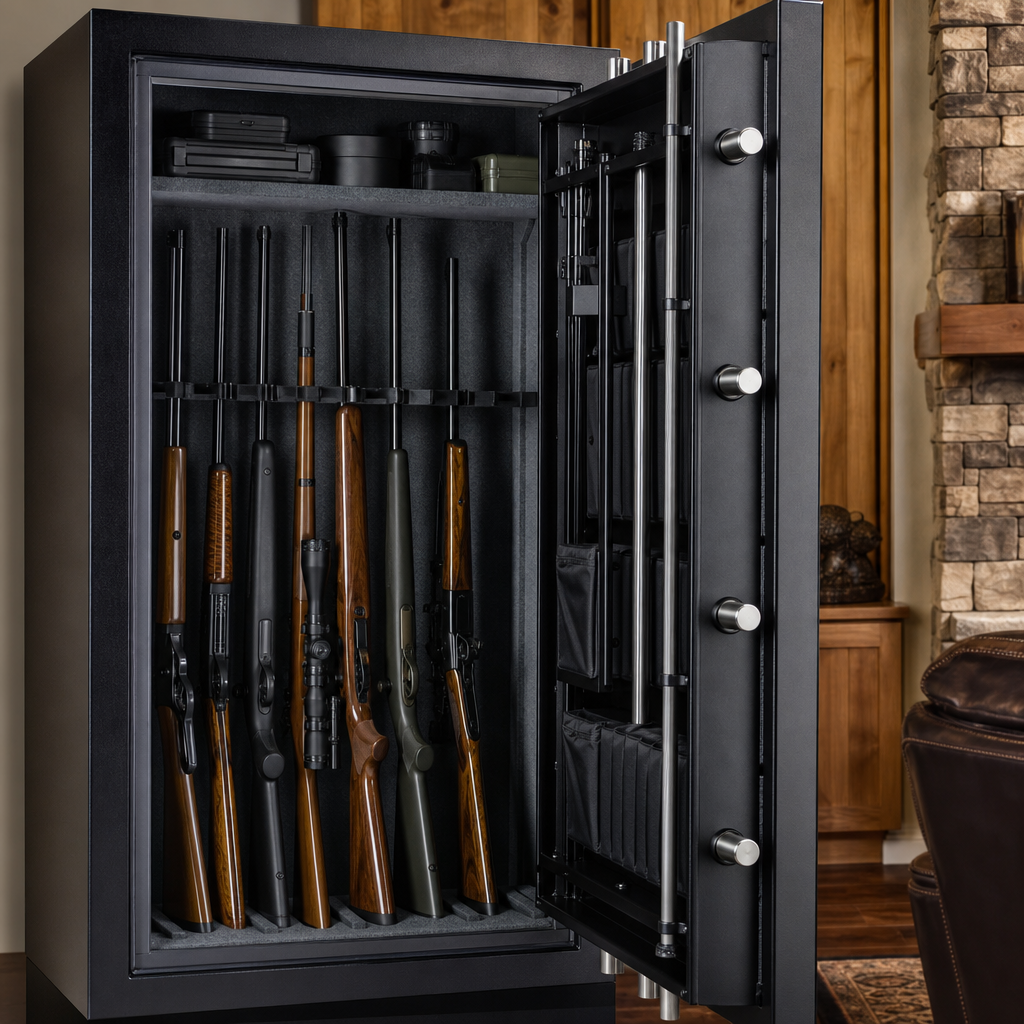
The best gun safes that provide reinforced steel bars for extra locking strength do one job better than ordinary cabinets: they resist forced entry by spreading pry pressure across multiple hardened locking points instead of relying on a simple door edge and key lock. In practical buying terms, reinforced steel bars are the live or dead bolts that extend from the door into the safe body, usually on two to four sides, creating a stronger seal against crowbars, screwdrivers, and peel attacks. For buyers building a dependable home-defense or collection-storage setup, this feature matters because gun safes are judged less by marketing labels and more by steel thickness, bolt design, lock quality, fire protection, and installation. I have evaluated safes in homes, retail showrooms, and delivery inspections, and the pattern is consistent: a thick door with weak boltwork is less reassuring than a well-engineered body-and-door system with robust bars, solid relockers, and proper anchoring. This buying guide serves as a hub for choosing the right model within the broader Gun Safes & Safety category, helping you compare construction types, understand ratings, and identify which features genuinely improve security. If you are shopping for long-gun storage, handgun access, or mixed-use protection for documents and optics, reinforced steel bars should be assessed alongside burglary resistance, fire performance, interior capacity, and long-term serviceability.
A gun safe, strictly speaking, is a secure storage container designed to restrict unauthorized access to firearms while protecting them from theft, fire, and in some cases humidity damage. Some products marketed as “gun safes” are closer to Residential Security Containers, or RSCs, the category defined under UL 1037 for limited attack resistance. That distinction matters. An RSC can still be a strong consumer choice, but it should not be mistaken for a commercial-grade TL-rated burglary safe. Within the consumer market, extra locking strength usually comes from larger-diameter steel bolts, reinforced lock plates, anti-pry tabs, continuous welds, and doors supported by composite structures rather than simple sheet steel shells. Buyers often focus on capacity first, yet the real decision starts with risk: Are you preventing child access, stopping opportunistic theft, delaying a prepared burglar, or seeking a balance of all three? Once that is clear, the buying process becomes more disciplined. You can compare AMSEC, Fort Knox, Liberty, Browning, Rhino Metals, Vaultek, and SecureIt by measurable attributes instead of branding alone, and you can choose a safe that suits your floor load, room layout, insurance requirements, and firearm count without paying for features you will never use.
How Reinforced Steel Bars Improve Gun Safe Security
Reinforced steel bars improve locking strength by increasing the number and distribution of contact points between the door and the safe body. In plain terms, when a thief pries at one corner of the door, the force must overcome not just a latch near the handle but multiple steel bolts or bars extending into reinforced receivers. Better safes place these bars along the opening side and often the top and bottom edges. Some use active bolts driven by the handle; others combine them with dead bars on the hinge side so the door cannot be removed even if hinges are cut. In field comparisons, the safest designs do not simply advertise “10 bolts” or “14 locking points.” They pair bolt count with meaningful bolt diameter, deep engagement depth, hardened steel hardplates protecting the lock, and relockers that trigger if the lock is punched or drilled.
There is also an important distinction between round bolts, rectangular bars, and continuous dead-bar systems. Round bolts are common and effective when properly supported, but rectangular steel bars can provide broader engagement and resist localized deformation. Continuous bars, used in some higher-end designs, spread stress over a larger area and help reduce door flex under prying. None of these features should be judged in isolation. I have seen inexpensive safes boast numerous decorative bolts on the hinge side that do not actually contribute to primary security. What matters is whether the bars engage reinforced frames, whether the door edge is tightly toleranced, and whether the surrounding steel is thick enough to prevent the frame itself from bending. A safe with fewer, stronger locking bars and heavier steel often outperforms one with a long feature list and lighter construction.
What to Look for in a Buying Guide Comparison
The most useful buying guide starts with five criteria: steel thickness, lock system, locking-bar design, fire protection, and installation method. Steel thickness is commonly listed in gauge, but brands do not always make apples-to-apples comparisons because doors may use composite construction while bodies use a different gauge. As a rule, lower gauge numbers mean thicker steel. Many mass-market safes use 14-gauge to 12-gauge bodies, while better units move into 10-gauge, 7-gauge, or heavier plate steel. A reinforced locking system is significantly more effective when paired with heavier body steel; otherwise, pry resistance shifts to the weakest component. Lock systems matter just as much. A UL-listed mechanical lock remains a benchmark for reliability, while modern electronic locks offer speed and multiple user codes. Premium electronic options from SecuRam, S&G, and La Gard are far superior to generic keypads with vague specifications.
Fire protection deserves scrutiny because advertised minute ratings often reflect proprietary testing rather than independent standards. Look for details: temperature reached, duration, whether the rating includes a cool-down period, and whether door seals expand under heat. For many households, a realistic objective is enough fire resistance to survive a localized residential fire while preserving firearms, paper documents, and optics. Installation is the fifth factor buyers underestimate. A safe with reinforced steel bars can still be tipped, removed on a dolly, or attacked elsewhere if it is not bolted to concrete or structurally sound flooring. Placement in a corner, closet, or alcove can reduce pry access. This hub page should guide buyers to think like a security planner, not just a shopper comparing glossy brochures.
Best Gun Safe Types for Different Buyers
Not every buyer needs the same safe format. Full-size long-gun safes are the default choice for rifle and shotgun owners, especially when scopes, slings, suppressor-ready spacing, and document shelves are part of the plan. These models benefit most from reinforced steel bars because their taller doors create more leverage for pry attacks. A strong multi-side bolt system is especially important here. Handgun safes, by contrast, are often chosen for quick access, bedside placement, or vehicle use. In that segment, reinforced side bars may be less visible in the marketing, but internal steel lugs, anti-pry lips, and rigid door frames serve a similar purpose. Brands such as Vaultek emphasize speed, while Fort Knox and V-Line lean into heavy steel and Simplex-style mechanical access on selected models.
There is also a growing market for modular and agile gun storage systems. SecureIt, for example, focuses on organized access and military-inspired interior layouts. These products can be excellent for responsible storage, but buyers seeking maximum anti-pry strength should compare door construction and locking bars carefully because organizational convenience is not identical to burglary resistance. For households with children, the best buying choice often combines a larger anchored safe for long-term storage with a smaller rapid-access pistol safe for defensive readiness. For collectors, interior flexibility matters almost as much as security. Barrel rests, adjustable shelving, and power ports for dehumidifiers improve real-world use. The ideal hub recommendation is not one “best” model for everyone, but a shortlist aligned to use case, threat level, and room constraints.
How Leading Brands Compare on Reinforced Locking Strength
Among major brands, AMSEC is widely respected for pairing credible steel construction with dependable lockwork across several price tiers. Its BF series, for example, is known for robust door construction and higher-end security features than many big-box offerings. Fort Knox has a strong reputation for customization, heavier steel options, and substantial boltwork, making it attractive to buyers who want to specify body thickness and interior configuration. Liberty remains one of the most recognized names in the consumer market, with broad dealer support and models that range from accessible entry points to more serious security-focused units. Browning emphasizes storage layout and access efficiency, which many rifle owners appreciate, though construction details should still be compared model by model rather than by brand alone.
| Brand | Known Strength | Best For | Buying Caution |
|---|---|---|---|
| AMSEC | Strong lockwork, respected security heritage | Buyers balancing burglary and fire protection | Check exact series; specs vary widely |
| Fort Knox | Heavy steel options, custom configurations | High-security residential buyers | Cost rises quickly with upgrades |
| Liberty | Wide availability, broad lineup | Mainstream buyers wanting dealer support | Compare body steel and lock tier carefully |
| Browning | Efficient interiors, practical storage design | Owners maximizing long-gun capacity | Interior benefits do not replace thicker steel |
| Rhino Metals | Solid aesthetics, competitive feature sets | Buyers wanting premium fit and finish | Verify independent details behind claimed ratings |
Rhino Metals, including lines such as Ironworks and Kodiak, often appeals to buyers who want a premium look without abandoning practical security features. In my experience, brand reputation helps narrow the field, but serious buyers should still verify the exact gauge, bolt count, lock brand, relocker presence, and warranty terms on the specific model under consideration. A dealer who can explain the difference between a decorative hinge, a dead bar, and a true multi-directional locking system is usually worth more than a temporary sale price. The best comparison standard is not the logo on the door but how the safe performs against the most common residential attack methods: prying, drilling, lock punching, and attempted removal.
Important Tradeoffs: Fire Ratings, Capacity Claims, and Installation
The strongest buying guides acknowledge tradeoffs. First, more steel usually means more weight and higher cost. A 10-gauge or 7-gauge body with reinforced bars is materially better for burglary resistance than a lighter unit, but it may require professional delivery, stair assessment, and reinforced flooring considerations. Second, fire ratings are often presented in ways that sound uniform when they are not. One safe rated for 60 minutes at 1,200 degrees Fahrenheit may not be equivalent to another rated for 75 minutes under a different testing protocol. Ask whether the test was internal or third-party, whether seams were protected by intumescent seals, and whether the interior temperature stayed below the threshold that damages paper or sensitive accessories.
Capacity claims are another frequent pain point. A “36-gun safe” rarely stores 36 scoped modern rifles in a practical arrangement. Realistic capacity is often 50 to 70 percent of the sticker number, especially if you own AR-platform rifles, lever guns with optics, or shotguns with extended controls. That is why reinforced locking strength should be considered alongside usable interior dimensions, not just external size. Installation completes the picture. Bolting the safe down is nonnegotiable for burglary resistance, and humidity control is essential in basements, garages, and seasonal climates. GoldenRod dehumidifiers, silica systems, and basic hygrometer monitoring can prevent rust that slowly damages both firearms and optics. Good storage is not only about resisting thieves; it is about preserving condition over years of use.
How to Choose the Right Gun Safe for Your Home
Start by listing what you need to store today, then add room for growth. Most owners underestimate future purchases, ammunition segregation needs, and document storage. Next, define your threat level. If your priority is child safety and basic theft deterrence, a well-made RSC with reinforced steel bars, a UL-listed lock, and proper anchoring may be sufficient. If you have a valuable collection, live in an isolated area with slower police response, or want stronger delay against determined attacks, move toward thicker steel and more advanced boltwork. Then measure your space carefully, including doorways, stair turns, and floor load. Weight distribution matters in second-floor installations.
Finally, buy through a reputable dealer or manufacturer that publishes detailed specifications and supports parts, lock replacement, and warranty service. Read the fine print on forced-entry coverage, fire replacement policies, and lock labor reimbursement. If possible, inspect the door gap, handle feel, weld quality, and interior fit in person. Reinforced steel bars are a critical feature, but the best gun safe is the one whose entire construction, placement, and daily usability support safe firearm ownership. Use this hub as your starting point, compare models systematically, and choose a safe that protects both access control and long-term value. When you are ready, shortlist three models, verify their steel and lock details, and invest in the one you can anchor and use confidently for years.
Frequently Asked Questions
What do reinforced steel bars actually do in a gun safe, and why are they better than a basic locking door?
Reinforced steel bars are one of the key features that separate a true gun safe from a lightweight cabinet or basic lockbox. Their main job is to secure the door at multiple points so that forced entry becomes much more difficult. Instead of relying on a single latch or a simple lock at the door edge, these bars extend from the door into the body of the safe, often along two, three, or even four sides. That creates multiple hardened contact points that help resist prying, peeling, and twisting attacks.
In practical terms, this matters because most break-in attempts against residential safes are not sophisticated. Thieves typically use pry bars, screwdrivers, hammers, or leverage tools to attack the door seam. A safe with reinforced steel bars spreads that pressure across several locking points rather than allowing all force to concentrate on one weak spot. That makes it harder for the door to flex or pop open, especially if the safe also has a solid steel plate door, a reinforced frame, and tight door tolerances.
Another advantage is overall door stability. Reinforced locking bars can help keep the door aligned and tightly sealed when locked, which improves both security performance and the feel of the safe over time. Buyers should remember, though, that locking bars are only part of the equation. Their effectiveness depends on the thickness of the door, the quality of the steel, the strength of the frame, the internal relocker system, and proper anchoring. In other words, reinforced steel bars are a major strength upgrade, but they work best as part of a well-built safe rather than as a standalone marketing feature.
How many locking bars or bolts should a good gun safe have?
There is no single magic number that guarantees security, because the quality, size, placement, and depth of engagement of the locking bars matter just as much as the total count. That said, a well-designed gun safe often uses multiple live bolts or steel bars around the door perimeter, commonly on at least two sides and sometimes on three or four sides. Many better safes advertise anywhere from several bolts to more than a dozen, but shoppers should be careful not to assume that a higher number automatically means a better safe.
What matters more is how those locking points are engineered. Large-diameter hardened bolts that engage deeply into a reinforced frame are generally more valuable than a long list of smaller, shallow locking points used mainly for advertising. The arrangement also matters. If the safe only secures one side of the door heavily while leaving other edges vulnerable, it may still be susceptible to pry attacks. A balanced multi-side locking design usually offers better resistance because it distributes stress and reduces weak points around the perimeter.
For most buyers, the smartest approach is to look at the full construction profile rather than chase a bolt count. Check the steel thickness of the body and door, whether the hinge side includes fixed dead bars, whether the safe has anti-pry tabs or a stepped door design, and whether it has independent security testing or a recognized burglary rating. If a manufacturer explains not just how many locking bars are present but also where they are positioned and how they interact with the frame, that is usually a better sign than a simple headline number on a spec sheet.
Are reinforced steel bars the same thing as locking bolts, live bolts, and dead bolts?
These terms are related, but they are not always identical. In the gun safe market, manufacturers often use phrases like reinforced steel bars, locking bolts, active bolts, live bolts, and dead bolts somewhat interchangeably in their marketing. In general, live bolts are locking components that move when you turn the handle or operate the lock mechanism. Dead bolts, by contrast, are fixed locking elements that do not move with the handle but still help secure the door, especially on the hinge side.
Reinforced steel bars can refer broadly to the hardened steel locking members that extend from the door into the safe body. In some designs, they are round bolts. In others, they may be rectangular bars, flat bars, or continuous locking rails. The core idea is the same: they create multiple secure contact points to strengthen the door against forced entry. The exact shape is less important than the material strength, thickness, and how well the mechanism is protected inside the door.
For buyers, the important takeaway is to read beyond the label. A manufacturer may highlight reinforced bars, but you should still verify whether the safe includes both active locking points and fixed anti-pry support on the opposite side. It is also worth confirming whether the mechanism is shielded against punch attacks, drilling, and tampering. A good safe uses a complete locking system, not just prominent-sounding terminology. If product specifications are vague, asking the manufacturer about bolt diameter, number of locking sides, and whether the hinge side has dead bars can give you a much clearer picture of real security.
Do reinforced steel bars make a gun safe pry-proof?
No gun safe should be considered completely pry-proof, and any product advertised that way deserves closer scrutiny. Reinforced steel bars absolutely improve resistance to pry attacks, but they do not make a safe invulnerable. Given enough time, leverage, tools, and privacy, a determined attacker can eventually defeat many residential safes. The goal of reinforced locking bars is to make entry much more difficult, slower, louder, and riskier, which is exactly what most homeowners need in real-world conditions.
The reason they help so much is that they force an attacker to overcome multiple hardened locking points instead of defeating one weak latch or exploiting a thin door edge. When pry force is applied, a multi-point locking system can hold the door in place across a wider area, reducing flex and limiting the chance that one corner or edge can be peeled back. However, overall pry resistance still depends heavily on the door construction, the frame design, body steel thickness, weld quality, and whether the safe is properly anchored to the floor or wall structure.
Anchoring is especially important. Even a strong safe with reinforced steel bars loses a lot of its advantage if thieves can tip it over and attack it from a more favorable angle. Mounting the safe securely helps preserve the effectiveness of the locking system and prevents thieves from carrying the unit away for later attack. So while reinforced steel bars are a major anti-pry feature, the best way to think of them is as part of a layered defense system that includes heavy-gauge steel, a quality lock, relockers, anti-drill protection, and solid installation.
What else should I look for in a gun safe besides reinforced steel bars?
Reinforced steel bars are important, but they should never be the only feature guiding your decision. Start with steel thickness, because the body and door material determine how well the safe resists cutting, bending, and prying. A safe with impressive locking bars but thin sheet metal construction may still be easier to breach than a more robust model with fewer but better-engineered locking points. Door design also matters. Look for recessed or pry-resistant doors, reinforced door frames, and tight gaps that make it harder to insert tools.
You should also evaluate the lock type. Quality electronic locks offer speed and convenience, while mechanical dial locks are valued for long-term reliability and independence from batteries. Whichever style you prefer, it should come from a reputable lock manufacturer and ideally be paired with relockers and hard plate protection against drilling or punch attacks. Fire protection is another major category to compare, especially if you are storing important documents, optics, or valuables alongside firearms. Pay attention to tested fire ratings, not just broad claims, and understand the temperature and time standards being cited.
Capacity, interior layout, and installation are just as important for day-to-day satisfaction. Many safes advertised for a certain number of long guns hold fewer once you add optics, slings, and accessories, so it is wise to buy larger than your current needs. Adjustable shelving, door organizers, dehumidification options, and interior lighting can make a big difference in usability. Finally, consider third-party certifications, warranty support, replacement guarantees, and the reputation of the manufacturer. The best gun safe is not simply the one with the biggest locking bars on paper; it is the one that combines strong anti-pry engineering, reliable locking hardware, practical storage, and proper installation in your home.