How gun safe fireproofing standards differ by country matters because a “fireproof safe” label can mean very different levels of protection depending on where the safe is tested, how the test is run, and what temperature limit is considered acceptable for firearms, documents, or ammunition. In practical terms, buyers shopping within the broader Gun Safes & Safety category often assume a listed fire rating is universal. It is not. I have reviewed safe specifications, certification sheets, and test summaries across multiple markets, and the biggest mistake I see is comparing minutes alone without examining the underlying standard. A safe rated for sixty minutes in one country may endure a very different furnace curve, drop test, humidity condition, or internal temperature threshold than a safe carrying the same claim elsewhere.
Fireproof and disaster-resistant storage includes protection against house fire, wildfire exposure, structural collapse, water from sprinklers or firefighting, corrosion after humidity spikes, and in some cases explosive heat buildup around stored ammunition. Fire resistance refers to how long the container limits internal temperature rise during a prescribed test. Disaster resistance is broader and includes water seals, impact integrity, anchoring, smoke control, and post-fire accessibility. For gun owners, this topic matters beyond property value. Excess heat can damage optics, weaken lubricants, degrade stocks, ruin records, and in severe cases create unsafe storage conditions after a fire event. Understanding standards by country helps you read product claims correctly, compare safes fairly, and choose a model suited to your actual risk profile rather than a marketing headline.
This hub article explains the major testing approaches used in North America, Europe, and Asia-Pacific markets; where manufacturer-declared ratings fit in; how document safes differ from gun safes; and what features support real-world performance during fire and other disasters. It is designed as a starting point for deeper articles on insulation materials, water resistance, placement strategy, insurance requirements, and post-fire recovery. If you want one guiding principle up front, use this: compare the certifying body, test temperature curve, internal temperature limit, duration, and any drop or hose-down component before trusting a fire rating on a gun safe.
Why fire ratings are hard to compare internationally
Fire testing is not one single global system. Standards differ in purpose, specimen preparation, pass criteria, and classification labels. Some are built around paper document protection, where the internal temperature generally must stay below about 177°C or 350°F because paper chars around that point. Others are aimed at data media, where acceptable internal temperatures are far lower because magnetic and digital media fail sooner. Gun safes sit awkwardly between categories. Firearms can tolerate higher temperatures than paper in some components, but wood stocks, polymer frames, optics, adhesives, lubricants, and important records stored alongside guns often cannot. That mismatch is why a gun safe marketed with a paper-safe style rating may still leave owners with damaged accessories after a severe fire.
Another source of confusion is the difference between independent certification and manufacturer testing. In the United States, many gun safes are advertised with time-and-temperature claims based on factory protocols rather than third-party certification. Some brands are transparent about this and publish furnace temperatures, sensor locations, and whether the test included a cool-down period. Others provide only a badge such as “90 minutes at 1200°F,” which gives too little information to judge. In Europe, certified safes more often reference a specific EN standard and class, but even there, not every cabinet sold for firearms is independently fire certified. Country-level regulation of firearm storage may focus on burglary resistance and access control, leaving fire protection optional.
Real fires also vary from lab tests. A garage fire can burn hotter and longer than a furnished room. Wildfire ember intrusion may ignite structures externally before a room flashover occurs. Firefighters may flood a safe with thousands of liters of water during suppression. A safe on an upper floor may fall through a weakened structure. Because of these variables, the best reading of any standard is comparative rather than absolute: it tells you how one product performed under a defined method, not how it will perform in every disaster scenario.
United States and Canada: marketing claims, UL benchmarks, and practical gaps
In North America, consumers encounter a mix of independent and self-declared ratings. Underwriters Laboratories remains the most recognized name. UL 72 is the classic fire test for record protection equipment, with classes such as Class 350 for paper, Class 150 for microfilm, and Class 125 for data media. These ratings combine a duration with a protected internal temperature threshold. For example, a Class 350 one-hour container is intended to keep the interior below 350°F during the prescribed test. The important point for gun buyers is that most residential gun safes on the market are not UL 72 listed. They may use gypsum board insulation and have internal tests, but that is not the same as a UL fire-endurance listing.
The gap appears clearly in retail specifications. A mass-market gun safe might claim thirty to ninety minutes at temperatures ranging from 1200°F to 1400°F, often without stating whether the clock stops when the furnace turns off or continues through the cool-down phase. In my experience reviewing these claims, the cool-down period is critical. Heat soak continues after external flames diminish, and many failures happen during cooling because insulation and steel release stored heat inward. Better manufacturers state whether the safe remained below a target interior temperature for the full cycle, including cool-down. Better still are those that reference independent labs such as Intertek/ETL or issue a complete test report summary.
Canada broadly overlaps with the U.S. market, though insurers and commercial buyers may pay closer attention to ULC or UL-related documentation. For residential gun owners, the practical buying environment is similar: many products rely on manufacturer ratings, and direct comparison requires careful reading. A useful rule is to treat vague fire claims as lower-confidence data and place more weight on safes with published methodology, door-seal details, body insulation thickness, and independent verification.
Europe: standardized classifications and clearer certification language
European markets generally use more standardized fire classifications. EN 1047-1 covers fire-resistant safes and data cabinets with classes such as S 60 P or S 120 P for paper, and analogous data classes with lower internal temperature limits. EN 15659 introduces lighter-duty fire storage units classified as LFS 30 P or LFS 60 P, commonly used where moderate document protection is needed. These standards specify furnace exposure and performance outcomes more rigorously than many consumer gun-safe marketing claims in North America. When a safe is certified to an EN fire class by a recognized body such as ECB-S or VdS, the buyer has a much firmer basis for comparison.
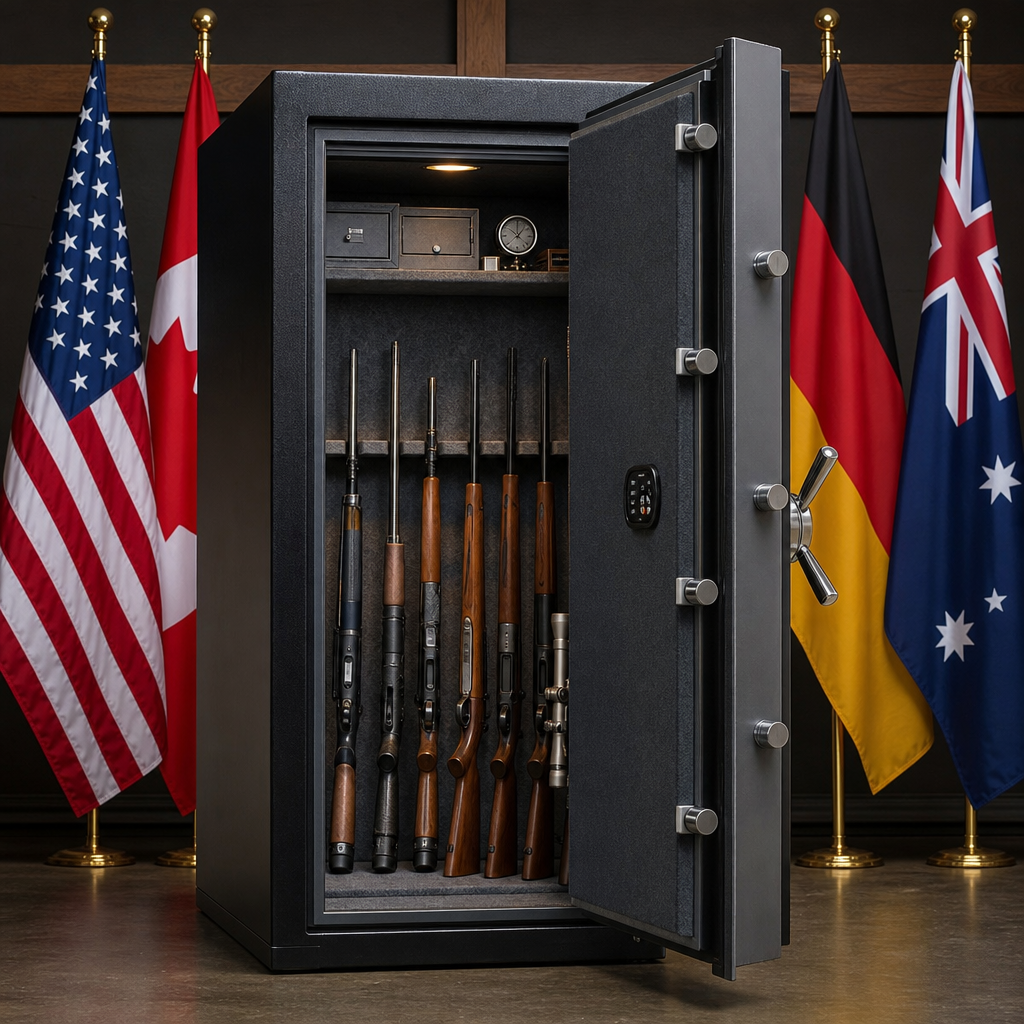
That said, firearm storage rules differ across European countries, and burglary resistance often receives more legal emphasis than fire. Germany, for example, is well known for linking firearm storage to burglary-resistance standards such as EN 1143-1 for safes and secure cabinets. A German gun owner may therefore buy a compliant burglary-rated safe and then separately evaluate whether it offers EN 15659 or EN 1047-1 fire protection. In the United Kingdom, insurers and police guidance may shape the market differently, with cabinets for shotgun or rifle storage often prioritizing security anchoring and hidden installation over strong fire certification. Across Europe, the lesson is the same: legal storage compliance does not automatically equal fire resilience.
European certification language is often more precise, which benefits buyers. If a product is labeled LFS 60 P, that shorthand carries information about duration and media type. It also limits the room for inflated comparisons. A lighter gun cabinet with no EN fire class should not be assumed equivalent to a certified fire-resistant safe simply because both are sold for firearms. For households storing passports, deeds, suppressor paperwork, and digital backups with guns, that distinction matters.
Asia-Pacific markets: JIS influence, mixed import practices, and local conditions
Asia-Pacific is less uniform because local manufacturing, imported brands, and national testing traditions all intersect. Japan has long used Japanese Industrial Standards for fire-resistant storage, especially in document-safe categories, and the market tends to respect formal test classifications. However, not every firearm container sold across the region is built or certified under a dedicated local gun-safe fire standard. Australia and New Zealand often draw from imported European and American products, with consumer understanding shaped by insurer requirements, bushfire risk, and strict firearm storage laws focused mainly on unauthorized access.
Bushfire exposure changes the conversation in Australia in particular. A standard internal-structure fire test may not fully represent radiant heat, ember attack, prolonged external heating, and utility loss during a wildfire event. In practice, buyers in high-risk regions should prioritize not only the listed fire duration but also intumescent door seals, continuous weld quality, multi-layer insulation, and room placement away from external walls or attached garages. Imported safes can perform well, but label translation and distributor marketing sometimes blur whether the rating came from an overseas certifier, a factory test, or a simple equivalence claim.
In Southeast Asia, humidity can be as damaging as fire. A disaster-resistant strategy often includes dehumidifiers, desiccants, corrosion inhibitors, and sealed document pouches inside the safe. Regional buyers should therefore read fire standards alongside climate-control features. A fire-rated safe that traps moisture after monsoon conditions or post-suppression flooding can still cause significant firearm damage.
How major standards differ in practice
The table below shows why similar-sounding labels may not mean the same thing when comparing gun safe fireproofing standards by country.
| Region | Common reference | Main focus | Typical pass basis | Buyer caution |
|---|---|---|---|---|
| United States | UL 72 or manufacturer test | Record protection or brand claim | Time plus interior temperature threshold; many gun safes self-tested | Minutes alone are not comparable without method details |
| Canada | UL/ULC-related documentation and manufacturer test | Similar to U.S. residential market | Mixed independent and self-declared ratings | Verify lab, cool-down, and sensor placement |
| Europe | EN 1047-1, EN 15659 | Certified protection for paper or data media | Defined classes such as LFS 60 P or S 120 P | Fire certification may be separate from firearm-storage compliance |
| Japan | JIS-based safe testing traditions | Formal fire classification, especially documents | Standardized testing within domestic framework | Confirm relevance to firearms and imported products |
| Australia/NZ | Imported EU/U.S. ratings plus local retail claims | Security compliance with growing fire concern | Varies by imported certification or factory test | Bushfire conditions may exceed typical house-fire assumptions |
Three variables drive most of the differences. First is the furnace curve, meaning how quickly and how high the external temperature rises. Second is the interior threshold: paper-safe limits are far lower than what a bare steel firearm might survive, but your documents and optics follow the lower threshold. Third is the test sequence. Some standards include impact or drop components, explosion hazard checks, or reheating after a fall. These added steps are valuable because houses do collapse and safes do get drenched and shifted during real incidents.
What “fireproof” should mean for firearms, optics, ammunition, and records
No safe is literally fireproof under all conditions. “Fire-resistant” is the more accurate term, and responsible manufacturers use it. For firearms, the vulnerable items are often not the steel actions but everything attached to or stored beside them. Scope internals, red-dot electronics, suppressor tax paperwork, passports, hard drives, and family records may fail at temperatures much lower than the firearm itself. Ammunition introduces another nuance. Sporting ammunition stored in a safe can cook off in an intense fire, but without chamber confinement it typically presents less projectile hazard than many people assume. The bigger concern is pressure, smoke contamination, and the challenge it creates for recovery and cleanup.
That is why the best disaster-resistant gun safe setup usually layers protection. Use the main gun safe for burglary resistance and moderate fire endurance, then add a smaller certified document or data insert for the most heat-sensitive items. I have seen this approach work well for collectors who need one secure location for firearms, titles, trust documents, and digital backups. It avoids overpaying for a very large high-end fire safe when the most fragile contents occupy only a small volume.
How to evaluate a gun safe when standards differ by country
Start with five questions. Who tested it? Which standard was used? What was the interior temperature limit? Did the rating include the cool-down period? Was there any drop, impact, or water exposure component? If a seller cannot answer those basics, treat the fire claim as weak. Then inspect construction. Composite doors, multiple insulation layers, expanding seals, robust hinge-side protection, and continuous body welds usually correlate with better real performance than decorative thickness claims. Weight also matters. Heavier safes often contain more insulating mass, though weight alone is not proof of quality.
Placement remains one of the most effective upgrades. Install the safe on the lowest practical floor, away from fuel loads, exterior wildfire exposure, and areas likely to trap water. Anchor it correctly, but avoid creating an unsealed path for water ingress through the floor if the design requires a bottom seal. Keep critical papers in sealed fire pouches or a certified insert. Use dehumidification consistently. Finally, align the safe with your insurance documentation. The best rating is the one you can verify after a loss.
Gun safe fireproofing standards differ by country because countries use different test methods, certification cultures, and consumer expectations. North America blends strong benchmark standards with widespread manufacturer-declared claims, so buyers must read beyond the advertised minutes. Europe offers clearer certified classes, but firearm-storage compliance and fire protection are often separate questions. Asia-Pacific mixes formal domestic testing, imported standards, and environmental challenges such as bushfire exposure and extreme humidity. The common thread is simple: a rating only has meaning when you know the standard behind it.
For anyone building a fireproof and disaster-resistant storage plan under the Gun Safes & Safety umbrella, the smartest approach is to match the safe to the contents and the local hazard. Store guns securely, but also protect optics, records, media, and paperwork according to their lower heat tolerance. Favor independent certification where possible, demand transparent test details where certification is absent, and improve outcomes with smart placement, humidity control, and layered protection. If you are comparing models now, start by making a shortlist of safes with clearly stated standards and published fire-test methodology, then use that list to guide your next purchase with confidence.
Frequently Asked Questions
Why do gun safe fireproofing standards vary so much from one country to another?
Gun safe fireproofing standards differ by country because there is no single worldwide testing system that every manufacturer, testing laboratory, or regulator must follow. Each country, or in some cases each region, tends to rely on its own historical safety codes, product certification bodies, liability rules, and consumer expectations. That means one market may emphasize document protection at a lower internal temperature threshold, while another may focus more on structural endurance, burglary resistance, or the ability to withstand a specific furnace curve for a set amount of time.
Another major reason is that “fireproof” is often used as a marketing term rather than a precise technical category. In one country, a safe may be tested by an independent laboratory under a recognized protocol; in another, a rating may come from in-house testing by the manufacturer. Even when two safes are both labeled as having a 60-minute fire rating, the conditions behind that claim can be very different. Variables can include the furnace temperature reached, how quickly the heat rises, whether the safe is preheated before testing, whether impact or drop tests are included, whether the safe is cooled naturally or rapidly, and what internal temperature is allowed before the test is considered a failure.
For gun owners, this matters because firearms, optics, paper records, electronics, and ammunition do not all tolerate heat in the same way. A rating that may be acceptable for general storage in one market may not be stringent enough for another buyer’s needs. The key point is that fire ratings are not universally interchangeable. A safe tested under one national or regional standard should not automatically be assumed to deliver identical performance to a safe carrying a similar time rating from another country.
Does a 30-minute or 60-minute fire rating mean the same thing worldwide?
No. A time-based fire rating is only meaningful when you know the exact test standard behind it. The same “30-minute” or “60-minute” label can represent very different levels of protection depending on where the safe was tested and how the test was conducted. Some standards expose the safe to higher furnace temperatures than others. Some measure whether the inside stays below a specified limit for paper documents, while others may evaluate the cabinet’s external survivability more than internal temperature control. Some tests include a cool-down phase, which is important because temperatures inside a safe can continue rising even after the external fire source is removed.
For example, one country’s test may require the internal temperature to remain below the level at which paper chars, while another may require additional performance for data media or other more heat-sensitive contents. A 60-minute rating for paper protection is not the same as a 60-minute rating suitable for digital media, and neither necessarily tells you exactly how well firearms stocks, lubricants, scopes, or ammunition components will fare. If a buyer only sees the time number without the standard, the listing can be misleading.
This is why it is important to look beyond the headline rating. The better question is not “How many minutes?” but “According to which standard, under what furnace conditions, and for what type of contents?” When comparing gun safes across countries, the test protocol and certifying organization are often more informative than the simple duration printed in product marketing.
What testing details should buyers compare when evaluating fireproof gun safes from different countries?
Buyers should compare the certifying body, the test method, the maximum furnace temperature, the rate of temperature increase, the allowed internal temperature, the duration of exposure, and whether any post-fire or impact testing was required. These details reveal far more than the word “fireproof” ever will. A safe tested by a recognized independent laboratory under a published standard generally gives buyers more confidence than a claim based only on an internal manufacturer test with limited technical disclosure.
The internal temperature threshold is especially important. Different contents fail at different temperatures. Paper records, passports, deeds, and printed manuals can tolerate more heat than hard drives, memory devices, some adhesives, polymer components, or optics-related materials. Firearms themselves are not just lumps of steel; many include wood, polymer, coatings, lubricants, mounted electronics, and sensitive accessories. A safe that technically survives a furnace test may still expose internal contents to temperatures high enough to cause damage if the standard allows a relatively high internal limit.
Buyers should also check whether the test includes a drop test or impact component. In a real house fire, a floor can collapse and the safe may fall into a lower level while still hot. Some standards account for that scenario, while others do not. Cooling method also matters. If the safe is simply removed from the furnace and evaluated immediately, that may not reflect real-world fire behavior as accurately as a test that includes a cool-down period. Finally, ask whether the claimed rating applies to the complete assembled safe in the same configuration sold to consumers, not just to insulating material or a single prototype. Those details make cross-country comparisons much more reliable.
Are independent certifications more trustworthy than manufacturer fire ratings?
In general, yes. Independent certification is usually more trustworthy because it involves testing by a third-party laboratory or certification agency that follows a published methodology and applies pass-fail criteria consistently. That does not guarantee every certified safe is equal, but it does give buyers a more objective basis for comparison. When a safe carries a fire rating supported by a known external testing organization, you can often trace the claim back to a standard, a classification, or a test report framework. That is much more useful than broad advertising language such as “factory tested,” “fire resistant,” or “up to 1,200 degrees,” which may omit critical context.
Manufacturer testing is not automatically meaningless, but it requires more scrutiny. Some manufacturers conduct legitimate internal tests, yet the problem is that test conditions can be selected in ways that are favorable to the product and difficult for consumers to verify. A company may cite peak temperature without stating exposure time, or it may advertise a temperature limit without disclosing the internal temperature reached inside the safe. In some cases, the wording is technically true but incomplete enough to create a stronger impression of protection than the data actually supports.
For buyers comparing safes across different countries, independent certification becomes even more important because it reduces ambiguity. If one safe is tested under a recognized national or regional standard and another relies only on marketing claims, they are not on equal footing. The most confident purchase decisions usually come from matching a safe’s independently verified fire performance to the actual contents being stored, rather than relying on a generic “fireproof” label.
How should gun owners use international fire ratings when choosing the right safe?
Gun owners should treat international fire ratings as a starting point, not a final answer. The first step is to identify what will actually be stored inside the safe: firearms alone, or firearms plus paper records, optics, electronics, cash, legal documents, suppressor paperwork, backup drives, or ammunition. Once you know what needs protection, you can compare the safe’s fire rating against the temperature sensitivity of those items and the exact standard used to test the unit. That is the only practical way to make sense of ratings from different countries.
It is also wise to consider your real fire risk, not just the advertised number. Home construction type, distance from the fire department, rural versus urban response time, floor location, and whether the safe will sit in a garage, basement, closet, or interior room all affect what level of protection is sensible. In some homes, a lower certified rating from a well-tested safe placed in a lower-risk location may be more practical than a heavily marketed but poorly documented “higher-rated” model. Installation matters too. Proper anchoring, avoiding direct exposure near accelerants, and choosing a location with lower expected fire intensity can materially improve outcomes.
Finally, remember that no safe is truly invulnerable. Fire ratings are controlled test results, not guarantees of survival in every structure fire. The smartest approach is to combine a properly verified fire-rated gun safe with insurance, off-site or digital backups for critical records, and realistic expectations about what the safe is designed to protect. When reading specifications from different countries, prioritize transparent testing details, independent certification, and suitability for your actual contents over simplified marketing claims.