
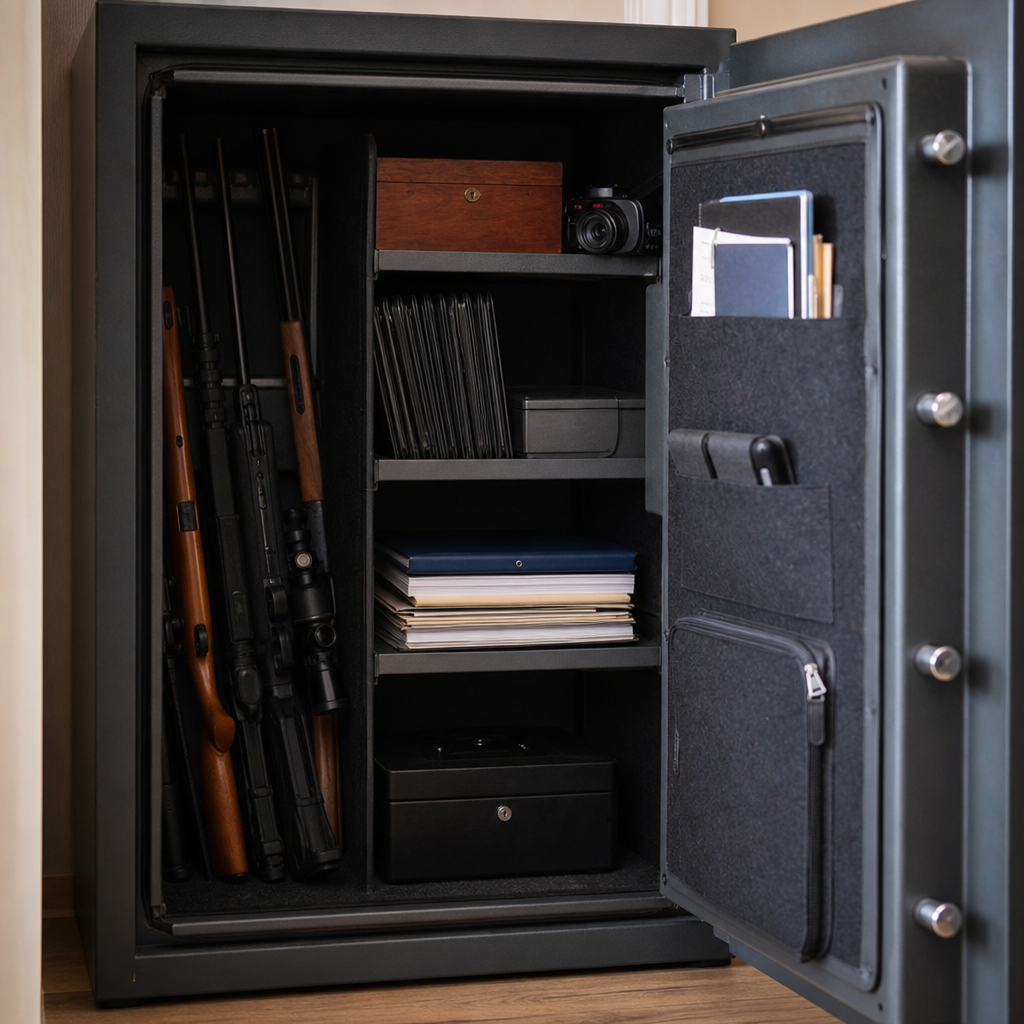
Fireproof gun safes can protect important documents, but only when buyers understand what “fireproof” really means, how long ratings last, and which disasters the safe is actually built to resist. In my experience evaluating residential safes for firearms, records, and media storage, the biggest mistake is assuming a gun safe labeled fireproof offers the same level of protection as a dedicated document safe. It usually does not. A gun safe is primarily engineered to slow forced entry and store long guns in an organized way. Fire resistance is often added through gypsum board, expanding door seals, and layered steel construction, but the interior temperatures that remain acceptable for paper are not always safe for photos, passports with chips, hard drives, or cash. That distinction matters because a house fire can exceed 1,100°F quickly, and suppression efforts add water, steam, and structural collapse risk long before the flames reach the safe.
Important documents include birth certificates, deeds, wills, insurance policies, titles, tax records, and backup media containing digital copies. Disaster-resistant storage means planning for multiple threats at once: fire, smoke, water from sprinklers or hoses, humidity, impact, and theft during the chaotic aftermath. For gun owners, combining firearms and records in one container is attractive because it centralizes security. The tradeoff is that a safe optimized for rifles may leave dead air around folders, expose paper to higher internal temperatures, and make retrieval less practical in an emergency. The right answer is not a simple yes or no. Some fireproof gun safes offer enough protection for paper documents under realistic home-fire conditions. Many offer partial protection that is good, but not complete. Others are better treated as burglary safes with limited fire resistance.
This matters because replacing critical documents is time-consuming, expensive, and sometimes impossible. A firearm collection can often be insured and replaced; an original notarized trust, irreplaceable family records, or an external drive with decades of scans may not be. If you want one storage strategy that genuinely covers “fireproof and disaster-resistant storage,” you need to read labels carefully, match ratings to what you are storing, and often add a secondary container inside the gun safe. That is the practical approach I recommend most often: use the gun safe as the theft-resistant shell, then create a controlled micro-environment for documents and sensitive media inside it.
What a fireproof gun safe actually protects against
A fireproof gun safe is not literally proof against fire in all conditions. The meaningful question is this: for how long can the safe keep the interior below a temperature that your contents can survive? Paper generally begins to char around 350°F, which is why many document safes are designed to keep interior temperatures under that threshold for a stated duration. Digital media is more fragile. Data disks, USB drives, photographs, and magnetic or solid-state storage can be damaged at much lower temperatures, and they are especially vulnerable to humidity and steam. That means a gun safe with a broad “30 minutes at 1,200°F” claim may be acceptable for paper, yet inadequate for backups or sentimental media.
Construction details matter more than marketing language. Most consumer gun safes achieve fire resistance using layers of fireboard in the walls and door, intumescent seals that expand when heated, and heavier steel that slows heat transfer. Better models use multiple layers, continuous door seals, tighter tolerances, and independent fire testing. Lower-cost units may rely on thinner steel and minimal insulation, with ratings based on internal tests that are hard to verify. When I inspect spec sheets, I look for the exact temperature and time, whether testing was performed by an independent lab such as UL or Intertek/ETL, and whether the rating references the whole safe rather than just the insulation material.
Fire is only one part of the threat profile. During a real residential fire, safes are exposed to thermal shock, falling debris, prolonged heat after flashover, and large volumes of water. If the safe’s body seam or door edge is not well sealed, water intrusion can ruin documents even when flame never enters. Smoke and corrosive combustion byproducts can also penetrate gaps and damage paper or metal. This is why “disaster-resistant storage” should be interpreted broadly. A safe that survives burn testing but leaks badly under hose exposure may still fail to protect the contents that matter most.
How to read fire ratings and separate marketing from verified performance
Fire ratings on gun safes are often confusing because manufacturers use different methods and not all tests are equal. A reliable rating specifies three things: the outside temperature, the duration of exposure, and the maximum inside temperature. For paper documents, the benchmark is usually keeping the interior below 350°F. For digital media, dedicated media safes target lower thresholds, often around 125°F with tightly controlled humidity. If a product listing says “fireproof up to 1,400 degrees” without a time period or interior limit, that statement is incomplete and should not drive your decision.
The most credible ratings come from independent testing programs. UL Class 350 is widely recognized for paper document protection, while specialized UL media classes address lower internal temperatures and humidity limits for data storage. Many gun safe brands instead publish factory test results because full certification is expensive. Factory testing is not automatically worthless, but it requires scrutiny. Ask whether the thermocouple placement was inside the cavity, whether the safe was heated on all sides, whether a cool-down period was included, and whether the safe was dropped to simulate floor collapse. If those details are absent, treat the rating as directional, not definitive.
| Claim type | What it usually means | What to verify |
|---|---|---|
| “30 minutes at 1,200°F” | Basic residential fire claim for paper storage | Independent lab, interior temp limit, full safe test |
| “UL listed fire seal” | Only a component may be certified | Whether the complete safe has a fire rating |
| “Fireproof insulation” | Marketing description of wall material | Time, temperature, and actual test protocol |
| “Water resistant” | Some protection from splash or short exposure | Depth, duration, door seal design, warranty limits |
As a working rule, higher numbers alone do not guarantee better protection. A 90-minute claim from a lightly built safe with vague testing can be less reassuring than a 45-minute rating from a heavier, better sealed unit with transparent documentation. Also consider fire dynamics in your area. Urban homes near hydrants may see faster suppression than rural properties with longer response times. If your home is remote, wildfire-prone, or built with large open floor plans that accelerate fire spread, you should choose longer fire duration and stronger water protection than the average suburban buyer.
When a fireproof gun safe is enough for documents, and when it is not
A fireproof gun safe is often enough for paper records when three conditions are met: the safe has a credible fire rating, the documents are stored low in the safe in an added protective container, and you are protecting replaceable or recoverable originals rather than highly sensitive media. Examples include insurance policies, vehicle titles, tax returns, copies of wills, and home inventories. In many households, that level of protection is practical and reasonable. If the safe is bolted down on a concrete slab, away from likely ignition sources, and located in a climate-controlled interior room rather than a humid garage, the odds improve significantly.
It is not enough when the contents are heat-sensitive, legally irreplaceable, or needed immediately after a disaster. Passports with embedded chips, family photos, external drives, notarized estate documents, and business continuity records deserve stronger environmental control than most gun safes can provide on their own. In those cases, use a dedicated UL-rated document or media chest inside the gun safe, or keep a second certified document safe elsewhere in the home. I have seen this layered setup work extremely well: the outer gun safe handled theft resistance and impact, while the inner chest preserved paper through heat and water that would have destroyed loose folders.
Capacity and organization also influence protection. Long-gun safes are vertically oriented, and many owners place documents on top shelves near the upper interior, where heat accumulates first. That is not ideal. Paper belongs as low as practical, in sealed sleeves or a dedicated file box, away from dehumidifier rods and electrical penetrations. If you routinely overpack the safe, air circulation worsens and retrieval becomes slower, increasing the chance that records end up in unprotected drawers instead. Good protection depends as much on disciplined setup as on the advertised rating.
Building true disaster-resistant storage inside and around the safe
The most effective strategy is layered protection. Start with the safe itself: choose a model with a documented fire rating, continuous expanding seal, solid boltwork, and adequate steel thickness. Then add a secondary document container inside. Waterproof and fire-rated chests from brands such as Honeywell, SentrySafe, and First Alert are common entry-level options, while higher-end document inserts provide stronger ratings and better gasket systems. Use acid-free folders, polyester sleeves for vital records, and clearly labeled envelopes so you can retrieve essentials quickly during evacuation or after a loss.
Control moisture aggressively. Fireboard-lined safes can trap humidity, and post-fire conditions create condensation that damages paper and corrodes firearms. Use a monitored dehumidifier or desiccant system, but avoid placing documents directly beside heat-generating rods. Seal digital copies in moisture-resistant pouches and store them separately from originals. The best households I advise maintain three versions of critical records: originals in the safe, scanned copies on encrypted cloud storage, and an encrypted external backup stored off-site. That approach protects against fire, burglary, flood, and simple user error.
Placement matters more than many buyers realize. A safe installed on a ground-floor concrete slab usually performs better in a fire than one on a framed upper floor that can collapse into a hotter burn zone. Avoid garages where temperature swings and humidity are severe unless the safe is specifically suited to that environment. Keep it away from fuel sources, utility rooms, and exterior walls vulnerable to storm-driven water. Bolt it down, but also elevate it slightly with a sealed base or manufacturer-approved barrier if minor flooding is possible. For homes in hurricane, wildfire, or flood regions, this site’s related guides on safe placement, humidity control, and document backup planning should be part of the same decision.
Buying checklist for the best fireproof and disaster-resistant setup
When comparing safes, focus on evidence, not labels. Ask for the fire test protocol, not just the headline claim. Confirm whether the rating is for paper or media. Check for door seals, bolt-down hardware, replacement guarantees, and water exposure details. Review interior dimensions because document boxes and rifle racks compete for space more than buyers expect. Look for lock quality from established manufacturers such as Sargent and Greenleaf or SecuRam, and decide whether an electronic lock or mechanical dial better fits your maintenance habits. Neither lock type improves fire resistance directly, but reliability after years of use affects whether you can access documents when you need them.
Finally, insure what the safe cannot fully replace. Keep a current home inventory with serial numbers, scans of receipts, and photos of high-value items. Store emergency-contact sheets, medication lists, and identity documents in a grab-and-go packet if evacuation risk is high. The best answer to whether fireproof gun safes offer enough protection for important documents is conditional but clear: they can, for many paper records, when chosen carefully and used as part of a layered storage plan. If your documents are irreplaceable, heat-sensitive, or essential for business continuity, add a dedicated document or media container and maintain secure digital backups. Review your current setup today, identify the gaps, and upgrade before the next emergency tests your assumptions.
Frequently Asked Questions
1. Do fireproof gun safes provide enough protection for important documents?
They can, but the short answer is: only sometimes, and only under the right conditions. A fireproof gun safe is usually designed first as a security container for firearms, with fire resistance added as a secondary feature. That matters because paper documents, passports, deeds, birth certificates, wills, and insurance records have different protection needs than firearms. Many gun safes are built to keep the interior below a certain temperature for a limited time, but those ratings do not always match the stricter standards used for true document safes. In practical terms, a gun safe may be good enough for basic household paperwork in a short-duration fire, but that does not mean it offers the same level of protection as a safe specifically engineered for paper records, digital media, or archival storage.
The biggest issue is that the phrase “fireproof” is often used loosely in marketing. No residential safe is literally immune to fire under all conditions. What you are really buying is a tested level of fire resistance for a set amount of time and at a specific external temperature. If your home experiences a fast, hot fire or a collapse event where the safe is exposed longer than its rating, the contents may still be damaged. So yes, a fire-rated gun safe can protect important documents, but buyers should treat that protection as conditional, not absolute. If the documents are irreplaceable, the safer approach is to use a dedicated document safe, a fire-rated document insert inside the gun safe, or off-site backup storage in addition to the gun safe itself.
2. What does “fireproof” actually mean on a gun safe label?
In most cases, “fireproof” really means “fire-resistant for a limited period under certain test conditions.” That is an important distinction. A safe may be advertised as 30 minutes, 60 minutes, 90 minutes, or even two hours at a stated temperature such as 1200°F, 1400°F, or 1700°F. Those numbers are meant to indicate how long the interior is expected to remain below a threshold that helps protect contents during a controlled fire test. The challenge is that not all ratings are created equally. Some are based on independent lab testing, while others may come from the manufacturer’s own methods, which are not always directly comparable.
For paper documents, interior temperature matters a lot. Paper begins to char and degrade as internal temperatures rise, so a true document-protection rating is more meaningful than a general “fireproof” claim. Gun safes often use layers of gypsum board or similar insulation materials in their walls, and while that can slow heat transfer, it is not the same as the construction used in higher-end document safes. Also, many labels focus on the external test temperature and duration but say little about humidity, steam penetration, door seal performance, or what happens if the safe falls through a floor during a fire. That is why shoppers should look beyond the word “fireproof” and ask: Who tested it? For how long? At what temperature? What interior temperature was maintained? Was the test relevant to paper documents, digital media, or just general fire resistance? Those details tell you far more than the label alone.
3. Are fire ratings on gun safes enough for paper records, passports, and legal documents?
Sometimes, but not automatically. A basic fire rating may be adequate for storing common paper documents if the safe is from a reputable brand, the rating is realistic, and the fire exposure stays within that tested window. For example, a well-built safe with a credible 60-minute fire rating may offer reasonable protection for household records in many residential fire scenarios. However, “reasonable” is not the same as guaranteed, and it is not the same as specialized document security. If you are storing original legal paperwork, estate planning documents, titles, family records, or anything difficult or impossible to replace, the standard should be higher.
Another factor is that not all sensitive items fail at the same temperature. Paper is more forgiving than electronic media, hard drives, USB drives, photo negatives, and optical discs. Those media types can be destroyed at temperatures well below the point where paper visibly burns. Moisture and steam inside the safe can also ruin documents even if flames never reach them. In other words, a gun safe that protects rifles from heat damage for an hour may still be a poor environment for digital backups or delicate records. If your goal is true document preservation, the best solution is often a layered one: use the gun safe for theft resistance, then place critical paperwork inside a smaller UL-rated document container or a dedicated fire-resistant document pouch or insert designed for paper storage. That setup typically gives you better odds than relying on the gun safe’s main compartment alone.
4. What should buyers look for if they want to store both firearms and important documents in one safe?
Start with realistic priorities. If the safe must handle both firearm security and document protection, do not assume the largest or heaviest model is automatically the best. You want a safe with credible fire testing, solid burglary resistance, effective door seals, and enough interior flexibility to keep documents away from heat-prone areas. Shelving layout matters more than many people realize. Documents should be stored higher in the safe if possible, inside a dedicated fire-rated organizer, box, or insert, rather than loose on the floor near steel walls that can conduct heat. The safe should also be installed in a location that reduces fire exposure, such as a lower-risk area of the home, while still being practical for access.
It is also wise to evaluate the safe as a whole system rather than just by its brochure specs. Look for continuous welds, thicker steel, reinforced door construction, and a quality expanding fire seal around the door opening. Ask whether the rating comes from an independent testing body and whether the brand has a track record of transparent specifications. Interior dehumidification is another consideration because the needs of firearms and documents can conflict: guns benefit from moisture control, while some fire-resistant materials can release moisture during a fire event. A document box or insert can help create separation between your records and the rest of the interior environment. Finally, remember that convenience should not override preservation. The more valuable and irreplaceable the documents are, the more sense it makes to combine in-home safe storage with scanned digital copies and off-site backups.
5. What are the biggest mistakes people make when relying on a fireproof gun safe for document protection?
The most common mistake is trusting the word “fireproof” without understanding the rating behind it. Many buyers assume that if a gun safe advertises fire protection, their birth certificates, deeds, tax files, estate documents, and family records are fully covered in any fire. That is rarely true. Fire resistance always has limits, and those limits may be narrower than the buyer expects. Another major mistake is overlooking the difference between paper protection and media protection. A safe that may preserve paper for a certain amount of time can still destroy USB drives, backup drives, SD cards, and photo media. People often store all of these together without realizing they have very different temperature tolerances.
Other avoidable mistakes include placing documents directly against the interior steel walls, failing to verify whether the safe’s fire rating was independently tested, and storing everything in one location with no backup plan. Homeowners also underestimate how installation affects outcomes. A safe placed in a garage, near fuel sources, or in an area vulnerable to collapse, flooding, or prolonged burn exposure may face harsher conditions than the rating suggests. And finally, many people never review whether a gun safe is truly the right tool for the job. If the documents are mission-critical, the safest strategy is not blind faith in a fire-rated gun safe. It is a layered approach: a reputable safe, a dedicated document-rated container inside it if needed, digital copies in secure cloud or off-site storage, and a clear understanding that “fire-resistant” is a performance claim with boundaries, not a blanket guarantee.