
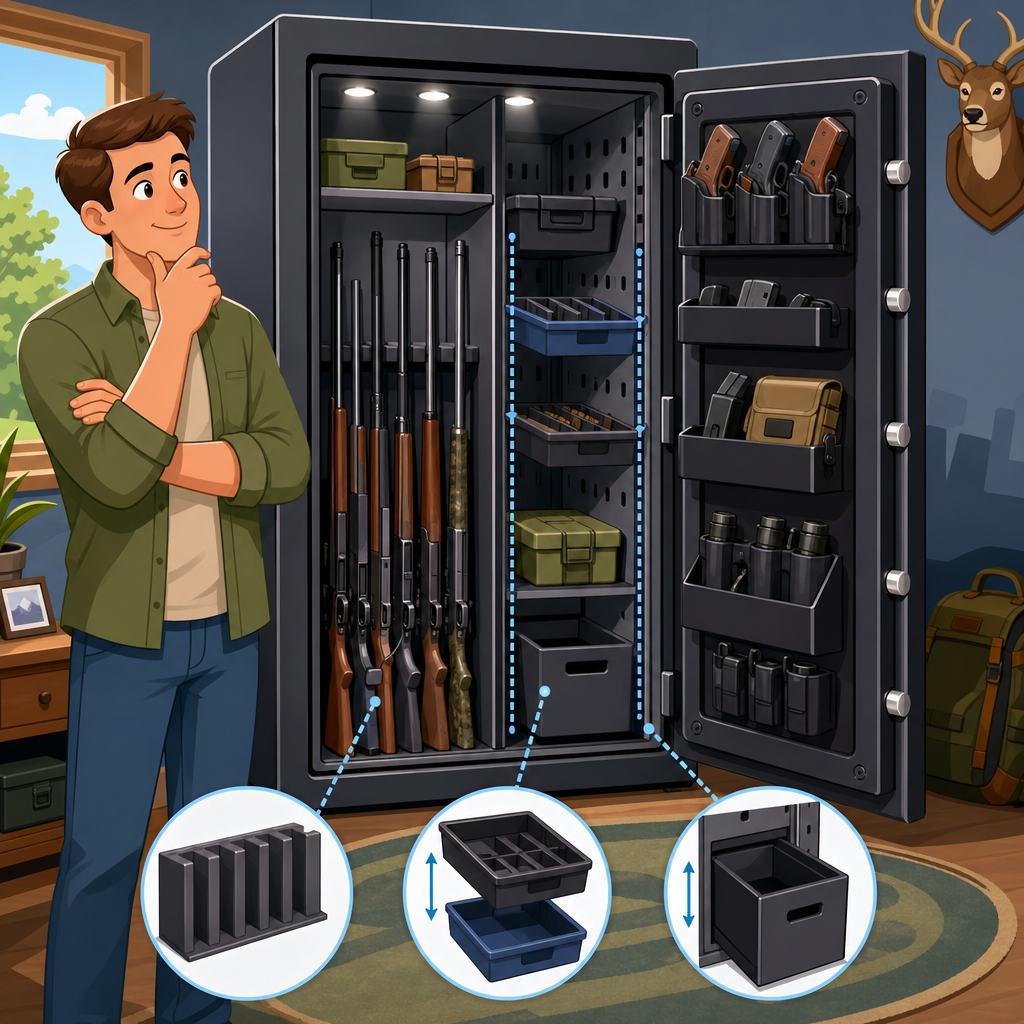
Choosing a gun safe that offers expandable storage options starts with understanding a simple fact: most owners outgrow their first safe faster than they expect. In my work helping buyers compare residential security containers, full-size gun safes, and modular storage systems, I have seen the same pattern repeatedly. A safe bought for six long guns and a few handguns soon has to hold optics, tax stamps, documents, magazines, suppressors, ammunition, and family valuables. That is why expandable storage matters. It describes a safe design that can adapt after purchase through adjustable shelving, door organizers, modular racks, accessory panels, power ports, and interior layouts that can change as your collection and storage needs evolve.
A good buying guide for gun safes has to do more than list dimensions and lock types. It should answer the practical questions buyers actually ask: How much capacity is real versus advertised? Which expansion features are useful instead of gimmicky? How do security, fire protection, and internal flexibility affect each other? What size should you buy if you expect your collection to grow? These questions matter because a gun safe is not just a cabinet. It is part of a broader home safety plan involving theft deterrence, unauthorized access prevention, moisture control, inventory management, and compliance with local requirements. The best expandable gun safe balances all of those functions while remaining usable every day.
This hub article covers the core decisions behind buying guides in the gun safe category, with expandable storage as the organizing principle. It explains how to evaluate capacity honestly, compare interior systems, assess construction and fire ratings, plan installation, and think long term about upgrades. If you are building a first setup or replacing an undersized unit, the goal is the same: choose a safe you will not regret in two years.
Start with realistic capacity, not the number on the brochure
Gun safe capacity claims are usually optimistic. A “24-gun safe” often assumes slim, unscoped long guns placed closely together with no slings, bipods, oversized bolt handles, or optics. In real homes, rifles have variable scopes, red dots, weapon lights, and padded cases nearby. AR-platform rifles and precision rifles also consume more width than traditional sporting arms. As a rule, I tell buyers to treat the published long-gun number as roughly half to two-thirds of practical capacity if they own modern rifles with accessories. This one adjustment prevents a lot of expensive mistakes.
Expandable storage begins with buying more cubic space than you currently need. A safe that feels slightly oversized on day one often feels correctly sized by year three. The most adaptable models use convertible interiors, where a full shelving side can become gun storage later, or a bench-style rack can be repositioned to fit both long guns and bins. Models from Liberty, Fort Knox, Browning, Rhino Metals, and SnapSafe commonly offer some variation of reconfigurable interiors, though execution differs. Browning’s Axis-style systems and similar track-based layouts are particularly useful because they allow owners to move shelves and pouches without tools.
Depth matters as much as width. A 60-inch-tall safe with shallow depth can limit scoped rifle placement and door organizer clearance. Wider safes also create better spacing between stocks and optics, making access safer and faster. If you want expandable storage, compare not only external dimensions but also the net usable interior after insulation, door panel depth, and hinge intrusion are considered. Interior volume is what determines whether expansion is meaningful.
Which expandable storage features actually add value
Not every accessory improves a safe. The most valuable expansion features solve common storage problems. Adjustable shelves are the first priority because they let one compartment hold handguns, documents, cameras, or ammo cans now and convert to long-gun space later. Door organizers are next. A well-designed door panel can move handguns, passports, charging cables, choke tubes, and magazines off the shelves, freeing substantial internal space. I have measured gains equivalent to several cubic feet in larger safes simply by organizing the door efficiently.
Rifle rack flexibility is another major differentiator. Some safes use fixed wooden barrel rests that lock you into one spacing pattern. Better options use removable sections, notched inserts, or modular cradles that accommodate optics and mixed firearm lengths. Pistol racks, pull-out shelves, and MOLLE-compatible panels are useful when they are securely mounted and do not interfere with door closure. Interior electrical outlets are also worth paying for because expandable storage increasingly includes dehumidifiers, LED lighting, rechargeable devices, and biometric handgun boxes placed inside the main safe.
Buyers should be cautious with accessory overload. Too many pouches on the door can press against long-gun optics. Deep shelves can reduce barrel clearance. Added organizers may also make a safe feel cluttered if the core layout is poor. Expansion should improve retrieval and visibility, not just increase the quantity of things crammed inside. The best systems remain modular, so accessories can be removed as the collection changes.
| Feature | Why It Matters | Best For | Watch Out For |
|---|---|---|---|
| Adjustable shelves | Lets storage shift from valuables to firearms over time | Growing collections, mixed-use households | Weak clips or limited shelf positions |
| Door organizer | Frees shelf space for larger items | Handgun owners, document storage | Interference with scoped rifles |
| Modular rifle racks | Improves fit for optics and varied firearm profiles | ARs, hunting rifles, precision setups | Fixed spacing marketed as flexible |
| Interior power outlet | Supports lights, dehumidifiers, chargers | Humid climates, high-use safes | Poor cable routing or no surge protection |
Security and fire protection still come first
Expandable storage is valuable only if the safe performs its primary job. Construction quality should be evaluated before interior accessories. Look at steel thickness, body construction, door plate design, relocker presence, bolt coverage, hinge protection, and anchoring provisions. In the consumer market, many products are technically residential security containers rather than high-security safes. That does not make them useless, but buyers should understand the difference. A heavier unit with thicker steel and better boltwork generally offers more time against attack than a lighter model with elaborate upholstery and many accessories.
Fire ratings also deserve careful reading. Manufacturers may cite minutes and temperatures based on proprietary testing rather than a common independent standard. Ask whether the rating reflects the entire safe, what the peak temperature was, and whether the interior was kept below thresholds relevant to paper documents or electronics. Fireboard thickness, door seals, and body seams all influence performance. In practice, placement in the home, local fire response time, and whether the safe is elevated off a combustible floor can matter nearly as much as the sticker rating.
There is often a tradeoff between internal flexibility and brute strength. A heavily accessorized interior may distract from thin steel or weak locking components. Prioritize a solid shell, dependable lock, and proper installation first. Then evaluate how well the inside can adapt.
Choosing the right lock, layout, and daily-access setup
The lock affects how a safe is used every day, and daily use determines whether storage features remain practical. Mechanical dial locks have a long reputation for durability and do not depend on batteries, but they are slower. Electronic keypad locks offer faster access and easier code changes, making them popular for households that open the safe often. Higher-end options from Sargent and Greenleaf, SecuRam, and La Gard are widely recognized. Biometric systems are improving, but quality varies, and I generally recommend them only from reputable brands and only when there is also a reliable keypad or override option.
Layout planning should reflect access patterns. If you retrieve one defensive long gun regularly, place it where it can be removed without dragging past several hunting rifles. Handguns used most often belong in a door holster or upper shelf, not buried in cases. Important documents should sit in labeled pouches or a separate interior lockbox. Expandable storage works best when zones are intentional: long guns in one section, handguns and magazines on the door, valuables and records on adjustable shelves, accessories in bins. That structure is what makes a larger safe feel organized rather than chaotic.
Many owners pair a full-size safe with a quick-access handgun safe elsewhere in the home. That is often the most practical arrangement. The main safe provides long-term secure storage and growth capacity, while the bedside or closet unit handles immediate access. Buying guides should account for this ecosystem instead of assuming one box solves every need.
Installation, environment, and future-proofing your purchase
A well-chosen safe can fail in practice if installation is poor. Weight matters because heavier safes are harder to move and often more resistant to opportunistic theft, but even a thousand-pound unit should be anchored when possible. Concrete slab installation is ideal. On wood-framed floors, confirm load capacity and distribute weight if needed. Measure not only the final location but every turn, stair, hallway, and doorway on the delivery path. I have seen buyers order excellent safes they physically could not get into the intended room without removing trim or upgrading the route.
Environmental control is essential for expandable storage because larger collections usually mean more metal, optics, leather, and paper exposed to humidity swings. A power outlet supports a dehumidifier rod or low-watt heater, while desiccant canisters provide backup moisture control. In basements, elevate the safe slightly to reduce risk from minor water intrusion. In garages, think about temperature swings, slab moisture, and visibility from outside. A hidden location with stable climate is preferable to a convenient but exposed one.
Future-proofing means budgeting for accessories and growth from the start. Leave room for suppressor paperwork, extra magazines, cleaning gear, and estate documents. If you expect NFA items, optics upgrades, or more training equipment, choose a model with adaptable shelving and a power pass-through. If you move often, modular or disassemblable systems such as SnapSafe’s panel-based designs may be worth considering, though they involve tradeoffs in theft resistance compared with welded units. The right choice depends on your home, your collection, and your likely next five years, not just your next purchase.
How to compare brands and make the final buying decision
When narrowing options, compare safes on a weighted scorecard rather than by advertised gun count. I recommend ranking build quality, lock quality, usable interior volume, shelving flexibility, door storage, fire design, warranty support, delivery logistics, and total installed cost. Total cost matters because freight, stair carries, anchoring, humidity control, and accessories can add substantially to the ticket price. A lower-priced safe that requires immediate aftermarket fixes may cost more in the end than a better-configured model bought once.
Brand reputation should be judged by consistency, not marketing. Look for documented warranty terms, lock support, replacement part availability, and dealer service networks. Read owner feedback with attention to recurring issues such as failed keypads, warped shelves, or poor interior fit and finish. If possible, inspect floor models in person. Open the door fully, test shelf movement, check whether a scoped rifle would clear the organizer, and look at welds, bolt engagement, and finish quality. These hands-on checks reveal more than brochure photos.
For most buyers, the smartest expandable gun safe is one size larger than initially planned, with a reconfigurable interior, a proven electronic or mechanical lock, interior power, a practical door organizer, and solid anchoring capability. Start with honest capacity expectations, insist on real security and fire performance, and choose flexibility that matches how you actually store firearms and valuables. That approach prevents crowding, protects your investment, and keeps the safe useful as your needs change. Use this hub as your buying guide foundation, then compare specific models, measure your space carefully, and buy once with room to grow.
Frequently Asked Questions
Why is expandable storage so important when choosing a gun safe?
Expandable storage matters because most gun owners fill a safe much faster than they originally expect. A safe that looks roomy on day one can become overcrowded once you add scoped rifles, handguns, spare magazines, documents, optics, suppressors, ammunition, tax stamps, jewelry, cash, and other household valuables. In practice, the stated gun count on many safes is also optimistic. A “12-gun safe” may only hold that number if every firearm is slim, unscoped, and arranged perfectly, which rarely reflects real-world ownership.
Choosing a safe with expandable storage options gives you flexibility as your collection and needs change. Instead of being locked into one fixed interior layout, you can adapt shelves, door organizers, handgun racks, file compartments, and modular accessories over time. That means your safe can evolve from basic firearm storage into a more efficient system for protecting both firearms and related gear. Expandability also helps prevent the common problem of stacking items on top of one another, which can slow access, increase the chance of cosmetic damage, and create unnecessary disorganization. In short, expandable storage helps you buy for the next several years, not just for the items you currently own.
What expandable storage features should I look for in a gun safe?
The most useful expandable storage features are the ones that let you reconfigure the interior without replacing the safe itself. Adjustable shelving is one of the most important features because it allows you to change the balance between long-gun storage and shelf space as your needs shift. Modular barrel rests and stock bases are also valuable, especially if you own firearms with optics, bipods, slings, or nontraditional profiles that do not fit well in rigid factory layouts. Door panel organizers are another major advantage because they turn otherwise wasted space into practical storage for handguns, magazines, paperwork, choke tubes, and other compact items.
You should also pay attention to whether the safe supports aftermarket or brand-specific accessories. Some models are designed with interiors that accept additional shelves, bins, handgun hangers, document pouches, and rifle rods. This compatibility can make a big difference in long-term usability. If document storage matters, look for interiors that can accommodate hanging files, lock boxes, or dedicated shelf zones for passports, deeds, and estate paperwork. For buyers considering modular safes or configurable storage systems, evaluate how easily sections can be added or rearranged later. The best expandable storage features are not just about capacity; they are about preserving accessibility, protecting firearm finishes and optics, and keeping everything organized as your inventory grows.
How much larger should a gun safe be than my current collection?
A good rule is to buy significantly larger than your current inventory suggests. Many experienced buyers aim for at least 25 to 50 percent more usable capacity than they think they need, and in many cases doubling the expected firearm count is the smarter move. That recommendation is not sales hype; it reflects the reality that manufacturer capacity ratings are often based on tightly packed long guns without accessories. Once you include scoped rifles, tactical shotguns, AR-style platforms, handguns in soft cases, and shelf-stored valuables, available space shrinks quickly.
When estimating size, think beyond firearms alone. Consider whether the safe will also hold ammunition, optics, suppressors, important documents, family heirlooms, emergency cash, camera gear, or electronics. Also think about future acquisitions, not just current ownership. If you expect to add a few rifles, a couple of handguns, or NFA items over the next several years, factor those in now. It is usually more cost-effective to buy one properly sized safe with expansion potential than to outgrow a smaller model and replace it prematurely. The right approach is to measure your actual storage habits, then choose a safe that leaves room for growth, accessory storage, and a practical interior layout rather than merely maximizing the advertised gun count.
Are modular gun safes and configurable interiors better than traditional fixed-layout safes?
They can be, depending on your goals. Traditional fixed-layout safes may work well for owners with a stable, predictable collection and minimal accessory storage needs. However, if you expect your collection to change or you want the safe to store more than long guns, modular and configurable interiors offer a major advantage. They allow you to shift from rifle storage to shelving, create dedicated spaces for handguns and documents, and make better use of door and sidewall areas. This flexibility is especially helpful for households that want one secure storage unit for firearms as well as personal valuables.
Modular systems can also be beneficial in homes where installation constraints matter. Some modular safes can be moved in sections and assembled in place, which helps with stairways, tight hallways, upper-floor installations, or rooms with limited access. That said, not every modular solution is equal. Buyers should still evaluate steel thickness, locking mechanism quality, fire protection, bolt design, anchor options, and overall construction. A configurable interior is useful only if the safe itself provides appropriate security and durability. The best choice is usually a well-built safe that combines strong physical protection with an interior that can be adapted over time. Flexibility should enhance security and usability, not replace the need for solid construction.
How can I tell if a gun safe will still meet my needs five to ten years from now?
The best way to judge long-term suitability is to evaluate the safe as a storage system, not just as a metal box with a lock. Start by looking at the interior adjustability. Can shelves be moved or added? Can the long-gun section be reduced to create more shelf space later? Is there room for door-mounted storage, handgun racks, bins, and document organizers? Then consider whether the manufacturer offers compatible accessories or updated interior components. A safe that supports long-term customization is far more likely to remain useful as your collection and priorities change.
You should also assess overall size, construction quality, and placement in your home. A safe may have a flexible interior, but if it is already near capacity on day one, it still may not serve you well in the future. Think about whether it has enough volume for larger optics, additional rifles, boxed valuables, and legal paperwork. Verify that it can be properly anchored and that the location allows the door to open fully so interior accessories remain practical. Finally, consider your buying pattern. If you tend to add gear regularly, store important family items, or want one central security container for multiple categories of valuables, choose a model with more space and more reconfiguration options than you currently need. In most cases, the safes that age best are the ones designed with growth, organization, and changing storage priorities in mind from the start.