
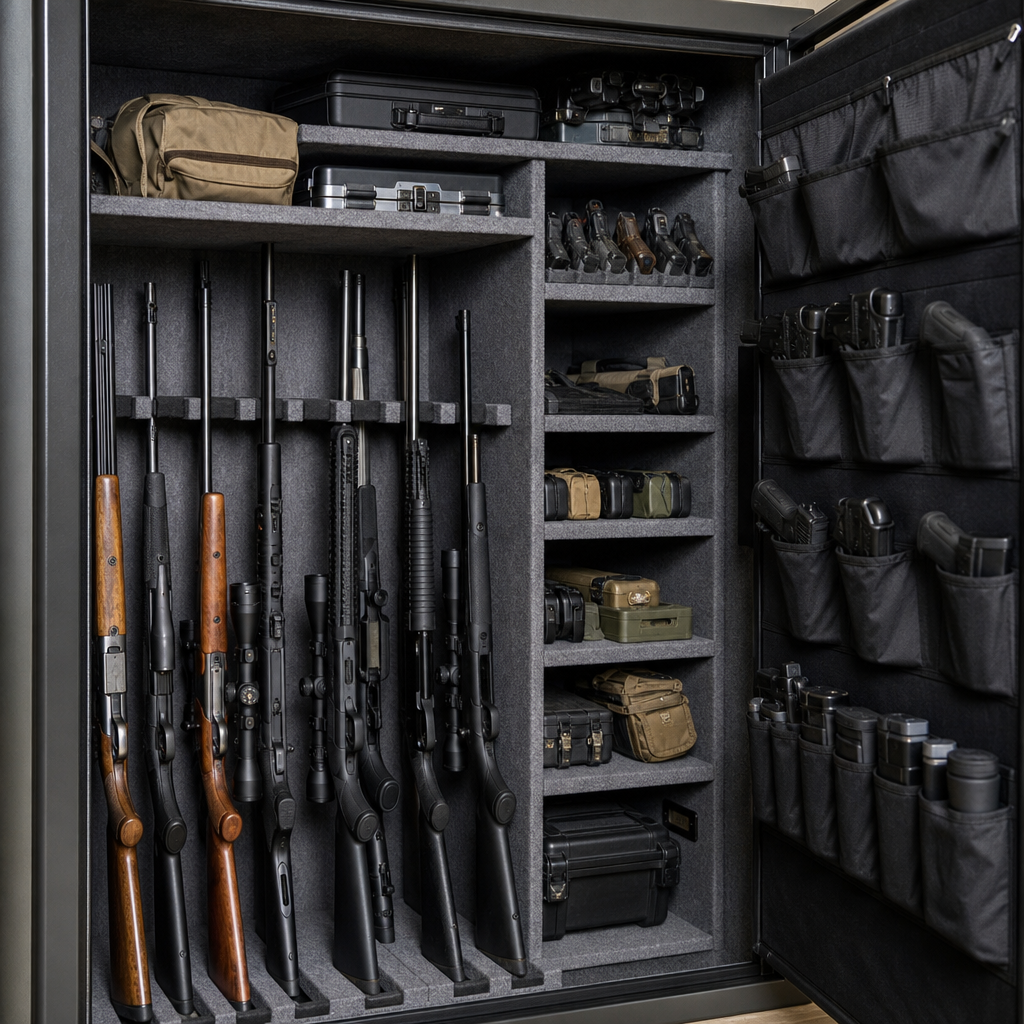
DIY gun safe interior upgrades turn a crowded steel box into a controlled storage system that protects firearms, speeds access, and reduces wear on optics, stocks, slings, and documents. In practical terms, “interior upgrades” means any modification inside the safe that improves organization, capacity, visibility, humidity control, or protection without compromising the safe’s fire barrier, locking system, or structural integrity. “Custom and DIY gun safe modifications” can include rifle rod racks, door panel organizers, LED lighting, dehumidifiers, pistol pegs, shelf reconfiguration, magazine bins, and labeled storage zones for ammunition, suppressors, and important records. This topic matters because most factory interiors are generic. They assume every owner stores the same number of long guns, handguns, accessories, and paperwork, which is never true in the real world.
I have reorganized safes for hunters, competitive shooters, collectors, and families with mixed defensive and sporting needs, and the same problem shows up almost every time: wasted vertical space and poor item separation. A safe advertised for twenty-four guns may hold far fewer once scopes, bipods, side saddles, and soft cases enter the picture. Worse, clutter creates risk. Firearms bump together, muzzle crowns scrape shelves, magazines disappear behind carpeted partitions, and emergency access slows because the item you need sits behind three others. A well-planned interior solves these problems by assigning every category of gear a defined home.
The best DIY approach starts with constraints. Interior modifications should preserve fireboard, avoid drilling exterior walls, respect weight limits on shelves and door panels, and maintain clear airflow for humidity control. Good upgrades also support safe handling habits. Store long guns upright with stable butt support, keep handguns protected from finish damage, separate loaded defensive items from training gear according to your household rules, and make serial-number records easy to reach. As a hub article, this guide covers the full landscape of custom gun safe interior upgrades so you can plan a system, choose materials, avoid common mistakes, and identify which projects deserve a deeper step-by-step guide next.
Start with a storage audit before buying a single accessory
The most effective gun safe organization plan begins with measurement, not shopping. Empty the safe completely. Measure interior height, width, depth, shelf span, and door clearance, then record how many long guns you own, how many have optics, and which firearms need fast access versus long-term storage. Count handguns, magazines, suppressors, slings, cleaning gear, documents, battery chargers, and ammunition you intend to keep inside. This audit reveals the real storage profile. In my experience, owners overestimate rifle capacity and underestimate accessory volume. One shelf can disappear quickly once ear protection, range bags, and optics boxes are stacked without a system.
Next, divide the interior into zones. A practical layout usually includes a long-gun bay, a handgun section, a ready-access shelf, a documents shelf, and an accessory area for magazines, bolts, choke tubes, batteries, and maintenance supplies. If children are in the home, many owners reserve the upper shelf for essential papers and valuables while keeping firearms below in fixed positions. Labeling these zones matters because organization fails when categories drift. Adhesive bin labels, shelf markers, and inventory cards keep the layout consistent over time. If you own both heirloom wood-stock rifles and compact AR-pattern carbines, plan separate spaces because they demand different spacing and support.
Finally, decide what should not live in the safe. Large ammo cans, solvent-heavy chemicals, soaked cleaning rags, and bulky soft cases consume valuable space and can increase moisture or odor. Many owners get better results by storing ammunition in a separate locking cabinet and keeping only defensive magazines or a modest reserve inside the safe. This single decision often frees enough room to add pistol racks or a second long-gun row. A storage audit is the foundation for every interior modification because it aligns upgrades with actual use rather than marketing claims printed on the safe’s label.
Space-saving upgrades for rifles, shotguns, and carbines
Long guns usually dominate safe capacity, so upgrading their storage produces the biggest improvement. Factory barrel notches often assume slim scopes and equal stock dimensions, but modern rifles vary widely. Precision rifles with large objective lenses, shotguns with extended charging handles, and carbines with weapon lights all need extra clearance. Adjustable rifle rod systems are one of the most efficient solutions. These systems use lightweight rods inserted into the barrel or muzzle protector and attach to an upper fabric panel, allowing tighter spacing while keeping guns upright. For scoped rifles, this can dramatically increase usable capacity because stocks no longer need to line up perfectly with fixed slots.
Another proven upgrade is a staggered buttstock platform. By raising every other firearm slightly, scopes and pistol grips interlock more cleanly, reducing side pressure. DIY versions can be built from sealed plywood wrapped in automotive carpet or closed-cell foam, provided they sit securely and do not interfere with the door. For collectors, I recommend wider spacing than the maximum possible density. Better separation prevents finish wear on blued steel and walnut stocks. Tactical owners often prefer denser storage but should still leave room for optics turrets and slings so nothing snags during retrieval.
Door swing and retrieval path matter as much as raw capacity. The firearm you access most often should sit nearest the door opening with enough clearance to remove it in one motion. Avoid placing a scoped rifle directly behind hanging door pockets if the optic will catch on them. If your safe has removable shelves, test one-side long-gun storage and one-side shelving instead of forcing a full-width rifle row. In many safes under thirty cubic feet, a split layout stores fewer total long guns on paper but works better in practice because each firearm remains visible, stable, and reachable without unloading the entire row.
Door panels, shelves, and handgun racks create usable capacity
The inside of the door is often the most underused surface in a gun safe. A quality door panel organizer can hold handguns, magazines, choke tubes, documents, and small tools while shifting weight off shelves. The best systems attach with straps, hook-and-loop panels, or manufacturer-approved clips rather than screws into fire lining. I strongly favor modular door boards with stitched pockets and holsters because they adapt as your collection changes. Handgun pouches should fully cover sights and controls so pistols do not rub against zippers or rivets. Magazine pockets work best when labeled by platform, such as Glock, 1911, AR-15, or shotgun shell cards.
Shelf reconfiguration is the next high-impact project. Many safes ship with one or two broad shelves that invite unstable piles. Replacing them with more narrow, adjustable shelves creates vertical layers for optics boxes, binoculars, NFA paperwork, passports, and maintenance kits. Use shelf material with enough rigidity to resist sagging under concentrated loads. Three-quarter-inch plywood sealed on all sides is a practical DIY choice, and melamine-coated panels are easy to wipe clean, though their edges can chip if unsupported. Cover shelf tops with felt, marine carpet, or closed-cell foam to protect finishes and reduce noise during access.
Handgun racks multiply shelf efficiency by turning flat space into indexed storage. Wire pistol racks coated in vinyl are common, but foam cradle racks are gentler on finishes and easier to customize for optics-ready pistols. Peg-style racks that fit under shelves are excellent when headroom is limited. Keep enough spacing for red-dot sights and extended magazines. To help compare core upgrade categories, use this planning table before you buy or build anything.
| Upgrade | Primary Benefit | Best For | Main Caution |
|---|---|---|---|
| Rifle rod system | Increases long-gun density | Scoped rifles and carbines | Use muzzle protectors and confirm height clearance |
| Door panel organizer | Frees shelf space | Handguns, magazines, documents | Avoid overloading hinges or blocking rifle removal |
| Adjustable shelves | Creates defined zones | Mixed firearm and accessory storage | Support spans properly to prevent sagging |
| Pistol racks | Protects and indexes handguns | Collections with multiple pistols | Allow room for optics and tall sights |
| LED lighting | Improves visibility | Deep safes and low-light rooms | Choose low-heat strips with protected wiring |
Lighting, power, and climate control protect what you store
Visibility is not cosmetic; it is a safety and preservation issue. Dark interiors hide serial numbers, encourage rough handling, and make it easy to leave a magazine or key item buried in the back corner. Low-voltage LED strip lighting is the standard upgrade because it produces minimal heat, fits along door frames or shelf undersides, and can be activated with a motion sensor or magnetic switch. Warm white light often renders wood and parkerized finishes better than harsh blue-toned strips. Route wiring along existing seams or adhesive clips, and avoid puncturing fireboard or insulation. If your safe includes a factory power port, use it rather than modifying the shell.
Climate control matters even more than lighting in humid regions, basements, garages, and homes with seasonal swings. Corrosion starts where air stagnates and condensation forms, especially on cold steel surfaces. Two common solutions are desiccant systems and convection dehumidifier rods. Rechargeable silica canisters work well in smaller spaces if you monitor color indicators and dry them on schedule. Electric rods such as the GoldenRod raise interior temperature slightly, promoting air circulation and reducing condensation. In larger safes, I often combine a rod at the bottom with a hygrometer on the middle shelf so humidity trends are visible at a glance.
Target relative humidity for firearms storage is generally around 40 to 50 percent. Below that, some wood stocks can dry excessively over time; above that, rust risk increases. Foam-lined cases should not be used for long-term storage inside the safe because many foams trap moisture against metal. Silicone-treated gun socks can help on blued firearms, but they are not a substitute for humidity control. If you keep documents inside, use a separate sealed pouch or fire-rated document box so moisture management for firearms does not conflict with paper preservation needs.
DIY materials, installation rules, and mistakes that damage safes
Successful custom gun safe modifications rely on the right materials and a clear respect for how safes are built. Inside many residential security containers, the walls and doors include fireboard layers that should not be drilled casually. Penetrating those layers can reduce fire performance and, on some models, affect warranty coverage. Adhesive-backed hook-and-loop, tension-fit panels, friction brackets, and free-standing inserts are safer DIY methods than screws through unknown interior surfaces. When a manufacturer offers approved accessory mounting points, use them. If not, choose reversible upgrades that can be removed without tearing carpet or exposing insulation.
Material choice should balance durability, chemical stability, and finish protection. Closed-cell polyethylene foam resists moisture better than open-cell craft foam. Automotive trunk liner and marine carpet are better than rough household carpet because they shed less fiber and hold shape. Avoid pressure-treated lumber, which can off-gas corrosive compounds, and avoid cheap adhesives with strong solvent odor in enclosed spaces. For handgun contact surfaces, wool felt, synthetic felt, or vinyl-coated wire work well when kept clean. For bins and dividers, acid-free plastic containers are preferable to cardboard, which absorbs moisture and deforms over time.
The most common mistakes are simple but expensive. Owners overload door organizers until the door sags, stack ammo until shelves bow, or place firearms so tightly that optics scrape each time the door closes. Others install battery lights that fail after a month and then ignore the dark interior. The fix is disciplined planning: weigh heavy items, distribute loads near shelf supports, leave retrieval clearance, and test every upgrade with the door fully closed. If a modification requires force, blocks lock bolts, or hides the dehumidifier, it is the wrong modification. A professional-looking interior is not about cramming in more gear; it is about making each item secure, visible, and easy to access.
Build a modular system that can evolve with your collection
The smartest gun safe interior upgrade strategy is modular. Firearm collections change. A hunting safe can become a mixed-use safe once a red-dot carbine, a suppressor, or several competition pistols enter the picture. If your shelves, racks, and bins can be moved without damage, the safe stays useful longer. Keep a simple inventory sheet with firearm model, serial number, storage position, and associated accessories. I also recommend assigning one small bin per platform for parts like optic batteries, sight tools, choke keys, or spare bolts. That prevents cross-mixing and saves time before a range trip or hunting season.
As a hub for custom and DIY gun safe modifications, the practical path is clear: start with a storage audit, optimize long-gun spacing, reclaim the door, add shelves and handgun racks, improve lighting, control humidity, and use safe materials that preserve both the container and its contents. Those upgrades deliver the core benefit every owner wants: more usable capacity with less risk and faster access. From here, map your next project one section at a time, measure carefully, and upgrade the interior so your safe works like a professional storage system every day.
Frequently Asked Questions
What are the best DIY gun safe interior upgrades for improving organization without damaging the safe?
The best DIY gun safe interior upgrades are the ones that increase order, visibility, and usable space while leaving the safe’s structure, locking components, and fire lining untouched. In most cases, that means focusing on modular, non-invasive additions such as rifle rod storage systems, magnetic or adhesive-backed LED lighting, door panel organizers, adjustable shelf inserts, handgun racks, labeled bins, and soft-lined document holders. These upgrades help transform a cramped interior into a layout where long guns stand securely, handguns are separated and easy to identify, magazines and accessories stay contained, and important paperwork does not get buried under loose gear.
A smart starting point is vertical organization. Rifle rods or barrel support systems can dramatically increase long-gun capacity by keeping firearms upright and evenly spaced, especially when optics, slings, and varying stock sizes make traditional rack spacing inefficient. Next, consider the door. A purpose-built door organizer can hold pistols, magazines, choke tubes, tools, and documents, which frees shelf space and keeps frequently accessed items near eye level. Adjustable shelving and handgun hangers also make a major difference because they let you tailor the interior to your actual collection instead of forcing everything into a generic factory layout.
Protection matters just as much as capacity. Soft-touch surfaces, foam-lined contact points, and separated storage zones help reduce wear on optics, wood finishes, synthetic stocks, and slings. Good lighting is another underrated upgrade because it improves inventory control and reduces fumbling, especially in larger safes or low-light rooms. The key principle is simple: use upgrades that attach to shelving, carpeted surfaces, or existing interior panels rather than drilling into the safe body or disturbing any fire-protective materials. That approach gives you better organization and access while preserving the safe’s intended security and fire-resistance performance.
How can I add more firearm storage capacity inside a gun safe without overcrowding it?
The safest way to add capacity without creating chaos is to store firearms more efficiently, not more tightly. Overcrowding leads to bumped optics, tangled slings, scratched finishes, and difficult access, so the goal is controlled density. Start by evaluating how your current space is being wasted. In many safes, long guns consume more width than necessary because scopes, bolts, bipods, and sling swivels interfere with standard rack spacing. A rifle rod system or similar vertical support solution can reclaim a surprising amount of room by allowing barrels to be stabilized independently rather than relying only on fixed notches in a factory rack.
You can also gain space by separating firearm types and assigning each category a dedicated zone. Handguns should usually come off the shelves and move to door holsters, under-shelf handgun racks, or tiered pistol stands. Magazines, suppressor accessories, cleaning supplies, and small tools should go into bins or pouches rather than being stacked loosely around firearms. Documents should be moved into slim fire-rated or protective sleeves stored upright on a shelf or in a door pocket. Once these supporting items stop sharing space with long guns, the interior becomes far more efficient.
It is also important to maintain practical spacing around optics, charging handles, sling mounts, and oversized stocks. More capacity should never mean forced contact between guns. Leave enough clearance so each firearm can be removed without dragging across another. If your safe includes adjustable shelves, experiment with staggered heights to accommodate different firearm profiles. In some setups, placing shorter carbines or scoped rifles in alternating positions creates better clearance than lining everything up uniformly. Done correctly, increased capacity should still preserve visibility, airflow, and quick identification, which are all essential for long-term protection and responsible storage.
What should I avoid when doing custom and DIY gun safe interior modifications?
The biggest thing to avoid is any modification that compromises the safe’s fire barrier, structural shell, door seal, locking components, relockers, wiring channels, or anchor points. That means no drilling into the safe body unless the manufacturer explicitly approves it and provides guidance. Many gun safes rely on layered construction that includes steel, fireboard, insulation, seals, and internal paneling. Penetrating those layers can reduce fire performance, introduce moisture pathways, void the warranty, or in the worst case interfere with security features. Even seemingly minor changes can have bigger consequences than most owners expect.
You should also avoid upgrades that create abrasion or pressure points on firearms. Bare metal hooks, cheap adhesives that fail under heat or humidity, rough plywood edges, and overly dense foam that traps moisture can all cause long-term problems. Foam deserves special mention because while it can seem protective, some foam products hold moisture against metal surfaces and may increase the risk of rust if the safe’s humidity control is not dialed in. Similarly, overloaded door organizers can affect door closure or place unnecessary stress on hinges and interior panels if they are not designed for the weight being carried.
Another common mistake is prioritizing capacity over access. If you have to remove three guns to reach one, the safe may be technically full but functionally disorganized. Avoid mixing ammunition, cleaning chemicals, paperwork, and firearms in a way that creates clutter or contamination risk. Be careful with battery-powered lighting and electronic accessories as well; use quality products, route wires cleanly, and keep anything heat-generating or loosely mounted away from firearms and documents. In short, the best DIY gun safe modifications are reversible, organized, padded where needed, and respectful of the safe’s original engineering.
How do I control humidity and protect firearms after upgrading the interior of a gun safe?
Humidity control should be part of every interior upgrade plan because better organization only solves half the problem. Firearms need a stable environment to resist rust, pitting, corrosion, and damage to wood, leather, optics, and paperwork. Once you add shelves, bins, pouches, and tighter storage systems, airflow patterns inside the safe can change, so it becomes even more important to monitor moisture rather than guessing. A small hygrometer is one of the most useful additions you can make because it gives you a real-time picture of internal conditions and helps you verify whether your dehumidification setup is actually working.
For active protection, many owners use a combination of desiccant packs and an electric dehumidifier rod, depending on the safe’s size and location. Desiccants help absorb excess moisture, while dehumidifier rods gently raise the internal temperature to reduce condensation. Basements, garages, and exterior-wall closets typically need more attention than climate-controlled interior rooms. After upgrading the interior, make sure nothing blocks airflow completely around the lower portion of the safe, where moisture issues can be more pronounced. Avoid packing soft goods, cases, or dense foam tightly against firearms for long periods, especially if you live in a humid region.
Maintenance still matters. Wipe firearms down with an appropriate protectant, inspect optics mounts and metal contact points periodically, and check hidden areas such as under slings or inside soft sleeves. If you store important documents in the safe, use protective sleeves or dedicated pouches so they are shielded from incidental moisture and handling wear. Good lighting helps here too, because it makes regular inspections easier and faster. The best humidity-control strategy is layered: monitor conditions, use the right moisture-control tools, maintain airflow, and keep the upgraded interior clean and intentionally arranged.
How do I design a professional-looking gun safe layout that balances quick access, protection, and long-term flexibility?
A professional-looking gun safe interior starts with a plan, not with products. Before adding any organizers, inventory what you actually store: scoped hunting rifles, defensive carbines, shotguns, handguns, magazines, suppressor accessories, important documents, jewelry, cash, or cleaning gear. Then divide the interior into functional zones. Long guns should occupy the main vertical area with enough clearance for optics and slings. Handguns should sit in dedicated racks or door holsters. Small accessories should be grouped in labeled bins or pouches. Documents should have a clean, protected location that is easy to access without disturbing firearms. This zone-based approach instantly makes the safe look cleaner and work better.
Quick access comes from visibility and consistency. Install interior lighting so every shelf and corner can be seen at a glance. Arrange firearms by purpose, size, or frequency of use so you always know where to reach first. Keep defensive or frequently handled firearms in the most accessible positions, while seasonal or less-used items can go deeper into the layout. Use shelf risers, handgun stands, and door storage to keep items from stacking on top of one another. A safe feels professional when every item has a defined place and can be removed without shifting half the contents.
Long-term flexibility comes from choosing adjustable and reversible upgrades. Collections change over time, and your storage system should adapt without requiring major rework. Modular shelves, removable bins, hook-and-loop backed organizers, and rifle rod systems are especially useful because they can be reconfigured as your needs evolve. Leave some open capacity instead of filling every inch on day one. That breathing room helps with airflow, future purchases, and easier maintenance. The most effective DIY gun safe interior upgrades do not just make the safe look organized today; they create a durable system that protects firearms, supports responsible ownership, and stays useful as your collection changes.