
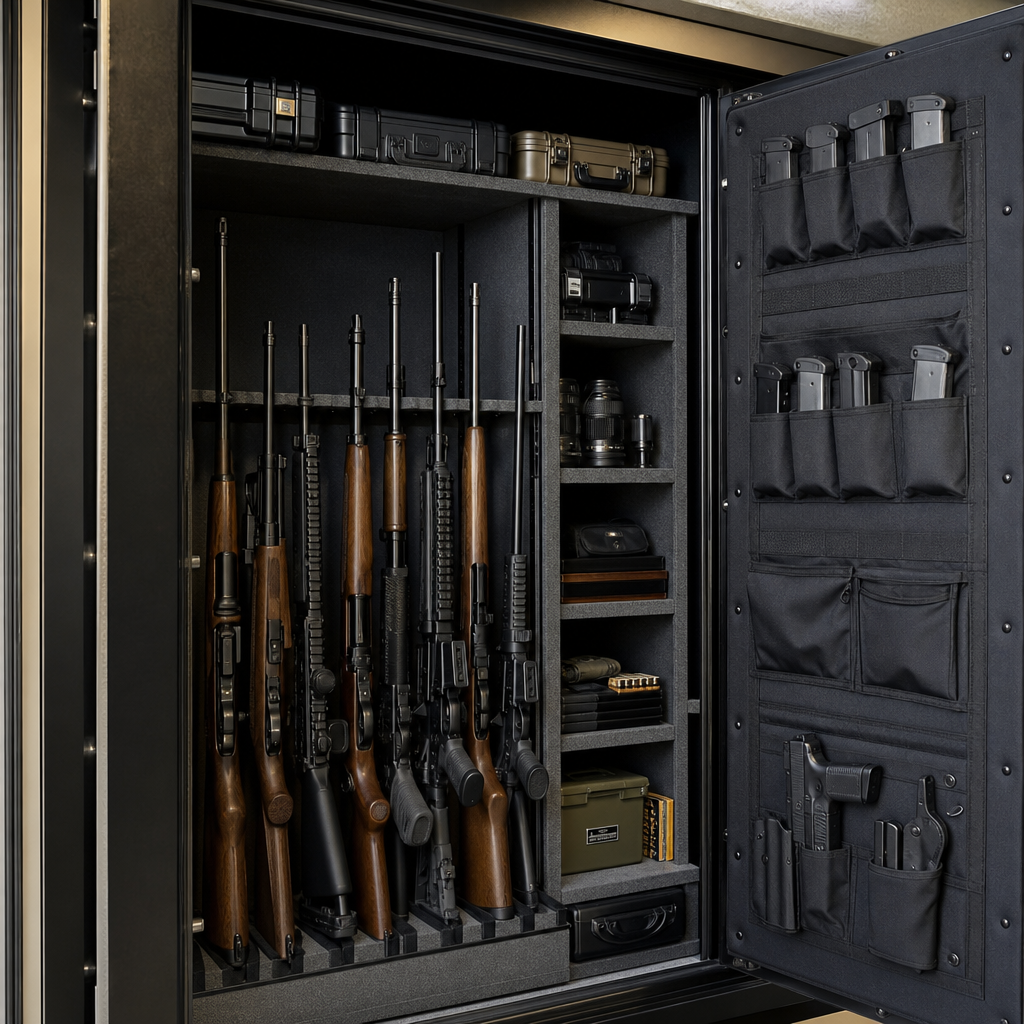
Customizing a gun safe for maximum security means improving how the safe resists theft, controls access, protects firearms from fire and humidity, and organizes contents so owners can verify at a glance that every weapon is secured. In my work with residential security setups, I have seen factory safes perform well structurally yet still fail in daily use because shelves sag, door organizers block long guns, lock batteries die unnoticed, and owners store ammunition, documents, and handguns in ways that create confusion during emergencies. A custom or DIY gun safe modification plan solves those practical weaknesses without undermining the safe’s original certification or function.
A gun safe is only as secure as its weakest point. For one owner, that weak point may be access control: too many family members know the code, or the keypad sits exposed in a garage. For another, the issue is environment: a basement safe develops condensation and surface rust on blued steel. Others need better internal layout because optics, suppressors, and pistol racks reduce usable space, forcing careless stacking. Customization matters because modern firearm storage is no longer just about keeping thieves out. It is also about preventing unauthorized access, preserving value, meeting insurance expectations, and supporting responsible ownership every day.
Key terms help clarify the discussion. Hardening refers to upgrades that make theft more difficult, such as anchor bolts, relocker protection, reinforced hinges, or relocating the safe into a tighter enclosure. Access control covers locks, code management, biometric readers, audit trails, and layered barriers around the safe itself. Environmental protection includes dehumidifiers, desiccants, thermal seals, and airflow management. Interior optimization means shelving, barrel rests, door panels, mag racks, lighting, and compartmentalization. DIY modifications can be highly effective, but they must respect manufacturer guidance, fire lining, and the structural geometry of the door and body.
This hub article explains how to customize your gun safe for maximum security by breaking the subject into the practical decisions that matter most: location, anchoring, lock upgrades, interior configuration, environmental control, surveillance integration, and maintenance. It is written to help you decide which custom gun safe modifications add real protection and which ones merely look impressive. If you are planning a full safe build-out or a few targeted upgrades, start with the principle I use on every project: improve resistance, control, visibility, and consistency without compromising the safe’s tested shell or locking system.
Start with placement, anchoring, and external hardening
The best gun safe modifications begin outside the safe, not inside it. A heavy safe can still be stolen if it is left freestanding on smooth concrete near a garage door. I have seen crews tip midweight safes onto dollies in minutes because the owner assumed mass alone was enough. Proper placement reduces leverage, visibility, and working room for pry attacks. The strongest position is usually a ground-floor corner, ideally on a concrete slab, with one side and the rear tight to walls. In a closet or alcove, thieves have less room to attack hinges, door gaps, and lock areas with long pry bars.
Anchoring is the single most important DIY gun safe modification for physical security. Use the manufacturer’s anchor holes when available, and install wedge anchors or epoxy anchors sized for the safe and slab thickness. On wood floors, bolt through joists with steel backing plates rather than lagging into subfloor alone. The goal is not merely to stop movement but to prevent tipping, because many attacks become easier once the safe is laid on its back. If the safe sits upstairs, confirm load-bearing capacity before adding contents; large gun safes can exceed 1,000 pounds loaded.
External hardening can also include constructing a fitted cabinet surround, adding a false wall, or placing the safe behind a locking closet door. These are not substitutes for a strong safe, but they delay discovery and reduce attack angles. Motion lighting, camera coverage, and an alarm contact on the room or closet door create another layer. A thief who must breach a room, then a closet, then a bolted safe under surveillance is dealing with escalating time pressure. That is what real security customization should do: multiply delay and detection.
Upgrade access control without creating failure points
Many owners ask whether they should replace a factory dial with an electronic lock or add biometric access. The right answer depends on who needs access, how often the safe is opened, and your tolerance for maintenance. Mechanical dial locks from recognized makers such as Sargent and Greenleaf or La Gard remain durable and resistant to battery-related failures, but they are slower under stress. Quality electronic locks provide faster access, multiple users, time delay functions, and easier code changes. Cheap keypad retrofits, however, are a mistake. They often fail early, use weak mounting hardware, and may not match the door’s relocker configuration.
If you upgrade the lock, use a certified locksmith or a manufacturer-approved installer, especially on safes with glass relockers, hard plates, or proprietary lock footprints. The upgrade should preserve boltwork alignment and relocker function. For owners with children, caregivers, or shared household access, code management matters as much as lock type. Change default or inherited codes immediately, rotate codes after staffing or family changes, and avoid patterns tied to birthdays or addresses. If the safe supports duress codes, silent alarm outputs, or time windows, enable them only after testing with your alarm provider and documenting the settings.
A practical rule I recommend is separating quick-access needs from bulk storage needs. Do not try to make one large safe perform every role. Keep the main gun safe optimized for security and use a dedicated bedside or defensive handgun safe for immediate-access firearms. This reduces unnecessary opening cycles on the primary safe and limits who knows its code. It also keeps long-term storage more orderly, which directly improves accountability. Maximum security is not just a stronger lock. It is a system that matches access speed to realistic use cases.
Customize the interior so firearms stay visible, separated, and protected
Interior customization is often treated as cosmetic, but it has direct security value. A cluttered safe encourages unsafe handling, hidden damage, and poor inventory control. When rifles overlap, optics snag, and handguns are stacked in soft cases, owners stop doing quick visual checks. That creates the conditions for unauthorized borrowing, missing magazines, and unnoticed corrosion. The best interior gun safe modifications make every item visible, supported, and easy to count.
Adjustable shelving is the foundation. Factory shelves are usually designed around generic hunting rifles without large optics, bipods, weapon lights, or suppressor-ready lengths. Replace flimsy particleboard shelves with sealed plywood or steel-supported modular panels sized to your actual collection. Add dedicated pistol racks, magazine bins, document trays, and labeled ammo segregation only if the safe has room and the manufacturer permits ammunition storage. Door organizers can add tremendous capacity for handguns and paperwork, but test door clearance carefully. On some safes, overfilled pockets press against rifle scopes and shift long guns off their rests.
LED lighting is one of the most underrated custom gun safe modifications. Low-heat adhesive or magnetic LED strips with motion activation improve visibility and reduce careless muzzle contact when removing firearms. Choose wiring routes that do not interfere with boltwork or intumescent door seals. If drilling pass-through holes is not manufacturer-approved, use battery-powered units and replace cells on a schedule. Interior improvements should feel boringly functional. If a modification adds storage but makes firearms harder to inspect or retrieve safely, it is not an upgrade.
| Modification | Security Benefit | Best Use Case | Main Caution |
|---|---|---|---|
| Concrete anchoring | Prevents removal and tipping | Garage or slab installations | Use proper anchor depth and spacing |
| Electronic lock upgrade | Faster access and code control | Frequent access households | Avoid low-grade aftermarket locks |
| Door organizer | Improves visibility and capacity | Handgun-heavy collections | Can interfere with scoped rifles |
| GoldenRod or dehumidifier | Reduces condensation risk | Basements and humid climates | Requires safe cable routing planning |
| Camera and contact sensor | Adds detection and evidence | Detached garages or remote rooms | Needs reliable power and alerts |
Control humidity, fire exposure, and long-term preservation
Security includes preserving the condition and function of stored firearms. Rust, stock swelling, optic damage, and ammunition degradation are not cosmetic issues; they reduce reliability and value. In basements, coastal climates, and unconditioned garages, humidity control is essential. The most effective setup usually combines a low-wattage convection dehumidifier such as a GoldenRod with rechargeable desiccant packs placed at different heights. The heating rod gently raises interior temperature to reduce condensation, while desiccants capture residual moisture in stagnant zones. Add a digital hygrometer so you can verify conditions instead of guessing.
Target relative humidity for firearm storage is commonly around 45 to 50 percent. Much higher invites corrosion; much lower can dry wood furniture excessively over time. Keep silica packs renewed on a calendar, not when you remember. Avoid storing guns in foam cases or fabric sleeves inside the safe for long periods, because those materials can trap moisture against metal finishes. If the safe is in a garage, elevate it slightly with approved spacers or a base system when flooding or slab condensation is possible, while preserving anchor integrity.
Fire protection needs similar realism. Many safe advertisements cite fire ratings that vary widely by test protocol, duration, and temperature. Customization cannot turn a lightly insulated cabinet into a true fire-resistant safe, but you can improve outcomes by location and contents management. Avoid placing the safe against walls with likely fuel loads such as paint storage or utility equipment. Use document pouches or media-rated containers inside the safe for passports, trusts, and backup drives, because paper and digital media have different heat tolerances. Most important, do not drill through fire-lined panels or door edges unless the manufacturer explicitly approves the modification. One careless hole can compromise both fire performance and warranty coverage.
Add monitoring, inventory control, and layered security around the safe
The most effective custom gun safe modifications extend into the surrounding security ecosystem. A safe should never stand alone as the only protective measure. Integrate it with monitored alarms, entry sensors, and indoor cameras that send verified alerts. In one residential installation I helped design, the safe itself was excellent, but the real improvement came from adding a contact sensor to the closet door, a shock sensor on the safe enclosure, and a camera covering the approach path. That setup did not make the safe physically stronger, but it sharply reduced the time an intruder could work undetected.
Inventory control is another overlooked security layer. Maintain a written and digital record of serial numbers, model designations, optic pairings, and photographs. Store a copy off-site or in encrypted cloud storage. If theft, fire, or water damage occurs, recovery and insurance claims depend on accurate documentation. For larger collections, use labeled shelf zones and a simple check-in system so missing items are noticed immediately. This is especially important in homes where multiple adults access the safe, at hunting properties, or in collections that rotate firearms seasonally.
Finally, recognize the limits of DIY work. Painting interiors, adding LED strips, changing shelving, and installing hygrometers are straightforward. Altering lock footprints, drilling new body penetrations, welding reinforcements, or modifying hinge geometry can ruin the safe’s protective design. When in doubt, contact the manufacturer, verify warranty implications, and hire a safe technician. Smart customization improves performance by respecting tested design parameters rather than improvising around them.
Custom and DIY gun safe modifications work best when they follow a clear priority order: secure the location, anchor the safe, upgrade access control if needed, optimize the interior, control humidity, and connect the safe to broader home security. That sequence reflects what actually prevents loss. A beautifully organized interior means little if the safe can be tipped and removed. A premium lock adds less value if everyone in the house knows the code. Real maximum security comes from layered decisions that reduce opportunity, increase delay, and make daily storage habits more consistent.
The main benefit of customizing your gun safe is not appearance. It is confidence. You can open the door, verify your firearms quickly, access what you are authorized to access, and know that theft, moisture, and disorder are being actively managed. For a sub-pillar topic like custom gun safe modifications, that is the central lesson: every upgrade should solve a specific problem with a measurable result. Better visibility, lower humidity, tighter anchoring, cleaner code control, and stronger monitoring all translate into safer ownership.
If you are ready to improve your setup, start with a simple audit today. Evaluate placement, anchoring, lock type, humidity level, and interior layout before buying accessories. Then make upgrades in order of risk reduction, documenting each change as you go. A gun safe becomes truly secure when customization is disciplined, purposeful, and built around how the safe is used in the real world.
Frequently Asked Questions
What are the most important upgrades to make when customizing a gun safe for maximum security?
The best upgrades focus on the areas where many factory safes are weakest in real-world use: anchoring, access control, interior organization, and environmental protection. Start by anchoring the safe to concrete or solid structural framing so thieves cannot tip it, pry at weak points, or remove it entirely for later attack. A heavy safe is good, but an anchored safe is far more secure. Next, evaluate the lock. Electronic locks are convenient, but they should be paired with a disciplined battery replacement schedule and regular function checks. Mechanical locks offer long-term reliability, while some owners prefer higher-end redundant lock systems for both convenience and fail-safe access.
Inside the safe, customization matters more than many people expect. Poorly designed shelves, overcrowded racks, and bulky door organizers can interfere with proper firearm storage and even make it harder to confirm quickly that every gun is present and secured. Upgrading to reinforced shelving, adjustable rifle racks, handgun hangers, and low-profile door panels can improve both security and daily usability. Add dedicated zones for firearms, ammunition, documents, and valuables so items do not become piled together in ways that block access or conceal missing equipment. Finally, protect the contents from fire and moisture with a dehumidifier, humidity monitor, fire-rated document containers, and proper airflow planning. Maximum security is not just about resisting break-ins; it is also about ensuring your firearms remain protected, accessible to authorized users, and verifiably secured every day.
How should I organize the inside of a gun safe so it is both secure and easy to monitor?
A secure gun safe interior should be designed for visibility, stability, and separation of contents. One of the most common problems in factory setups is that owners try to maximize storage volume instead of maximizing control. That often leads to rifles pressed tightly together, pistols stacked in cases, ammunition stuffed behind long guns, and important documents buried on upper shelves. In that arrangement, it becomes difficult to tell at a glance what is inside, whether something has shifted, or whether an item is missing. A better approach is to assign specific storage zones and keep every firearm in a consistent, repeatable position.
Use adjustable racks for long guns so optics, slings, and bolt handles do not force firearms into unstable angles. For handguns, dedicated pistol shelves or under-shelf handgun hangers usually provide better access than stacking cases. Reinforce or replace weak shelves if they bow under ammunition weight, because sagging shelves eventually create clutter and can damage both gear and the safe’s interior layout. Be cautious with door organizers: they can be very useful for magazines, documents, and small handguns, but if they protrude too far they may interfere with rifle stocks or scoped firearms when the door closes. Keep ammunition separate from defensive handguns and critical documents, and avoid storing heavy loose items where they can shift during opening or closing. The goal is a layout where you can open the safe and immediately verify that each weapon is present, upright, protected from contact damage, and not obstructed by unrelated gear.
Is an electronic lock or a mechanical lock better for a customized gun safe?
Neither is automatically better in every situation; the right choice depends on how you use the safe, how often you access it, and how disciplined you are about maintenance. Electronic locks are popular because they are fast and convenient, especially for owners who need regular access. They also allow easy code changes, which can be useful in households where access permissions change over time. However, convenience only translates into security if the lock is maintained properly. Dead batteries, neglected low-battery warnings, and cheap keypad assemblies are frequent causes of avoidable lockouts and access problems. If you choose an electronic lock, use quality batteries, replace them proactively on a schedule, test the keypad regularly, and keep the manual and override procedures documented in a secure location.
Mechanical locks remain a strong option for owners who prioritize long-term reliability and low dependence on electronics. They are slower to open, but they are not vulnerable to battery failure and often appeal to users who want fewer components that can degrade unnoticed. For maximum security, many owners look beyond the simple electronic-versus-mechanical debate and instead focus on lock quality, installation quality, and inspection routines. A premium lock from a reputable manufacturer, properly installed and periodically checked, matters more than the basic category alone. If the safe stores defensive firearms, speed of authorized access may justify an electronic system. If it stores primarily long-term holdings, a mechanical lock may be preferable. In either case, the best customization includes regular testing, clear access procedures for authorized users, and no reliance on assumptions that the lock will “just work” forever without attention.
How can I improve fire and humidity protection when customizing my gun safe?
Fire and humidity protection should be treated as core security features, not optional add-ons. A gun safe that survives theft attempts but allows rust, stock warping, optic damage, or document loss is not fully protecting its contents. Start by understanding the safe’s fire rating and its limitations. Fire ratings vary widely, and they depend on both temperature and duration. If you keep passports, titles, wills, cash, or backup drives in the safe, consider adding a dedicated fire-rated document container inside the safe for layered protection. This is especially useful because many safes marketed for firearms provide better theft resistance than they do true archival protection for paper and electronics.
For humidity control, install an internal dehumidifier such as a powered heating rod or rechargeable desiccant system, and monitor conditions with a hygrometer so you are not guessing. In many homes, especially basements, garages, and humid climates, moisture damage develops slowly and goes unnoticed until rust appears. Good customization also includes sensible spacing. Do not pack guns and gear so tightly that air cannot circulate. Keep firearms clean and lightly protected with appropriate corrosion inhibitors, and inspect the interior regularly for signs of condensation or musty odor. If the safe sits against an exterior wall or in a damp location, address the room environment as well, not just the safe interior. True maximum protection comes from a layered strategy: a safe with realistic fire performance, internal document protection, active humidity control, and routine inspections that catch small problems before they become expensive damage.
What mistakes do gun owners make when customizing a safe, and how can they avoid them?
The biggest mistake is customizing for storage capacity instead of secure daily function. Many owners try to fit too many rifles, too much ammunition, and too many miscellaneous valuables into one safe without thinking about access, visibility, or weight distribution. That leads to leaning firearms, blocked door closure, overloaded shelves, and a layout where no one can quickly confirm what is actually secured. Another common mistake is assuming that factory components are sufficient forever. Shelves sag under ammunition, interior brackets loosen, and door organizers that looked helpful in the showroom turn into obstructions once scoped rifles and larger stocks are inside.
Other avoidable errors include ignoring lock maintenance, failing to anchor the safe, and mixing unlike items without a plan. Batteries die, codes are not updated, and owners sometimes discover access problems only when they urgently need the contents. Ammunition, documents, jewelry, passports, and handguns are often stored in ways that create clutter rather than control. To avoid these issues, customize with a clear purpose: theft resistance, authorized access, environmental protection, and visual accountability. Anchor the safe, inspect the lock on a schedule, strengthen or replace weak shelving, and choose organization accessories that fit your actual firearms rather than generic marketing photos. Leave enough room for safe handling and airflow, and create a repeatable placement system for each item. The best customized safe is not the one that holds the most; it is the one that consistently keeps every firearm protected, accessible to the right person, and easy to verify as secured.