
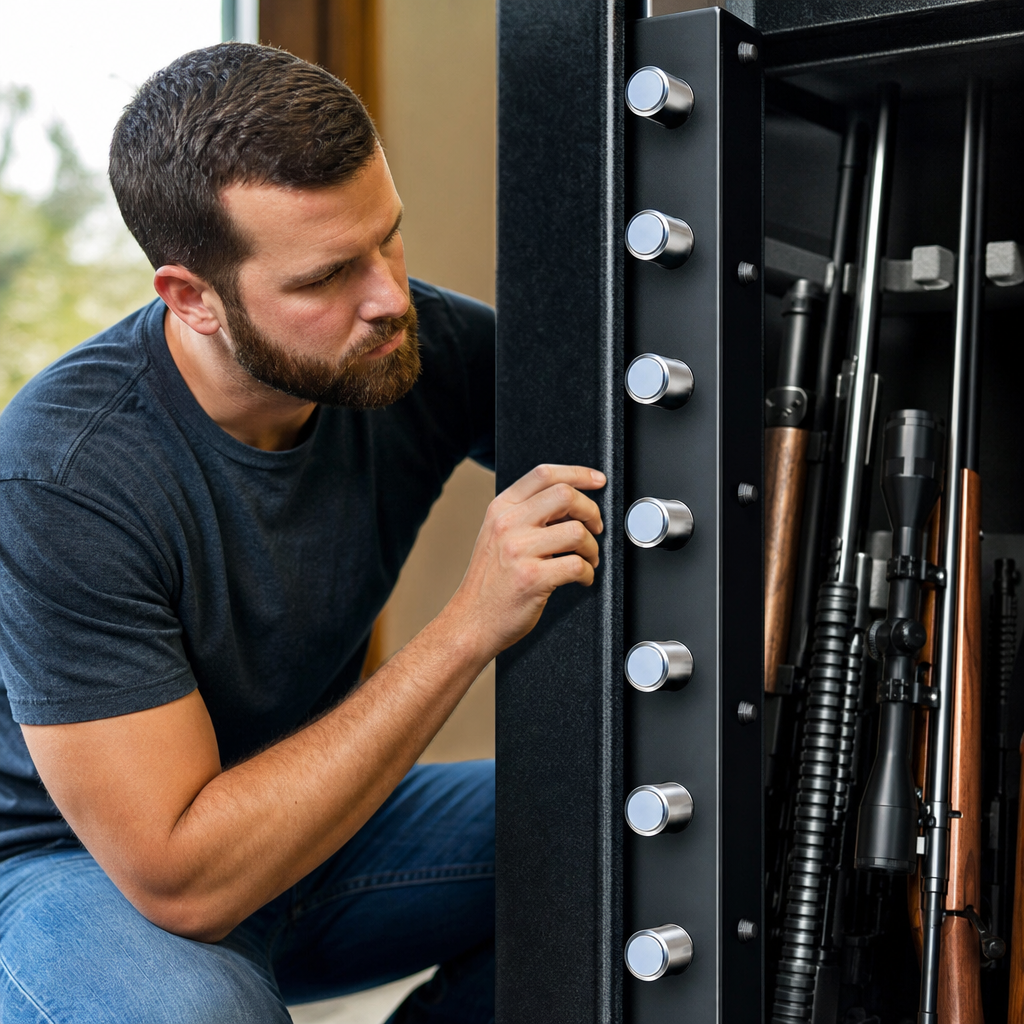
Many buyers assume a gun safe with more locking bolts must be more secure, but that belief confuses a visible feature with the full engineering that actually resists theft, prying, fire, and misuse. In the gun safe market, “locking bolts” are the round or rectangular steel bars that extend from the door into the body when the handle turns or the lock releases, and they are often advertised in large numbers because the count is easy to print on a sales tag. “Security,” however, is broader: it includes steel thickness, door construction, boltwork design, lock quality, hardplate, relockers, hinge protection, anchoring, and how the safe performs under attack, not just how it looks on a showroom floor. This matters because buyers making decisions on bolt count alone can overpay for a weaker safe, miss more important specifications, and end up with a product that delivers less protection than expected. I have inspected residential security containers, compared spec sheets line by line, and watched pry and cut tests where bolt count had far less impact than door gap, body gauge, and anchoring. In short, more locking bolts can help in some designs, but they do not automatically mean a better gun safe, and treating them as a primary ranking factor is one of the most persistent myths in gun safe shopping.
Why the locking bolt myth is so common
The myth persists because bolt count is simple, visible, and marketable. A buyer can compare “10 bolts” versus “18 bolts” in seconds, while comparing 12-gauge versus 7-gauge steel, formed door construction versus plate door construction, or the presence of active relockers requires more technical understanding. Manufacturers know this. Entry-level and mid-tier safes often emphasize polished chrome bolts, multi-sided coverage, and oversized handles because those features photograph well and feel substantial in a retail setting. By contrast, hidden factors such as composite door structure, continuous weld quality, anti-pry tabs, and lock protection are harder to explain on a label.
There is also a psychological effect: people equate more contact points with more strength. That is sometimes true in construction and mechanical fastening, but gun safe doors are not secured in the same way as a bank vault. In many consumer gun safes, several visible bolts are passive on the hinge side, meaning they do not move with the handle and mainly serve to hold the door in place if the hinges are cut. Passive bolts can be useful, but counting them the same as active locking bolts can mislead buyers about actual resistance. I have seen safes promoted with impressive total bolt counts where only one vertical edge had robust active engagement and the body steel remained thin enough to flex under a pry attack.
The result is a classic misconception within gun safe myths and misconceptions: shoppers focus on the easiest number to compare, while the product’s real performance depends on the system around that number.
What locking bolts actually do, and what they do not do
Locking bolts perform one core task: they secure the door to the frame when the lock and boltwork are engaged. In a well-designed safe, active bolts distribute force, reduce localized stress, and help resist prying by making it harder to spread the door edge away from the body. They matter most when paired with a tight door gap, strong frame returns, rigid door construction, and a body that will not deform quickly. Without those supporting elements, extra bolts can become little more than decorative hardware.
Locking bolts do not compensate for thin steel. Many residential gun safes use 14-gauge or 12-gauge body steel, which is substantially easier to bend, peel, or cut than 10-gauge, 7-gauge, or thicker plate construction. If a thief attacks the safe body with a pry bar, grinder, or even by tipping the unit over to gain leverage, the number of door bolts may become irrelevant. Likewise, bolt count does not tell you whether the lock is protected by a hardplate, whether a glass relocker or mechanical relocker will trigger after a punch or drill attack, or whether internal boltwork is shielded from tampering.
Another limitation is bolt placement. Four large active bolts on the opening side with a robust frame can outperform twelve smaller bolts spread around a less rigid door. The geometry matters. Bolt diameter matters. Engagement depth matters. The strength of the receiving channel matters. Better manufacturers publish these details, while weaker marketing relies on raw totals. When evaluating security, ask what type of bolts are used, which sides are active, how far they extend, and what structure they lock into.
The features that matter more than bolt count
If your goal is to buy the best gun safe for actual protection rather than brochure appeal, prioritize the specifications below before you use bolt count as a tie-breaker. In practice, these factors have a greater influence on burglary resistance and long-term value.
| Feature | Why it matters | What to look for |
|---|---|---|
| Body steel thickness | Thicker steel resists prying, bending, and cutting far better than thin sheet metal | 10-gauge minimum for serious residential use; 7-gauge or thicker is stronger |
| Door construction | A rigid door reduces flex and makes bolt engagement meaningful | Plate or composite doors with reinforced edges and minimal door gap |
| Lock protection | Hardplate and relockers help defeat drilling, punching, and lock tampering | UL-listed lock, hardplate, and at least one relocker |
| Anchoring | An unanchored safe can be tipped, pried, or removed for off-site attack | Concrete anchoring with proper hardware and reinforced anchor points |
| Independent testing | Third-party standards are more reliable than advertising language | UL Residential Security Container rating or stronger burglary certification |
| Hinge and frame design | Good hinge-side protection and anti-pry features reduce leverage points | Passive hinge-side bolts, robust frame returns, anti-pry tabs |
From field experience, anchoring is one of the most underestimated factors. A 700-pound safe sounds immovable until two people use a hand truck, furniture sliders, or leverage after tipping it onto its back. Once a thief gains favorable angles, even a decent door can be compromised more easily. Anchoring converts the safe from a movable object into part of the structure, which dramatically changes the attack profile. That single installation step often matters more than adding six more bolts to the door.
How standards and construction reveal true security
One of the best ways to cut through gun safe misconceptions is to rely on recognized standards and measurable construction data. In the United States, many consumer products sold as “gun safes” are technically residential security containers rather than true safes. A UL Residential Security Container rating indicates the unit met a baseline burglary-resistance test against limited attacks using common hand tools on the door. That rating does not make every RSC equivalent, but it is more meaningful than vague claims such as “military style” or “ultimate protection.”
Beyond the label, steel thickness is critical. Gauge numbers run inversely, so 10-gauge steel is thicker than 12-gauge or 14-gauge. This point is routinely misunderstood by first-time buyers. A safe with sixteen bolts and a 14-gauge body may be less secure than a safe with ten bolts and a 10-gauge body, especially if the latter has stronger welds, better anchoring provisions, and a reinforced door jamb. Plate steel doors also deserve attention. Many stronger safes use heavier outer door plates that resist flexing under pry force better than lighter formed sheet designs.
Weld quality, door gap, and frame design are less glamorous but decisive. A narrow, consistent gap gives pry bars less purchase. Reinforced returns around the opening side prevent the door from spreading outward. Internal hardplate over the lock and relock devices can stop quick attacks that bypass the boltwork entirely. When I evaluate a safe, I spend more time studying the edge geometry, steel spec, lock listing, and anchor layout than I do counting visible bolts, because those details usually predict real performance.
Common gun safe myths that sit beside the bolt-count myth
Because this article serves as a hub for gun safe myths and misconceptions, it is useful to place the locking bolt question in the wider pattern of marketing-driven assumptions. One common myth is that heavier always means stronger. Weight can indicate thicker steel, but it can also come from multiple layers of fireboard, larger dimensions, or interior finish materials. Another myth is that fire ratings are directly comparable across brands. They are not, unless the test method, temperature curve, duration, and pass criteria are clearly disclosed. A “90-minute” claim from one company may not equal a “90-minute” claim from another.
A third myth is that biometric locks are inherently unreliable. In reality, quality varies by sensor design, power management, and environmental conditions. For quick-access handgun safes, a well-made biometric lock from a reputable manufacturer can work very well if it is enrolled properly and backed by keypad or key override access. A fourth myth is that external hinges are less secure than internal hinges. Not necessarily. If the door has proper dead bars or passive hinge-side bolts, cutting exposed hinges does not let the door open.
There is also the belief that any safe sold in a big-box store offers equivalent protection if the cubic-foot size is similar. This is rarely true. Similar capacity can conceal major differences in steel thickness, lock listing, boltwork complexity, and warranty support. Finally, many buyers think concealment replaces security. Hidden placement helps, but a concealed thin-walled cabinet is still a thin-walled cabinet. Real security comes from layered protection: concealment, alarm coverage, anchoring, and a container built to withstand attack long enough to matter.
How to shop for a gun safe without being misled
Start with your threat model. If your primary concern is keeping children and unauthorized visitors away from firearms, a lighter container with a reliable lock, solid mounting, and sensible access control may be enough. If your concern includes organized burglary, targeted theft, or protection of high-value firearms, you should move quickly toward thicker steel, stronger burglary ratings, and professional installation. The right safe is not the one with the biggest bolt count; it is the one matched to the risk.
Next, ask better questions than “How many bolts does it have?” Ask: What gauge is the body? Is the door plate steel or folded sheet construction? Is the lock UL listed? Is there hardplate? How many relockers are installed? Which bolts are active, and what is their diameter and engagement depth? Does the hinge side use passive locking bars? Has the model been independently tested? What is the anchor pattern, and does installation into concrete void the warranty or support the intended rating?
If possible, inspect the safe in person. Open the door and look at the frame returns, bolt receptacles, and lock area. Feel for flex in the door. Check whether the interior and advertising materials obscure thin steel with carpeting and trim. Read the fine print on fire claims and replacement warranties. Reputable brands usually provide clearer documentation and fewer gimmicks. If you are comparing products online, create a simple matrix with body gauge, door thickness, lock type, rating, weight, and anchor provisions. Once you do that, bolt count usually falls into its proper place: relevant, but not decisive.
More locking bolts do not automatically mean a better gun safe, because bolt count is only one part of a larger security system and often not the most important part. Buyers who focus on the visible hardware can miss the specifications that actually determine burglary resistance: body steel thickness, door rigidity, lock protection, relockers, frame geometry, hinge-side defense, independent testing, and proper anchoring. In real-world attacks, weak steel, excessive door gap, poor installation, or the lack of hardplate can defeat a safe long before an extra row of chrome bolts makes a difference.
The practical takeaway is simple. Treat locking bolts as a supporting feature, not a headline feature. A well-built safe with fewer, stronger, well-placed bolts can outperform a flashy model with a higher advertised bolt count. As you explore gun safe myths and misconceptions, use this page as your starting point and evaluate every claim against construction details, testing standards, and realistic use conditions. If you are shopping now, compare your top models by steel, rating, lock, and anchoring first, then use bolt count only as a final secondary check.
Frequently Asked Questions
Do more locking bolts automatically make a gun safe more secure?
No. A higher bolt count does not automatically mean a gun safe is more secure. Locking bolts are only one part of the door system, and they are often used in marketing because they are easy to see and easy to count. Real security depends on how the entire safe is engineered, including the thickness and quality of the steel, the strength of the door frame, the design of the boltwork, the integrity of the hinges, the lock and relocker system, and how well the body resists prying, cutting, and attack at weak points. A safe with fewer but well-supported locking bolts can outperform a safe with many bolts if the door, frame, and body are built to resist deflection. In other words, locking bolts help, but they do not tell the whole story. Buyers who focus only on bolt count may end up paying for a feature that sounds impressive on a sales label without getting a meaningful increase in real-world protection.
What matters more than locking bolt count when comparing gun safes?
Several factors matter more than bolt count, especially if your goal is meaningful burglary resistance and safe firearm storage. Steel thickness is one of the biggest. Thin steel can flex or be peeled back more easily, which can reduce the value of having many bolts around the door. The way the door fits into the frame is also critical, because a weak frame can allow prying attacks to create enough gap to defeat the locking system. The lock itself matters as well, whether mechanical or electronic, along with any relockers designed to engage if the lock is punched or tampered with. You should also look at the internal boltwork design, because some systems use active bolts on one side and fixed dead bars on another side, which can provide strong resistance without inflating the total bolt count. Independent testing or ratings, fire protection design, anchor capability, overall weight, and the reputation of the manufacturer are also important. In practical terms, a well-built safe is defined by the strength of the system, not by a single advertised number.
Why do manufacturers advertise locking bolt numbers so heavily?
Manufacturers emphasize locking bolt counts because the number is simple, visible, and easy for shoppers to compare. It works well in marketing because “more” sounds better, especially to buyers who are trying to make a quick decision in a showroom or online listing. The problem is that bolt count can be misleading when it is presented without context. A safe may advertise dozens of locking bolts, but if the door skin is thin, the frame is weak, or the boltwork is lightly built, that impressive number may not translate into significantly better resistance against pry attacks. In some designs, extra bolts are added more for appearance and promotional value than for structural advantage. That does not mean locking bolts are unimportant, only that they are often overemphasized compared with less glamorous but more meaningful features like body construction, weld quality, reinforced lock areas, hard plates, and secure anchoring. Smart buyers treat bolt count as one data point, not as proof of superior protection.
Can a gun safe with fewer locking bolts still be a better choice?
Absolutely. A safe with fewer locking bolts can be a much better choice if the rest of the design is stronger and more thoughtfully engineered. For example, a robust door with a reinforced edge, a tight frame fit, solid internal boltwork, and thick steel can resist attack far better than a flashy model with a high bolt count but lighter construction. Many quality safes rely on a combination of active bolts and fixed dead bars to secure the door effectively without needing to place moving bolts on every edge. In those cases, the overall resistance to prying and forced entry can be excellent even though the advertised bolt number is lower. A lower bolt count may also mean a simpler, sturdier mechanism with fewer unnecessary moving parts. When comparing safes, it is better to ask how the safe performs as a complete security unit rather than assuming the model with the biggest bolt number is automatically the winner. Good engineering beats feature inflation every time.
How should buyers evaluate a gun safe if bolt count is only part of the story?
Buyers should evaluate a gun safe by looking at the complete protection package. Start with the steel thickness of both the door and the body, because material strength is foundational. Next, examine how the door is supported, how tightly it fits the frame, and whether the safe includes features such as hard plates, relockers, reinforced boltwork, and anti-pry construction. Check whether the hinges are protected by the design and whether the safe uses fixed locking bars on the hinge side. Consider the lock type and the manufacturer’s reputation for reliability and service. Fire protection should be reviewed separately, including insulation method, seal design, and whether the fire rating comes from meaningful testing. Also look at size, weight, and anchor options, since an unanchored safe can be removed and attacked elsewhere. Finally, think about your real use case: theft deterrence, child access prevention, fire concerns, and long-term durability. The best buying decision comes from balancing all of these factors, not from choosing the safe with the most locking bolts on the spec sheet.