
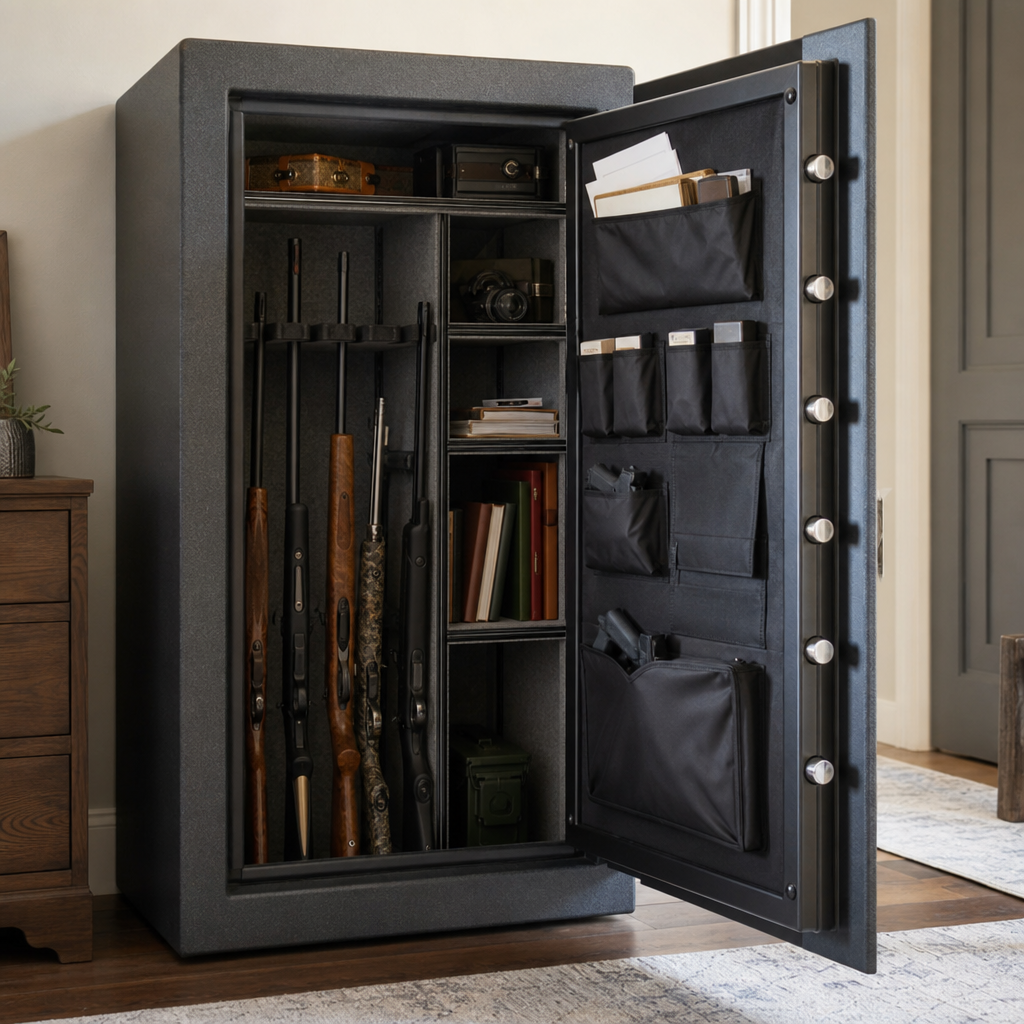
A fireproof gun safe can protect important documents, but only when the safe’s fire rating, internal temperature limit, seal design, and document storage method match what paper, photos, digital media, and legal records actually require. I have evaluated residential gun safes for homeowners who assumed that “fireproof” meant universal protection, and that assumption causes more document loss than outright burglary. In the gun safe market, fire protection claims vary widely. Some safes are designed primarily to slow unauthorized access, while their fire features are secondary. Others use layered gypsum board, intumescent door seals, and composite construction to keep the interior below a specified temperature for a defined time. Those details matter because ordinary paper chars at roughly 451 degrees Fahrenheit, many plastics deform much earlier, and digital media can fail at temperatures paper easily survives.
Understanding the difference between a fireproof gun safe and a document safe is essential for anyone storing wills, passports, deeds, tax files, backup drives, family photos, or insurance records alongside firearms. The term “fireproof” is often used loosely in advertising, yet most tested safes are not literally proof against all fire conditions. They are fire resistant for a measured duration, such as 30, 60, 90, or 120 minutes, under a specific test protocol. That protocol may be performed by an independent laboratory such as UL, ETL, or Intertek, or it may be an in-house manufacturer test with less transparency. For buyers comparing products within the broader Gun Safes & Safety category, this topic matters because a safe that protects rifles may still fail to protect birth certificates or hard drives if heat, humidity, and smoke infiltration are overlooked.
This article is the hub for Gun Safe Myths & Misconceptions because document protection sits at the center of several common misunderstandings. People often believe heavier always means safer, thicker steel always means better fire protection, waterproof ratings are irrelevant, the advertised fire time guarantees survival in any house fire, and placing papers in folders on the top shelf is enough. In practice, document survival depends on a system: verified fire testing, sensible placement in the home, correct safe anchoring, interior organization, and selective use of secondary containers. A well-chosen fire resistant gun safe can absolutely help protect important documents, but not every model offers the same level of security or preservation. The sections below explain what protection a gun safe can realistically provide, which myths mislead buyers, and how to build a storage setup that protects both firearms and irreplaceable records.
What “Fireproof” Really Means in a Gun Safe
When a manufacturer calls a gun safe fireproof, the practical meaning is almost always fire resistant, not immune to fire. A meaningful fire rating includes three parts: maximum internal temperature, test duration, and test conditions. For paper documents, the usual target is keeping the interior below about 350 degrees Fahrenheit. That threshold provides a margin under the point at which paper ignites or suffers severe degradation. A safe advertised as “60 minutes at 1400 degrees” suggests that in testing, the exterior was exposed to 1400 degrees Fahrenheit for one hour while the interior stayed below the specified limit. That sounds straightforward, but the quality of the claim depends on who performed the test and whether the result reflects a full unit, not just a material sample.
Residential Structure Fire studies from NFPA consistently show that modern home fires can reach flashover quickly because synthetic furnishings burn hotter and faster than older natural materials. That means a nominal 30-minute fire rating may be enough for some suburban homes with short fire department response times, but inadequate for rural homes, wildfire zones, or properties with delayed detection. In my experience, homeowners most often overestimate the value of low-end fireboard construction. Several entry-level gun safes rely on thin steel shells lined with gypsum board. Gypsum releases chemically bound water as steam when heated, which helps absorb energy, but performance depends on board thickness, door gaps, and whether heat bypasses seams and corners.
Another critical detail is the door seal. Intumescent seals expand when exposed to heat, helping block smoke and hot gases from entering the safe. Without a robust seal, documents may suffer smoke damage, water vapor exposure, and heat spikes even if the outer body survives. Fire ratings also do not necessarily account for impact after a floor collapse. Better tests include a heat cycle, cooldown period, and sometimes impact or explosion hazard evaluation. If the label does not identify a recognized testing organization or explain the protocol, treat the claim as a rough marketing statement rather than a firm preservation standard.
Can Important Documents Survive Inside a Fireproof Gun Safe?
Yes, many important paper documents can survive inside a quality fire resistant gun safe, especially if the safe has a credible 60- to 120-minute rating and is placed in a lower-risk location. Items such as passports, paper deeds, wills, titles, insurance policies, and printed tax records usually fare well if internal temperatures stay below the paper threshold and the safe remains closed. However, survival is not automatic. Documents stored near the door, pressed against exterior walls, or placed loosely in plastic sleeves can suffer more heat damage than papers kept inside a dedicated document pouch or secondary fire-rated box.
The biggest limitation is that not all “important documents” have the same tolerance. Paper records are relatively durable compared with photographs, negatives, CDs, DVDs, USB drives, SSDs, and magnetic backup media. Data media often require internal temperatures below 125 to 150 degrees Fahrenheit and lower humidity levels than paper can tolerate. In other words, a gun safe suitable for firearms and paper may still destroy your digital backup drive. I have seen homeowners retrieve readable insurance papers from a burned safe while every family photo on optical media was warped and unusable. That is why mixed storage needs should drive safe selection, not the marketing headline alone.
Moisture is another overlooked threat. During a fire event, steam release from fireboard and later firefighting water can raise humidity inside the safe. Even without a fire, dehumidifier rods, desiccant packs, and air circulation affect document longevity. If you store original records for many years, use acid-free folders, avoid cheap vinyl sleeves, and keep the documents elevated from the safe floor. A safe can protect against theft and fire while still creating a poor archival environment if condensation is ignored. For many households, the best answer is a fire resistant gun safe for firearms and core paper records, plus a smaller media-rated document safe inside the home for digital storage and irreplaceable photographs.
Common Gun Safe Myths and Misconceptions About Document Protection
The most persistent myth is that all gun safes with fireboard are equally protective. They are not. Construction quality differs dramatically in steel gauge, insulation thickness, seam design, and door fit. A second myth is that a bigger safe automatically gives better document protection. Extra interior volume can help if it allows distance from hot walls, but a larger cavity also means more air mass to heat and more surface area that can leak heat if insulation is mediocre. Third, many buyers assume a house fire will burn uniformly for the exact duration on the label. Real fires are uneven, can involve localized high heat, and may expose one side of the safe far more intensely than a controlled furnace test.
Another misconception is that weight equals quality. Heavy safes can be heavy because of thicker steel, poured composite insulation, larger locking mechanisms, or simply more size. Weight alone says little about how well documents will survive. The opposite myth also appears online: that steel thickness matters only for burglary and not for fire. In fact, thermal mass, structural rigidity, and weld quality influence how a safe behaves under heat stress. Thin bodies can warp more easily, compromising the door seal and raising internal temperatures.
Buyers also confuse water resistance with fire resistance. After a fire, suppression water is often what ruins papers that escaped flame damage. Some gun safes include limited water protection from expanding seals or recessed doors, but many do not carry a tested waterproof rating. Another frequent error is believing that a basement is always the best safe location. Basements can reduce direct flame exposure, but they introduce flood risk, higher ambient humidity, and in some homes difficult access for rapid retrieval of records. Finally, electronic locks are often blamed for all post-fire failures. The real issue is not that electronic locks are inherently unreliable; it is whether the lock, relocker, keypad membrane, and door alignment remain serviceable after heat exposure. High-quality electronic locks from established brands can perform well, but mechanical redundancy still matters.
How to Evaluate a Gun Safe for Documents and Firearms
The right way to evaluate a gun safe is to match the safe’s tested performance to the contents you plan to store. Start with the fire label. Look for a named test laboratory, a stated duration, and a stated maximum internal temperature. Then inspect construction details: body steel thickness, continuous welds, door gap consistency, multiple active bolts, and expanding heat seals. If the manufacturer publishes only vague phrases such as “fireproof up to 30 minutes,” ask what temperature was used and who conducted the test. Reputable brands provide specifics because specifics sell to informed buyers.
Next, assess your risk profile. A suburban homeowner with monitored smoke alarms, nearby hydrants, and a five-minute fire response can often justify a different safe than a rural owner storing records in a detached building. Also consider what you are protecting. If your main concern is passports and paper deeds, a gun safe with a genuine one-hour rating may be sufficient. If you need to store external hard drives, notarized originals, collectible documents, and family photos, add a media-rated insert or separate file safe. Burglary resistance matters too. A document-safe-within-a-safe only helps if thieves cannot carry away the outer unit.
| Storage Need | What to Look For | Main Limitation |
|---|---|---|
| Paper records | Verified fire rating, 60 to 120 minutes, interior under 350°F | Smoke and moisture damage if seals are weak |
| Digital media | Separate media-rated container, lower heat and humidity tolerance | Standard gun safe ratings are usually inadequate |
| Combined guns and documents | Fire seal, organized shelves, dehumidification, anchor bolts | One safe rarely optimizes every storage condition |
| Flood-prone homes | Raised placement, water resistance details, inventory backups | Basement placement can defeat fire advantages |
Finally, think beyond the product page. Placement on a concrete slab generally beats an upper floor for both security and fire stability. Anchoring prevents tip-over and smash-and-grab theft. Interior organization matters because papers crammed beside ammunition, solvents, or rechargeable devices face unnecessary risk. In installations I trust most, homeowners maintain digital copies in encrypted cloud storage, originals in a protective folder inside the safe, and a current inventory stored off-site. That layered approach is more reliable than trusting any single “fireproof gun safe” claim.
Best Practices to Improve Document Protection Inside a Gun Safe
If you already own a fire resistant gun safe, you can improve document protection substantially without replacing it. Store original papers in the center of the safe rather than against sidewalls, the door panel, or the floor. Use archival folders or envelopes, and place the most critical records inside a dedicated fire-rated document pouch only if the pouch is designed for heat exposure and does not trap damaging moisture. Keep digital media in a separate media-rated box; do not assume a paper-rated interior is safe for electronics. Use rechargeable desiccant packs or a low-watt dehumidifier rod to reduce condensation risk, but route power carefully and preserve the door seal.
Review your safe location with the same seriousness as the safe itself. An attached garage seems convenient, yet garages often have higher ambient heat, more combustible liquids, and easier access for thieves. A master bedroom closet may be practical, but upper floors can collapse sooner in severe fires. A ground-floor interior room on a concrete slab is often the best compromise. Keep the safe away from exterior windows where radiant heat can spike and burglars can observe it. Maintain updated scans of every critical record in secure cloud storage and verify that your executor, spouse, or business partner can access those backups lawfully if needed.
Most important, treat the safe as one layer of a complete records protection plan. Replace fading thermal paper receipts with scanned copies, review insurance coverage annually, and label folders clearly so documents can be retrieved quickly during emergencies. If your current safe lacks a trustworthy fire rating, do not rely on it for irreplaceable originals. Upgrade thoughtfully, and use your next purchase as an opportunity to correct the myths that lead so many owners to confuse firearm security with true document preservation. Audit your safe today, identify what you store, and make sure the protection matches the risk.
Frequently Asked Questions
Does a fireproof gun safe really protect important documents?
Yes, a fireproof gun safe can protect important documents, but only if its fire rating actually matches the type of items you plan to store inside. This is where many homeowners get misled. The word “fireproof” sounds absolute, but in practice it usually means the safe was tested to resist heat for a specific amount of time under specific conditions. Paper documents, passports, wills, deeds, tax files, and similar records are generally safer than items like photographs, USB drives, hard drives, CDs, and backup media because paper can tolerate a higher internal temperature before it chars or ignites. Digital media and photo materials are far more heat-sensitive.
What matters most is not just the outside fire rating advertised on the safe, but the maximum internal temperature the safe is designed to maintain during a fire. A gun safe may be marketed as offering 30, 60, or 90 minutes of fire protection, yet still allow interior temperatures high enough to damage certain valuables long before that time is up. In other words, some fire-rated gun safes are acceptable for paper records but a poor choice for digital backups or irreplaceable family photos. If you want true document protection, you need to look beyond marketing language and verify the tested temperature threshold, duration, and test standard used.
What should I look for in a gun safe’s fire rating before storing legal papers, passports, or financial records?
Start with the fire rating details, not just the headline claim. A good document-protection decision depends on knowing how long the safe was tested, at what external temperature, and what internal temperature it maintained. For paper documents, the interior generally needs to stay below the temperature at which paper begins to scorch and break down. That means a safe with a stronger, independently verified fire rating is much more reliable than one with vague wording like “fireproof” or “factory tested.” If the manufacturer does not clearly explain the test method, duration, and internal temperature results, that should raise caution.
You should also pay attention to seal design. Heat is one threat, but smoke, steam, and water intrusion are others. Many better safes use expanding heat seals around the door that help close gaps during a fire. That can improve the odds that documents survive not only direct heat exposure but also smoke contamination and firefighting moisture. In addition, review how the safe is constructed. Thicker steel, better door fitment, multiple layers of insulation, and a well-designed fire liner typically perform better than entry-level units built mainly for basic theft deterrence.
Finally, consider whether the gun safe is truly the right storage environment for your most important records. For many homeowners, a gun safe can work well for copies of legal and financial papers, but the most sensitive originals may deserve a dedicated fire-resistant document chest placed inside the gun safe. That layered approach gives you an extra temperature buffer and often offers more dependable protection for the records that would be hardest to replace.
Are photos, USB drives, hard drives, and other digital items safe inside a fireproof gun safe?
Usually not to the same degree as paper documents, and this is one of the biggest misconceptions in the market. A fireproof gun safe that does a reasonable job protecting paper may still become hot enough inside to ruin photographs, backup drives, memory cards, external hard drives, CDs, DVDs, and USB flash drives. These materials are much more vulnerable to heat, humidity, and thermal deformation than paper. Even if they do not visibly burn, they can warp, melt, delaminate, or become unreadable after exposure to elevated interior temperatures.
This is why many residential gun safes should not be treated as universal archival storage. If you store family photo albums, legal evidence scans, encrypted backups, or business records on digital media, those items should ideally go into a media-rated fire container, not loose on a shelf in the gun safe. Some owners assume that if the guns survive and the paper files look intact, their USB drive or hard disk is fine too. Unfortunately, digital media often fails silently. It may look normal after a fire and still be unrecoverable.
If you must keep digital records in the safe, use a secondary media-rated box or pouch designed specifically for heat-sensitive storage, and keep off-site or cloud backups as well. The safest strategy is redundancy. Store paper originals appropriately, digitize critical records, and keep those digital copies in more than one location. A gun safe can be one part of the protection plan, but it should not be your only line of defense for heat-sensitive media.
How should I store important documents inside a fireproof gun safe for the best protection?
Organization and packaging make a real difference. Important documents should not be stacked loosely beside firearms, ammunition, or accessories. Instead, place them in clearly labeled folders or envelopes and keep them in a dedicated area of the safe where they are less likely to be crushed, bent, or exposed when the safe is opened frequently. For the best protection, use a fire-resistant document box or pouch inside the gun safe, especially for originals such as birth certificates, property deeds, titles, wills, trust papers, insurance records, and passports. This adds another barrier against heat spikes and helps reduce smoke and moisture exposure.
You should also think about humidity control. Gun safes are often managed for firearm preservation, which means owners may add dehumidifiers, desiccants, or heating rods. Those can be helpful, but documents should still be stored in a way that avoids direct contact with damp surfaces, oil residue, or cleaning chemicals. Keep records in archival-safe sleeves or acid-free folders when appropriate, and avoid overpacking the safe. Airflow and separation matter because tightly crammed contents can trap moisture and make it harder to retrieve essentials quickly in an emergency.
It is also smart to separate originals from copies. Store the most critical originals in the most protective container inside the safe, and keep photocopies or scanned versions elsewhere. If a disaster occurs, recovery is easier when everything is categorized in advance. A simple document checklist taped inside the door or stored digitally can save time and reduce panic. The goal is not just surviving the fire itself, but making sure the documents remain readable, organized, and usable afterward.
Is a fireproof gun safe enough on its own, or should I use another type of protection for valuable records?
For many households, a fireproof gun safe is a good starting point, but not the complete solution. It can offer theft resistance and some level of fire protection in one unit, which makes it appealing for combined storage of firearms and documents. However, the best answer depends on what you are protecting. Basic paper records may do reasonably well in a properly rated safe. Highly sensitive originals, irreplaceable photos, digital backups, and business records usually deserve more specialized storage. A dedicated fire-resistant document safe or media-rated chest inside the gun safe often provides better protection than relying on the gun safe alone.
You should also remember that real fires are unpredictable. Duration, fuel load, room location, collapse risk, and firefighting water can all affect survival outcomes. A safe’s label is not a guarantee that every item inside will emerge unharmed under every scenario. That is why layered protection is the most reliable approach: use the right safe rating, use secondary document containers when needed, scan important records, maintain encrypted digital backups, and store copies off-site if the records would be difficult or impossible to replace.
In practical terms, think of a fireproof gun safe as one component of a broader protection plan. It can absolutely help protect important documents, but only when its fire performance, seal quality, and storage setup align with the real vulnerability of the items inside. Homeowners who understand that distinction make better purchasing decisions and are far less likely to confuse a marketing claim with true document security.