
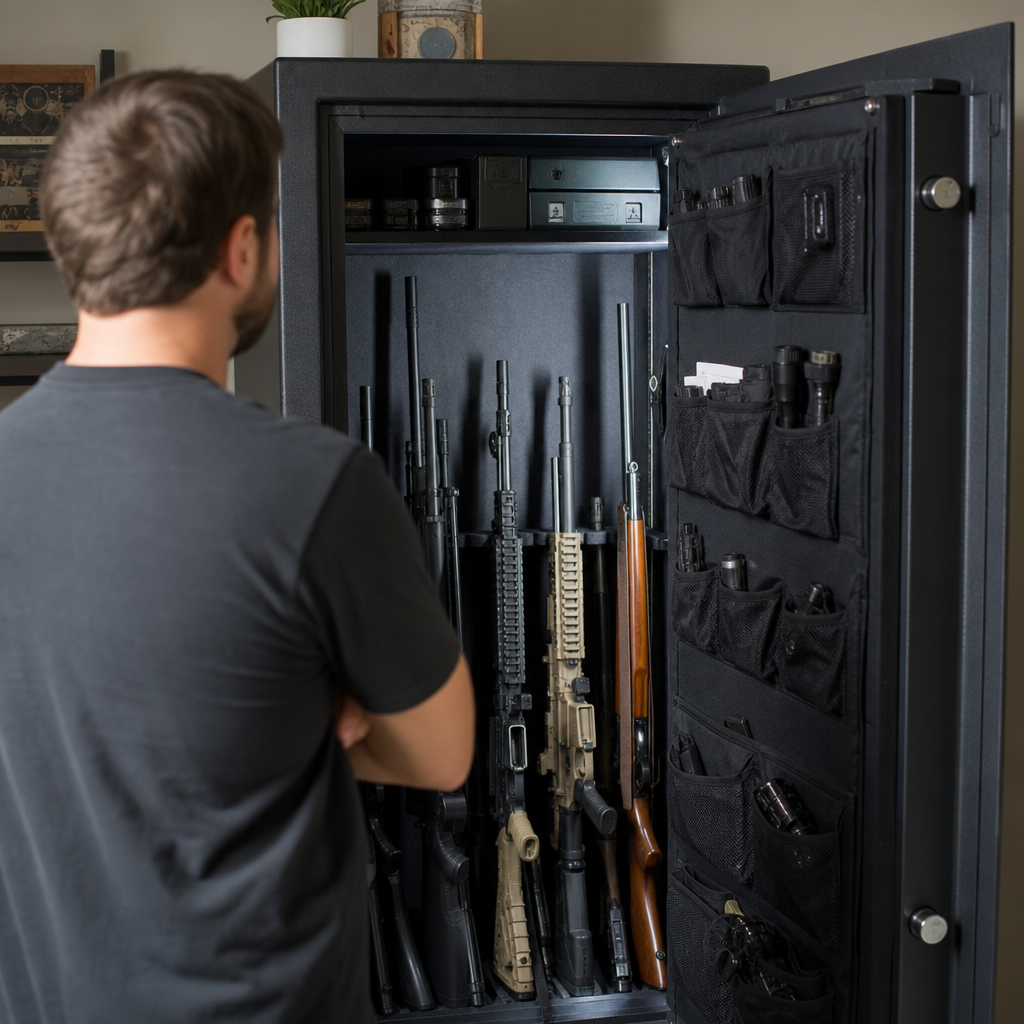
Buying a gun safe is a smart safety step, but it does not automatically make you compliant with storage laws. Compliance depends on how firearms are stored, who can access them, what your state requires, and whether the safe you chose actually meets the legal standard that applies to your situation. In practice, I have seen gun owners assume that any metal box with a lock solves the problem, only to learn that a prosecutor, insurer, or civil court may look at far more than the purchase receipt. That gap between ownership and lawful use is where many of the most common gun safe myths begin.
Storage laws govern how firearms must be secured to prevent unauthorized access, especially by children, prohibited persons, or thieves. A gun safe is generally a locked container designed to restrict access, but legal definitions vary. Some states speak broadly about a locked container. Others refer to a locking device, a locked box, or secure storage whenever a firearm is not being carried or controlled. Certain laws become stricter if a minor is likely to gain access, if the firearm is loaded, or if the owner knew or should have known the risk. For owners, retailers, and instructors, that means the same safe setup can be acceptable in one state and inadequate in another.
This matters because the consequences of misunderstanding storage requirements are serious. Criminal charges, negligence claims after an unauthorized access incident, denied insurance claims, and preventable injuries all turn on details. Questions also arise after travel, moving across state lines, divorce, shared living arrangements, or adding faster-access devices for home defense. A common misconception is that compliance is determined by the product category alone. It is not. The law usually cares about actual security, actual access, and actual circumstances. This article serves as the hub for gun safe myths and misconceptions by explaining where owners go wrong, what courts and statutes tend to focus on, and how to build a storage plan that is both safer and more defensible.
Why a gun safe alone does not equal legal compliance
The core answer is simple: owning a gun safe does not automatically make you compliant because storage laws regulate conduct, not just equipment. If the firearm is left on a nightstand while the safe sits empty, the existence of the safe does nothing. If the safe is unlocked, the code is shared with a teenager, the backup key is hidden in an obvious drawer, or a prohibited person in the home knows the combination, your legal position may be weak even if the safe itself is high quality. When I review storage practices with gun owners, the first issue is almost never the brand name. It is whether daily behavior matches the duty to restrict access.
Another reason is that legal triggers differ by jurisdiction. Some child access prevention laws impose liability when a minor actually gains access. Others apply when a gun is stored negligently in a manner likely to allow access. States including Massachusetts and California are known for more explicit storage rules, while other states rely more on child access prevention statutes, reckless endangerment theories, or post-incident negligence analysis. Federal law is narrower in this area, though licensed dealers face requirements around secure gun storage device availability under the Child Safety Lock Act of 2005. Because no single national standard controls every home storage situation, owners need to read the law where they live, not assume a universal rule.
Compliance can also depend on the firearm type and context. A loaded handgun kept for immediate defense may be treated differently from long guns stored for hunting season. Homes with minors, roommates, in-home caregivers, or visitors create higher foreseeable access risks. Courts and investigators often ask practical questions: Was the safe anchored? Was there evidence of tampering? How quickly could an unauthorized person obtain the code? Was ammunition stored separately where required or advisable? A gun safe helps answer those questions favorably, but it is only one piece of the overall analysis.
What storage laws usually require in plain terms
Although wording varies, most storage laws revolve around four ideas: locked storage, unauthorized access prevention, heightened responsibility around minors, and reasonable control over loaded firearms. Locked storage means the firearm is placed in a locked container, secured with a locking device, or otherwise rendered inaccessible. Unauthorized access prevention means the owner takes affirmative steps so people who should not have the gun cannot get it. Minor access rules often impose criminal penalties if a child obtains an unsecured firearm and uses it, carries it in public, or causes injury. Reasonable control standards appear when an owner leaves a firearm where access was foreseeable even if no statute lists every required hardware feature.
In real use, that means the legal question is often less “Do you own a safe?” and more “Would your storage method predictably stop the wrong person from getting the gun?” A thin locker with a default keypad code, placed unanchored in a garage, may satisfy a narrow reading of one rule yet fail badly under theft-prevention expectations or negligence scrutiny after a break-in. By contrast, a compact quick-access handgun safe bolted to a bed frame and programmed with a private code may be a stronger choice for a defensive pistol, even though it is much smaller. Suitability matters.
Gun owners should also understand that manufacturer advertising is not law. Terms like California DOJ approved, TSA compliant, pry resistant, or child safe each mean something different, and some are marketing shorthand rather than broad legal guarantees. For example, California maintains standards for firearms safety devices and approved lock boxes, but approval for one purpose does not certify compliance in every scenario. Likewise, Underwriters Laboratories burglary ratings such as Residential Security Container classifications address attack resistance under testing conditions, not child access statutes directly. The safest approach is to treat product labels as useful data points, then compare them to the exact legal language and your household risk profile.
Common gun safe myths and the reality behind them
Several myths repeatedly create confusion. Myth one: any gun safe counts. Reality: some laws are broad enough that many locked containers qualify, but others demand more than mere possession of a lockable box. Myth two: if the safe is in the house, the guns are legally stored. Reality: compliance usually depends on the firearm being secured when not under immediate control. Myth three: biometric safes are always compliant because they are modern. Reality: speed does not equal reliability, and false rejects, battery failure, and poorly managed backup entry can undermine security. Myth four: a cable lock through the action is always enough. Reality: it may satisfy a limited statutory requirement but still leave a firearm accessible if ammunition and keys are easily available.
Myth five is especially dangerous: if no child lives in the home, storage laws do not matter. In practice, children visit, neighbors enter, maintenance workers come through, and stolen firearms create major liability issues. Myth six: separate ammunition storage is always legally required. In many states it is not mandatory in every circumstance, but it can still be a strong safety measure and may matter in certain regulated contexts. Myth seven: insurance replaces the loss, so storage details are secondary. Insurers often ask whether the safe was rated, anchored, and used as represented. Poor storage can complicate claims for both stolen firearms and resulting damage.
As a hub topic, these myths connect to deeper questions owners routinely ask: Does a gun cabinet count as secure storage? Are trigger locks enough? Is a bedside safe legal if it stays loaded? Can a spouse know the code? What if a roommate is prohibited from possessing firearms? Each question turns on access control and legal context. The useful mindset is to stop asking whether the safe exists and start asking whether unauthorized access is realistically prevented in daily life.
How to evaluate whether your setup is actually defensible
A defensible setup starts with a legal check, then a risk check, then a hardware check. First, confirm your state and local rules, including child access prevention statutes, negligent storage provisions, and any rules tied to licensing or carry permits. Second, map the people who can reach your firearms: children, teens, guests, housekeepers, contractors, ex-partners, and prohibited persons. Third, assess the container itself: lock type, steel thickness, pry resistance, anchoring, fire seal quality, backup access method, and placement within the home. This sequence works because compliance and safety both fail when one weak link is ignored.
The table below shows how common storage options compare in practical terms.
| Storage option | Best use case | Main compliance strength | Main limitation |
|---|---|---|---|
| Full-size gun safe | Multiple firearms, long-term home storage | Strong access control when locked and anchored | May encourage leaving a defensive handgun outside for convenience |
| Quick-access handgun safe | Loaded bedside or closet defensive pistol | Balances rapid access with restricted entry | Battery management and code privacy are critical |
| Locking gun cabinet | Basic organization for low-risk environments | Better than open storage | Often weaker against forced entry and theft |
| Trigger or cable lock | Transport, layered security, temporary use | May satisfy limited locking-device rules | Does not secure the firearm itself from being taken |
| Hidden compartment furniture | Discreet storage | Concealment reduces casual discovery | Concealment is not the same as secure locking |
Notice that no option guarantees compliance by itself. A strong safe left open fails. A modest lockbox used consistently may succeed. This is why investigators examine actual practices after an incident. They look for signs of regular locking, access logs on smart safes, key control, and whether the setup matched foreseeable risks in the home.
Special situations that create legal and practical problems
Some of the hardest cases involve shared access. If both spouses are lawful possessors, sharing a code may be fine. If one adult in the home is prohibited, even indirect access can create serious federal and state issues because constructive possession arguments may arise. I have also seen problems where an owner stores firearms in a common closet while assuming a roommate will never look there. That is not a serious access-control plan. In blended families, codes that older children can observe or guess are another frequent weak point.
Travel and vehicles cause additional confusion. A home safe does nothing for the handgun left unsecured in a car console overnight. Many theft reports begin there. State vehicle storage rules vary, and some locations mandate locked containers in specific settings such as employer parking lots, school zones, or certain public properties. Temporary lodging is equally tricky. A cable looped through a suitcase frame inside a hotel room may deter opportunistic theft, but it is not equivalent to robust home storage. Owners should build a travel-specific storage method instead of assuming the home safe solves every compliance question.
Another overlooked area is maintenance and emergency planning. Biometric readers can fail with wet fingers, dead batteries, or poor enrollment. Mechanical simplex locks avoid batteries but still require periodic testing. Keys stored too close to the safe undermine the point of locking it at all. Fire protection also deserves realistic expectations. A manufacturer’s 30-minute or 60-minute fire rating may reflect internal testing conditions that differ from a whole-house burn. For irreplaceable documents, many owners pair the firearm safe with a separate UL-classified document safe. Layering functions usually works better than expecting one container to do everything.
Best practices for staying compliant and genuinely safer
The most reliable approach is to create a written storage policy for your household. Decide which firearms stay loaded, where they are kept, who may access them, how codes are managed, when keys are carried, and what happens when guests or children visit. Use one primary secure container for long-term storage and separate quick-access storage only where a real defensive need exists. Anchor safes according to manufacturer instructions, change factory codes immediately, and test backup entry methods on a schedule. If your state publishes official guidance, save a copy with your records.
Documentation helps more than owners realize. Keep purchase records, model numbers, anchoring photos, battery replacement logs, and any proof that your lockbox or safe meets named standards. If you train family members, document that too. In the aftermath of theft, unauthorized access, or a legal dispute, evidence of a thoughtful storage system matters. So does periodic review. A setup that was sensible for a single adult may become inadequate after a child is born, a parent moves in, or a prohibited person enters the household.
The key takeaway is straightforward: a gun safe is a tool, not a legal force field. Owning one is often part of a compliant storage plan, but automatic compliance is a myth. Laws focus on prevented access, not just purchased hardware. The best results come from matching the container to the firearm, the law, and the people around you. Audit your current setup, verify your state requirements, and close the weak points now before a preventable mistake becomes a criminal, civil, or personal tragedy.
Frequently Asked Questions
Does buying a gun safe automatically mean I am following the law?
No. Owning a gun safe by itself does not automatically make you legally compliant with firearm storage laws. The key issue is not simply whether you purchased a safe, but whether your actual storage practices satisfy the law that applies where you live and under your specific circumstances. Many laws focus on access: can a child, prohibited person, unauthorized adult, or household guest get to the firearm? If the answer is yes, the fact that a safe exists somewhere in the home may not help you very much.
State laws vary widely. Some states impose child access prevention rules, some require firearms to be locked when not in use, some create liability only if a minor actually gains access, and others set stricter standards if a prohibited person lives in the home. In certain situations, the law may also care about whether the gun was loaded, whether ammunition was stored separately, and whether the locking device or container qualifies under a statutory definition. A lightweight cabinet, bedside lockbox, or inexpensive keyed container may be enough in one context and completely inadequate in another.
Just as important, compliance is often judged after an incident. If a child opens the safe, a burglar steals the firearms because the unit was not secured, or a domestic violence respondent accesses a weapon that should have been restricted, investigators and courts may examine how the firearms were stored in real life. They may look at the safe’s locking mechanism, whether it was actually locked, who knew the combination, where keys were kept, and whether the unit was anchored. So while a gun safe is usually a strong safety measure, legal compliance depends on the total storage setup, not the receipt showing that you bought one.
What factors determine whether my gun safe setup meets storage law requirements?
Several factors matter, and they go beyond the simple question of whether your firearm was inside a locked container. First, you need to know what law applies in your state or locality. Some laws are written around preventing child access, while others address negligent storage more broadly. If you have minors in the home, regularly host children, live with someone who is legally prohibited from possessing firearms, or are subject to a protective order or other court restriction, the standard may be more demanding than you expect.
Second, the type of storage device matters. A true gun safe, a residential security container, a lockbox, a locking cabinet, and a trigger lock are not always treated the same under the law. Some statutes or court orders may require locked storage generally, while others may expect a device that reasonably prevents unauthorized access. That can raise questions about construction quality, pry resistance, lock reliability, and whether the unit was mounted to prevent easy removal. A small portable box can be useful, but if someone can simply carry it away unopened, that may create separate legal, insurance, and negligence concerns.
Third, access control is critical. If other people know the code, if the key is hidden nearby, if the biometric lock frequently fails and you leave the safe open out of convenience, or if the firearm is routinely kept outside the safe for quick access, then your day-to-day practice may fall short of legal expectations. Investigators often care more about what you actually did than what your equipment was theoretically capable of doing.
Finally, context matters. Storage expectations may differ depending on whether the firearm is in your home, your vehicle, a temporary residence, or a shared living environment. There may also be special rules for gun dealers, certain professional roles, or people under specific court obligations. The safest approach is to confirm the exact legal standard in your jurisdiction and then compare that standard to your real storage habits, not just the product label on the safe.
If my firearm is locked in a safe, can I still face criminal, civil, or insurance problems?
Yes. A locked safe can help your position, but it does not eliminate risk. Criminal liability may still arise if the firearm was stored in a way that violated a child access prevention law, a negligent storage statute, or a court-imposed restriction. For example, if a minor gains access because the code was shared, the key was left in an obvious place, or the firearm was regularly left outside the safe, prosecutors may argue that the owner failed to secure the gun properly even though a safe was present in the home.
Civil liability is another concern. If someone is injured because they obtained access to a firearm that was not stored with reasonable care, an injured party may sue and argue that your storage practices were negligent. In that situation, a court may look well beyond whether you bought a safe. It may examine whether the safe was suitable for the risk, whether it was used consistently, whether it was anchored, whether household members had unsupervised access, and whether prior warning signs existed. If you knew children visited the home, knew a family member was unstable, or knew the lock was unreliable, those facts can matter significantly.
Insurance issues can also come into play. Some homeowners or specialty firearm policies include conditions regarding theft prevention, proof of ownership, or security measures. After a theft, an insurer may ask whether the firearms were stored in a locked safe, what type of safe it was, whether it was bolted down, and whether there was forced entry. If the safe did not meet policy expectations or if your account of storage is inconsistent, coverage disputes can arise. In other words, a safe is helpful evidence of responsible ownership, but it is not a universal shield against prosecution, lawsuits, or claim denials.
Do all gun safes and locking containers count the same under storage laws?
No. The law does not always treat every locking device as functionally equivalent. In everyday conversation, people use terms like “safe,” “cabinet,” “lockbox,” and “locked case” interchangeably, but legal and practical differences can matter. A heavy safe with a reliable lock and substantial resistance to unauthorized entry is different from a thin metal cabinet with a simple key lock, and both are different from a trigger lock or cable lock. Depending on the wording of the law, one option may satisfy the requirement while another may not, especially if the issue is whether the storage method reasonably prevented access by a child or prohibited person.
Even when the statute is broad, quality still matters. A container that can be pried open quickly, a biometric lock that is inconsistent, a keypad with a default code that was never changed, or a box that is easy to carry away may undermine the argument that the firearm was securely stored. If a case ends up in court, the discussion may not stop at “was there a lock?” The question may become whether the storage method was genuinely secure under the circumstances.
There is also an important difference between legal minimums and best practices. A basic locking container may technically satisfy a narrow legal requirement in some jurisdictions, but still leave you exposed to theft, unauthorized access, or negligence arguments. That is why responsible gun owners should look at statutory compliance and practical security together. Before assuming your storage device is sufficient, review your state’s definitions, any relevant local rules, and the manufacturer’s specifications, then assess whether the device truly matches the level of risk in your household.
What should I do to make sure I am actually compliant, not just assuming I am?
Start by identifying the exact laws that apply to you. Do not rely on general internet summaries, retail marketing, or broad assumptions that “a safe is enough.” Look at your state statutes, any local ordinances, and any special rules that may apply because of children in the home, prohibited persons, domestic violence orders, or transportation and vehicle storage requirements. If the language is unclear, consult a qualified attorney in your state. Firearm storage law is one of those areas where small factual differences can matter a great deal.
Next, evaluate your actual storage routine honestly. Ask yourself whether the firearm is always secured when it is supposed to be, whether the safe remains locked, who knows the combination, where keys are kept, whether the unit is anchored, and whether unauthorized people could realistically get access. If you use the safe inconsistently or bypass it for convenience, that gap can become the most important fact in a legal or civil case. Compliance is about practice as much as equipment.
Then review the safe itself. Make sure it is appropriate for the firearms you own and the risks in your environment. Change default codes, limit access credentials, secure backup keys, maintain the lock, and keep records of purchase and serial numbers. If your safe is small or portable, consider whether it should be bolted down or supplemented with other security measures. If children are present or frequent visitors to the home include minors, use the most secure storage method reasonably available, not just the bare minimum you think the law might allow.
Finally, remember that compliance is not a one-time purchase decision. It is an ongoing responsibility. A move to a new state, a child becoming old enough to explore, a new roommate, a family crisis, or a court order can all change what secure and lawful storage looks like. The smartest approach is to treat a gun safe as one part of a broader storage plan: know the law, choose the right device, control access tightly, and update your practices whenever your household situation changes.