
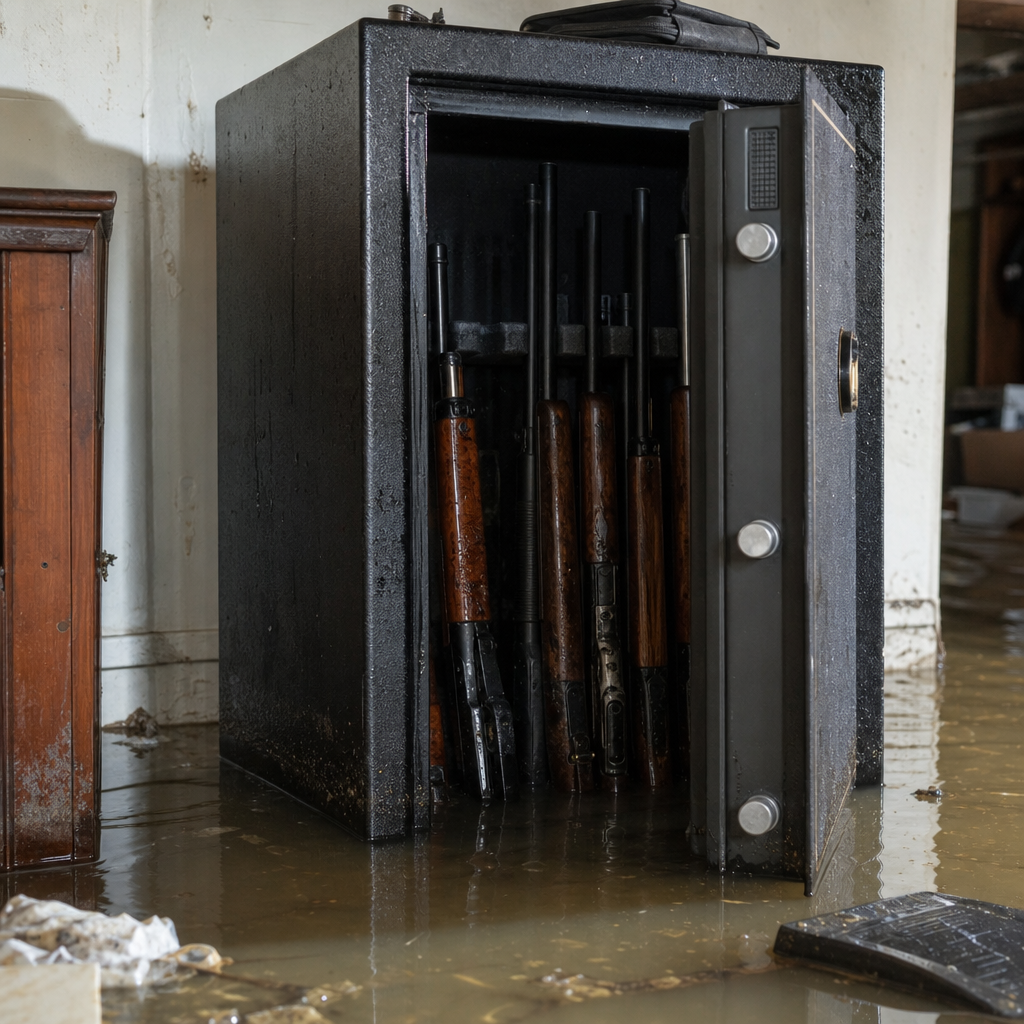
The belief that gun safes are completely waterproof sounds reassuring, but it is wrong often enough to cause expensive damage and dangerous false confidence. In real homes, safes face basement seepage, hurricane-driven rain, burst pipes, sprinkler discharge, fire hose runoff, and humid air trapped after a storm. A gun safe can resist some water intrusion, delay damage, or protect contents during shallow flooding, yet that is very different from being fully waterproof under all conditions. Understanding that distinction matters because firearms, optics, ammunition, documents, and digital media all fail in different ways when moisture gets inside a sealed steel box.
When people say waterproof, they usually mean one of three things: water resistant, gasket sealed, or independently tested for a stated depth and duration. Those are not interchangeable. Water resistance means a product reduces intrusion under limited exposure. A gasket seal means the door frame includes a compressible barrier intended to slow water entry. A tested rating means a manufacturer defines conditions, such as surviving twenty-four hours in eight inches of water, and ideally backs the claim with a lab standard or third-party report. In my experience evaluating safes after storms and plumbing leaks, most consumer confusion starts when marketing compresses those distinctions into one broad promise.
This topic matters beyond product labeling. Gun owners make storage decisions based on assumptions about theft, fire, and water, and each hazard demands different engineering. Thick steel, relockers, hard plates, and bolt work improve burglary resistance. Fireboard, intumescent door seals, and heat-expanding liners improve fire performance. Waterproofing depends more on door geometry, gasket integrity, anchoring method, weld quality, and how long standing water remains around the safe. A model can excel at one job and still perform modestly at another. The myth that all gun safes are completely waterproof obscures those tradeoffs and leaves owners unprepared when real water events happen.
As a hub for gun safe myths and misconceptions, this article also frames related questions many buyers ask: Do heavier safes always mean better protection? Are fire ratings standardized? Can a dehumidifier solve every moisture problem? Is a garage or basement automatically a bad place for a safe? Those questions connect because they all involve the gap between advertising shorthand and real-world performance. The most useful approach is to read claims literally, verify test conditions, and build a storage plan around your actual risks rather than the broadest possible promise on a product page.
Why gun safes are not completely waterproof
No mass-market gun safe should be assumed completely waterproof unless the manufacturer provides a clear immersion claim with conditions, and even then the claim has limits. Steel bodies are assembled from seams, welds, door gaps, lock penetrations, bolt holes, and anchor openings. Every one of those features can become a leak path under pressure, prolonged submersion, or gasket failure. Even a well-built safe with a door seal can admit moisture if water rises above the threshold long enough, if the safe tips, or if debris prevents the door from sealing evenly.
Another overlooked issue is hydrostatic pressure. Water sitting around a safe for several hours exerts force against the door perimeter and body seams. In a shallow spill, that pressure may be minimal. In a flooded basement, it is not. The difference between splash protection and submersion resistance becomes obvious fast. I have seen safes remain dry through minor floor water after a water-heater leak, then take on moisture during a storm surge because the same door seal was never designed for sustained water pressure.
Temperature changes also complicate the picture. During a fire response, a safe may encounter heat, then rapid cooling from hoses or sprinklers. Gaskets can compress unevenly, adhesives can degrade, and interior humidity can spike even without obvious leaks. That is why “waterproof” should never be read as a permanent, unconditional property. It is a performance claim tied to a specific test, installation, and maintenance state.
What manufacturers usually mean by waterproof
Most reputable brands describe water protection in narrow, measurable terms. Common examples include “water resistant for seventy-two hours in two feet of water” or “ETL verified for seven days in up to two feet.” Those statements are useful because they identify depth and duration. However, buyers still need to ask how the test was conducted, whether the safe was anchored, whether the seal was new, and whether the condition reflects fresh water rather than contaminated floodwater. Mud, detergents, sewage, and salt can compromise seals and accelerate corrosion long after the event ends.
Independent verification adds credibility. ETL has been used on some residential security containers to verify water claims, while fire ratings may come from manufacturer protocols rather than UL Class 350 document-safe testing. That distinction is important. A water claim from a respected third party is stronger than a vague sales phrase, but it still does not mean the safe is suitable for every flood scenario. A safe tested in controlled conditions is not automatically prepared for moving water, impact from debris, or complete submersion after a foundation failure.
Marketing language often amplifies the confusion. Terms like flood proof, sealed tight, or all-weather protection sound stronger than they are. In practice, the best way to evaluate a claim is to rewrite it into a simple sentence: “Under these exact conditions, the safe is expected to keep water out for this long.” If the manufacturer does not provide that sentence, treat the protection as limited and plan accordingly.
Where the myth comes from and why it persists
The myth survives because consumers naturally bundle security features together. If a safe is heavy, fire lined, and expensive, it feels logical to assume it also defeats water. Retail displays reinforce that assumption by listing fire minutes, steel gauge, and waterproof messaging side by side, even though those features rely on different engineering choices. Sales staff may also simplify explanations because most buyers want a quick recommendation, not a lesson on gaskets, body seams, and flood dynamics.
Another reason is survivorship bias. Owners whose safes stayed dry during one storm often tell others their model is waterproof, when the actual event may have involved only a half inch of floor water for a few hours. That anecdote is useful but incomplete. A safe that handled one incident may fail in a deeper or longer flood. I have seen the same brand perform perfectly in a first-floor laundry leak and poorly in a coastal flood where saltwater sat against the door seam for days. Context matters more than brand loyalty.
The myth also persists because visible damage is delayed. Moisture intrusion is not always obvious the day the water recedes. Condensation inside a safe can lead to rust bloom on blued steel, corrosion under grips, mildew on slings, and fogging in optics over the following weeks. When owners discover damage later, they may blame humidity alone without realizing floodwater or wet interior materials started the problem.
How water actually damages firearms and valuables
Water damage inside a gun safe is not limited to surface rust. Firearms contain springs, pins, trigger assemblies, bores, magazine bodies, and optics mounts where moisture hides. Ammunition can suffer primer contamination or case corrosion. Paper records wick water and become mold prone. Leather holsters trap moisture against metal. Wood stocks swell, crack, or shift point of impact. Electronic sights, hearing protection, and hard drives may fail from corrosion long before external surfaces look severe.
The danger increases when owners assume the safe protected everything and delay inspection. After any flood event, contents should be removed, dried, and assessed immediately. Field stripping, lubricating, and replacing desiccants are basic first steps. For optics and precision rifles, a gunsmith or manufacturer service center may be appropriate because trapped moisture can remain inside turrets, battery compartments, and bedding interfaces. Fast action matters; oxidation begins quickly, especially when floodwater contains minerals or salt.
| Item stored in the safe | Typical water-related failure | Best immediate response |
|---|---|---|
| Blued or carbon steel firearms | Flash rust, bore corrosion, seized small parts | Unload, dry, disassemble, clean, oil the same day |
| Optics and electronics | Internal fogging, battery corrosion, circuit failure | Remove batteries, dry externally, seek manufacturer inspection |
| Ammunition | Primer or powder contamination, case oxidation | Segregate exposed rounds, follow maker guidance, do not trust for defense |
| Documents and photos | Warping, ink bleed, mold growth | Air dry individually, use archival recovery methods if valuable |
| Leather gear and slings | Mildew, stiffening, corrosion transfer to metal | Dry separately and condition after cleaning |
Common gun safe myths linked to waterproof claims
The waterproof myth rarely appears alone. It travels with several other misconceptions in the gun safe myths and misconceptions category. One is that a fire seal automatically keeps out water. Not necessarily. Intumescent seals expand during heat to slow smoke and heat transfer, but they are not the same as long-duration water gaskets. Another myth is that a heavier safe is always better in every way. Added mass can improve theft resistance and thermal stability, but it does not guarantee superior door sealing or flood performance.
A third myth is that dehumidifiers make waterproofing irrelevant. Dehumidifier rods and desiccants help manage ambient moisture inside a closed safe, but they do not stop liquid water intrusion. If floodwater enters, a goldenrod-style heater will not save paper records or prevent immediate rust. A fourth myth is that basement placement is automatically safe if the unit is elevated on blocks. Elevation helps, often significantly, yet it only buys a margin. If sump pumps fail or water exceeds the stand height, the risk returns quickly.
Finally, many buyers assume all fire ratings are standardized. They are not. Some brands publish internal furnace tests, others use independent labs, and test endpoints differ. That matters because a safe chosen primarily for fire protection may still need separate planning for water exposure after sprinkler discharge or firefighting runoff. The smartest buying decision comes from understanding each claim on its own terms rather than assuming one specification covers every hazard.
How to choose a gun safe if flooding is a real risk
If your home has a basement, sits in a FEMA flood zone, faces hurricanes, or has a history of plumbing failures, prioritize explicit water ratings and smart placement. Look for a stated depth-and-duration claim, preferably with independent verification. Review door construction, gasket type, hinge arrangement, and anchoring instructions. Some safes require specific bolt-down methods to maintain water performance. Ask whether anchor holes are sealed and whether aftermarket modifications affect coverage.
Placement matters as much as product choice. In many homes, the safest spot is not the basement corner with the most hidden footprint but a higher interior room on a slab or reinforced floor. If the basement is your only option, raise the safe on a steel or concrete platform above expected water levels and keep vulnerable items in waterproof document boxes inside the safe. That layered approach works well in practice. I recommend separating high-value paper records, suppressor paperwork, passports, and digital backups rather than trusting one enclosure to do every job.
Environmental control should be routine. Use a hygrometer, maintain desiccants, inspect door seals, and open the safe periodically to check for condensation or mildew. After any move, confirm the door closes evenly and the seal is undamaged. A safe is not a set-and-forget appliance. Like smoke detectors and sump pumps, it only performs reliably when owners verify that it is still ready for the conditions they expect.
Practical storage strategy and final takeaway
The central lesson is simple: gun safes can be water resistant, gasket sealed, or tested for limited flood exposure, but they are not completely waterproof by default. That distinction protects your collection because it leads to better questions, better product comparisons, and better emergency planning. Read the exact claim. Verify who tested it. Match the safe to your real risks. Add elevation, humidity control, and separate waterproof containers for critical records and electronics. Inspect contents immediately after any leak or flood.
As the hub page for gun safe myths and misconceptions, this topic should shape how you evaluate every related claim in the broader gun safes and safety category. Do not assume fire protection equals flood protection. Do not assume heavy equals superior in every category. Do not assume a dehumidifier can undo standing water. Good storage comes from layered protection, not from one marketing word. If you are shopping now, compare models by stated water rating, placement suitability, and maintenance requirements before you buy.
Use this article as your starting point, then review the related guides in this subtopic so you can separate proven performance from sales language and build a gun storage plan that actually holds up when conditions get bad.
Frequently Asked Questions
Are gun safes actually waterproof?
No, most gun safes are not completely waterproof in the absolute sense people often assume. Some models are built to resist water entry for a limited period, at a certain water depth, or under specific test conditions, but that is very different from saying they will keep out water in every real-world event. In practice, safes may be exposed to basement seepage, standing floodwater, burst plumbing, wind-driven rain, sprinkler discharge, or water used during firefighting. Each of those situations puts pressure on seams, door gaps, locks, bolt openings, and other weak points in different ways. A safe that performs well during shallow, short-term exposure may still allow moisture inside during prolonged flooding or when water sits against the door for hours.
The bigger problem is the word “waterproof” itself. It creates a false sense of certainty. Buyers may hear that term and assume complete protection, then store firearms, optics, documents, and ammunition without extra safeguards. In reality, many safes offer water resistance, not total water exclusion. Even if liquid water does not pour in, moisture can still enter through humidity, condensation, or temperature swings after a storm. That means rust, mold, swollen wood stocks, damaged paperwork, and compromised electronics can still happen. A gun safe can absolutely add protection, but it should never be treated as a submarine-grade container unless the manufacturer provides clear, credible testing details that match the conditions you are worried about.
What does a “waterproof” or “water-resistant” rating on a gun safe really mean?
It usually means the safe met a limited standard set by the manufacturer or an independent test, not that it is immune to all water damage. When companies advertise water protection, the fine print matters. You may see claims such as protection for a certain number of hours in a few inches of water, or resistance up to a stated depth under controlled conditions. Those claims can be useful, but they are highly specific. They may not account for moving water, debris impact, pressure from deeper flooding, uneven floors, fire-related damage to seals, or a safe that tips over and becomes partially submerged at an angle.
A true evaluation should answer several questions: How deep was the water? How long did exposure last? Was the safe empty or fully loaded? Was the test done before or after a fire exposure? Were the seals new, and what happens as they age? If the company does not provide those details, the claim should be treated cautiously. Marketing language often compresses a complicated performance issue into one reassuring word. For consumers, the safest approach is to view any water rating as a temporary, scenario-specific advantage rather than a guarantee. A good safe may buy time and reduce damage, but the rating does not eliminate the need for desiccants, interior protective containers, elevated installation, and post-event inspection of the contents.
How does water still damage guns and valuables even if the safe seems sealed?
Water damage is not limited to obvious flooding inside the safe. Moisture is often the bigger long-term enemy. Humid air can get trapped in the interior after storms, power outages, or temperature changes, especially if the safe is opened in a damp basement or garage. Once humidity is inside, metal surfaces can begin oxidizing, optics can fog, paper can curl, and wood can absorb moisture and warp. In many cases, owners do not discover the damage immediately because there was no dramatic leak. They assume the safe “worked,” while corrosion quietly develops over days or weeks.
Another issue is condensation. If a safe is cooler or warmer than the surrounding air, moisture can form on firearms and accessories even without direct water intrusion. This is common after severe weather, flooding nearby, or heavy air conditioning in humid climates. Door seals can also compress over time, hinges and lock penetrations may not be perfectly moisture-tight, and any hole used for anchoring or electrical access can become a pathway for humid air. That is why responsible storage goes beyond the outer shell. Gun owners should use dehumidifiers or desiccant packs, keep firearms lightly protected with appropriate oil or rust inhibitor, store important papers in sealed interior pouches, and inspect contents regularly after any weather event or plumbing problem. A safe helps, but moisture control inside the safe is what often determines whether items come out truly unharmed.
What kinds of water events are most likely to overwhelm a gun safe?
The most common threats are not dramatic movie-style floods but everyday household and weather-related incidents. Basement seepage is a major one because it can allow water to accumulate slowly around the base of a safe for long periods. Burst supply lines, water heater failures, washing machine hose breaks, and upstairs plumbing leaks can also dump a surprising volume of water into a home in a short time. During fires, sprinkler systems and firefighting hoses can saturate rooms well beyond the burn area, and that runoff may pool around a safe for hours. In coastal and storm-prone regions, hurricane-driven rain can reach places owners never expected to get wet, while post-storm humidity can remain trapped indoors even after the standing water is gone.
Shallow flooding is often underestimated as well. A safe does not have to be fully submerged to suffer intrusion. Water can enter through the lower door edge, seams, bolt openings, and any compromised seal if it sits high enough and long enough. If the safe is in a garage or basement, the risk increases because those locations are often the first to take on water and the last to dry out. Fire can make things worse by warping components or degrading gaskets before water ever reaches the unit. The lesson is that location and duration matter just as much as water depth. A safe on the floor in a vulnerable area faces a much greater challenge than the same safe installed on a raised platform in a climate-controlled interior room.
What should gun owners do instead of assuming a safe is completely waterproof?
The best approach is layered protection. Start by choosing a safe based on realistic risks, not marketing shorthand. Ask for specific test data on water resistance, then compare that information to your actual environment. If your home has a basement, lives in a flood-prone area, or faces hurricane exposure, placement is critical. Put the safe on a raised concrete or steel platform rather than directly on the floor, and avoid low spots where water naturally collects. Interior rooms on higher levels are often better than garages or basements when feasible. Proper anchoring matters too, because a safe that shifts or tips during flooding can expose vulnerable edges and seams.
Inside the safe, use moisture-control tools such as desiccant packs or electric dehumidifiers, and replace or recharge them on schedule. Store important documents, suppressor paperwork, passports, cash, and heirloom items in secondary waterproof pouches or sealed containers within the safe. Keep firearms cleaned and protected with appropriate rust-prevention products, especially in humid climates. After any storm, leak, or firefighting event, inspect the exterior and interior promptly rather than assuming everything is fine. Open the safe carefully, check for condensation, dry contents if needed, and address any signs of corrosion immediately. In short, a gun safe should be treated as one part of a broader protection strategy. It can reduce risk significantly, but it is not a license to ignore water, humidity, or smart storage practices.