
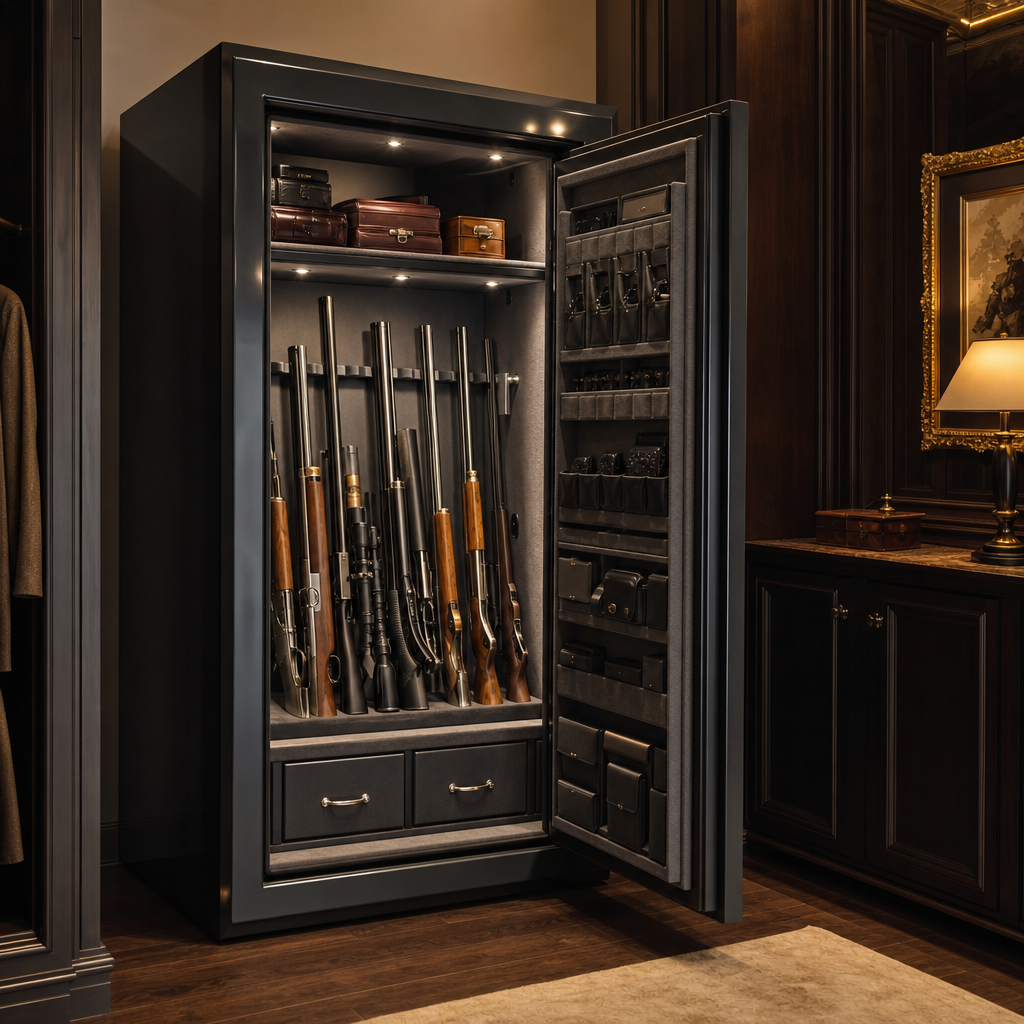
Gun safes for high-net-worth individuals sit at the intersection of physical security, risk management, privacy, and design, serving buyers who expect vault-level protection without compromising the look and function of a primary residence, ranch, lodge, yacht-adjacent property, or private collection room. In this segment, a gun safe is not merely a steel cabinet for firearms storage; it is a carefully specified asset-protection system engineered to resist burglary, manage fire exposure, support inventory control, and integrate with the architectural standards of luxury homes. High-net-worth buyers also approach firearms differently than entry-level owners do. Many maintain mixed collections that include sporting shotguns, heirloom rifles, custom handguns, transferable machine guns where lawful, optics, suppressors, rare ammunition, and documents tied to insurance, provenance, and estate planning. That complexity changes what “best” means. Capacity, burglary rating, lock redundancy, humidity control, white-glove installation, and discreet placement matter as much as finish options. This buyer persona also has distinct concerns: reducing liability, protecting privacy, satisfying insurers, and preserving asset value over decades. I have seen affluent clients reject perfectly good retail safes because they looked out of place in a paneled study, lacked service support in remote areas, or forced awkward compromises on collector-grade firearms. The right solution combines tested security, refined presentation, and a long ownership horizon. This hub explains the high-net-worth persona in depth and maps the broader gun safe buyer landscape, so readers can compare needs, identify the right specifications, and navigate related articles across the gun safes and safety category with confidence.
What Defines the High-Net-Worth Gun Safe Buyer Persona
A buyer persona is a practical decision model: a profile built from goals, constraints, risks, buying triggers, and ownership behavior. For high-net-worth firearm owners, the persona usually includes one or more of the following characteristics: substantial real estate holdings, multiple residences, dedicated staff, elevated burglary risk due to public visibility, significant insured assets, and collections whose financial or sentimental value far exceeds the cost of the safe itself. These buyers are often not price sensitive in the conventional sense, but they are acutely value sensitive. They will spend for proven protection, discreet installation, premium interiors, and long-term service, yet they expect measurable performance rather than marketing language. In consultations, this group typically starts with questions that differ from mass-market shoppers: What burglary standard backs the body and door construction? Can the installer coordinate with the builder, architect, or security integrator? How will humidity, lighting, and inventory be managed? What happens if the lock fails on a holiday weekend?
Luxury in this context does not mean ornamental excess. It means fit, finish, customization, and frictionless ownership. Security means independently tested resistance, robust anchoring, intelligent placement, lock quality, and layered protection beyond the safe itself. The most successful products for this persona pair heavy steel construction, reinforced boltwork, hard plate protection, relockers, and fire insulation with cabinetry-grade interiors, concealed compartments, jewelry drawers, watch winders, document storage, and tailored firearm racks. Many buyers also want a safe that disappears into millwork or sits behind a concealed door. Others want a trophy presentation piece finished in automotive paint, hand-stitched leather, or exotic wood veneer. Both approaches can work, but only if the underlying security engineering is credible.
This persona is also broader than many brands acknowledge. It includes collectors, family office principals, executives, public figures, ranch owners, professional athletes, luxury second-home owners, and estate managers buying on behalf of principals. A sub-pillar hub on gun safe buyer personas should connect these overlapping profiles because product selection changes with use case. The collector prioritizes organization, provenance records, and gentle support for high-polish bluing and figured walnut. The security-driven owner wants high burglary resistance, fast access to defensive firearms, and integration with cameras, sensors, and monitored alarms. The design-conscious homeowner wants concealment and architectural harmony. The estate buyer wants standardization across properties, documented maintenance, and clear access protocols for authorized users.
Security Priorities, Ratings, and Real-World Risk
The first mistake affluent buyers make is assuming weight and price alone equal security. They do not. A 1,200-pound safe with thin body steel and decorative finishes can still underperform against pry attacks, grinding, or sidewall penetration. Serious buyers should evaluate construction details: steel thickness, composite barriers, door edge design, internal hinges or protected external hinges, bolt diameter and travel, relocker count, hard plate over the lock, and anchor strategy. When available, burglary ratings from recognized testing bodies matter because they provide a common benchmark. In the United States, UL Residential Security Container classification is common in the consumer market, while UL TL-15 and TL-30 ratings represent a different class of tested burglary resistance. A luxury buyer storing six-figure collections should understand that an attractive residential safe may offer convenience and concealment, but a true TL-rated unit provides a more meaningful security baseline.
Fire protection deserves the same scrutiny. Fire ratings vary by test method, duration, internal temperature threshold, and whether the manufacturer cites an independent lab or an in-house protocol. For firearms, optics, documents, and wood stocks, heat and moisture can be as damaging as flame. In coastal homes and mountain properties alike, environmental control often matters daily, not only during disasters. That means dehumidifiers, desiccants, sealed door systems, and room-level climate management should be considered part of the package. I advise clients to think in layers: perimeter alarm, surveillance, access control, safe room or concealed placement, anchored safe, environmental controls, and documented inventory. A safe should never be treated as the sole line of defense.
Location risk changes specifications. A penthouse with concierge staff has different vulnerabilities than a rural estate with long law-enforcement response times. A primary residence occupied year-round differs from a vacation property that sits empty for months. Wildfire zones, hurricane regions, and high-humidity environments all affect material and installation choices. The safest purchasing process starts with a threat assessment, not a catalog.
Luxury Features That Actually Add Value
Premium features should solve ownership problems. Interiors are a prime example. Adjustable shelving, barrel supports, door organizers, and scoped-rifle spacing make storage safer and more efficient than generic foam slots. Soft-touch materials, LED lighting with motion activation, and drawers for documents, watches, and jewelry are not just cosmetic; they reduce handling damage and improve inventory management. For collectors, configurable racks that prevent firearms from knocking together are essential. For households with mixed-use storage, modular compartments can separate defensive firearms from heirlooms, ammunition, passports, and important records.
Locks are another area where “luxury” should mean better function, not trend-driven styling. Mechanical dial locks remain durable and time-tested, while electronic locks provide speed and audit-friendly user management on some commercial-grade systems. Redundant lock options, duress features, and EMP-resistant designs can be worthwhile depending on the model. Biometric access can be useful on quick-access handgun safes, but for large-format safes I view biometrics as secondary to proven lock quality and serviceability. High-end buyers should also examine after-sale support: who services the lock, how quickly parts are available, and whether technicians can reach remote properties.
Customization becomes valuable when it aligns with the collection and the home. Color matching, luxury hardware, inset cabinetry, hidden rooms, and bespoke interiors can elevate the ownership experience. However, cosmetic upgrades should never consume budget needed for security upgrades. A practical rule is to specify the protection level first, then the appearance package. The best luxury safes feel refined because they are engineered well and finished well, in that order.
How High-Net-Worth Buyers Compare With Other Gun Safe Buyer Personas
This hub also serves readers researching the broader category of gun safe buyer personas. Understanding adjacent profiles helps clarify where affluent buyers overlap and where they diverge. First-time gun owners often prioritize affordability, straightforward setup, and compliance with household child-safety goals. Competitive shooters care about rapid organization, frequent access, and transport-adjacent storage planning. Hunters may value mudroom placement, corrosion control, and capacity for long guns with optics. Preparedness-minded buyers focus on layered resilience, backup access, and storage for ammunition and medical kits. Collectors emphasize display-quality interiors and preservation. Luxury homeowners combine pieces of all these personas but add stronger demands around privacy, design integration, concierge service, and asset protection.
| Buyer persona | Primary priority | Typical safe choice | Key tradeoff |
|---|---|---|---|
| First-time owner | Basic security and budget | Entry RSC gun safe | Limited burglary resistance |
| Hunter | Capacity and rust prevention | Mid-size long-gun safe | Less focus on aesthetics |
| Collector | Preservation and organization | Premium interior safe or vault | Can underweight physical placement risk |
| Preparedness buyer | Layered access and supplies | Modular high-capacity safe | May sacrifice finish quality |
| High-net-worth owner | Security, privacy, design, service | Custom luxury safe or TL-rated vault solution | Complex specification and installation |
These distinctions matter because recommendations should change by persona. A household buying its first long-gun safe does not need the same consultation process as a principal outfitting three residences and a hunting lodge. The high-net-worth segment rewards brands and dealers that can translate nuanced needs into precise specifications, coordinate installation logistics, and support the product for years.
Selection Criteria: From Capacity Planning to Installation
For affluent buyers, capacity planning should begin with a realistic ten-year inventory forecast. Manufacturers regularly overstate long-gun counts by assuming unscoped rifles packed tightly together. In real use, optics, bipods, oversized bolts, slings, and protective sleeves reduce practical capacity dramatically. I usually tell clients to buy for at least double their current collection if floor loading and room layout allow. That buffer accommodates acquisitions, family transfers, accessories, and document storage without forcing unsafe crowding.
Placement is equally important. Ground-floor installation on a concrete slab simplifies anchoring and load distribution, while upper-floor placement may require structural review. Concealed locations reduce targeting, but they must still allow door swing, ventilation, service access, and egress around the unit. Delivery logistics for premium safes are not trivial. Stair climbs, narrow turns, radiant flooring, finished millwork, and elevator limits can all complicate installation. White-glove delivery teams with insured movers, stair-climbing equipment, and builder coordination are worth paying for because mistakes at this level damage both property and security.
Buyers should also clarify whether they need a standalone safe, modular safe, vault door, or full safe room. Modular systems can be assembled in spaces inaccessible to welded safes and can work well in urban luxury homes. Vault rooms make sense when collections are large or when mixed assets, such as jewelry and documents, are stored together. Insurance should be discussed early. Carriers may require appraisals, inventory schedules, alarm systems, and specific storage standards. Estate planning is another overlooked factor. Trusted-access procedures, documented combinations in secure legal custody, and clear succession instructions prevent expensive complications later.
Brands, Integrators, and the Ownership Experience
In the premium market, the dealer or integrator matters almost as much as the brand. Established manufacturers such as Browning, Fort Knox, Liberty, AMSEC, Rhino Metals, and Graffunder occupy different positions across consumer, premium, and higher-security tiers, while true commercial-security providers and custom vault firms serve buyers needing TL-rated solutions or architectural vault rooms. The right partner will explain those distinctions candidly. If a six-figure collection is being stored, a dealer should be comfortable discussing UL classifications, fire-test limitations, lock options from recognized manufacturers like Sargent and Greenleaf or La Gard, and the realities of installation and service.
For luxury projects, coordination with residential security firms, architects, and interior designers often determines success. A beautiful hidden installation can fail if ventilation is ignored, if network-connected lock features are added without cyber hygiene, or if millwork makes future lock servicing impossible. The best projects are documented like any other high-value home system, with as-built drawings, maintenance contacts, serial records, and photographs for insurance. That disciplined approach protects the owner long after the excitement of purchase fades.
High-net-worth buyers need gun safes that do more than store firearms; they need systems that protect assets, preserve privacy, and fit seamlessly into exceptional homes. The strongest buying decisions start with persona-based planning: identify whether the priority is collection preservation, defensive access, design concealment, multi-property standardization, or a combination of all four. Then match those needs to measurable criteria such as burglary rating, fire performance, environmental control, realistic capacity, and installation quality. Luxury features add value when they improve organization, access, and long-term ownership, not when they distract from core security. Across the wider world of gun safe buyer personas, affluent owners stand out for demanding both engineering credibility and refined execution. That combination is achievable, but only through careful specification and knowledgeable guidance. Use this hub as the starting point for your next step: compare related buyer-persona articles, assess your collection and property risks, and consult a qualified safe specialist who can design a solution worthy of what you are protecting.
Frequently Asked Questions
What makes a gun safe “luxury-grade” for high-net-worth individuals?
A luxury-grade gun safe goes far beyond basic firearm storage. For high-net-worth individuals, it is typically specified as part of a broader security and asset-protection strategy that considers burglary resistance, fire performance, privacy, insurance requirements, aesthetics, and long-term collection management. These safes are often built with substantially heavier steel, advanced hardplate protection around lock areas, reinforced bolt systems, and more sophisticated anti-pry and anti-drill engineering than standard consumer models. In many cases, the difference is not cosmetic alone; the internal construction, lock redundancy, anchoring strategy, and overall integration with the property’s security infrastructure are significantly elevated.
What also distinguishes this category is the expectation that security should coexist with refined design. High-end buyers frequently want safes that complement luxury interiors, whether in a main residence, ranch house, trophy room, library, executive office, or purpose-built collection space. That can mean custom veneers, premium paint finishes, leather-lined interiors, jewelry and watch drawers, climate support, discreet installation, and architectural concealment. The safe becomes a fitted element of the home rather than an obvious utility object. For owners with curated collections, the interior may be tailored for specific firearm dimensions, optics, suppressor storage, ammunition segregation, documents, and other valuables.
At this level, the buying decision is also about risk management. Luxury-grade safes are often chosen in consultation with security professionals, builders, insurers, and estate planners because they are expected to protect not just firearms, but privacy, legacy assets, and reputational concerns. In practical terms, that means evaluating certified lock options, fire testing standards, delivery logistics, structural load capacity, surveillance coverage, access protocols for staff or family offices, and contingency planning for travel or seasonal occupancy. A true luxury safe is therefore best understood as a custom security solution wrapped in premium craftsmanship.
How secure are premium gun safes compared with standard residential models?
Premium gun safes are generally much more secure than entry-level or mid-market residential models, but the degree of protection depends on the exact construction and rating rather than the price tag alone. Standard residential gun safes often focus on basic deterrence: they may provide locking bolts, moderate steel thickness, and some fire lining, but they are still vulnerable to concentrated attacks using pry tools, abrasive wheels, torches, or prolonged force. Premium safes, by contrast, are more likely to incorporate heavier-gauge steel or composite bodies, reinforced door structures, relockers, hardplates, upgraded hinges, protected lock chambers, and more robust anchoring systems designed to withstand more serious burglary attempts.
For high-net-worth owners, an important distinction is whether the safe has recognized burglary and fire testing from credible standards organizations. Marketing language such as “heavy-duty” or “vault-style” does not automatically translate into meaningful attack resistance. A better approach is to examine steel thickness, door construction, lock certifications, boltwork design, and any independent burglary or fire ratings. In a luxury context, the safe should ideally be part of layered protection that includes monitored alarms, access control, discreet placement, surveillance, room hardening, and controlled information about who knows the collection exists. The most secure safe is one that is both physically formidable and operationally difficult for an intruder to locate, access, remove, or attack for long.
It is also worth noting that premium safes can be engineered to address specific threat profiles. A buyer concerned about smash-and-grab burglary at a seasonal property may prioritize anchoring, concealment, and rapid alarm integration. A collector storing high-value sporting arms, NFA-regulated items, or historic pieces may care more about controlled access logs, compartmentalization, and environmental management. In other words, “more secure” does not simply mean thicker steel; it means the safe has been configured to match the owner’s residence, schedule, assets, and exposure. That level of tailoring is where premium safe solutions clearly separate themselves from standard residential offerings.
What features should affluent buyers prioritize when choosing a gun safe for a luxury home or private collection room?
Affluent buyers should start with the fundamentals: real burglary resistance, credible fire protection, lock quality, and proper installation. These elements matter more than decorative upgrades, and they form the baseline of a sound purchase. Look closely at body and door construction, anti-drill and anti-pry defenses, internal relockers, lock certifications, hinge design, and whether the safe can be professionally anchored into an appropriate structural substrate. Fire protection should be evaluated in terms of tested duration, peak temperature exposure, door seals, and how those claims align with the risks of the specific property. A mountain lodge, rural estate, or second home in a wildfire-prone region may require a different fire-performance profile than an urban residence with rapid fire response.
After core protection, buyers should evaluate how the safe will actually be used. Collection size, firearm dimensions, optics, case storage, suppressors, documents, and accessories all affect layout. A serious collector may need custom racks, pull-out shelving, hand-finished cabinetry, soft-lined compartments, humidity control, and dedicated storage for jewelry, watches, passports, title documents, or precious metals. If multiple family members or staff require limited access, then lock programming, dual-control access, audit capabilities, and compartmentalized interiors become more important. For some households, biometric convenience may be useful for rapid access, but many buyers at this level prefer commercial-grade electronic or mechanical lock systems with proven reliability and backup protocols.
Aesthetics and discretion are also legitimate priorities, especially in luxury residences where the safe must harmonize with the home’s design language. That may include custom exterior finishes, panel-ready integration, concealed rooms, flush installations, or safe cabinetry that reads as millwork rather than security hardware. Finally, buyers should prioritize the team behind the product: reputable manufacturers, knowledgeable dealers, insured installers, and security consultants who understand structural engineering, delivery risk, and confidentiality. In the high-net-worth segment, the process of specification and installation is just as important as the safe itself, because a poorly planned installation can undermine even an excellent product.
Can a high-end gun safe be integrated discreetly into the design of an upscale residence?
Yes, and for many luxury buyers, discreet integration is one of the biggest advantages of working in the high-end safe market. A premium gun safe can be incorporated into a residence in ways that preserve architectural intent while enhancing privacy and security. Depending on the property and design goals, the safe may be concealed behind custom millwork, hidden in a dressing room or study, integrated into a secure collection room, or installed within a hardened closet or secondary locked envelope. In some projects, the safe is designed to visually disappear into cabinetry; in others, it becomes a showpiece with museum-quality presentation. The right approach depends on whether the owner values concealment, display, or a hybrid of both.
Successful integration requires early coordination with architects, interior designers, builders, and security specialists. Weight, floor loading, wall clearances, delivery routes, ventilation, power needs, humidity management, and service access all need to be resolved before finishes are complete. This is particularly important in luxury homes with delicate flooring, narrow transitions, custom paneling, or upper-level installation plans. If the safe is being placed in a wine room, library, basement retreat, or purpose-built armory, the surrounding materials and environmental conditions should also be evaluated to avoid corrosion, moisture issues, or operational constraints. Seamless integration is not just about appearance; it is about preserving the safe’s performance while ensuring the installation does not create structural or functional compromises.
Discretion also extends to operational privacy. High-net-worth individuals often prefer installations that minimize visibility to visitors, contractors, and household staff. That can mean staggered delivery procedures, limited site disclosure, screened installation teams, and a broader policy of need-to-know confidentiality. In practice, the most elegant solution is one that does not advertise itself, yet remains highly accessible to the owner and fully integrated into the home’s alarm, surveillance, and emergency planning systems. When done well, a high-end gun safe becomes part of the residence’s invisible security architecture: always present, highly capable, and almost unnoticed.
Are luxury gun safes a worthwhile investment for asset protection, insurance, and long-term collection preservation?
For many high-net-worth individuals, the answer is yes, provided the safe is chosen and installed correctly. A luxury gun safe can play a meaningful role in preserving valuable firearms, heirloom collections, regulated items, and related assets by reducing theft risk, mitigating fire exposure, and improving organization and environmental control. If a collection includes bespoke shotguns, engraved rifles, historic arms, optics, rare ammunition, or associated documents and accessories, the financial and sentimental value may justify a substantially higher level of protection than mass-market storage can provide. The safe is not merely an expense; it can be a risk-reduction tool that helps protect irreplaceable property and simplify responsible stewardship across generations.
Insurance is another important consideration. While a safe does not guarantee lower premiums, insurers often look favorably on well-documented security measures, especially when high-value firearms and collectibles are involved. A professionally installed, properly anchored, quality safe may support underwriting discussions, demonstrate responsible storage practices, and strengthen claims documentation when paired with appraisals, inventories, photographs, and serial-number records stored securely. Some policies