
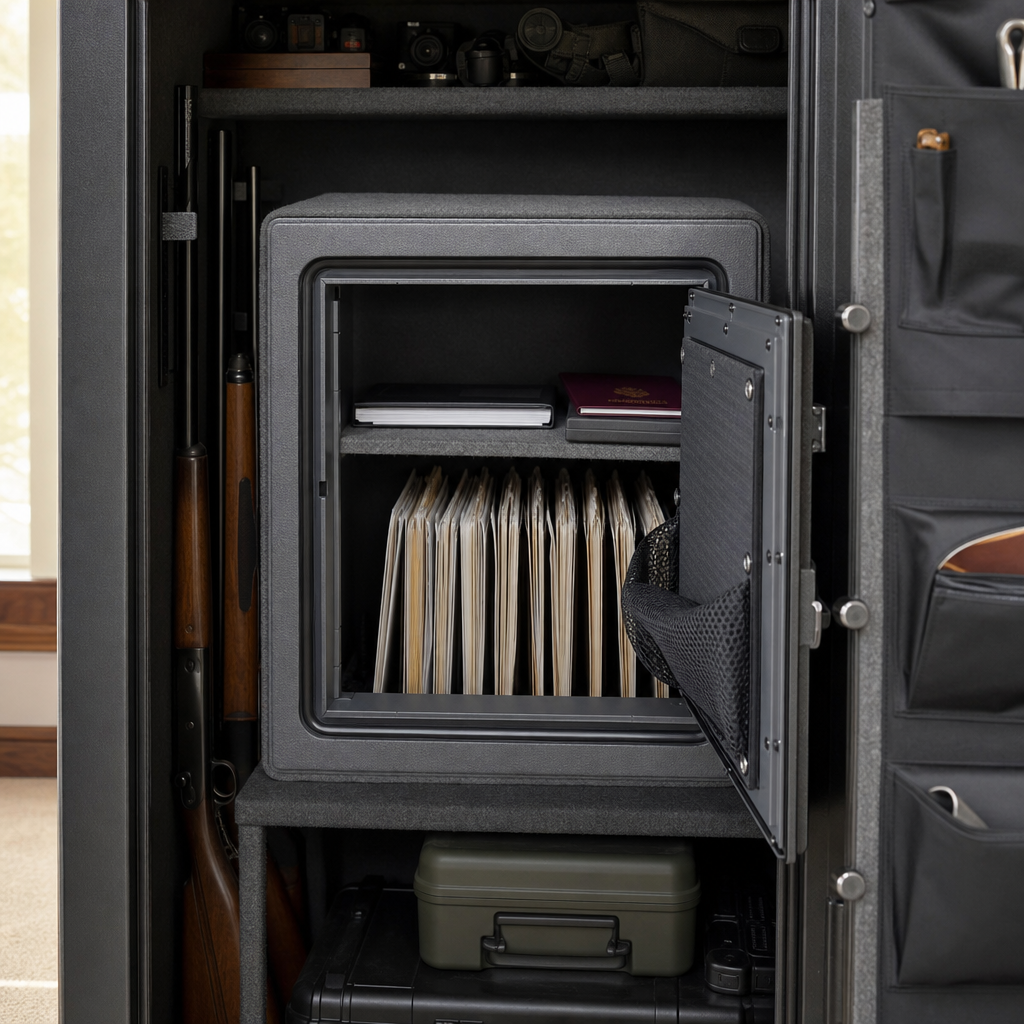
A fireproof document storage section inside a gun safe protects two categories of valuables that are often stored separately but threatened by the same event: firearms and essential papers. In practical terms, this modification creates a defined compartment, container, or insert within the safe that slows heat transfer, limits smoke exposure, and keeps documents organized without compromising firearm access. For owners building a complete gun safes and safety setup, it is one of the most useful custom and DIY gun safe modifications because it solves a real household problem with materials and methods that are accessible to careful do-it-yourself work.
When people ask how to add a fireproof document storage section in your gun safe, they usually mean one of three things. First, they want a place for passports, deeds, wills, insurance records, tax files, and backup media. Second, they want better fire resistance than a standard shelf, pouch, or door organizer can provide. Third, they want the upgrade to fit around long guns, handguns, ammo separation rules, humidity control, and the safe’s rated fire performance. Those goals can conflict, and that is why this topic matters. I have helped set up safes where paper documents warped from humidity, USB drives failed after being stored beside desiccants, and poorly placed boxes blocked rifle retrieval. A good modification avoids those mistakes.
It also helps to define “fireproof” accurately. No residential gun safe is literally proof against all fire conditions forever. Most are fire-resistant for a stated period, such as 30, 60, or 90 minutes, at a tested temperature. Paper begins to char around 451 degrees Fahrenheit, while digital media and photos can fail at much lower internal temperatures. That means a document section inside a safe should be designed as layered protection: the safe shell, interior insulation strategy, document container, and smart placement away from heat-prone zones. Done correctly, this hub article will help you plan custom and DIY gun safe modifications with realistic expectations, safer materials, and a layout that serves everyday use.
Start With the Safe’s Fire Rating, Interior Space, and Access Pattern
Before adding any document compartment, evaluate the safe itself. The manufacturer’s fire rating, body construction, door seal design, and interior dimensions determine what kind of modification makes sense. A common mistake is assuming that a 60-minute fire rating means every point inside the safe stays equally cool. In reality, heat patterns vary. Door panels, upper corners, and areas near steel walls can warm faster than the insulated center mass. In several retrofits I have seen, the best place for a document section was low and toward the rear on a shelf, not on the door, because the door area experienced higher heat and more temperature swing.
Next, look at how you actually use the safe. If your rifles come in and out weekly, do not place a bulky file box where it forces you to remove guns to reach it. If the safe is primarily for storage and rarely opened, a deeper rear shelf container may be ideal. Measure width, depth, and usable height with shelves installed, then account for dehumidifier rods, power pass-throughs, and door organizer bulge. For many owners, the most efficient document section is not a full-width drawer. It is a compact insulated module sized for letter documents in sealed sleeves, mounted on an upper shelf or fixed into a side cavity left unused by firearm stocks.
Think about what you need to protect. Paper documents do well in layered paper folders, polyethylene sleeves, and insulated boxes. Birth certificates, passports, property records, and notarized originals belong in the highest-protection area. Photos, hard drives, SSDs, USB flash drives, and optical media need more conservative heat management because media can be damaged at temperatures lower than paper can tolerate. If you plan to store both paper and digital backups, treat them as different categories and build the section around the most heat-sensitive item, or use separate containers within the same document zone.
Choose the Right Fire-Resistant Insert Instead of Building Bare Against Steel
The most dependable approach is usually to place a tested fire-resistant document box or media chest inside the gun safe rather than trying to fabricate a fully fire-rated compartment from raw materials. Steel alone is a poor insulator. A simple metal drawer, filing tray, or lockbox mounted inside the safe can actually transmit heat quickly. Better options include UL-classified or ETL-verified document chests from brands such as Honeywell, SentrySafe, First Alert, or FireKing, depending on size and certification class. For paper, many compact chests are rated to keep internal temperatures below the threshold that chars documents during a defined fire exposure. For media, look for products specifically rated for digital storage.
That does not mean DIY has no role. The smart DIY path is to build a support system around a tested insert: shelf reinforcement, anti-tip brackets, slide-out platforms, divider panels, and moisture-controlled organization. In my experience, this hybrid method performs far better than homemade “fireproof” boxes made from sheet metal and generic insulation board. Gypsum board, ceramic fiber, and intumescent materials all have legitimate uses in fire assemblies, but reproducing a tested enclosure without engineering data is guesswork. A residential gun safe interior is also a confined space where adhesives can off-gas, insulation can shed fibers, and airflow can become uneven.
If space is tight, choose a slim chest with a side-opening lid or front-access door. If the safe is wide, a lateral document box on a dedicated shelf may be more efficient than a deep chest that consumes vertical gun clearance. Always verify loaded weight. Document boxes become surprisingly heavy when filled with originals, binders, and metal media cases. Shelf pins in economy safes may not be designed for concentrated weight, so reinforce as needed with steel angle, hardwood cleats, or manufacturer-approved shelving accessories. The goal is simple: use a tested fire-resistant core, then customize the fit and organization around it.
Best Materials and Layout Choices for Custom and DIY Gun Safe Modifications
Custom and DIY gun safe modifications work best when each material solves one clear problem. Powder-coated steel brackets add strength. Hardwood or cabinet-grade plywood can stabilize shelving if sealed properly and kept clear of direct contact with damp surfaces. Closed-cell foam helps prevent movement but should not be relied on for fire resistance. Archival polypropylene sleeves protect documents from abrasion and moisture better than cheap vinyl, which can stick or degrade over time. Silica gel desiccant, rechargeable desiccant canisters, and electric dehumidifier rods control condensation, but they must be positioned so they do not overheat or dry out paper excessively.
For attachment methods, mechanical fastening is more dependable than strong-looking adhesive tape. High temperatures can soften adhesives, and many construction glues release odor in enclosed safes. If drilling into the interior is allowed by the manufacturer, use short fasteners that do not penetrate outer walls or fire liners. If drilling is not advisable, build freestanding modules that lock into shelf geometry or use compression-fit partitions. I prefer reversible modifications whenever possible because safe layouts change as collections grow. A removable divider panel, a reinforced upper shelf, and a strapped document chest give you flexibility without risking the fire barrier.
| Modification option | Best use | Main advantage | Main limitation |
|---|---|---|---|
| Tested fire document chest on shelf | Paper records and passports | Known fire performance | Takes shelf depth and adds weight |
| Media-rated internal box | USB drives, SSDs, photos | Lower internal heat for sensitive media | Smaller capacity and higher cost |
| Slide-out reinforced tray with chest | Frequent document access | Better reach in deep safes | Requires careful load support |
| Door organizer pocket system | Copies, not originals | Easy access and low cost | Weakest heat protection zone |
Layout matters as much as materials. Keep the document section away from firearm muzzles, optics, and areas where sling hardware can snag folders. Separate ammunition and documents where possible, not because cartridges create unusual fire behavior inside a secure safe, but because mixed storage often leads to clutter and retrieval delays. Leave space around dehumidifier rods for air movement. Place the most important originals in the center of the document chest, with less critical copies around them as sacrificial buffering layers. That is a practical tactic many owners overlook.
Step-by-Step Installation That Preserves Safety, Organization, and Daily Use
First, empty the target shelf or side compartment and vacuum dust, powder residue, and debris. Inspect for rust spots, loose shelf pins, failed door-panel screws, or torn interior fabric. Address those issues before adding anything new. Second, map the interior with actual dimensions, including gun lengths, optics clearance, and door closure depth. Third, dry-fit the chosen document chest and confirm that the lid or door opens without contacting rifles, shelving, or interior lights. In deep safes, add a pull tab, low-profile slide board, or a front stop so the chest does not shift backward where it becomes hard to reach.
Fourth, reinforce the supporting surface if necessary. A chest loaded with legal files can exceed the point load that thin particleboard shelves handle comfortably. Replace weak shelves with plywood edged for stiffness, add steel angle underneath, or support the shelf on fixed cleats instead of pins alone. Fifth, add organization inside the document box. Use labeled folders for identification, property, insurance, medical, estate, and firearm records. Put originals in archival sleeves, then use waterproof zip pouches only as secondary containment, not as the sole long-term storage layer, because trapped humidity can be a problem if documents go in damp.
Sixth, integrate moisture control. Place desiccant in the safe, not loosely inside every paper folder. Monitor with a small digital hygrometer and aim for stable conditions rather than extreme dryness. Around 35 to 50 percent relative humidity is generally workable for mixed firearm and document storage, though local climate and safe placement matter. Seventh, test your access routine. Open the safe in low light, retrieve a rifle, then retrieve the document box, then return both. If anything catches, blocks, or forces awkward muzzle movement, revise the layout. The best custom and DIY gun safe modifications are the ones you can live with safely every day.
Common Mistakes, Limits of DIY Fire Protection, and When to Upgrade Further
The most common mistake is trusting untested materials because they are marketed with vague fireproof language. Fire-resistant drywall scraps, welding blankets, foil bubble wrap, or generic “fireproof bags” may provide some delay, but they are not substitutes for a tested internal container. Another frequent problem is overpacking. Thick binders, stacks of loose paper, and boxes of photos consume airspace and make it harder for the compartment to close properly. I have also seen owners place irreplaceable originals in door pockets because they are convenient. For high-priority documents, convenience should not outrank protection.
Be realistic about what a gun safe can and cannot do. House fires vary dramatically depending on fuel load, ventilation, room location, and suppression response time. A garage or outbuilding fire can burn hotter and longer than the ratings many residential safes are designed around. Water used for suppression introduces another threat, especially if steam and humidity enter after the fire seal is stressed. That is why redundancy matters. Scan essential records, store encrypted digital copies off-site or in a secure cloud service, and keep only the originals that truly need physical retention in the safe. For highly sensitive estates, business records, or large media archives, a dedicated document safe may be the better answer.
As a hub for custom and DIY gun safe modifications, this project connects naturally to related upgrades: better shelving, LED lighting, handgun racks, door panel organization, dehumidifier integration, anchor improvements, and inventory systems. The document section works best as part of that broader plan. If your current safe is undersized, badly organized, or lightly rated for fire, no clever insert will solve every limitation. In that case, use this modification as a transitional improvement while planning a larger safe or a dedicated records container. Start with the highest-value documents, use a tested internal box, reinforce the shelf, and create a layout that protects both access and fire resistance. Then review your setup annually and upgrade anything that no longer matches your collection, climate, or risk level.
Frequently Asked Questions
Why should I add a fireproof document storage section inside my gun safe instead of storing papers somewhere else?
Adding a fireproof document storage section inside your gun safe gives you one organized, protected location for two categories of valuables that are often separated but exposed to the same risks: firearms and essential documents. In a house fire, burglary, or major emergency, owners do not want to search multiple rooms for passports, deeds, insurance policies, trust paperwork, tax records, or backup media. A dedicated internal document section helps centralize those items while taking advantage of the security and controlled access already built into the safe.
Just as important, a properly designed document compartment can slow heat transfer, reduce direct smoke exposure, and keep paperwork from being crushed, bent, or misplaced among firearms, optics, magazines, and accessories. That matters because paper and digital media are often damaged long before the safe itself fails structurally. By creating a defined compartment, insert, or insulated container within the safe, you improve organization and add another layer of protection without interfering with your firearm layout. For many owners building a complete gun safes and safety setup, this is one of the most practical upgrades because it improves readiness, document preservation, and day-to-day access all at once.
What materials work best for building a fire-resistant document section inside a gun safe?
The best materials are those that help reduce heat transfer, tolerate the safe environment, and do not introduce unnecessary moisture problems. Many owners use a combination of a small fire-rated document box, an insulated pouch rated for documents, or a purpose-built internal compartment lined with non-combustible or heat-resistant materials. Common choices include gypsum-based fireboard, ceramic fiber insulation, mineral wool, and thin steel or aluminum housings used to create a barrier around the document area. These materials are often selected because they can help delay temperature rise inside the compartment during a fire.
That said, material selection should be practical and balanced. The inside of a gun safe can already hold humidity-control products, shelving, carpeting, and firearm accessories, so your document section should not trap excess moisture or crowd the interior. Avoid flammable foams, low-quality plastics, cardboard liners, or makeshift inserts that may melt, off-gas, or hold condensation against documents. It is also wise to use acid-free folders, sealed sleeves, and document organizers inside the fire-resistant container so the papers themselves remain protected from humidity, abrasion, and routine handling. If you want the strongest setup with the least guesswork, a compact UL-rated or manufacturer-rated fire document box placed inside the safe is often the simplest and most reliable solution, especially when paired with careful placement and moisture control.
Will adding a document storage compartment reduce firearm access or usable space in the safe?
It can, but only if the layout is poorly planned. A well-designed fireproof document storage section should preserve fast, safe access to firearms while using space that might otherwise be underutilized. In most safes, the best locations are upper shelves, door organizers with protected inserts, rear corners, or a dedicated top compartment above long guns. These areas typically allow document storage without blocking rifle stocks, interfering with handgun racks, or forcing you to move ammunition and accessories every time you need important papers.
The key is to treat document storage as part of the overall interior system rather than an afterthought. Start by identifying what must remain immediately accessible, such as home-defense firearms, spare magazines, and lighting. Then position the document section away from those high-priority access points. If your safe has adjustable shelving, reconfigure it to create a dedicated shelf for paperwork and media. If space is limited, use a slim fire-rated pouch or low-profile lockbox instead of a bulky hard-sided chest. Owners with larger safes may benefit from a raised shelf compartment or secondary internal cabinet that keeps records separate from firearm cleaning supplies and metal parts. The goal is clean separation: documents stay organized and protected, and firearms remain reachable without delay or clutter.
How do I protect documents from both fire and moisture inside a gun safe?
Fire resistance and moisture control need to work together. Many people focus only on heat, but humidity, condensation, and post-fire moisture can ruin documents even when flames never directly reach them. Gun safes often contain dehumidifier rods, desiccant packs, or other moisture-management products because enclosed steel spaces can trap humidity. When you add a fireproof document section, you should maintain that same moisture strategy while also using layers of protection for the papers themselves.
A strong setup usually includes documents placed in sealed or semi-sealed archival sleeves, grouped inside labeled folders, and stored within a fire-resistant box or insulated insert. Include fresh desiccant where appropriate, but monitor it so it does not become saturated and ineffective. If your safe uses an electric dehumidifier, make sure the document compartment still receives enough air movement to avoid stale, damp pockets. It is also smart to keep originals and copies organized separately. For example, store the originals in the fire-resistant compartment and maintain encrypted digital backups elsewhere. Remember that some media, such as USB drives, hard drives, CDs, and photos, can be more heat-sensitive than paper, so they may require higher-rated media storage rather than standard paper-rated protection. In short, the best results come from combining a fire-resistant barrier, internal organization, and active humidity control instead of relying on any single product.
What documents should I keep in a fireproof section of my gun safe, and what is the best way to organize them?
The most important documents to keep in a fireproof section are the ones that would be difficult, time-consuming, or high-stakes to replace after a disaster. That often includes passports, birth certificates, Social Security cards, wills, trusts, powers of attorney, property deeds, vehicle titles, insurance policies, marriage certificates, military records, estate planning documents, firearm purchase records where legally appropriate, serial number inventories, and emergency contact information. Many owners also store backup copies of tax returns, medical directives, and key account records. The exact mix depends on your household, but the general rule is simple: prioritize identity documents, legal records, ownership documents, and anything needed quickly after a fire, burglary, or evacuation.
Organization matters just as much as protection. Use clearly labeled folders or envelopes divided by category, such as identity, property, insurance, legal, financial, and firearms-related records. Place the most urgent documents near the front for quick retrieval. If you are storing firearm-related paperwork, keep it grouped neatly so it does not get mixed with manuals, range notes, or accessory receipts. For better long-term preservation, use acid-free materials and avoid overstuffing folders. It is also a good idea to review the contents once or twice a year to remove outdated paperwork, update policies, and confirm that your safe layout still supports both document access and firearm access. A fireproof section works best when it is not just a pile of papers in a box, but a deliberate, easy-to-use archive built into your overall safe organization system.